|
Hempstead Bay at a Turning Point: Monitoring Progress through Science and Collaboration
In Hempstead Bay—also known as the Western Bays—decades of excessive nitrogen inputs have led to ecological decline. Addressing these issues requires long-term, science-based monitoring—and that's where the Hempstead Bay Water Quality Monitoring Program plays a critical role.
The Hempstead Bay Water Quality Monitoring Program has been a cornerstone of efforts to restore and protect one of Long Island’s most ecologically and economically important coastal environments. Located within the South Shore Estuary Reserve (SSER), Hempstead Bay spans the southern shoreline of Nassau County. Here, water quality is not just an environmental issue—it’s central to community well-being and economic sustainability too.
Launched in 2019, this collaborative effort—led by the New York State Department of Environmental Conservation (DEC), Hofstra University, the Town of Hempstead Department of Conservation and Waterways, and the Long Island Regional Planning Council (LIRPC)—has been collecting essential data to track water quality trends and evaluate the impact of wastewater infrastructure improvements designed to reduce nitrogen pollution in Hempstead Bay. By combining long-term, science-based monitoring with strategic investment, key stakeholders are taking meaningful steps to restore and protect one of Long Island’s most valuable coastal ecosystems.
To learn more about the program and its recent expanded scope and goals, we spoke with Dr. Steve Raciti, the project lead and Associate Professor of Biology at Hofstra University.
Why Monitor Hempstead Bay?
Hempstead Bay, like much of the SSER, has been impacted by nitrogen pollution. Excess nitrogen, primarily from wastewater treatment plants, has led to a host of environmental issues including low oxygen levels, loss of seagrasses and wetlands, harmful algal blooms, and damage to bottom-dwelling organisms like shellfish and flounder. “The goal of the program is to monitor the overall health of Hempstead Bay. We are using the resultant data to improve our understanding of how environmental changes and infrastructure upgrades in the region influence water quality over time," said Dr. Steve Raciti.
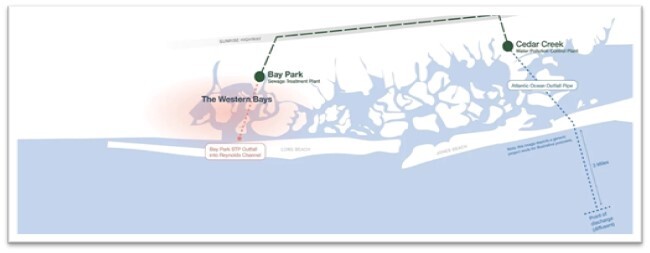
To address the issue of nitrogen pollution, large-scale infrastructure improvements in the area are underway. “The South Shore Water Reclamation Facility, formerly known as Bay Park, has recently finished implementation of Biological Nutrient Removal processes and a sidestream centrate treatment project, both of which have greatly reduced nutrient loads in effluent released by the plant,” Dr. Raciti said. “The Long Beach Water Pollution Control Plant, a smaller water treatment plant in the region, will be converted to a pump station, so its sewage can be rerouted to the South Shore Water Reclamation Facility and benefit from the upgraded treatment operations at that site. Finally, the Bay Park Conveyance Project will reroute effluent, which is currently released into Hempstead Bay, to an ocean outfall that is approximately three miles offshore.”
Bay Park Project Schematic.
These upgrades are expected to dramatically improve water quality within the bay over time. However, without consistent, high-quality data, it’s impossible to measure the full environmental return on these investments. Long-term monitoring ensures that changes are documented, and future actions are guided by sound science. “These are enormous investments in the health of our coastal environment, but we cannot understand the outcome of these investments without long term monitoring,” said Dr. Raciti.
A Comprehensive Monitoring Strategy
The Hempstead Bay Program collects water quality data through monthly sampling around the bay and a few fixed-location continuous monitoring stations. Monthly field samples measure nutrient levels—such as nitrate, ammonia, and phosphorus—alongside other key parameters like chlorophyll, turbidity, and dissolved oxygen. These samples are analyzed in the lab and provide broad spatial coverage across the bay. In addition, sensors deployed at fixed stations collect measurements every 12 minutes for variables such as temperature, salinity, and oxygen. This continuous data offers valuable insights into how environmental conditions shift with the tides, between day and night, and during weather events. Vertical water profiles are also collected at deeper locations, giving scientists a window into conditions at various depths, especially near the bay bottom where many important marine species live.
“By combining both sets of measurements, we can gain a more complete understanding of what is happening in the bay over time,” Dr. Raciti explained. “The water samples provide wide spatial coverage and information about many parameters, while the fixed-location measurements provide high-frequency data—but for a much smaller number of parameters in just a few locations. Conditions like low dissolved oxygen near the bottom of the bay are particularly problematic, and they’re more likely to persist when there’s less mixing between surface and bottom waters,” said Dr. Raciti.
The program also monitors atmospheric nitrogen deposition, a critical yet often overlooked contributor to water quality. “Vehicles, fossil fuel power plants, and other forms of fossil fuel combustion cause relatively inert (or inactive) nitrogen gas in the atmosphere to be converted into reactive forms of nitrogen that contribute to nitrogen pollution,” Dr. Raciti explained. “Atmospheric nitrogen deposition is an important source of pollution to Hempstead Bay, and we expect it to become a larger proportion of nitrogen inputs as wastewater treatment plants reduce their contributions to the nitrogen pollution problem.”
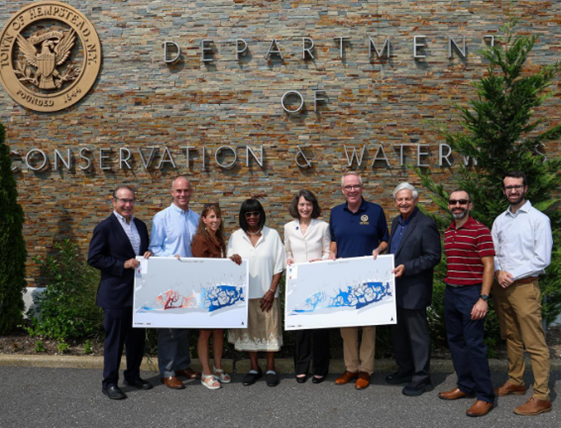 |
From left to right: Executive Dean of Hofstra University’s National Center for Suburban Studies, Lawrence Levy, Councilman Chris Schneider, Councilwoman Melissa Miller, Deputy Supervisor and Senior Councilwoman Dorothy L. Goosby, President of Hofstra University, Susan Poser, Town of Hempstead Supervisor Don Clavin, Executive Director LIRPC, Richard Guardino. Hofstra University Associate Professor of Biology, Dr. Steve Raciti and NYS DEC SPDES Program Supervisor, Ryan O’Mara, gathered at a press conference to present the Hempstead Bay Water Quality Monitoring Program and release the new report, "Water Quality Trends in Hempstead Bay, NY from 1968–2023: An Updated Report for Long Island’s South Shore Estuary Reserve Western Bays." The event highlighted decades of data and renewed commitment to restoring this critical coastal ecosystem. Photo credit: Town of Hempstead.
Expanding the Scope: Ocean Acidification
Thanks to the support from the New York State Department of Environmental Conservation the program has recently expanded to study ocean acidification- a growing concern for coastal ecosystems. “Excessive nutrient loading has long been recognized as a source of algal blooms and low oxygen conditions, but its influence on the acidification of coastal waters has often been overlooked,” Dr. Raciti said. “As the pH of coastal waters declines, becoming more acidic, it becomes difficult for shellfish, calcifying phytoplankton, and other marine organisms to produce calcareous shells.”
The new effort to monitor acidification will allow the team to track how these changes are unfolding in Hempstead Bay and better understand their broader ecological impacts.
Looking Ahead
The monitoring program’s data is publicly available through the EPA’s Water Quality Exchange (WQX) portal, where it can be accessed by policymakers, scientists, and the public. The program offers a valuable tool to evaluate the effectiveness of nutrient reduction strategies, adapt management practices, and continue restoring the ecological health of Hempstead Bay.
Looking ahead to the future Dr. Raciti shared a clear vision, “We hope the data that we collect is used to understand and improve the environment of Hempstead Bay, so we can all enjoy the benefits. The benefits include sustainable fisheries, recreational opportunities, supporting the local economy, protecting human health, and the beauty and intrinsic value of healthy coastal ecosystems."
Learn More
For the latest findings of the Hempstead Bay Water Quality Monitoring Program visit: LIRPC.ORG.
For updates on the Bay Park Conveyance Project visit: https://www.bayparkconveyance.org
Connect with Us!
|