- DEC Funding Opportunities Now Available
-
Water Quality Improvement Program (WQIP) Success Stories
The Department of Environmental Conservation’s Water Quality Improvement Program (WQIP)
This year, at least $75 million is available through WQIP and up to $3 million through NPG statewide. The applications for these grants are available through the state’s Consolidated Funding Application (CFA), open through July 31, 2025.
WQIP
Eight different project types are available for funding through WQIP, including:
- Wastewater Treatment Improvement
- Non-agricultural Nonpoint Source Abatement and Control
- Vacuum Trucks for Municipal Separate Storm Sewer Systems (MS4) Areas
- Land Acquisition for Source Water Protection
- Salt Storage
- Dam Safety Repair/Rehabilitation
- Aquatic Connectivity Restoration
-
Marine District Habitat Restoration
Eligible Entities: Municipalities, including Indian Nations, are eligible to apply for all project types. Soil and Water Conservation Districts and not-for-profits are eligible for select project types.
NPG
Two different project types are available for funding through NPG, including:
- Nonpoint Source Planning Reports
-
Mapping of Municipal Separate Storm Sewer Systems (MS4)
- Nonpoint Source Planning Reports: Municipalities; including Indian Nations; Soil and Water Conservation Districts (except for Decentralized Wastewater Treatment Facilities for Failing On-Site Treatment Systems)
-
MS4 Mapping: Municipalities regulated by the MS4 General Permit; Soil and Water Conservation Districts on behalf of regulated MS4 Operators
All eligible entities are encouraged to apply for funding. Use the links below to learn more.
For questions and more information, a webinar on the two programs, Water Quality Improvement Project Program and Nonpoint Source Planning and MS4 Mapping Grants, will be hosted on Monday, June 9, from 1-3pm. Register below:
WQIP Success Stories: Long Island Projects
The Department of Environmental Conservation’s (DEC) Water Quality Improvement Program (WQIP) plays a critical role in protecting and restoring New York’s waterbodies. This competitive, statewide reimbursement grant program funds projects that directly improve water quality or habitat, promote flood risk reduction, restoration, and enhanced flood and climate resiliency, or protect a drinking water source.
Last year, Governor Hochul announced over $222 million in WQIP grants for Round 21 across New York State, with nearly $9 million dedicated to projects right here on Long Island. These grants are funding projects aimed at upgrading aging water infrastructure, protecting drinking water, addressing harmful algal blooms, and enhancing habitats. The full list of awarded projects can be found here: 2024 WQIP Award List.
As part of LINAP’s commitment to mitigating nitrogen pollution and improving Long Island’s water quality, we are highlighting three successful WQIP-funded projects from previous rounds.
Town of Riverhead Cesspool Disconnection Project
The Town of Riverhead Cesspool Disconnection Project, funded by a $580,000 WQIP grant, protects the Peconic Estuary by redirecting 40,000 gallons of daily sewage flow from a 100-room hotel, a catering hall, and shopping center away from aging cesspools and into the Town's wastewater treatment plant.
The project has significantly reduced nitrogen pollution in the estuary while supporting Suffolk County's broader Clean Water Plan to improve wastewater infrastructure and safeguard regional water quality.
Town of Hempstead Cherrywood Yard Green Infrastructure Stormwater Improvements
The Town of Hempstead's Cherrywood Yard Green Infrastructure Stormwater Improvements project is a strategic initiative aimed at enhancing local water quality and managing stormwater runoff. Funded by a $306,000 WQIP grant, the project focuses on implementing multiple green infrastructure practices to improve onsite drainage and reduce stormwater runoff to a nearby stream. These practices are designed to treat and reduce the volume of stormwater entering the stream, thereby mitigating pollution and promoting environmental sustainability.
By integrating green infrastructure practices, the Cherrywood Yard project not only addresses immediate stormwater management challenges but also contributes to the long-term health of local waterways and the overall resilience of the community's infrastructure.
This initiative aligns with the Town of Hempstead's broader commitment to sustainable stormwater management, as outlined in their Stormwater Management Program.
"The Town of Hempstead is committed to environmental protection and conservation efforts throughout America’s largest township. The Cherrywood Yard project is another example of our Town’s proactive approach to safeguarding our waterways and preventing harmful pollutants from entering the local water supply” states Supervisor Clavin. From growing and deploying kelp and oysters to absorb nitrogen in the Western Bays, to overall investments in water improvement infrastructure to reduce nitrogen compound levels, as well as remove 1,4 dioxane, and other harmful contaminants, Hempstead Town has invested millions of dollars to ensure plentiful clean drinking water for residents and a pristine natural ecosystem for plant and marine life. We are grateful to the New York State Department of Environmental Conservation and the Water Quality Improvement Project for providing the resources to assist us in implementing this important green initiative."
Rehabilitation of East Island - Dosoris Pond Bridge
The Rehabilitation of the East Island-Dosoris Pond Bridge in Glen Cove, New York, was a comprehensive project aimed at enhancing the bridge's structural integrity and improving the surrounding environment. The City of Glen Cove undertook this initiative with several key improvements to enhance the functionality and environmental health of the area surrounding Dosoris Pond. First, the non-functional tidal gates were replaced to better manage water flow between the pond and adjacent waterways, improving overall hydrology. Structural enhancements were also made to the bridge's wingwalls, reinforcing their stability and ensuring long-term durability. In addition, green infrastructure elements were incorporated to promote environmental sustainability and improve water quality in the region. To protect the natural habitat, shoreline stabilization measures were implemented around the pond to prevent erosion. Finally, a comprehensive post-construction maintenance plan was developed to maintain the effectiveness of these improvements over time.
“The City of Glen Cove was proud to rehabilitate the tidal gates at Dosoris Pond and add green infrastructure to the surrounding area, with the goal of improving water quality for this impaired waterbody with connections to the Long Island Sound” City of Glen Cove Mayor Pamela Panzenbeck states. “The NYS WQIP provided a funding resource for a project that did not fit neatly into a box, such as this project which is a hybrid approach to water quality improvements.”
The project received a WQIP award of $695,160.
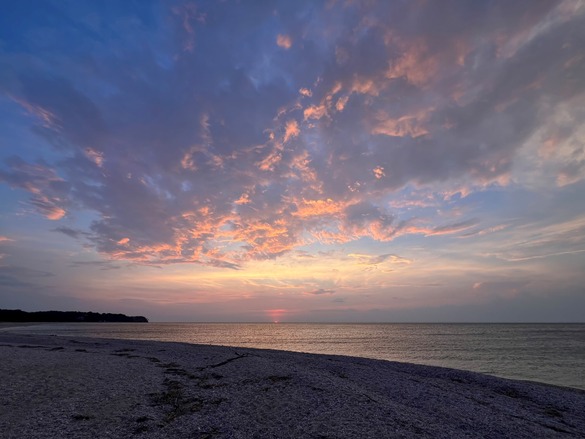
Sunset at Flax Pond. Photo Credit: Chris Eagler.
WQIP continues to play a vital role in advancing water quality and environmental resilience across Long Island and New York State. These projects show how WQIP funding supports essential improvements—from reducing nitrogen pollution to enhancing infrastructure and restoring habitats—helping to protect local waterways and strengthen community sustainability.
Connect with Us!
|