|
To implement source water protection actions at the local level, accessing and utilizing grant funding is vital. This month’s Drinking Water Source Protection Program (DWSP2) newsletter highlights the funding opportunities available through the NYS Consolidated Funding Application (CFA). Many of these funding opportunities may be helpful to your community as you work to protect your source of drinking water. Certain grant programs like the Water Quality Improvement Project (WQIP) and the Non-Agricultural Non-Point Source program even offer higher points for communities who are working within the critical and/or extended source water area of their State accepted Drinking Water Source Protection Program (DWSP2) plan. Check the scoring rubric specific to the project type(s) you are interested in to determine whether a State accepted DWSP2 plan increases the number of points for the project.
The NYS CFA is accepting grant applications until 4:00 p.m. on July 31, 2025. The grants are available for municipalities, not-for-profits, or other qualified groups to improve water quality and the environment.
Be sure to review the grant announcement and all associated materials thoroughly before applying.
The WQIP grant program funds projects to directly protect a drinking water source, improve water quality or aquatic habitat, promote flood risk reduction, restoration, and enhanced flood and climate resiliency. This funding is for construction/implementation projects, not for projects that are exclusively for planning. There are nine eligible project types in Round 21 with award amounts ranging from $100,000 to $15 million.
Eligible Project Types:
For full program details and requirements, or information about webinars on this funding program, visit the WQIP webpage. Additionally, sign up for the Division of Water Grants for WQIP and Implementation Project webinar on Monday, June 9 at 1 PM to learn more about accessing funding for eligible project types.
WQIP Land Acquisition funding webinar
Through the WQIP Land Acquisition for Source Water Protection municipalities, soil and water conservation districts, and not-for-profit corporations (e.g., land trusts) can purchase land and/or conservation easements, including associated transactional, riparian buffer, or groundwater restoration costs for the purpose of protecting public surface or groundwater drinking water supplies. These methods can be a powerful tool for protecting water quality. By strategically purchasing land and establishing riparian buffers or revegetating a groundwater recharge area, the program helps prevent pollutants (e.g., from stormwater runoff) from entering water supplies, leading to potentially reduced water treatment costs and higher-quality drinking water for communities.
As of May 2025, WQIP Land Acquisition for Source Water Protection grants have funded 67 projects across 29 counties, totaling nearly $100 million to protect source water across the state.
- Maximum grant amount: $5 million.
- Eligible project costs include buying land or development rights; transactional costs such as surveys, appraisals, transfer taxes, and title reports; and riparian buffer planting or wetland restoration costs.
- Advance Payment: Awardees may request advance payment of transactional and purchase costs.
- Riparian Buffer: Variable riparian buffer width depending on parcel location.
- Required local match: 25% of requested grant amount.
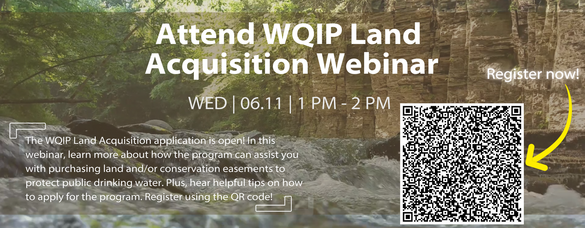
Register for the WQIP Land Acquisition webinar held on Wednesday, June 11 at 1 PM if you would like to know more about how to access WQIP Land Acquisition funding.
There is a wealth of information available to learn more about the WQIP Land Acquisition Program and its impact on communities. The video Protecting New York's Drinking Water Resources offers valuable insights into how applicants are successfully utilizing this program to achieve their source water protection goals. Watch the video to hear from 5 organizations on how the program funding helped them achieve their source water protection goals while also providing co-benefits including passive recreational opportunities for their communities. Don’t hesitate to share the video as well to raise awareness about this crucial initiative and its role in securing clean drinking water and a healthier environment for all.
In December 2024, the Town of St. Armand was awarded a $300,000 grant through WQIP to purchase 41 acres from Paul Smiths College that contains the Town's public drinking water wells. The land purchase will protect the drinking water of St. Armand and comply with NYS Department of Health wellhead protection area requirements. The Town of St. Armand was able to identify and ultimately be awarded funding for this property thanks to source water protection efforts they were completing as part of DWSP2.
Starting in 2022, the Town began development of their DWSP2 plan and St. Armand’s technical assistance (TA) provider gave the Town a suite of updated maps that were used, in part, to identify an area of land critical for protecting their groundwater. Utilizing this information, the Town and their TA provider selected land acquisition as a priority action to protect their source water. Together, they submitted an application to the WQIP Land Acquisition for Source Water Protection program in Summer 2024 to protect this parcel.
Many communities in DWSP2 experience stormwater and nonpoint source issues. The Non-Agricultural Nonpoint Source Planning and MS4 Mapping Grant (NPG) funds planning reports for nonpoint source water quality improvement projects and mapping of municipal separate storm sewer systems (MS4s). The program aims to prepare nonpoint source projects for construction and application for implementing projects, and to encourage and support cooperation among regulated MS4s to complete mapping of their stormwater system. Communities needing to address nonpoint source pollution may want to work with a technical assistance provider to apply for this grant program during the implementation phase of DWSP2.
Applicants are required to provide 10% of the requested grant amount as local match.
For full program details and requirements, including project type descriptions, visit DEC’s Non-Agricultural Nonpoint Source webpage.
The Local Waterfront Revitalization Program (LWRP) funds projects that can minimize nutrients and pollutants from getting into source waters and protect critical areas vital to sustaining water quality. LWRP funds municipalities to advance the preparation or implementation of these projects. Close to $14 million is available for LWRP grants, with a maximum award of $2 million. Applicants are required to provide a local match to cover the remainder of the total eligible cost of the project.
For full program details and requirements, review the Local Waterfront Revitalization Program webpage.
The Climate Smart Communities (CSC) grant program promotes projects that can positively impact source water by reducing the chance of potential contaminants from entering waterways and natural resources. A total of $22 million is available through this request for applications (RFA). Funds are available for two broad project categories, implementation and certification. Implementation projects have a maximum award of $2 million and certification projects have a maximum award of $200,000 and both have a required match of 50% of total eligible project costs. Eligible applicants include all municipalities within New York State. Additionally, Climate Smart Communities offers up to 10 points for municipalities that develop and implement their DWSP2 plan.
For information on which projects qualify as implementation or certification, visit DEC’s Climate Smart Communities Grant Program webpage.
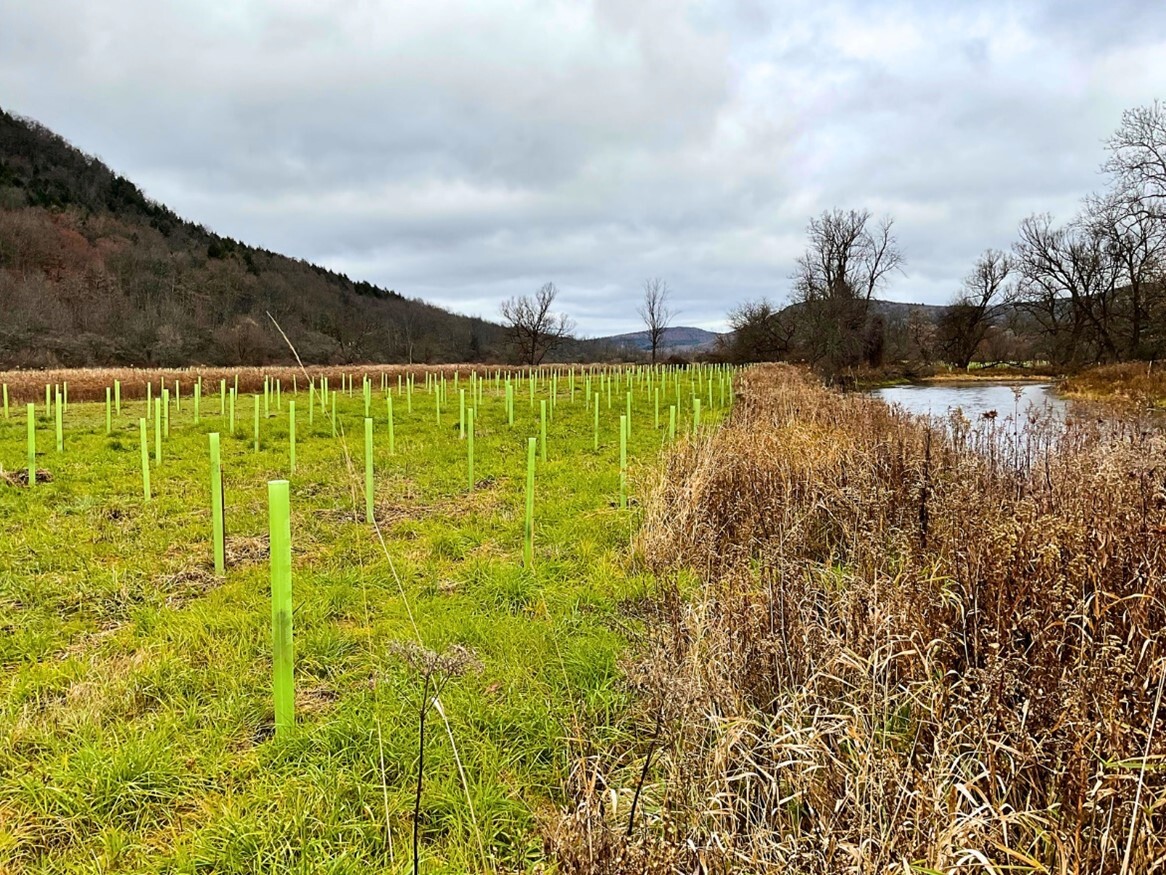
A riparian forest buffer that was installed in the Upper Susquehanna River watershed.
Source Water Buffer Program
The goal of the Source Water Buffer Program is to protect public drinking water and to enhance water quality protection. The Program funds the purchase of conservation easements and the implementation of buffer systems, which filter surface runoff or shallow groundwater to protect the water quality of New York State's aquifers, watersheds, reservoirs, lakes, rivers, and streams. Over $4 million is available for conservation projects with a required match of 25% of total eligible costs. Eligible applicants are soil and water conservation districts. Applications are accepted on a rolling basis and are funded on a first-come, first-served basis.
Hudson River Estuary Source Water Protection Funding
The Hudson River Estuary Program has announced approximately $700,000 in funding available through the Local Stewardship Planning (Round 47).This grant opportunity supports four categories of local projects and programs to help communities advance source water protection and watershed-based stewardship, conservation of natural resources, climate adaptation and resiliency, and enhanced public access to the Hudson River. Applicants may request up to $75,000 with a required match of 15%. The deadline to apply for this funding is August 7, 2025.
USDA NRCS Environmental Quality Incentives Program
EQIP provides technical and financial assistance to agricultural producers and forest landowners for several initiatives to improve source water quality, such as conserved ground and surface water, increased soil health, reduced soil erosion and sedimentation, and mitigation of drought and increasing weather volatility.
Funding and technical assistance is available for several priority practices that support these initiatives (e.g., installing filter strips and riparian forest buffers and herbaceous cover). Filter strips and riparian buffers help slow runoff and reduce potential contaminants from infiltrating soil and waterways, a crucial practice for maintaining and improving source water quality.
USDA NRCS Conservation Stewardship Program
The Conservation Stewardship Program (CSP) offers free technical and financial assistance to help agricultural and forest producers take their conservation efforts to the next level. The program is designed to compensate agricultural and forest producers who agree to increase their level of conservation by adopting additional conservation activities and maintaining their baseline level of conservation. CSP is for those who share a passion for conservation and environmental stewardship.
Past CSP-supported projects have allowed agricultural and forest producers to adopt and maintain nutrient and sediment management systems to improve water quality.
Resilient Watersheds Grant Program
The Resilient Watershed Grant (RWG) Program provides funding for riparian buffer establishment, streambank, stream channel, and shoreline restoration and stabilization, wetland creation and restoration and floodplain creation and restoration. These projects can benefit source water protection by enhancing natural filtration, reducing contaminant runoff, and restoring natural water and habitat functions at the source.
Up to $45 million is available for these projects, with a required 10% match requirement. This funding is available for the construction and implementation of these projects. The grant program is open to local governments, Indian Nations, soil and water conservation districts, State agencies, and not-for-profit corporations. The deadline to apply is June 6, 2025.
Coastal Rehabilitation and Resilience Projects Program
The Coastal Rehabilitation and Resilience Projects (CRRP) program provides funding for projects to reduce localized flooding, provide resiliency to impacts from increased precipitation and increased flooding due to climate change, green infrastructure, stormwater retrofit projects and vegetative buffers between land use and natural features. Project like these can improve water quality by reducing the amount of contaminants introduced into drinking water sources.
Up to $20 million (with a 10% match of total eligible project cost) is available to municipalities, not-for-profits, soil and water conservation districts, and State agencies and authorities. The deadline to apply for this funding is June 6, 2025.
Do you want to learn how to be successful at securing and managing grants? Check out DEC Division of Water’s webinar, Navigating Grant Funding: Municipal Success Stories to learn strategies and methods used in other communities to access grant funding. Each presenter either works directly for a municipality or partners with municipalities to support them in applying and managing grant funds. They provide examples on how grant funding helped solve problems in their community and reduce costs.
Additionally, the Funding Finder is a helpful tool designed to simplify the process of finding grant opportunities. The tool enables grant seekers to filter grant opportunities based on criteria (e.g., eligible applicants, project type, project phase, etc.) that meets their specific needs. To quickly reference whether a funding opportunity is open or closed, refer to the Status Filter feature on the bottom left of the Funding Finder.
Another great way to stay up to date is to sign up for newsletters that often include these grant program announcements such as the DWSP2 Newsletter and MakingWaves.
Hosting an event, webinar, or conference in 2025? Reach out to us at source.water@dec.ny.gov to schedule a presentation or tabling event. If you would like to learn more about DWSP2 and how it could help your municipality, fill out our Interest Form and a member of the DWSP2 team will contact you to discuss further.
Was this newsletter forwarded to you? Sign up so you don't miss an edition.
Missed the previous edition? Visit the DWSP2 Newsletter Archive to stay up to date.
Have you begun the DWSP2 process? Or do you have a program or are you aware of a program relevant to source water? Send in any helpful hints or information at source.water@dec.ny.gov and we may highlight them!
Follow DEC on Instagram to see what more you can learn about Connecting Climate Change to Drinking Water.
|