|
Clean Water, Healthy Communities: Advancing Septic System Upgrades in Nassau County
Tens of thousands of homes and some small businesses and nonprofits in Nassau County rely on cesspools and septic systems to treat their household wastewater. These systems allow for untreated nitrogen to leach into the groundwater, which eventually flows into our embayments and surface waters. For this reason, wastewater is one of the largest contributors to nitrogen pollution on Long Island. Reversing water quality degradation will depend, in part, on replacing these existing systems with new Innovative Alternative/Onsite Wastewater Treatment Systems (IA/OWTS).
Septic Environmental Program to Improve Cleanliness (S.E.P.T.I.C) is a grant program (funded by New York State Septic System Replacement Fund and soon the Long Island Sound Study will also provide funding) for homeowners and owners of small business that provides funds towards upgrading their septic systems. The program is administered by the Nassau County Soil and Water Conservation District (District and offers grants of up to $20,000 to replace septic systems with nitrogen-reducing IA/OWTS-- a proven technology that enhances water quality by reducing nitrogen pollution. To date, 741 residents have applied to the program. With an increasing number of residents participating, Nassau County is setting a precedent for sustainable wastewater management.
Spotlight on Bayville: A Model for Success
In Nassau County, the waterfront Village of Bayville is particularly vulnerable to nitrogen pollution due to its reliance on cesspools and septic systems. Without proper treatment, nitrogen from these outdated systems seeps into the local waterways, contributing to harmful algal blooms, fish kills, and declining water quality. Identified as a priority area for nitrogen reduction in the Nasau County 9 Element Watershed Plan, Bayville is taking proactive measures to address this issue. By embracing IA/OWTS, Bayville residents are taking critical steps to protect their local environment and preserve the health of their waterfront community.
Local officials and community organizations have been instrumental in driving awareness and participation in the program. Through education and streamlined permitting processes, Bayville has made it easier for homeowners to make the switch. Derek Betts, District Manager of the Nassau County Soil and Water Conservation District highlights Bayville’s’ leadership in the program “Bayville has emerged as one of the top communities participating in the SEPTIC program largely due to the incredible support the District has received from the Bayville building department. As an entirely coastal community, Bayville residents are eager to support initiatives that protect the environment and local waterbodies.”
A Homeowner’s Experience: A Firsthand Account
Bill Bleyer, a longtime Bayville resident and President of Friends of the Bay, learned about the program early on from the District. Understanding the impact of outdated septic and cesspool systems on Long Island’s water quality, Bill took action. “I was one of the first people to participate,” Bill recalls. “Soon after three neighbors on my block had applied to the program as well.” Bill’s pioneering efforts has contributed to Bayville becoming the record holder for the highest number of IA/OWTS installations in Nassau County! Through his leadership in the local block association, he provided guidance and firsthand experience to others considering the upgrade.
Having lived in Bayville for most of his life, Bill has a deep appreciation for the area’s coastal environment and recognized that upgrading to an IA/OWTS would prevent nitrogen pollution from seeping into the groundwater and, ultimately, into the Long Island Sound. “I can see Long Island Sound from my window,” he shares. “As President of Friends of the Bay, I felt it was my responsibility to do the right thing environmentally. I knew that my 50-year-old cinderblock cesspool was leaching pollutants into the groundwater and into the Sound.” Despite initial concerns about space constraints, Bill’s project was a success. His property size (40x100 feet) posed a challenge, but engineers found a way to make it. “We were able to tuck the unit into the corner of the property and use my old cesspool for the outflow, which meant I did not need a leeching field. This kept the costs within the $20,000 grant and I did not have to lay out any of my own money.” According to Derek, various systems are available for applicants to choose from in different sizes, providing critical flexibility for tough installations
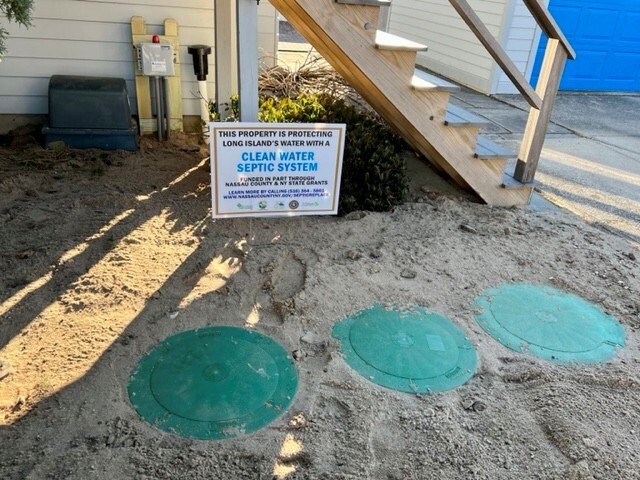 |
IA/OWTS System Installed. Photo Credit: Nassau County Soil and Water Conservation District.
Bill was initially apprehensive about the installation process, but he was pleasantly surprised by how smoothly everything went. The District provided clear guidance at every step, and the contractor was professional and efficient. Within a few days, the new system was up and running with minimal disruption. The installation team also took the time to explain how the system functioned. “They arrived in the morning and were done by lunchtime,” he says. “It was actually fascinating to watch. They even dug up old bottles from the 1920s, which I now have displayed in my home.” Bill also notes that Village officials have been very supportive of the program. “Our building inspector understood the benefits and really helped to streamline the process.”
Bill acknowledges that while many homeowners participated due to environmental awareness, others were motivated by the practicality of upgrading at no cost. “Most people saw it as a free way to protect themselves from future cesspool failures, while also doing something good for the environment.” He acknowledges that some homeowners may hesitate to make the change, but he firmly believes that the financial incentives and long-term benefits make it an easy decision. “If you have the opportunity, take advantage of it while the grants are available,” he says. “It’s a win-win for homeowners and for the environment.”
Now that the IA/OWTS is in place, Bill hardly notices it’s there—and that, he says, is the best part. The system runs quietly and efficiently, eliminating the worries he previously had about backups or leaks. More importantly, he has peace of mind knowing that he is contributing to a cleaner Long Island Sound. More neighbors have started asking him about the program, and he’s been more than happy to share his experience and encourage them to consider making the switch.
“The District is consistently working with all local towns/villages to provide educational materials and training so that they can understand the importance of nitrogen-reducing septic systems and spread the word about their benefits to residents. Communities with building departments that not only support the use of these systems in their towns/villages, but also actively encourage the program, have had the most success with the program to date,” said Derek.
With the success of early adopters like Bill and his neighbors, LINAP and its partners hope to see increased participation in Nassau County’s S.E.P.T.I.C. program and the grant programs that are also offered to Suffolk County residents. Every installation is an investment in cleaner water, healthier ecosystems, and resilient communities.
Join the movement and be part of the solution for a cleaner, more sustainable future!
If you’re a Nassau County homeowner looking to upgrade your septic system, call 516-364-5861, or visit the SEPTIC webpage. Applications can be submitted online.
Connect with Us!
|