In this issue:
Air Mail! is the publication to announce public and stakeholder information about air quality topics. All NYS residents are environmental stakeholders – we welcome anyone to join the information sessions and other opportunities posted here.
NYS is known for its beautiful lands. Whether sightseeing at Niagara Falls, hiking in the Adirondacks, or taking a stroll down a Long Island beach, the views are captivating. With spring’s warmer weather, it’s easier to get outside, enjoy scenic locations, and engage in outdoor activities. When planning our upcoming outdoor activities, it’s important that we all know and follow NYS’s open burning regulations.
Due to warmer spring temperatures, low humidity, and abundant dry, dead vegetation, NYS is at a higher risk for wildfires in springtime. The annual burn ban protects the State from wildfires by temporarily prohibiting residents from burning downed limbs and branches from March 16 through May 14. Some burning, such as small cooking fires, is not banned on a state level. However, make sure to check your local regulations for additional prohibitions as well. Residents should always be mindful when starting any cooking or camping fire to first check if it’s allowed in that location and if conditions are safe, and if so, constantly monitor the fire and fully extinguish it when done.
Wildfires can happen any time of the year, not just in the spring. In November 2024, numerous wildfires occurred in NYS, with the Jennings Creek/Sterling Forest State Park area facing the largest wildfire in the State since 2008. In March 2025, the State handled another batch of wildfires in Long Island, NY. Multiple brush fires burned, causing the officials to issue a State of Emergency as fire response teams worked to contain these fires. These fires burned hundreds of acres and led to an early issuance of the burn ban for some downstate counties.
One small spark can quickly turn into something much bigger. Be sure to follow safe burning habits and abide by the annual burn ban. By practicing safe burning habits, you are helping protect our State’s land, air, and people.
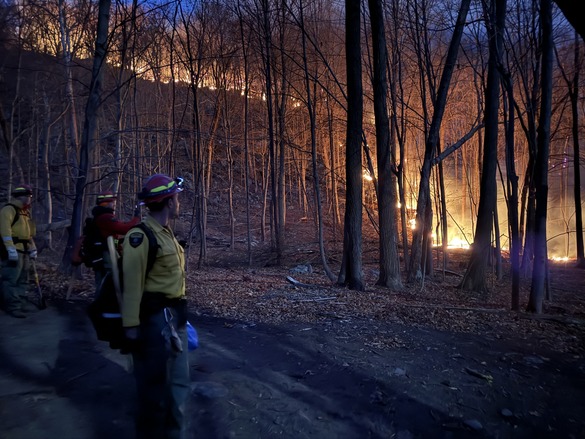 Forest Rangers responded to the Jennings Creek wildfire in Warwick, NY, in November 2024.
DEC continuously works to protect our State’s air. One of the ways DEC ensures this is by developing State Implementation Plans (SIPs) to help improve NYS’s air quality where needed. A SIP is a plan made up of regulations, assessments, and other documents to ensure the State meets the federal National Ambient Air Quality Standards (NAAQS) and other requirements of the federal Clean Air Act. NAAQS places limits on six criteria pollutants that are harmful to human and environmental health.
The Clean Air Act requires the Environmental Protection Agency (EPA) to oversee the NAAQS. EPA ensures that states meet clean air standards and regularly reviews the current standards to ensure that they adequately protect human health. A recent example of EPA’s NAAQS review occurred in February 2024, when the primary fine particulate matter (PM2.5) standard was revised. EPA strengthened the standard from 12.0 to 9.0 micrograms per cubic meter.
As DEC works to keep our air clean for everyone to enjoy, we can take on sustainable actions in our own lives as well. Choosing small actions like walking or using public transportation or big actions like adding solar panels to your home all add up to positive changes in our air quality.
The snow is melting, and grass is growing. It’s officially spring, meaning warmer weather and more outdoor activities. Before you head outside for some springtime fun, take a moment to check the daily Air Quality Index (AQI) forecast. The AQI lets New Yorkers know how clean or polluted the air is each day, year-round. This index monitors NYS’s regional particulate matter (PM) and ground-level ozone pollution levels. The higher the AQI value, the greater the health concerns.
While PM can be an air quality concern year-round, from April 1 through September 30, DEC forecasts the daily ozone levels alongside PM. Ozone is formed by reactions between human-made chemicals in our atmosphere and sunlight. These reactions happen quicker in warm temperatures, so it’s more likely that ozone will exceed healthy levels during warmer weather.
Due to governmental regulations and individual actions, NYS is fortunate to enjoy clean air most days. You can contribute to our State’s clean air by taking on more sustainable actions in your life. You can also carpool to work in the mornings, unplug your electronics that are not in use, or invest in a community solar project near you. As we continue to work towards cleaner air for all, remember to keep an eye on the AQI before heading outside to protect yourself and your loved ones from air pollution.
 |
|
Here in New York, we don't turn our backs on hardworking public servants – we open our doors.
We want you to join our New York State workforce. New York is a great place to live and work – and we have thousands of opportunities available for hardworking people who are looking for a fresh start in public service.
|
-
DECinfo Locator – An interactive map that lets you access DEC documents and public data about the environmental quality of specific sites in NYS as well as outdoor recreation information.
-
DEC Delivers – Stay in-the-know by subscribing to the environmental topics that interest you. We will send you information, updates, and e-newsletters on the topics of your choosing. As an Air Mail! subscriber, you may be interested in subscribing to the Air Quality Alert topic so you know when air quality levels are a concern in your area.
-
DEC Does What?! – Check out our new podcast, which highlights what DEC does to protect our environment.
-
AQI Forecasts – Check the daily ozone and particulate matter pollution forecast for your area of NYS.
-
NYSDEC YouTube – Keep up with what's going on with DEC staff by subscribing to our YouTube channel. Watch video clips of DEC public protection in action, learn about the Hudson River, or watch the latest episode of "On the Front Lines," DEC's video series.
-
Conservationist – NYS’ premiere outdoor magazine--bringing nature to your door! Published six times a year, Conservationist is a NYS-focused magazine that is packed with informative and entertaining articles, first-rate photography, and stunning artwork. Articles cover a broad range of environmental and natural history related topics. Subscribe today to get a piece of the outdoors in your mailbox.
-
Now through May 14: DEC's annual Saratoga Tree Nursery native tree and shrub seedling sale – Dozens of native tree and shrub species are available for purchase at low cost. Browse this year's selection on our website. For the most up-to-date species availability information or to place your order, call (518) 587-1120, Monday through Friday, 8:00 am to 4:00 pm.
-
Now through May 14: Annual Spring Burn Ban – Temporarily outlaws the burning of residential brush and yard debris.
-
March 22: World Water Day – As the saying goes, “What goes up must come down.” Air pollution is pulled down with rain and can harm our water resources, too.
-
April 1: April Fool’s Day – Air pollution is no joke. Please do your part to keep our air clean. Contact your local, State, and federal representatives so they know our air quality and environmental health are important to you and your family.
-
April 6 to 12: Water Week – Clean water is essential for everyone, just as clean air is. Learn about ways to keep water clean by preventing water pollution in the first place.
-
April 21: John Muir’s Birthday – Known as “The Father of our National Parks,” he inspired people to respect natural resources and explore America’s wilderness.
-
April 22: Earth Day – Remember that Earth Day is every day. Include activities that reduce air pollution, such as using less energy at home, walking or biking instead of using a car, and ditching gas-powered lawnmowers. Visit our website for more tips.
-
April 25: National Arbor Day – Trees clean the air by absorbing odors and pollutants and trapping them in their leaves and bark. They also make the all-important oxygen that we all breathe.
-
May 4 to 10: International Compost Awareness Week – The theme for 2024 in the United States is “Sustainable Communities Begin with Compost!” The program's goal is to raise awareness of the benefits of using compost.
-
May 5 to 9: Air Quality Awareness Week – Air Quality Awareness Week's goal is to increase awareness of how vital clean air is and to inspire people to take steps to reduce their contribution to air pollution. Let’s take action together to keep our air clean.
NYS' ozone season runs from April through September. DEC publishes ground-level ozone forecasts during ozone season and particulate matter pollution forecasts year-round, using a scale called the Air Quality Index (AQI). DEC sends out an air quality alert when there is a high AQI value, which indicates polluted air. Individuals with pre-existing respiratory or cardiovascular conditions and people who exercise outdoors should take caution during an air quality alert.
The AQI can be accessed in four ways:
Did you enjoy reading this issue? Perhaps your friends and family would too. Share Air Mail! by using the “Share” button below. If you would like to receive Air Mail! in your own email box, sign up now!
We would also like to know what you think. Send your Air Mail! questions and comments to the team at DAR.web@dec.ny.gov.
|