Long Island Groundwater Sustainability Project
Safeguarding Long Island’s Groundwater
Long Island’s groundwater is the sole source of drinking water for over 2.8 million residents. Stored in a system of aquifers beneath the surface, this resource is vital for daily life, local ecosystems, and economic activities. However, growing challenges such as over-pumping, population increase, pollutants, and climate change can stress the aquifer system and public water supply. Protecting this invaluable resource is a goal of the Long Island Nitrogen Action Plan and the Long Island Groundwater Sustainability Project.
What is the Long Island Aquifer System?
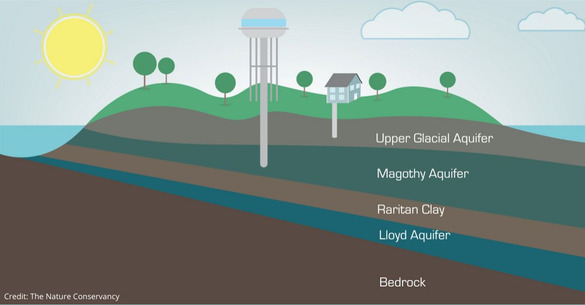
The aquifer system beneath Long Island is a layered network of permeable sediment and clay that stores and filters water. Rainfall and snowmelt replenish these aquifers, which serve as the sole source of drinking water for the region.
There are four primary formations which make up the Long Island Aquifer System. These formations are:
-
Glacial Aquifer: A shallow aquifer supplying water for irrigation and some public use.
-
Magothy Aquifer: The largest and most heavily utilized source of fresh groundwater.
-
Raritan: A clay layer that separates the Magothy and Lloyd aquifers. Some portions of the upper Raritan contain permeable, sandy formations that hold water that can be pumped.
-
Lloyd Aquifer: This is the largely untapped aquifer which contains the oldest water, some of which has been held in the aquifer system for more than 5,000 years.
Long Island Aquifer System Graphic. Photo Credit: The Nature Conservency.
Challenges Facing Aquifer Systems
As Long Island’s population grew over the past 75 years — Nassau’s population has more than doubled since 1950, and Suffolk’s more than quintupled — water use has increased. Today, roughly 425 million gallons are pumped daily from more than 1,000 public supply wells for household uses. Agriculture and industry consume approximately another 60 million gallons. This is a small fraction of the estimated 50 trillion gallons of water stored underground.
Although the availability of water for the Island overall is not at risk, over pumping has caused the saltwater interface — the boundary where saltwater meets fresh groundwater — to shift inland in some areas. There have been instances of saltwater intrusion observed since the 1930s in Kings and Queens counties, 1940s in Nassau County, and the 1970s in Suffolk County. Saltwater intrusion contaminates freshwater aquifers with salt, making the water unsuitable for consumption and many other uses.
A healthy aquifer maintains a balance between water that flows out and water that flows back in from rainfall and snowmelt. Long Island’s streams, ponds and lakes are fed by precipitation and groundwater. When large amounts of groundwater are withdrawn for human use, the aquifer can begin to run a deficit. If the groundwater level falls lower than a lake or stream bed, groundwater no longer flows into that lake or stream. Coastal wetlands and estuaries are affected, too. When groundwater stops flowing out, it upsets the balance of fresh and saltwater that many coastal species depend on.
Spotlight: Long Island Groundwater Sustainability Project (LIGWSP)
To combat these potential challenges, the New York State Department of Environmental Conservation (DEC), in collaboration with the U.S. Geological Survey (USGS), launched the Long Island Groundwater Sustainability Project. The Long Island Groundwater Sustainability Project is a multi-phase effort initiated in 2016 to develop a comprehensive state-of-the-art 3D groundwater model to understand Long Island’s sole source aquifer, help make informed, scientifically driven water-use decisions, and bolster water supply sustainability and resiliency on Long Island.
The study simulates various combinations of changes in aquifer recharge, groundwater pumping, and sea-level position to determine the effects of these changes on water levels, streamflow, and saltwater intrusion from 1900 to present, and can be used to simulate the aquifer system’s response to various stresses in the future.
Phase 1 is now complete and focused on portions of the aquifer beneath Kings, Queens, and Nassau counties revealing these key findings:
-
location of the boundary between fresh and salty groundwater is most likely much closer to the coastline than previously thought;
-
historical onshore saltwater intrusion in Kings and Queens counties has not receded, despite the cessation of New York City groundwater withdrawals since the early 1990s;
-
although saltwater intrusion remains a concern in certain localized areas of western Long Island, presently saltwater intrusion is not a significant concern for its overall water supply; and
-
increases in aquifer recharge and sea level in response to climate change can increase water levels and stream flows, creating concerns for groundwater flooding of underground infrastructure in low-lying areas where the unsaturated zone- land above the groundwater table- is already thin.
Phase 2 is expected to conclude in 2025, and will focus on Suffolk County, followed by Phase 3, which will address data gaps and establish long-term monitoring and modeling.
Based on current and future model scenario outcomes, DEC will work with partners to develop policies and best management practices to protect Long Island’s groundwater resources. This comprehensive, science-driven modeling will advance our understanding of Long Island’s groundwater-flow system, enabling DEC, water supply stakeholders, and policymakers to manage this precious resource effectively and efficiently.
Visit the Groundwater Sustainability of the Long Island Aquifer System webpage here to explore Phase 1 results and stay informed about future developments.
Water Conservation – Actions You Can Take
Feeling motivated to reduce your water usage at home? Try adopting these practices:
-
Use EPA WaterSense products: WaterSense-labeled products are certified to use at least 20 percent less water. Make your home more water-efficient by upgrading to WaterSense appliances.
-
Take shorter showers: Showers can use up to 6.5 gallons of water per minute! Try taking shorter showers to reduce that usage.
-
Turn off the water when brushing your teeth: Turn the faucet off while brushing, there is no reason to leave the tap running as you brush unless you like wasting water and money!
-
Fix leaks in your home: Even the smallest leak can cumulatively lead to a lot of water usage. Fix those leaky faucets and consider using a smart leak control system that connects to your main supply line and monitors every ounce of water coming into the home to detect leaks automatically and stop wasted water
-
Go to the car wash: Car washes today are designed to recycle water and be as efficient as possible. Visit your local car wash instead of washing at home.
-
Fully load your washers before using: Whether it’s your washing machine or dishwasher, only run these appliances if they are completely full.
For more tips and ways to conserve your water usage, visit the Long Island Commission for Aquifer Protection (LICAP)’s Our Water Our Lives webpage.
Connect with Us!
|