In this issue:
Estuaries are among the most productive of Earth's ecosystems, and the Hudson River estuary is no exception. The Hudson's signature migratory and resident species—Atlantic sturgeon, river herring, striped bass, blue crab, and shortnose sturgeon—depend on rare and important tidal habitat for spawning, feeding, and over-wintering. The Hudson River Estuary Action Agenda 2021-2025 establishes specific measures to conserve, protect, and restore these signature species and their valuable habitat.
DEC's Hudson and Delaware River Marine Fisheries staff have been managing the migratory and resident fishes of the estuary since the 1980s through numerous long-term monitoring surveys. Long-term data are extremely valuable for documenting population trends over time, as they can reveal patterns in abundance not evident from single-survey events or short-term studies. Migratory species are managed in collaboration with other coastal states through the Atlantic States Marine Fisheries Commission (ASMFC). The status of each major species has been very dynamic, influenced by local and coastal conditions. Read about some of this year's significant research findings and new developments in this newsletter.
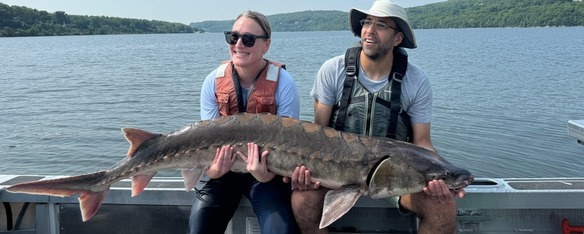
Natural Resources Deputy Commissioner Katie Petronis and volunteer John Kogan hold an Atlantic sturgeon that has been weighed, measured, and scanned for tags. NMFS Permit #20340
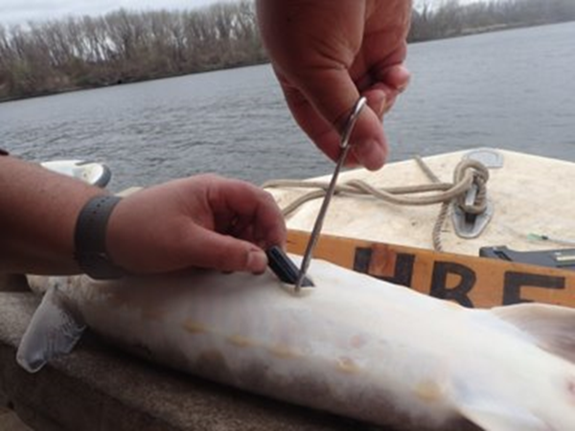
The Hudson River Fisheries Unit and Delaware State University have been maintaining an acoustic river-wide array since 2009. The array consists of 68 receivers from NY Harbor to the Federal Dam at Troy, and detects fish that are equipped with a unique acoustic tag. The receivers (fish detection equipment) are hung on US Coast Guard (USCG) buoys and when the fish swims past the equipment, the receiver stores the tag number, date, and time (like EZ Pass for fish). This data helps us understand how fish move through the Hudson River and allow us to identify, protect, and restore important habitat. Over several years, we get a complete picture of movement for the tagged fish
Tag being surgically implanted in a shortnose sturgeon. NMFS Permit 20340.
However, this fall we deployed special receivers that can be deployed through the winter and are not susceptible to ice damage. We will use these data to better understand winter movement and use of the river during a vulnerable time of year. The winter array will be retrieved in the spring of 2025 and will be redeployed in the fall of 2025 for another winter of data collection.
All of the detection data is uploaded to a coast-wide database where it is shared with other researchers. Fish tagged up and down the Atlantic Coast are detected in the Hudson River and shared through this coastwide system. This network enables us to understand how our Hudson River fish move far beyond our Hudson River acoustic array. Our new year-round array will inform important research on a variety of Hudson River species including Atlantic sturgeon, striped bass, blueback herring, and American eel.
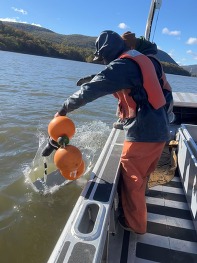
A Hudson River Fisheries biologist deploys a winter receiver in the Hudson
Little is known about the mysterious American eel. They can be found in creeks, rivers, and estuaries along the Atlantic coast from South America to Greenland and in the Gulf Coast. American eels are catadromous, meaning they spend most of their lives in fresh water and migrate to the sea to breed. American eels are a vital part of the ecosystems in which they live, as they are an important predator in freshwater environments and are also a significant food source for larger fish, mammals, and birds. Their unique migratory nature also facilitates the distribution of nutrients between freshwater and marine environments.
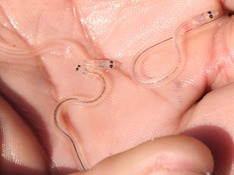
"glass eels"
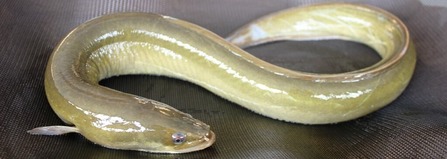
The different life stages of eels are all unique and while they are still the same species, they are referred to by different names for each of these life stages. After the eggs hatch in the Sargasso Sea, they are known as leptocephali and are small, clear leaf-shaped organisms. They ride the ocean currents for about a year and as they approach coastal areas transform into what is then called “glass eels”. They remain clear and are only about two inches long, but round out into the standard shape typically associated with eels. Glass eels make their way into estuaries and up rivers and into creeks and other freshwater bodies. As they continue to grow, they will become larger and start to gain color and become “elvers”. Eventually they become “yellow eels”, which is the life stage that they will spend the most time in. Yellow eels may spend decades in inland waters and estuaries before reaching sexual maturity, when they become silver eels
"Yellow Eel"
The silver eel is the final life stage of the American eel, marked by external and internal changes such as the enlargement of their eye size, a dark back color with a white colored belly, elongated pectoral fins, the deterioration of its digestive system, and gonadal development. Finally, when the time is right, silver eels will make their final migration out of the lakes, creeks, rivers, and estuaries that they have called home and make their way to the Sargasso Sea to where they will spawn. To investigate the timing of this departure and the route of emigration, the Hudson River Fisheries Unit in collaboration with the Hudson River Estuary Education Team has been working on a project tagging silvering eels. By using the river wide acoustic array and other coastal receivers, we hope to be able to shed a little more light on the mysterious movements of the silver eels and find out what sort of environmental variables may trigger them to leave, at exactly what times, and perhaps what are some areas of habitat that they may utilize that could need protecting as they make their final journey out.
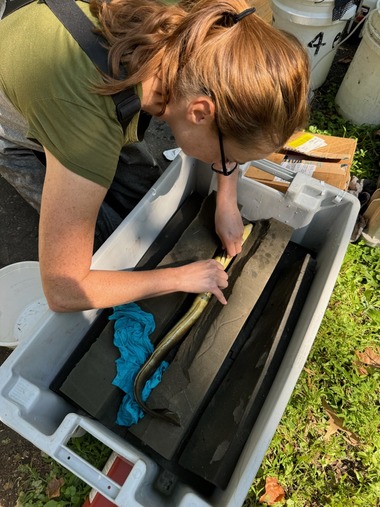 |
Jessica Best implanting an acoustic tag into an eel. (Photo: ElizaBeth Streifeneder)
Each summer as the migratory striped bass spawning run tapers off, juvenile bass hatch from eggs in the upper reaches of the Hudson River Estuary and begin a downriver journey of growth and survival. These tiny fish quickly reach several inches in length over a few months, then spend time in the lower estuary and coastal ocean until they are large enough to join the coastal migratory stock. How have we kept track of these juvenile striped bass and other estuarine fish? With the help of dozens of technicians and biologists in the Department of Environmental Conservation’s Hudson River Fisheries unit, who have pulled in a beach seine over 8,300 times over the past 45 years.
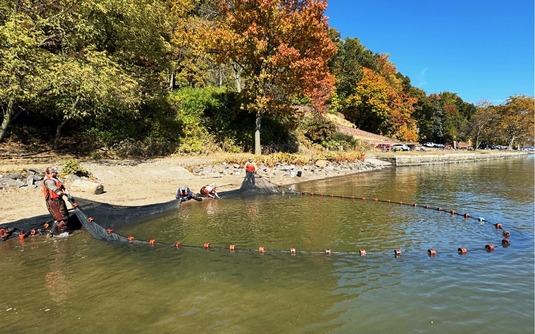
On a beautiful mid-October sampling day, DEC technicians pull in the 200-ft seine at a Nyack beach.
n 1979 DEC began monitoring annually for young-of-year (YOY) striped bass in the Haverstraw and Tappan Zee regions of the Hudson River. The survey utilizes a 200-ft small mesh net deployed in a horseshoe shape by boat to collect juvenile striped bass and other juvenile estuarine species like white perch, Atlantic menhaden, and Atlantic silversides among other brackish species at 13 stations throughout the sample region. Before returning the fish to water, they are identified and counted, and a subset is measured. In fact, since 1979 DEC staff have measured over 300,000 fish during striped bass beach seining. Because it spans such a long time-series, this YOY survey has generated an invaluable fishery-independent dataset for the Hudson River Estuary.
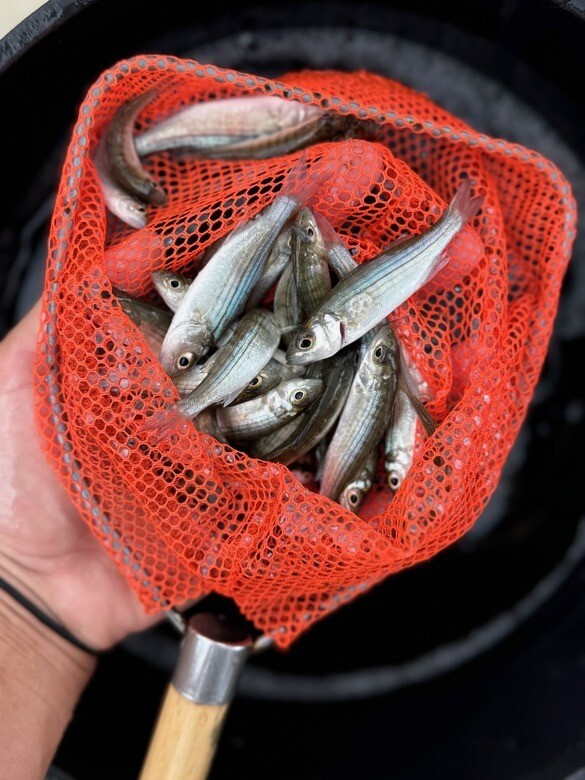
Young-of-year striped bass collected on August 19, 2024, A subset of these fish are measured for their total length, and all others are identified and counted.
What do we learn from these sampling efforts? YOY survey data are used to generate a juvenile abundance index (JAI) for Hudson River striped bass, calculated as the geometric mean catch per haul. The Atlantic States Marine Fisheries Commission, responsible for managing striped bass and other migratory Atlantic coast species, uses this index along with data inputs from other surveys to guide regulations that will ensure a robust striped bass population for years to come. In addition to target species data, the numerous fish counts, length measurements and water quality data may be used to detect changes in fish communities and nursery habitat conditions in the sampling region. The growing dataset will continue to inform management decisions about striped bass and Hudson River fish species in the future.
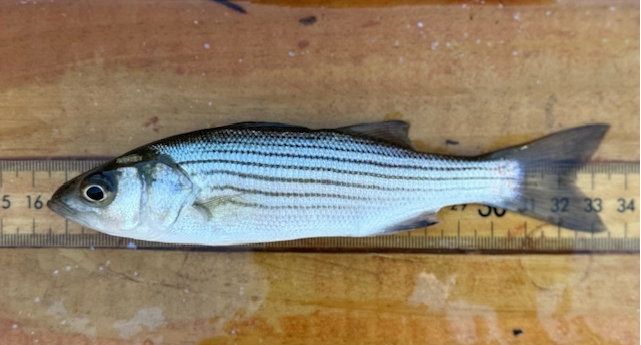
Yearling striped bass caught while seining in Haverstraw Bay in September
Did you know there is a network of water quality monitoring stations in the Hudson whose data are available to the public? The Hudson River Environmental Conditions Observing System (HRECOS) is an environmental monitoring network that collects high-frequency water quality and weather data in and along the river. This data is publicly available in near real-time online.
HRECOS data can help shed light on river conditions, such as how the current drought and warming waters have brought some unusual fish species into the Hudson this year. In Yonkers, the Sarah Lawrence College Center for the Urban River at Beczak (CURB) has documented much higher salinity levels this year (blue) than last year (brown).
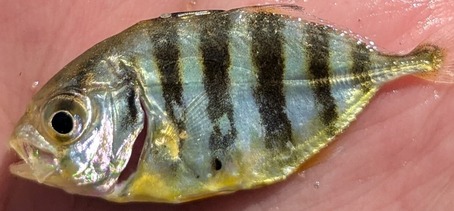
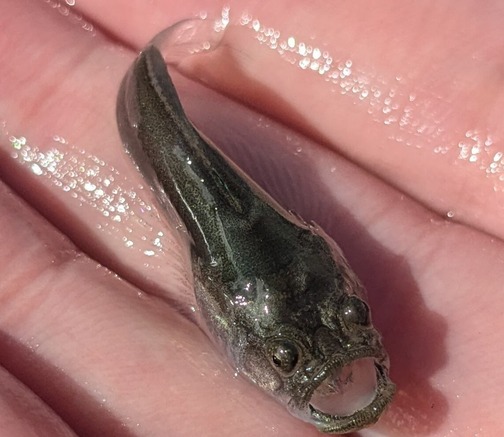
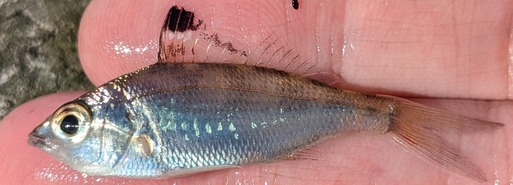
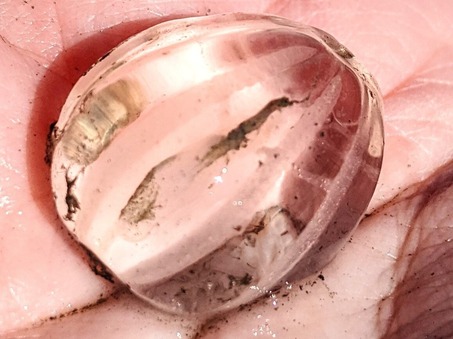
 This much higher than average salinity has resulted in some interesting tropical strays turning up in CURB's seine net including a crevalle jack, northern stargazer, and spotfin mojarra. These are all first-time catches for the Yonkers location. Additionally, they have caught 5,100 comb jellies (ctenaphores) this year, nearly 4,000 more than their previous annual high. This species has been linked to warm water conditions. What other interesting stories are hidden in HRECOS? See what you can find!
crevalle jack
northern stargazer
spotfin mojarra
5,100 comb jellies (ctenaphores) were caught in Yonkers this year, nearly 4,000 more than their previous annual high text. Photo by Jason Muller
This issue of Saltwater Fishing and Boating is on behalf of the Hudson River Estuary Program. Interested in more information like this? Subscribe to the Hudson River Estuary Newsletter.
|