This bulletin provides only the most recent notices. Check the Adirondack Backcountry webpages for more detailed information on access, outdoor recreation infrastructure, and conditions.
Emergency Situations: If you get lost or injured; keep calm and stay put. If you have cell service, call 911 or the DEC Forest Ranger Emergency Dispatch, 833-NYS-RANGERS.
Welcome to the Adirondacks. The Welcome to the Adirondacks webpage provides information about the Forest Preserve, conservation easement lands, outdoor recreation, and Leave No Trace™.
Love Our New York Lands: All New Yorkers and visitors should be able to access, enjoy, and feel welcome on state lands. While enjoying these shared spaces, be respectful of other visitors. Share trails, treat people with kindness, and leave things as you found them for others to enjoy. All of us have a responsibility to protect state lands for future generations. Learn more about how you can Love Our New York Lands.
In this issue:
The following are only the most recent notices pertaining to public lands in the Adirondacks. Please check the Adirondack Backcountry webpages for a full list of notices, including seasonal road statuses, rock climbing closures, specific trail conditions, and other pertinent information.
NEW THIS WEEK
-
High Peaks Wilderness Maintenance: DEC will be doing maintenance on the bridge over the Hudson River on the East River Trail, in the Town of Newcomb on Tuesday 6/4/24 thru Wednesday 6/5/24. This trail provides access to Mt. Adams, to Allen Mtn and Flowed Lands. The bridge will be closed to use by the public during this time, though hikers may wade through the river at the old ford, upstream of the bridge. Signage will be placed at the trailhead, at the old ford and the bridge. Thank you for respecting the safety concerns and avoiding the worksite during the day or after hours. If anything changes with the dates or times, DEC will share the information, in addition to announce the completion of the project. Please direct any questions to: tate.connor@dec.ny.gov.
-
Grass River Wild Forest Maintenance: The Rainbow Falls foot trail along the Tooley Pond Road will undergo maintenance during the weeks of June 3 to 7 and June 10 to 14, 2024. A foot bridge will be replaced, which may make Rainbow Falls temporarily inaccessible to hikers.
-
Aldrich Pond Wild Forest Road Closure: The canoe launch accessing the Little River on the Youngs Road is temporarily closed to allow a re-route of the road during a culvert replacement project.
-
Bog River Complex Maintenance: The maintenance work on Low’s Lower Dam has re-started for the 2024 field season and the area is expected to remain closed through the fall of 2024. Additional information can be found in the updated press release.
-
Horseshoe Lake Wild Forest Maintenance: The Otterbrook Road will undergo maintenance during the summer and fall seasons in 2024 and 2025. Campsite 2 along State Route 421 and Campsite 9 along the Otterbrook Road will be temporarily used as gravel stockpile sites and will be closed to camping until roadwork is completed.
-
Moose River Plains Complex Road Opening: The gate over Otter going toward Muskrat Lake is now opened.
-
Essex Chain Lakes Complex Road Openings: All access roads from the north (town of Newcomb) to the Essex Chain of Lakes are now open. Also, the motorized access route for people with disabilities (by CP3 permit only) to Fifth Lake is passable; high clearance vehicles recommended. Be sure to get the current year's lock combination.
-
Lake George Wild Forest Road Openings: All MAPPWD routes in Lake George Wild Forest are open.
-
Lake George Wild Forest Campsite Repairs: Campsites 1-4 (Scofield Flats and Pike’s Beach) in the Hudson River Special Management Area are being repaired this spring and may be unavailable during the week while work is being completed.
LAST WEEK
-
Avalanche Pass Trail Damage: The Avalanche Pass Trail, near Marcy Dam, has a temporary route for Hiker Safety flagged with yellow. This route brings hikers around an area where beavers have flooded the trail and a bridge has been damaged. DEC is developing a Work Plan to reroute this section of trail to minimize impacts to the Natural Resources and Hiker Safety.
-
West Canada Lakes Wilderness Flooding: There is significant beaver flooding west of the Pillsbury Lake lean-to on the French Louie Trail.
-
Siamese Ponds Wilderness Washout: The bridge at Diamond Brook on the East Branch Trail is washed out.
-
Lake George Wild Forest Repair Closures: The 13 primitive tent sites in the Shelving Rock Special Management Area will be closed June 3-7, 2024, for hazard tree removal. Jabe Pond Road will also be closed to motor vehicles the week of June 3-7, 2024, for culvert replacements and road upgrades. Users will need to park at the parking lot before the gate on Battle Hill Road and walk the 1-mile road to access Jabe Pond.
-
Independence River Wild Forest Camping Loops Openings: Water has been turned on and gates to camping loops 2 and 3 have been opened at the Otter Creek Horse Trail Assembly Area.
-
Multiple Road Openings: Multiple roads have been opened, including:
- High Peaks Wilderness – Corey’s Road
- Santa Clara Conservation Easement Tract – All roads except Madawaska Road (due to a washout)
- Blue Mountain Wild Forest – O’Neil Flow Road in Township 19 Conservation Easement, and Minerva Club Road and Pickwickett Pond Road (access to Fishing Brook) in Township 20 Conservation Easement. High clearance vehicles recommended on Barker Pond Road (Township 19) and Minerva Club Road (Township 20)
- Moose River Plains Complex – Moose River Plains entrance gates (Rock Dam Road remains closed until further notice. Road shoulders may be soft in areas.)
- Essex Chain Lakes Complex – seasonal gates on Chain Lakes Road South (which provides access to Pine Lake Primitive Area)
- Jessup River Wild Forest – Perkins Clearing Road, Military Road, and Jessup River Road are open (allowing access to Mason Lake, Pillsbury Lake Trailhead, and Spruce Lake Trailhead)
- Perkins Clearing/Speculator Tree Farm Conservation Easement Tracts: Perkins Clearing Road and Elm Lake Road, Cave Hill Road, Pine Lakes Road and Fly Creek Road are open. All other easement roads will remain closed for mud season and for repairs
- Ferris Lake Wild Forest – Powley Road (which provides access to Ferris Lake Wild Forest)
- Silver Lake Wilderness – West River Road (which provides access to the Whitehouse Trailhead of the Northville Placid Trail)
 |
Fire Danger: Check the fire rating map for daily updates.
Temperatures: These are forecast temperatures for base elevations throughout the region.
Weekend temperatures in the region are expected to produce lows in the upper-40s and highs in the high-70s, with it getting progressively warmer Friday through to Sunday. Mostly sunny or cloudy skies with minimal chance of rain.
Check the National Weather Service’s Mountain Point Forecast for more accurate forecasts at elevation on or near your intended route.
Reminder: These forecasts are for low elevations. Anticipate losing 5 degrees Fahrenheit for every 1,000 feet of elevation gain. Snow and ice have accumulated throughout the High Peaks, and will likely remain throughout the weekend.
Even with sunny skies, inclement weather is always a possibility and can change very quickly. Remember – hypothermia is always a risk in wet conditions, even when it feels warm outside. Be prepared with extra dry layers and keep an eye on the weather.
Conditions: Although mud season is coming to an end and trails are starting to dry up (key word: starting!), still expect conditions to be variable with muddy sections. Additionally, there is still snow and ice on some high elevation High Peaks, so hikers should be prepared by considering bringing their traction devices.
Sunrise/Sunset: Sunrise = 5:14 a.m.; Sunset = 8:32 p.m. Pack at least one headlamp (two headlamps recommended) even if you expect to finish your activity before sunset. Phone batteries drain quickly and are discouraged.
Check the Weather: Check the forecast for your destination and pack and plan accordingly. Check the National Weather Service Northern Adirondacks and Southern Adirondacks Mountain Point Forecasts for select summit forecasts. Check both daytime and nighttime temperatures and remember that temperatures will drop as you gain elevation.
Seasonal Road Closures: See DEC’s Adirondack Backcountry Information page for specific road conditions and information.
Water Crossings: Water levels are mostly average for this time of year in the Adirondack region. Expect water levels to rise with new rainfall. Check the USGS Current Water Data for New York for stream flow of selected waters. Personal Flotation Devices (PFDs aka lifejackets) are strongly recommended.
Visit the main Adirondack Backcountry page for more trip-planning resources.
Adirondack Mountain Reserve: From May 1 through Oct. 31 (2024), reservations are required to access the parking lot, trailheads, and trails located on the privately owned 7,000-acre AMR property in the town of Keene in the Adirondack High Peaks region. For a list of frequently asked questions, visit AMR's website
Adirondack Rock Climbing Closures: DEC closes certain rock-climbing routes in the Adirondacks to protect nesting peregrine falcons. For a full list of closures, visit Adirondack Rock Climbing Route Closures. Once peregrine nest sites are determined, climbing routes that will not disturb nesting will be reopened. Routes that remain closed will reopen after the young have fledged. Thank you for your cooperation. For more information, please contact the Bureau of Wildlife at (518) 623-1250.
Mount Colden Trapdike: The trapdike is considered a technical climb and not a hike. Climbers should be prepared with helmets, ropes, and climbing gear to ascend this route. Hikers looking to summit Mount Colden should do so via the hiking routes. Attempting to climb the trapdike unprepared can result in a rescue operation, serious injury, or death.
Bear Canisters Required: NYSDEC requires the use of bear-resistant canisters by overnight users in the Eastern High Peaks Wilderness between April 1 and November 30. NYSDEC encourages campers to use bear-resistant canisters throughout the Adirondack backcountry. Bear canisters should be used to store all food, food garbage, toiletries, and other items with a scent. Canisters should be stored a minimum of 100ft from tents, lean-tos and cooking sites and kept closed whenever they are not being accessed. Learn more about bear canisters and avoiding human-bear conflicts.
No Overnight Camping at Trailheads: Overnight camping is not permitted at trailheads or other roadside locations where a camping disc is not present. This includes individuals sleeping in cars, vans, and campers. Campers should seek out designated roadside campsites marked with a "Camp Here" disc or open campgrounds. When camping, always carry out what you carry in and dispose of trash properly. Use designated bathroom facilities, pack out human and pet waste, or dig a cat hole.
Travel: Plan on arriving at your destination early and have several back-up plans in place in case parking at your desired location is full. Check recent notices for road closure announcements.
Ticks: We do have ticks in the Adirondacks! Wear light-colored clothing with a tight weave to spot ticks easily. Wear enclosed shoes, long pants and a long-sleeved shirt. Tuck pant legs into socks or boots and shirt into pants. Check clothes and any exposed skin frequently for ticks while outdoors. Consider using insect repellent. Stay on cleared, well-traveled trails and walk in the center of trails. Avoid dense woods and bushy areas. Additional tips for tick prevention.
Ausable Point Campground in Peru, NY, 10 a.m.-2 p.m.
DEC and State Parks, in partnership with the Office for People with Developmental Disabilities and the Division of Veterans' Services, is hosting this free event for people of all abilities, ages, and backgrounds to enjoy the outdoors and learn new skills!
Check out the following informational tables/activities at Ausable Point Campground:
- Track Talk (rubber tracks, furs, taxidermy)
- Leave No Trace Education Station
- Tree ID/Invasive Species
- Campfire Safety & S’mores
- Nature Art
- Archery
- Outdoor Games (e.g., ring toss, parachute, etc.)
- 10am Introduction to Birding Demo
- 12pm Fishing Demo
- And more!
Get Outdoors & Get Together Day coincides with National Get Outdoors Day, an annual event to encourage healthy, active outdoor fun. For more info and a complete list of sites, check Get Outdoors & Get Together Day. Please contact the site you’re interested in directly for specifics on available adaptive equipment. Guests are encouraged to bring their own water, snacks, and sunscreen. See you there!
Would you like to work in New York State's beautiful High Peaks Region of the Adirondack Forest Preserve this summer?
Environmental Educators Needed!
Join our Region 5 Outreach Team and become an integral part of the High Peaks Information Station Program this summer. Educators will spend the summer educating on safe and sustainable recreation in the High Peaks. Your role as an educator is vital in protecting the Adirondack’s natural resources while enhancing the safety, experience, and wellbeing of our communities and visitors. Positions are based out of the Region 5 headquarters in Ray Brook, NY but educators will spend much of their time at their designated information station. Please read the posting for more information and instructions on where to send your application.
 |
The start of June is a welcomed time for many outdoor enthusiasts in the Adirondacks, as it typically signals mud season coming to a close. Although trails are starting to dry up, we’re now in the thick of bug season—particularly black fly season! Black fly season usually is the worst from Mother’s Day to Father’s Day. As we’ve talked about in recent bulletins, there are some key ways to avoid the wrath of black fly swarms, namely:
- wearing light-colored, long-sleeve clothing
- timing your outdoor adventures based on the weather
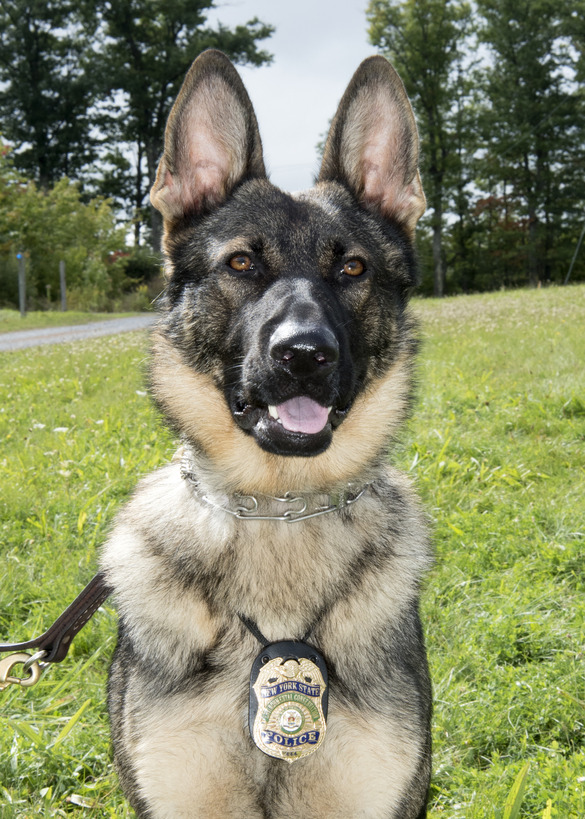
But don’t forget about protecting your pets, too! The Adirondack trails may be dog-friendly, but black flies are not too friendly to us humans or our canine friends! Since your dog may not fully appreciate a netted hat, make sure you consider the weather very carefully, and opt for windy, cool, sunny days with low humidity, while avoiding wet areas.
While you are considering how buggy it will be for your dog, make sure to thoroughly consider your dog’s general physical abilities as well. As active and in shape as your dog may seem, it’s much harder for our dogs to express when they’re in stress. Certain breeds are not as apt for hiking safely. For example, short-muzzled dogs are at higher risk of heat stroke and exercise intolerance, and dogs with long or short hair both deal with temperatures differently.
Dogs may be a man’s best friend and follow us anywhere, but it’s our responsibility to ensure that we’re leading them to safe places!
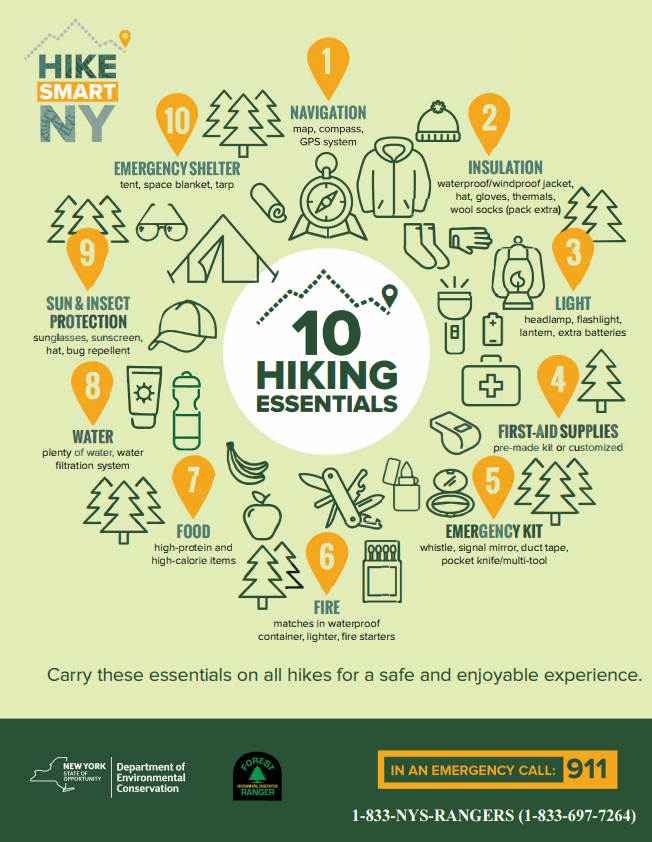
Whether you are hiking, mountain biking, or paddling, Hike Smart NY can help you prepare with a list of 10 essentials, guidance on what to wear, and tips for planning your trip with safety and sustainability in mind.
In addition to keeping your dog safe from bugs, make sure to keep your dog safe from bigger critters by ensuring your dog is on a leash when hiking. This is also important for the safety and overall experience of everyone else, i.e., Principle 7 of Leave No Trace: Be Considerate of Others.
In the Eastern High Peaks Zone, it is required to leash pets on trails, at primitive tent sites, at lean-to sites, at elevations above 4,000 feet, or at other areas where the public congregates.
Here are some reasons you should keep your dog on a leash while hiking:
- Demonstrates respect to other hikers who may not be comfortable with dogs.
- Keeps your dog safe from falls on cliffsides.
- Keeps your dog safe from wildlife.
- Avoids conflict with other dogs.
- Minimizes environmental impact by staying on the trail.
- Allows you to gauge and be more in control of your dog’s pace/energy exertion.
- Most importantly…prevents your dog from being picked up by a swarm of black flies and flown away!
Follow the Seven Principles of Leave No TraceTM to maintain minimal impact on the environment and the natural resources of the Adirondacks.
|