|
In this month’s newsletter, the Drinking Water Source Protection Program (DWSP2) highlights one implementation activity from five participating municipalities’ DWSP2 Plans. As you may recall, the DWSP2 provides free technical assistance to communities to develop and begin implementation of their community specific DWSP2 Plan. During the 12-18 month period that a technical assistance provider works with a community, they not only help the municipality develop a thorough plan to protect their drinking water, but also help them initiate implementing source water protection actions. As of March 2024, nine of the communities participating in the program have transitioned to implementation, so let’s take a closer look at the broad range of actions they are implementing to protect their drinking water!
Implementation is one of the most important pieces of a source water protection program and often one of the most rewarding. Implementation occurs when concrete actions are taken to protect and manage drinking water. Assistance with implementation can help translate these actions into substantial gains in drinking water quality. DWSP2 Plans can be a tool for program participants to create connections that extend to other areas of municipal planning. This enhances overall collaboration and cooperation between neighboring communities. For example, a municipality can designate a Critical Environmental Area (CEA) for a source water of interest, which heightens awareness of the important features within the CEA during assessment of potential project impacts under SEQR. This ensures that essential source waters are not overlooked during SEQR, and that potentially harmful impacts to source waters are evaluated.
The influence that implementation has on advancing source water protection extends to safeguarding public health and the environment, bolstering consumer confidence in drinking water quality, avoiding possible treatment costs, and the potential increase of climate change resilience. In these ways, implementation primes communities for success in protecting water quality.
The Village of Allegany is located in Cattaraugus County, New York. In 2019, the Village applied to receive free technical assistance to protect their source water by building on previous efforts, namely their Source Water Assessment Program (SWAP) maps completed in the early 2000s. The Village and their technical assistance provider developed a community-specific plan that focused on source water protection and implementation activities. With a special focus on land use risks, the Village of Allegany proposed several implementation initiatives to improve their drinking water quality, including:
Adopt an Aquifer Protection Overlay District
Aquifer Protection Overlay Districts can help municipalities be proactive about managing land uses that may affect water quality. This would happen through a series of protective ordinances that supplement a municipality’s existing zoning laws. The Village of Allegany’s proposed Aquifer Protection Overlay District will help preserve and maintain groundwater quality by implementing additional regulations that prioritize the protection of drinking water and other environmental resources. Other benefits of Overlay Districts that support water quality include:
- Guidance on land use activities around drinking water sources.
- Protections of natural features such as wetlands, riparian zones, and critical source waters.
-
Updated definitions within local code, such as watershed, community water system, and regional aquifer subdistrict to ensure adequate protection of drinking water.
The Town/Village of Ellicottville is also located in Cattaraugus County, NY in the foothills of the Allegany Mountains. In October 2022, the Town and Village received state acceptance to develop and begin implementation of their DWSP2 Plan. While working with their technical assistance provider, Ellicottville made it a priority to learn who owns the lands around their source water. To increase their knowledge of land ownership and find ways to protect their drinking water quality, Ellicottville employed the following implementation activity:
Perform a Local Law Gap Analysis
Local law gap analyses can assess the effectiveness of existing local laws in protecting drinking water sources from potential contaminants and identify areas that may need to be strengthened. Read on for additional benefits of a local law gap analysis:
-
Identify gaps in local code for potential amendment.
-
Inform changes to local law.
-
Explore zoning modifications that could protect drinking water quality.
Lake George is found in the southern Adirondack Region in New York State. In addition to its recreational uses, more than 6,000 people receive their drinking water from the Lake. Since many communities in and around Lake George depend on the waterbody, protecting water quality is of the utmost importance. As a result, their DWSP2 Plan focused on informing municipal officials, businesses, and communities about the value and interconnected nature of protecting their drinking water source. One implementation strategy they employ is:
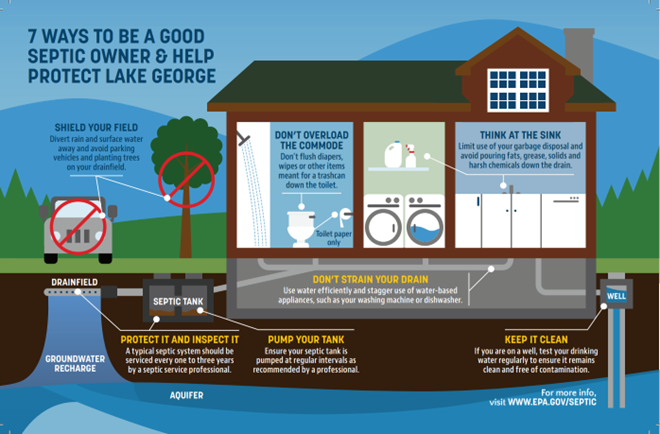
Septic System Public Awareness Campaign
From Lake Geroge Communities' DWSP2 Plan, 2022
The Lake George communities highlighted the importance of septic system awareness and its connection to the quality of drinking water. Technical assistance providers for the Lake George Communities’ DWSP2 Plan created many useful materials, such as the graphic above, to deliver important information to homeowners regarding best management practices. Public education campaigns performed by municipalities and watershed associations can be an effective way to engage the community and establish a dialogue on issues related to drinking water quality. Other benefits of outreach, education, and engagement include:
-
Communication with diverse community members.
-
Community-wide pride and responsibility for source waters.
-
Low-cost compared with treating water that has been contaminated.
The City of Ithaca is located in the Finger Lakes region of Central NY. Known for its natural beauty, the City participated in the DWSP2 beginning in 2021, and welcomed the completion of their state-accepted plan in 2022. With the plan, Ithaca desired to find solutions to sediment and erosion, and new development within the source water area, which can decrease the overall quality of Ithaca’s drinking water. A number of implementation activities to address these issues were outlined in Ithaca’s DWSP2 Plan, including:
Identify and Apply for Relevant Grants
Grants are a powerful, practical, and effective method to achieve implementation goals. They can provide the means to implement measures identified in a DWSP2 Plan. With participation in the DWSP2, Ithaca’s technical assistance provider helped the City develop a grant application that will help inform future land use planning within the City of Ithaca’s drinking water source protection area. Once Ithaca was awarded the grant, the City used the funds to develop a build-out analysis that allowed them to model the impacts of various development scenarios on drinking water quality. Receiving the grant enables the City of Ithaca to take steps towards long-term source water protection. Additional benefits Ithaca gained as a result of working with their technical assistance provider include:
-
Expanding local representatives’ knowledge of the grant application process and fostering their interest in applying for other source water-related grants to continue DWSP2 implementation.
- Assessing stream corridors to address erosion.
The Village of Ravena is located in Albany County, NY. The Village participated in the DWSP2 with the intention of protecting their main drinking water source through methods like monitoring, reporting and public education and outreach. Upon state acceptance in 2022, Ravena desired to use their DWSP2 Plan to carry out these source water protection methods, including:
Develop an Intermunicipal Planning Toolbox
An Intermunicipal Agreement (IMA) is a collaboration between two or more municipalities with shared interest to develop solutions of mutual concern. Instead of drafting a full IMA, Ravena first decided to develop an Intermunicipal Planning Toolbox to outline the benefits of an IMA through a collection of fact sheets, guidelines, and templates. The Toolkit will be used by potential IMA collaborators like water operators, planning boards, and neighboring municipalities to further understand the benefits of entering into an IMA. As the Village prepares to participate in a full IMA, they can expect to enjoy the following benefits:
-
Access additional funding sources by forming partnerships across watersheds.
- Build a collaborative atmosphere with partners to benefit water quality improvements.
- Combine municipal resources for cost-effective planning.
The implementation activities featured above are just a few of the initiatives underway in communities participating in the Drinking Water Source Protection Program across the state. Stay tuned for more implementation examples as more communities join the program and progress towards implementing their DWSP2!
Hosting an event, webinar, or conference in 2024? Reach out to us at source.water@dec.ny.gov to schedule a presentation or tabling event. If you would like to learn more about DWSP2 and how it could help your municipality, fill out our Interest Form and a member of the DWSP2 team will contact you to discuss further.
Was this newsletter forwarded to you? Sign up so you don't miss an edition.
Missed the previous edition? Visit the DWSP2 Newsletter Archive to stay up to date.
Have you begun the DWSP2 process? Or do you have a program or are you aware of a program relevant to source water? Send in any helpful hints or information at source.water@dec.ny.gov and we may highlight them!
Follow DEC on Instagram to see what more you can learn about Connecting Climate Change to Drinking Water.
|