|
The DEC Bureau of Invasive Species and Ecosystem Health’s Forest Health Program worked hard in 2023 to monitor, map, research, and manage invasive species across New York State. In this issue, we review brief program highlights and invasive species updates summarizing our work to protect forests last year. The full-length 2023 New York Forest Health Highlights will added to the Forest Health webpage soon.
As always, thank you to all New York State residents and visitors for doing your part to prevent the spread of invasive species.
Our Forests
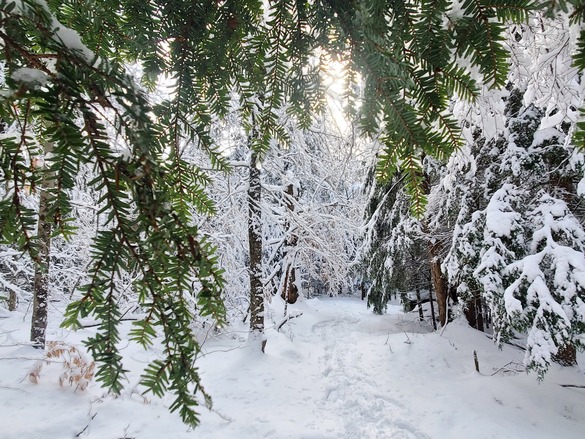
Forests in New York cover 18.6 million acres of land making the State 61% forested. Whether it’s hiking, hunting, camping, or birdwatching, these forest lands provide recreational opportunities for millions of residents and others visiting the state’s scenic regions. New York’s forests also provide employment and bolster the state’s economy through the production of timber. New York’s forests are made of variety of forest types, mostly maple and other hardwoods, along with pine, oak, and eastern hemlock.
Photo credit: Mary Downey
Forest Damage
Insects
Asian longhorned beetle (ALB)
New York State has been managing ALB since the insect was first found in Brooklyn in 1996. Since then, ALB has been eradicated from all five New York City boroughs. The single remaining quarantine area is in Central Long Island, covering 53 square miles. When ALB is found, infested trees are cut down and destroyed, while healthy nearby trees are sometimes treated to prevent future infestation.
Elm Zigzag Sawfly (EZS)
EZS was first detected in New York in 2022 in St. Lawrence County, the area with the highest density of elm in the state. Later in 2022, EZS was detected in an additional 22 counties via ground surveys and public reports. Even though this species appears to be widespread, damage detected so far has been minor. Research is ongoing to learn more about how this species may impact our ecosystem. This year, we learned that EZS had three generations in northern New York, and that green assassin bugs and exotic ladybugs were the most predominant predators. We also learned that yellow sticky traps are the most effective way to capture the insect.
Hemlock wooly adelgid (HWA)
In 2023, DEC treated hemlocks with systemic insecticides at Five Rivers Environmental Education Center, Lake George Wild Forest, Glen Island Campground, Wilcox Lake Wild Forest, Hearthstone Campground, Peck Hill State Forest, and Rockwood State Forest to protect sensitive hemlock ecosystems and high public-use areas. DEC supports the New York State Hemlock Initiative at Cornell University to conduct HWA biological control work across the state, which uses the natural predators of invasive species to reduce their populations. In 2023, predators of HWA were released at Hearthstone Point Campground, Five Rivers Environmental Education Center, Battle Island State Park, and Schenectady’s Plotterkill Preserve among other locations. Chemical treatments help to buy time for biological control to become established and effective across the landscape.
Southern Pine Beetle (SPB)
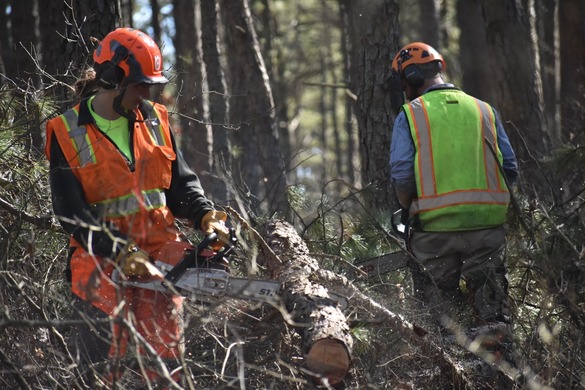
SPB continues to cause significant pine mortality on Long Island. To respond to this threat, in 2023 DEC thinned 175 acres of pine forest in Suffolk County to restore a healthy, naturally sparse pine barrens that are resistant to SPB outbreaks. Outside of Long Island, DEC traps for SPB throughout eastern NY to monitor potential spread of the beetle and to learn more about SPB’s behavior at the northern edge of its current distribution. We are learning how SPB is responding to warmer winters, and how their populations are impacted by our native, natural predators.
Forest Health staff members Allison McKenna and Bob Slocum thinning trees for pine barrens ecosystem health
Spongy Moth
Spongy moth outbreaks occur every 7 to 10 years and cause severe defoliation of oaks and other hardwoods. When populations get exceptionally high, moths will also feed on conifers like white pine and hemlock. Hardwoods can often recover from 1-2 years of defoliation, but may succumb if they are defoliated for multiple years. Conifers do not rebound well, and may die after just 1-2 years of defoliation. The current outbreak began in 2020 in the Finger Lakes region and spread to many areas of the state, peaking in 2021. In 2023, the heaviest defoliation was observed throughout the Hudson Valley from Westchester County to Albany. DEC mapped approximately 188,291 acres of damage in the Hudson Valley during aerial surveys in July 2023. Outbreaks typically collapse after 3 to 5 years, and so we are hopefully nearing the end of this outbreak.
Pathogens
Beech leaf disease (BLD)
BLD was first found in New York in 2018. In 2023, there was significant rapid expansion of the disease. It was found in 12 new counties including Albany, Broome, Columbia, Delaware, Greene, New York, Onondaga, Rensselaer, Saratoga, Seneca, Ulster, and Warren. Currently, there is no known treatment for BLD. DEC, funded by the U.S. Forest Service, is testing potential treatment strategies including canopy thinning and understory removal to see if the impacts of BLD can be mitigated by forest management. Trial treatments began in the winter of 2023, and are slated to continue into 2024.
Invasive Plants
Giant Hogweed
Giant hogweed plants have been managed since 2008 and are present in 52 counties, with the largest and densest number of sites located in the western portion of New York State. At sites where giant hogweed plants are found, a mix of manual and/or chemical control methods are used. Sites that have previously been treated for giant hogweed continue to be monitored until no giant hogweed plants are found for a total of nine years, at which point they are considered eradicated. Information is available for landowners and the public through our giant hogweed/invasive plant information line, outreach materials, and website. Because of our control efforts over 60% of historical giant hogweed sites in New York no longer have these invasive plants.
Kudzu
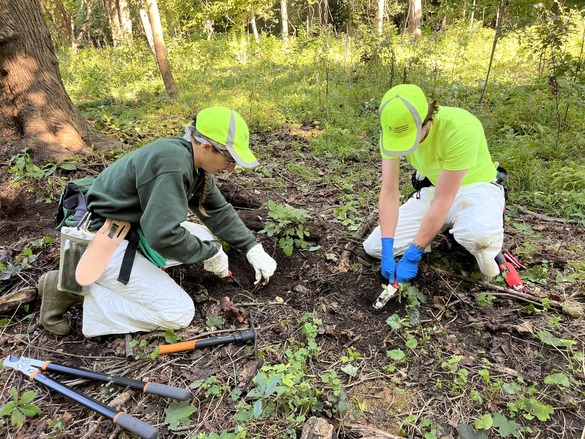
Kudzu plants have been managed since 2014 and are present in 14 southeastern counties. Because of our control efforts kudzu has been eradicated from over 30% of New York sites where it was historically present. Sites that have been successfully managed are monitored for nine years until no more kudzu plants are found, at which point the kudzu is considered eradicated.
Forest Health staff Meaghan Schwartz and Tim Koski manually controlling kudzu by digging up the roots.
Forest Health Diagnostic Lab
The DEC Forest Health Diagnostic Lab continues to provide insect and forest pathology diagnostic services to New Yorkers and promotes research and survey methods development within the various Forest Health programs. The lab responded to 641 diagnostic requests to date and conducted six public site visits in 2023. General insect identification remains the most frequently inquired subject across the state, while oak wilt inquiries had the most significant increase due to 2023’s late season frost causing oak decline symptoms.
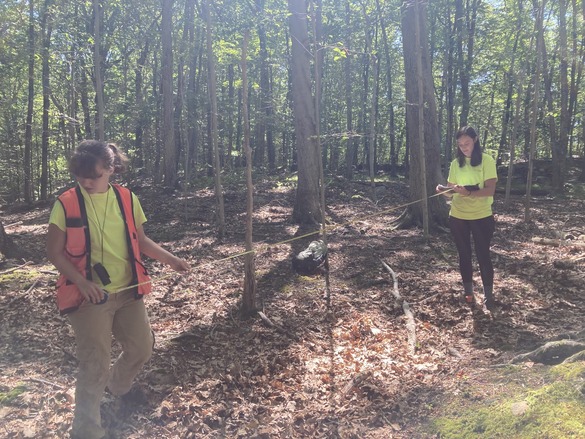
Forest Health Diagnostic Lab staff members Kelsey McLaughlin and Erica Culbert checking a BLD monitoring plot.
|