DEC Announces Duck Season Dates for the 2024-2025 through 2026-2027 Seasons
*Corrections made to the 2024-2025 season table*
Choosing the “best” duck season in New York has always been a challenging task, because duck abundance and migration, land and water access, weather, and habitat vary widely across the state and through the year. In addition to the annual variation in environmental factors (i.e. weather), season dates preferred by hunters chasing wood ducks on small ponds or wetlands may be very different than seasons preferred by someone who hunts diving ducks on large water bodies. To select the season dates in each zone that may work best for most hunters, DEC needed to understand what is important to hunters and pair those values with actual data on duck abundance, migration, and recent weather patterns.
Based on the input of over 3,500 duck hunters across the state and current abundance, migration, and temperature trends, DEC will implement the following duck season date selections (barring any changes to federal season lengths) for the 2024-2025 season:
| Zone |
1st Split |
2nd Split |
| Western Zone |
October 12 - November 3 |
December 7 - January 12 |
| Southeast Zone |
October 12 - October 20 |
November 9 - December 29 |
| Northeast Zone |
October 12 - December 1 |
December 14 - December 22 |
| Long Island Zone |
November 23 - November 29 |
December 7 - January 26 |
Lake Champlain Zone dates are selected by the Vermont Fish and Wildlife Board and were not included in this decision process.
For season dates through the 2026-2027 season and more information on why these dates were selected, please see the following page for detailed information on hunter values, duck abundance and migration, and weather data for each individual zone: Duck Season Setting.
DEC has also developed a list of frequently asked questions about the process, results, and individual zones (PDF).
It's a Boy! It's a Girl!
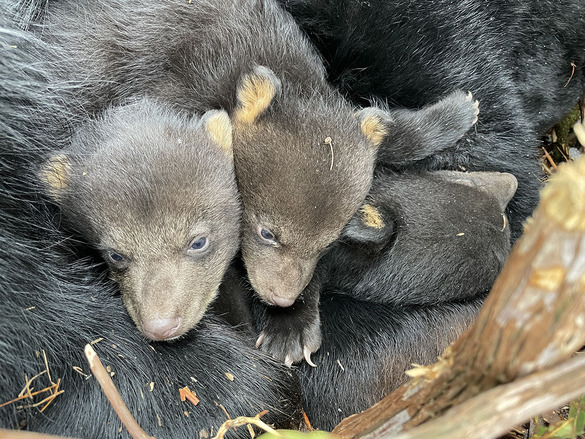
If bears had birthday parties, they’d all be in January and February. That’s when winter dens across the country turn into nurseries as most pregnant bears give birth to cubs weighing in at less than a pound that would easily fit into your hands. Human moms would probably envy a mother bear’s ability to give birth to one, two, or three or more tiny cubs while half-asleep.
Even though cubs are born with their eyes closed, unable to hear or smell and weak and uncoordinated they instinctively find their mom’s nipples and start nursing. Soon the den will be filled with mom’s snores and the happy sounds of cubs humming and purring while they snuggle up to mom and their siblings and fill their tummies with a steady diet of rich, warm milk. Bear’s milk has a fat content around 33%, so nursing cubs have no problem gaining weight.
Over the next several weeks, cubs will keep eating, sleeping and growing and eventually start cautiously exploring their winter quarters. As winter slowly gives way to spring, their eyes will open, their teeth will come in and the fine hair they’re born with will be replaced by fur coats.
To find out how many cubs are usually born, what a very large litter could mean and more fascinating facts, keep reading at BearWise.org!
Article courtesy of BearWise®
Photo of three cubs by Emily Carroll of Pennsylvania Game Commission
Successful Third Year of Pilot Deer Hunting Program for 12- and 13-Year-Olds
Currently, all other states allow youths 12 years old or younger to hunt big game with a firearm. In 2021, New York State (NYS) enacted legislation that created a new section of the Environmental Conservation Law authorizing a license holder who is 12 or 13 years-of-age to hunt deer with a crossbow, rifle, shotgun, or muzzleloading firearm under the supervision of an experienced adult mentor in eligible counties. The legislation established this opportunity as a pilot program through 2023 and required counties to adopt a local law authorizing participation and to notify DEC of such participation. Legislation enacted in 2023 extended this pilot program through 2025.
Of NYS’s 54 eligible counties, 52 participated during the first three years of the pilot program. DEC has documented no hunting-related shooting incidents involving 12- and 13-year-old deer hunters over this time making 12- and 13-year-olds the safest demographic of hunters.
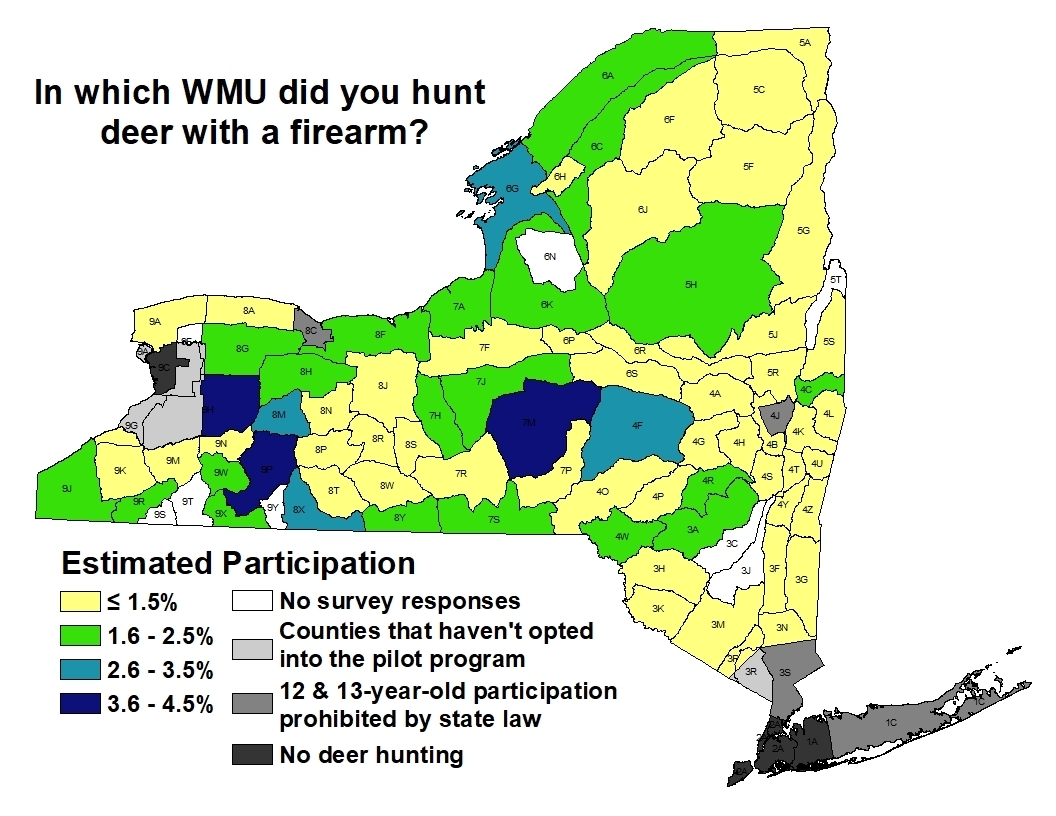
DEC also continues to document high levels of participation in and satisfaction with the pilot program through post-season surveys of eligible hunters and their mentors. Three hundred eighty 12- and 13-year-old hunters and their mentors responded to DEC’s post-season survey to evaluate the third year of the pilot program. Surveyed 12- and 13-year-old hunters went deer hunting with a firearm in 78 Wildlife Management Units (WMUs) across the state with the highest estimated participation in WMUs 7M, 9H, and 9P. Similar to previous years, 80% of 12- and 13-year-old hunters and 84% of their adult mentors were moderately or greatly satisfied with their youth deer hunting experience.
DEC recently provided a report to the NYS Legislature (PDF) highlighting the success of the first three years of the pilot program, and recommendations to make the program permanent. DEC provided four recommendations to the Legislature to continue to cultivate the next generation of safe and responsible hunters and capitalize on the success of the pilot program:
- Make permanent the authorization for 12- and 13-year-old hunters to hunt deer with a firearm and crossbow.
- Extend the authorization for 12- and 13-year-old hunters to hunt deer with a firearm or crossbow to all of NYS (subject to other provisions of ECL) and remove the requirement for counties to pass a local law opting into the program.
- Allow 12- and 13-year-old hunters to also hunt black bear with a firearm and crossbow.
- Allow 12- and 13-year-old hunters to hunt big game with a firearm from an elevated position.
|