 In this issue:
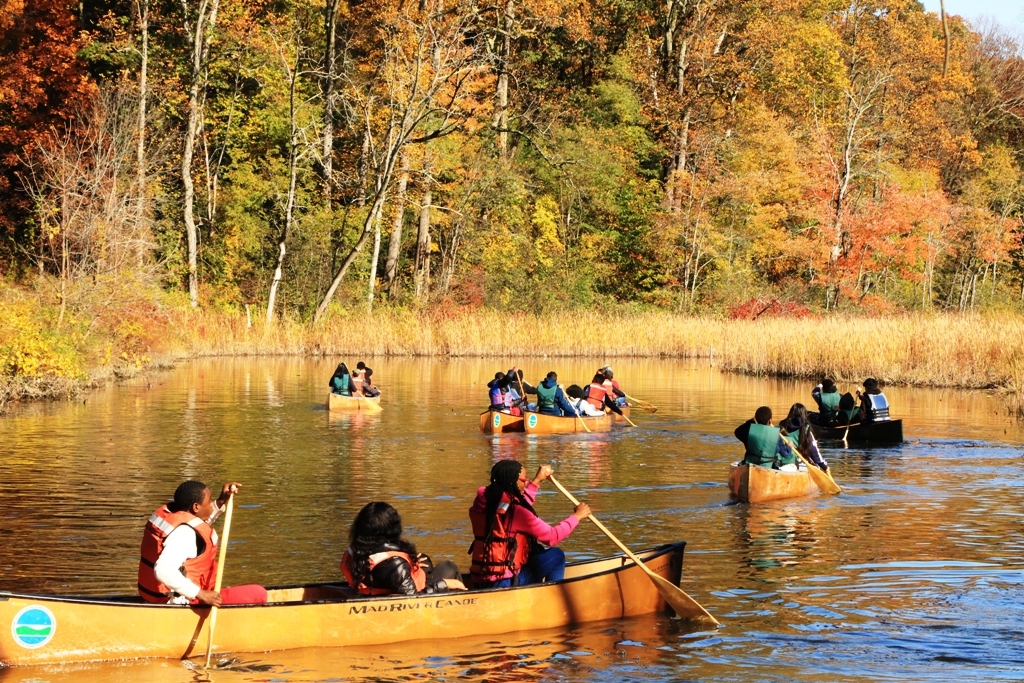
To inspire and engage people to become good stewards of the tidal Hudson and its ecosystem, learning about and experiencing the Hudson River first-hand is essential. The Estuary Program, in partnership with the Hudson River National Estuarine Research Reserve, implements a wide range of field and classroom programs to introduce students of all ages, residents, and visitors to the fish and wildlife, tides and currents, and habitats of the tidal Hudson and its watershed. The Hudson River Estuary Action Agenda sets a course to carry out this work through place-based programs, community science, research, exhibits, and curricula.
 |
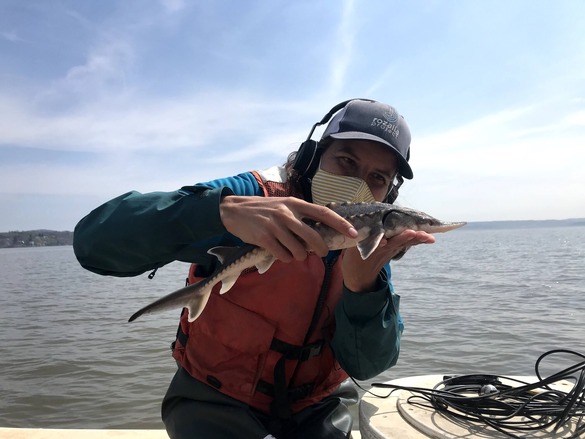
Underwater acoustic recorders have been deployed below the surface of the Hudson River to detect the sounds of fish as they go about their lives. Because many fish make sounds when they hunt, defend their habitats, migrate, and spawn, ecological acoustics can be used to learn about the geographic locations and activities of certain animals. Like birds and frogs, some of sounds are made for communication, while some sounds are created incidentally when moving rocks to make nests, competing for resources, or crunching food.
Our ecological acoustic surveys cover key habitats such as streams, tidal wetlands, and the open river to better determine the seasonal and geographic patterns of important Hudson River fish species, such as Atlantic sturgeon. This innovative research project is a collaboration between Dec’s Hudson River Estuary Program, HRNERR, Cornell University’s Lab of Ornithology, the U. S. Military Academy at West Point, and DEC’s Hudson River Fisheries biologists.
Passive acoustic monitoring informs fisheries management by allowing scientists to understand fish behavior and habitat use while also engaging students with interesting recordings from local aquatic habitats. Hudson Ecological Listening Laboratory and Observatory (HELLO) is our publicly accessible sound exhibit at the Norrie Point Environmental Center where you can listen to ecological acoustic recordings from the Hudson River and around the world. This interactive multisensory display immerses you in the sounds made by animals, humans, and natural phenomena.
With this science collaboration, researchers and educators on the Hudson River are learning about underwater habitats, animal behavior, seasonal migrations, and human impacts by listening to ecological soundscapes.
From late March to early May, teachers, students, and partner environmental organizations participate in DEC’s Hudson River Eel Project to monitor migrating juvenile American eels (Anguilla rostrata). American eels hatch in the Sargasso Sea north of Puerto Rico, and every spring they arrive in estuaries like the Hudson River as translucent, two-inch long "glass eels." The juvenile fish are counted, weighed, and released, and other environmental data is recorded. In 2023, 1,040 volunteers helped count 257,325 juvenile eels at 12 streams that flow into the tidal Hudson
The species is in decline over much of its range, and baseline studies of populations, are crucial for management decisions. This year, the Hudson River Eel Project’s data was included in the Atlantic States Marine Fisheries Commission (ASMFC) American eel benchmark stock assessment, along with data collected through state, federal, and academic research programs from Florida to Maine. Including volunteer-collected data to help determine the benchmark stock assessment demonstrates that community scientists can and do contribute valuable data to scientific research and management. See the ASMFC American Eel Stock Assessment Overview (PDF) and Full Report (PDF) for detailed information.
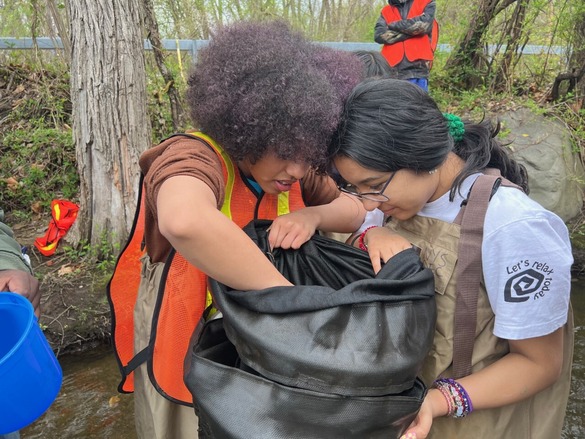
The waterfronts of the Hudson River and the piers of New York Harbor bustled with activity as thousands of students armed with seine nets, minnow pots, and water testing gear collected data and studied the Hudson River during DEC's 21st annual A Day in the Life of the Hudson and Harbor.
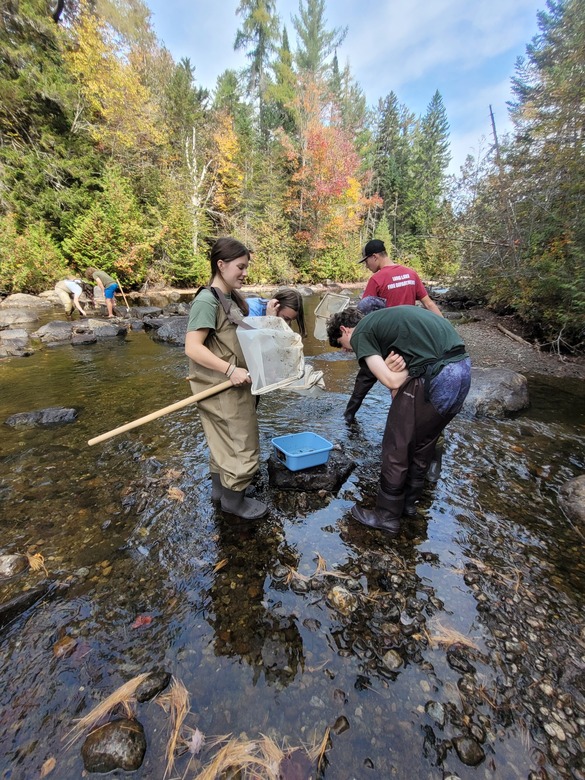
This year, the program expanded north to the headwaters of the Hudson River in the Adirondacks with the participation of Long Lake Central School in Long Lake NY and Johnsburg Central School in North Creek, NY. The Johnsburg Central School District’s High School environmental science class, joined the Long Lake Central School District High School’s living environment class near the Mount Adams Trail suspension footbridge, the reach of river where the Hudson first takes its name. Hudson Basin River Watch, and talented outdoor educators from SUNY’s College of Environmental Science and Forestry Newcomb Campus helped the students with observations of the physical characteristics of the site, a survey of benthic macro-invertebrate life, collection of a sediment core for lab analysis.
This A Day in the Life hands-on field program has been replicated in other areas of New York. Each fall, DEC, in partnership with Friends of Reinstein Woods, coordinates a Day in the Life of the Niagara River/Lake Erie Watershed. Students from 16 local schools collect scientific data along waterways from Chautauqua County to Niagara County along the Lake Erie and Niagara River shorelines. In Long Island, A Day in the Life has a dozen sites on Long Island Sound, including at the Carmans River, Nissequogue River, Peconic Estuary, Forge River, Connetquot River, Greene’s Creek, Carlls River, Mill River, Gardiner County Park in Bay Shore, Massapequa Preserve, and Fire Island.
Three positions with Cornell University for the Hudson River Estuary Program in New Paltz have recently been posted. The application deadline for each position is Friday, January 5, 2024.
Climate Resilience Program Manager
The Climate Resilience Program Manager will lead staff to implement the Climate-adaptive Communities. Benefit in the Hudson River Estuary Program’s Action Agenda (PDF). You will coordinate with communities, partners, and researchers to fund, develop, and implement innovative solutions to climate adaptation and resilience. This includes managing staff and contractors to deliver effective research, outreach, technical assistance, and design on natural and equitable solutions to climate change at local, regional, and state levels. Read the position description on Cornell's website and apply.
Water Resource Technician
The Water Resource Technician, you will assist in preparing field excursions, monitoring ambient water quality in rivers and streams, and assisting with outreach initiatives while supporting other core programs within the Hudson River Estuary Program watershed team. Read the position description and apply on Cornell’s website.
Stream Restoration Specialist
The Stream Restoration Technician, you will be responsible for developing and maintaining a plant materials nursery, conducting plant monitoring at previous restoration sites, data entry, providing one-on-one assistance to landowners, assessing and preparing potential planting sites, and leading volunteers at Hudson Estuary Trees for Tribs planting projects. Read the position description and apply on Cornell’s website.
The New York State Department of Environmental Conservation (DEC) officially debuted a redesigned public website.
The redesigned site offers a more responsive design and intuitive functionality, whether visitors are using a desktop, laptop, tablet, or handheld device. Features include streamlined navigation and new content presentation capabilities that allow DEC to better integrate video and other visual media. Updated DEC website URLs are all plain text, improving the ability of search engines to find and connect users to content. To ensure visitors can still find their favorite web pages from the old design, DEC has established redirects to the new web pages.
Expanded, task-focused navigation makes it easier for visitors to find regulatory, environmental protection, licensing, and environmental education content and resources more quickly. Larger call-to-action sections make it easy to purchase licenses, search for job openings, sign up for topic-specific newsletters through DEC Delivers, or subscribe to DEC’s Conservationist Magazine.
|