
Managing Migratory Fish in the Hudson River Estuary
The New York State Department of Environmental Conservation sent this bulletin on 11/21/2023 10:00 AM EST |
| DEC Delivers - Information to keep you connected and informed from the NYS Department of Environmental Conservation |
| View in browser |
Hudson RiverNet
|
In This Issue:
Managing Migratory Fish in the Hudson River Estuary
Estuaries are among the most productive of Earth's ecosystems, and the Hudson River estuary is no exception. The Hudson's signature migratory and resident species—Atlantic sturgeon, river herring, striped bass, blue crab, and shortnose sturgeon—depend on rare and important tidal habitat for spawning, feeding, and wintering. The Hudson River Estuary Action Agenda 2021-2025 establishes specific measures to conserve, protect, and restore these signature species and their valuable habitat. DEC's Hudson River Marine Fisheries staff have been managing the migratory and resident fishes of the estuary since the 1980s through numerous long-term monitoring surveys. Long-term data are extremely valuable for documenting population trends over time, as they can reveal patterns in abundance not evident from single-survey events or short-term studies. Migratory species are managed in collaboration with other coastal states through the Atlantic States Marine Fisheries Commission (ASMFC). The status of each major species has been very dynamic, influenced by local and coastal conditions. Read about some of this year's significant research findings and new developments in this newsletter. An Atlantic Sturgeon Tagging and Recapture Tale
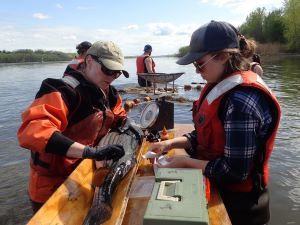
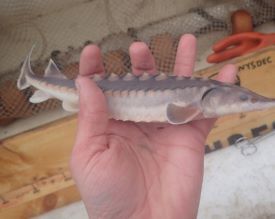
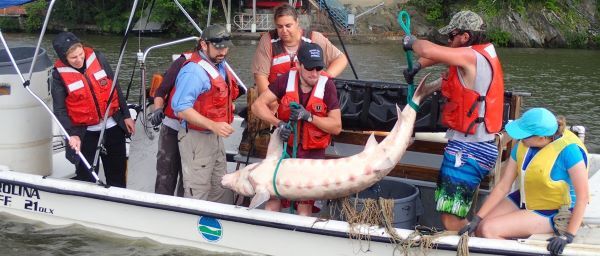
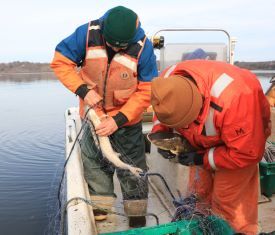
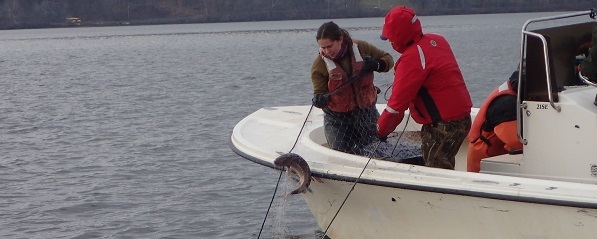
Each year, DEC biologists monitor both the juvenile and spawning adult populations of Atlantic sturgeon, one of the Hudson River’s most iconic fish species. These long-term monitoring programs were developed to track the Hudson River Atlantic sturgeon population following the commercial fishery closure in 1996 due to a declining population. Since the mid-2000s, DEC's Hudson and Delaware Marine Fisheries Unit have been monitoring the abundance of juvenile Atlantic sturgeon at their overwintering area in Haverstraw Bay. From late February to the end of April, young Atlantic sturgeon are collected using nets at their overwintering area in Haverstraw Bay. The sturgeon are weighed, measured for length, and examined for previous tags. Untagged fish are tagged under the dorsal fin with a Passive Integrated Transponder or PIT tag. This tag is like a microchip put in pets and is about the size of a grain of rice. Likewise, each June fisheries biologists use much larger nets (even bigger than the mesh of soccer nets) to monitor the size and sex composition of the adult spawning stock near Hyde Park. Adult sturgeon are processed in a similar fashion as the juveniles. However, the sex of the fish can be determined through the expression of milt or eggs, as individuals are mature and are in spawning condition. The adults also are scanned for a PIT tag. These PIT tags help managers and researchers learn more about sturgeon movement and behavior while in the Hudson. The tags also can be scanned and detected by other scientists in other rivers along the east coast. Atlantic sturgeon migrate as far south as Georgia and as far north as Canada's Bay of Fundy, so the tags give scientists clues about where sturgeon migrate from place to place. Lastly, the tags can help learn about reproduction, survival, and population recovery.
Young Atlantic sturgeon spend up to five to seven years in the freshwater Hudson before moving into the ocean to migrate along the east coast. They are also a late maturing species and females may not spawn for the first time until the age of 15. Therefore, protected sturgeon spawned after the 1996 moratorium would only begin to return and spawn in the Hudson River in the early 2010s. Through DEC’s long-term monitoring of both juvenile and adult sturgeon, DEC biologists are now seeing sturgeon originally PIT tagged as small toddlers returning to spawn as massive adults. Thus far, seven adult sturgeon have been recaptured on the spawning grounds after being at large for as long as 14 years. In 2023, three adults (two originally tagged in 2009 and one in 2011) were recaptured having grown between approximately a meter to 1.5 meters in length! Biologists hope to see an increasing trend in the number of adults that were originally tagged as juveniles returning to spawn in the Hudson River. This would signify the 1996 moratorium and other protection measures are benefiting the species and adult sturgeon are returning to produce more offspring that will overwinter in Haverstraw Bay and ultimately return again as adults. Can Round Goby Survive in Ocean Waters?Round goby, one of the fastest spreading non-native fish species in North America, was first documented in the Hudson River estuary in the summer of 2021. Environmental DNA (eDNA) samples and traditional fish monitoring have confirmed that round goby is now established in the upper two-thirds of the tidal Hudson River. However, there has been no detection of goby south of Newburgh, in the saltier southern waters of the estuary. Their ability to persist in brackish and saltwater environments is not known.
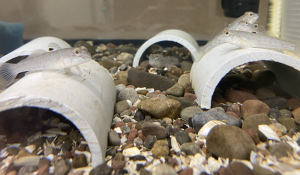
Information is lacking about the salinity tolerance of freshwater goby populations in North America, so it is uncertain how far goby will spread from the freshwater habitats they currently inhabit into the brackish estuary and connected marine environments. Researchers at Cornell University in collaboration with the DEC sought to answer this question by assessing the salinity tolerance of round goby through lab-based experimental trials, tracking their spread with beach seining and environmental DNA, and determining locations of origin with otolith (ear bone) chemistry. The experiments showed that in warmer waters, goby mortality increased at lower salinity levels compared to cold water conditions. At optimal cold-water temperatures, goby could survive in salinity levels similar to that of New York Harbor, indicating their ability to spread throughout the entire Hudson River watershed. The rapid expansion and potential impact on other Hudson River fishes will continue to be monitored by researchers and managers through long-term monitoring and future research projects. Hudson River American Shad Recovery Plan
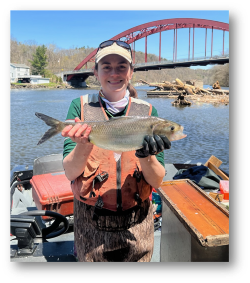
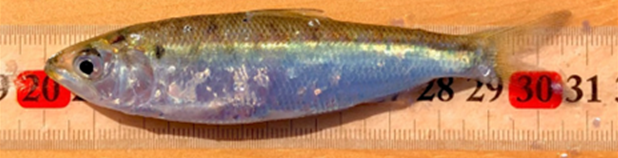
The Hudson River Fisheries Unit has conducted annual surveys of American Shad since the 1970s to track changes in the shad stock. Information collected during the springtime spawning stock survey of adult shad and the summer and fall young-of-year survey helps create annual indices of abundance to monitor shifts in spawning and recruitment (ability of young, small fish to survive to the next life stage.) In 2010, following several years of poor recruitment, the fishery was closed. In March 2023, the New York State Department of Environmental Conservation released the Recovery Plan for Hudson River American Shad (PDF). This plan outlines a brief history of the iconic Hudson River fishery that collapsed after years of overharvesting and loss of spawning and nursery habitat. With the aim of long-term stock resilience, the plan establishes management targets and criteria which when met will allow for the re-opening of sustainable fisheries. The Hudson River Fisheries Unit will continue to gather data and identify challenges for this American Shad stock. Monitoring data will be published on the DEC American Shad webpage annually to keep the public informed of the Hudson River shad stock’s progress. Additional information about American shad can be found on the DEC website.
How Many Shortnose Sturgeon are there in the Hudson?
Research scientists are collaborating on a large-scale project to provide an updated estimate for Hudson River’s shortnose sturgeon population, a federally endangered species, using acoustic telemetry and side-scan sonar. Acoustic telemetry uses stationary receivers to detect signals emitted from tagged marine species such as sturgeon. The receivers store the unique tag number and the date and time that a fish swims past a receiver (like e-z pass for sturgeon). The side-scan sonar uses sound waves to create an image of the river bottom and objects in the water column, such as fish. During winter side-scanning surveys, we also use gill nets to capture fish allowing us to validate the species that we are “seeing” on the side-scan imagery. Shortnose sturgeon congregate in large numbers in over-wintering locations. The relatively small size of adult shortnose sturgeon coupled with dense clusters of the fish make manually counting the side-scan sonar images very time consuming. As a result, we are now using automated image-processing analysis, followed by the application of machine learning to help speed up the process. Both programs are open-source and easily modifiable to fit the specific size of the fish and image quality. Pairing two open-source image and data processing programs gave us the ability to count large numbers of fish much more quickly than the previous human counts. The side-scan sonar derived counts will be merged with the river-wide acoustic telemetry data to estimate the proportion of individual fish in the overwintering areas, and by extension, in the overall Hudson River. This provides a robust and relatively low-cost means to track recovery of America’s first endangered fish. By early 2024, we hope to have population estimates for two years. Funding for this project comes from the Hudson River Foundation and the Hudson River Estuary Program. The Shortnose Sturgeon were collected and tagged under a National Marine Fisheries Service Endangered Species Act Research permit # 20340.
|
|
The New York State Department of Environmental Conservation respects your right to privacy and welcomes your feedback | Update preferences or unsubscribe | Learn more about DEC Delivers |
|
Connect with DEC:      
|
|
| Basil Seggos, Commissioner | |