Wildlife, Fish, and Marine Life Newsletter
The New York State Department of Environmental Conservation sent this bulletin on 05/23/2023 01:19 PM EDT |
| DEC Delivers - Information to keep you connected and informed from the NYS Department of Environmental Conservation |
| View in browser |
Wildlife, Fish & Marine Life Newsletter |
Each May and June, Motorists Should be on the Alert for Turtles Crossing the Road
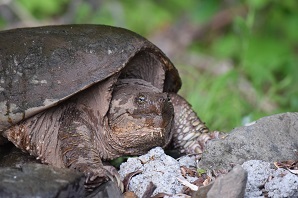
Our native turtles are on the move in May and June seeking sandy areas or loose soil to lay their eggs. In New York, thousands of turtles are killed each year when they are struck by vehicles as they migrate to their nesting areas. What you can do to help:
Photo of NY’s official state reptile, the snapping turtle, by Stephanie Stewart. What to Do When Encountering Young Wildlife — If You Care, Leave Them There
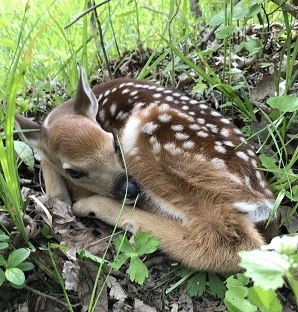
As spring moves into full bloom, you may encounter young or newborn wild animals. While a baby animal might appear abandoned, it is much more likely that a parent is in the area or the individual is an independent juvenile. Please do not touch a wild baby animal – call your regional DEC office or a licensed wildlife rehabilitator if you are concerned for its well-being. Many wildlife parents leave their young in a safe place, where they instinctively remain quiet and still to avoid detection by predators. The parents return periodically (sometimes only a few times within 24 hours) to feed the young. Fawns, cottontail rabbits, and fledgling birds are the most common species that are mistakenly “rescued” by people thinking that the animals have been abandoned. Unfortunately, this leads to the death of many young animals, as wildlife is difficult to raise in captivity. It is also illegal to rehabilitate or keep wildlife in captivity without a license. DEC also reminds people that young wildlife are not pets. If you come across a young, wild animal on its own, the best thing to do is leave it where it is and observe from a distance. The parents may not approach their young if they sense you in the vicinity. You can find more information on young wildlife on the DEC website. Photo of white-tailed deer fawn by Annette Smith-Wright. National Wetlands Month Species Profile
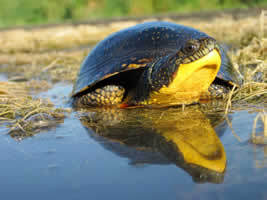
To continue highlighting the importance of wetlands this month and the species that live there, read below to learn about one of the most at-risk turtles in the northeastern United States. Blanding’s Turtle — A “Turtley” Awesome Smile This “smiley” turtle is listed as Threatened in New York State. It's likely that fewer than 3,000 individuals of this gentle turtle species remain in Massachusetts, New Hampshire, Maine, New York, and Pennsylvania combined. With so few left, losses to the illegal pet trade and introduced diseases make their situation even more precarious. Blanding’s turtles are most threatened by habitat loss and degradation and are easily harmed or killed by vehicles on roads during their overland movements. To help New York conserve this species, you can watch out for turtles on roads, especially during their nesting season from late May to July and avoid haying and mowing fields during this time. If you are lucky enough to see one, leave it in the wild, take a photo, and report the observation to your regional DEC wildlife office. Photo of Blanding’s turtle by M.T. Jones. |
|
The New York State Department of Environmental Conservation respects your right to privacy and welcomes your feedback | Update preferences or unsubscribe | Learn more about DEC Delivers |
|
Connect with DEC:      
|
|
| Basil Seggos, Commissioner | |