A Project of the Hudson River Estuary Program
Compiled and edited by Tom Lake, Consulting Naturalist
Overview
Marine mammals such as seals, dolphins, and whales in the Hudson River Estuary are always exciting. This week’s occurrence came with notice of a change in dolphin taxonomy. In the forest, shadbush was blooming, and bald eagle nestlings were emerging; in the river our first striped bass and blue crabs were caught —undeniably springtime.
Highlight of the Week
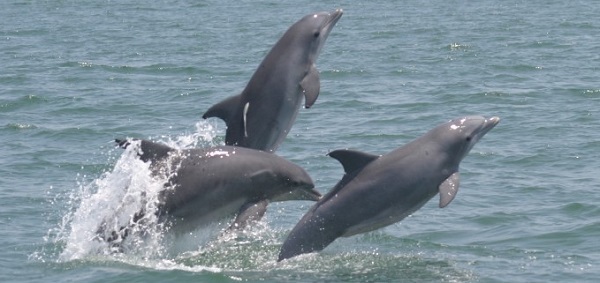
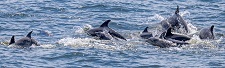 4/10 – Bronx, New York City: A pod of dolphins was spotted in the East River today. The presence of marine mammals in New York Harbor and the East River generally coincides with huge schools of Atlantic menhaden (herring), prime forage for marine mammals. Kim Durham (Atlantic Marine Conservation Society) identified the dolphins as Tamanend's coastal bottlenose dolphin (Tursiops erebennus). (Photo of Tamanend's coastal bottlenose dolphin with permission by AMSEAS) 4/10 – Bronx, New York City: A pod of dolphins was spotted in the East River today. The presence of marine mammals in New York Harbor and the East River generally coincides with huge schools of Atlantic menhaden (herring), prime forage for marine mammals. Kim Durham (Atlantic Marine Conservation Society) identified the dolphins as Tamanend's coastal bottlenose dolphin (Tursiops erebennus). (Photo of Tamanend's coastal bottlenose dolphin with permission by AMSEAS)
- Tom Lake
[A recent decade-long collaborative research study led by Dr. Ana Costa concluded that common bottlenose dolphins inhabiting nearshore coastal and estuarine waters between New York and Florida are a separate species from their offshore counterparts. The former common nearshore bottlenose dolphin (Tursiops truncatus) is now being recognized as Tamanend's coastal bottlenose dolphin (T. erebennus).
To determine a unique common name for the newly recognized species of dolphin, Dr. Costa and her co-authors found the location where the original specimen of T. truncatus was collected (type site) on the coast of what is now New Jersey. They consulted with the Nanticoke Lenni-Lenape Tribe, the descendants of the original people who inhabited that area. Everyone agreed on the name “Tamanend's bottlenose dolphin" after Chief Tamanend (1625–1701). Tamanend was the Chief of the Turtle Clan of the Lenni-Lenape nation in the Delaware Valley and was known for his wisdom and patience. Tom Lake]
[Our list of Hudson River Estuary marine mammals documented in the Hudson River Almanac.
- harbor seal (Phoca vitulina)
- hooded seal (Cystophora cristata)
- gray seal (Halichoerus grypus)
- harp seal (Pagophilus groenlandicus)
- common (harbor) porpoise (Phocoena phocoena)
- Risso’s dolphin (Grampus griseus)
- Tamanend's bottlenose (coastal) dolphin (Tursiops erebennus)
- Common bottlenose (offshore) dolphin (Tursiops truncatus)
- Florida manatee-2006 (Trichechus manatus latirostris)
- minke whale-2007 (Balaenoptera acutorostrata)
- humpback whale-2016 (Megaptera novaeangliae).
Natural History Entries
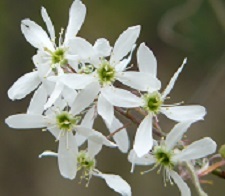 4/6 – Hudson River Watershed: Spring comes very slowly to our watershed. The ancestral Algonkian peoples of the Hudson River watershed used bio-indicators in spring to alert them that it was time to ready the soil, sow their fields, and set their fish weirs. When most of the trees in the forest are yet to leaf out, the soft, hazy white glow of shadbush (Amelanchier sp.) blooms. There is an ecological timing between these events: Shadbush blooms when the soil warms in late March at the same time the river reaches a temperature that signals the beginning of fish migration in from the sea to spawn. The procession proceeds from south to north in an orderly manner from magnolia to forsythia to shadbush to flowering dogwood, with lilac being the final signal that spring is ready for summer. This process is called phenology, the study of nature through the appearance of seasonal phenomena. The word comes from the Greek word “phaino,” meaning “to appear,” or the Latin “phenomenon,” meaning “appearance, happening or display. (Photo of shadbush courtesy of Tom Lake) 4/6 – Hudson River Watershed: Spring comes very slowly to our watershed. The ancestral Algonkian peoples of the Hudson River watershed used bio-indicators in spring to alert them that it was time to ready the soil, sow their fields, and set their fish weirs. When most of the trees in the forest are yet to leaf out, the soft, hazy white glow of shadbush (Amelanchier sp.) blooms. There is an ecological timing between these events: Shadbush blooms when the soil warms in late March at the same time the river reaches a temperature that signals the beginning of fish migration in from the sea to spawn. The procession proceeds from south to north in an orderly manner from magnolia to forsythia to shadbush to flowering dogwood, with lilac being the final signal that spring is ready for summer. This process is called phenology, the study of nature through the appearance of seasonal phenomena. The word comes from the Greek word “phaino,” meaning “to appear,” or the Latin “phenomenon,” meaning “appearance, happening or display. (Photo of shadbush courtesy of Tom Lake)
- Tom Lake
4/6 – Newcomb, HRM 302: After 0.72 inches of rain that was accompanied by thunder and lightning yesterday, the upper reaches of the Hudson River appeared to be ice-free. There was lots of open water and chunks of ice floating under the Route 28N bridge.
- Charlotte Demers
4/6 – Hudson River Watershed: Among indigenous peoples, full moons have long been labeled with fanciful names that are rooted in oral traditions, indigenous memories, and ethnographic accounts. Among Mohican people, whose ancestral homeland lies wholly within the Hudson River watershed, the April full moon is known as the Grass and Geese Moon, or Othkeethkwun wãak Pkwaaxowãpthowuk Neepãʔuk in the Mohican dialect. Tribal translations of full moons pre-date colonization and generally reflect the seasonality of the lunar phase. Moon phases, in fact, were used by indigenous people as measurements of time.
- Larry Madden, Stockbridge-Munsee Band of Mohican Indians
4/7 – Waterford, HRM 158: I checked bald eagle nest NY485 on Peebles Island late in the day and, based on the behavior of the adults, it appeared that we had our first egg hatch. Additional hatches may have occurred by now; we will soon know.
The nest has an additional feature this year that was “installed” a couple of weeks ago. I watched in horror as one of the adults brought a large limb to the nest and proceeded to place it along the top edge blocking our view into the nest. It may be some time before the young ones grow to a size where we can get a good count.
- Howard Stoner
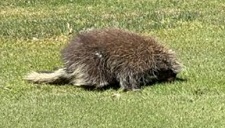 4/8 – Saratoga County, HRM 182: We were playing the thirteenth hole at a local golf course, and as we walked down the fairway, we came upon a porcupine digging in the turf. The porcupine showed no concern for our approach or presence. As an herbivore, the porcupine was likely searching for new plant growth. As I crouched down to take a photo, the porcupine took a sidelong glance at me. We walked on toward the green leaving the porcupine to its grubbing. (Photo of porcupine courtesy of Phil Margiotta) 4/8 – Saratoga County, HRM 182: We were playing the thirteenth hole at a local golf course, and as we walked down the fairway, we came upon a porcupine digging in the turf. The porcupine showed no concern for our approach or presence. As an herbivore, the porcupine was likely searching for new plant growth. As I crouched down to take a photo, the porcupine took a sidelong glance at me. We walked on toward the green leaving the porcupine to its grubbing. (Photo of porcupine courtesy of Phil Margiotta)
- Phil Margiotta
[The north American porcupine (Erethizon dorsatum) is a New World Porcupine indigenous to North America. They are our second-largest rodent—only beavers are bigger—ranging from 24-40 inches long and 10-35 pounds in weight. They are also known as quill-pig, hedgehog, and porky. Their back, sides, and tail are covered with as many as 30,000 stiff, needle-like, finely barbed hairs (quills) for defense. The quills are hollow and barbed, thus making them painful to remove. Porcupines cannot “shoot” their quills, but the quills come out quite easily on contact. Tom Lake]
4/8 – Hook Mountain, HRM 31: Among six north-migrating raptors at the Hook Mountain Hawkwatch today, bald eagle and osprey were high count with two each. Turkey vulture (19) was the high count among non-raptor migrants. Many of the migrants took thermals for a very high onward, north-bound movement, with little to no flapping. There were no sightings of any falcons this afternoon.
- Tom Fiore
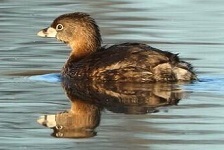 4/9 – Saratoga County, HR 157: On a beautiful Easter morning, ten enthusiastic birders started out at the Vischer Ferry Preserve to search for spring waterfowl and early songbirds. The air temperature at the start was around freezing, but the sun shining on the marshes created beautiful blue-and-golden reflections as the morning gradually warmed. Early on we watched an immature bald eagle perched along the West Pond and were entertained by the “laughing” call of a pied-billed grebe that soon became a frequent sound throughout the Preserve. 4/9 – Saratoga County, HR 157: On a beautiful Easter morning, ten enthusiastic birders started out at the Vischer Ferry Preserve to search for spring waterfowl and early songbirds. The air temperature at the start was around freezing, but the sun shining on the marshes created beautiful blue-and-golden reflections as the morning gradually warmed. Early on we watched an immature bald eagle perched along the West Pond and were entertained by the “laughing” call of a pied-billed grebe that soon became a frequent sound throughout the Preserve.
From the West and Back ponds to the Pine Grove, to the Spruce Circle and the Tall Spruce Trail, species included belted kingfisher, blue-winged teal, ring-necked duck, bufflehead, American wigeon, wood ducks, pied-billed grebes, at least five singing pine warblers, many ruby and golden-crowned kinglets, cedar waxwings, brown creepers, hermit thrush and a Carolina wren. Along the towpath we were pleased to hear and see several yellow-rumped warblers and finally a great blue heron. We managed to get our “woodpecker six-pack” with downy, hairy, red-bellied, northern flicker, yellow-bellied sapsucker, and pileated woodpecker. Our final tally was a surprising 51 bird species. (Photo of pied-billed grebe courtesy of John Hershey)
- John Hershey (Hudson-Mohawk Bird Club)
[The Mohawk Towpath Byway runs from Waterford to the historic Stockade District of Schenectady along the historic route of the Erie Canal. Tom Lake]
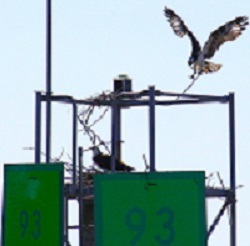 4/9 – Saugerties, HRM 102: On Easter Sunday we took the short hike out to the historic Saugerties Lighthouse. The boardwalk winds through marshy grounds that were alive with birds and blossoming witch hazel. From the mouth of Esopus Creek near the lighthouse, looking several hundred feet out on the river near the end of a stone jetty, we could see a green numbered 93 aids-to-navigation light tower. 4/9 – Saugerties, HRM 102: On Easter Sunday we took the short hike out to the historic Saugerties Lighthouse. The boardwalk winds through marshy grounds that were alive with birds and blossoming witch hazel. From the mouth of Esopus Creek near the lighthouse, looking several hundred feet out on the river near the end of a stone jetty, we could see a green numbered 93 aids-to-navigation light tower.
Right away we could see an osprey pair busily building a nest in the top of the structure. The presumed female was arranging sticks while the other osprey flew dozens of round trips to the adjacent bay gliding down to the tide flats where it dove to scoop up more sticks. It was fascinating to watch as the male osprey landed and hung the available new sticks on the top rung of the aluminum tower frame within reach for the female to select and add to the nest. (Photo of osprey courtesy of Mario Meier)
- Mario Meier
4/9 – Beacon, HRM 61: During a four-hour fishing session today, I caught, admired, and released three channel catfish (Ictalurus punctatus). The largest was a male, 24½ inches long and 4 lb. 9 oz. The other two measured 16-17 inches. As I fished along the shoreline, passers-by gave me news that from the end of the Pier, anglers had caught and released some small striped bass and a large channel catfish. This was my fourth trip to Beacon this season and I have yet to see carp jumping or rolling at the surface, suggesting a start of their protracted spawning season.
- Bill Greene
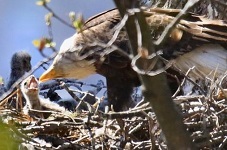 4/10 – Town of Poughkeepsie: I devoted more than an hour today to watching bald eagle nest NY62 and it was time well spent. One of the adults, one that had been guarding the nestlings, flew away from the nest for ten minutes. When it returned, the raptor was carrying a large fish and immediately settled in to feed the three nestlings. I noticed that she took her time feeding what appeared to be the smallest of the three nestlings. (Photo of bald eagle courtesy of Judy Winter) 4/10 – Town of Poughkeepsie: I devoted more than an hour today to watching bald eagle nest NY62 and it was time well spent. One of the adults, one that had been guarding the nestlings, flew away from the nest for ten minutes. When it returned, the raptor was carrying a large fish and immediately settled in to feed the three nestlings. I noticed that she took her time feeding what appeared to be the smallest of the three nestlings. (Photo of bald eagle courtesy of Judy Winter)
- Judy Winter
4/10 – Hook Mountain, HRM 31: Among 22 north-migrating raptors at the Hook Mountain Hawkwatch today, sharp-shinned hawk was high count with eight. Turkey vulture (58) was the high count among non-raptor migrants. Most migrants were moving along rapidly. Double-crested cormorant (50+), in loose north-bound flocks plus a few single birds, came past. A non-migrating peregrine falcon did a bit of fancy-flying and at least once seemed to play-tag with a turkey vulture. However, it was not clear if the TV was wishing to play as well.
- Tom Fiore
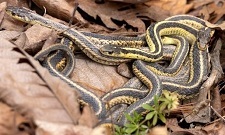 4/11 – Hudson River Watershed: Snakes, being cold-blooded, or ectotherms, must find a spot to spend the winter where their bodies will not freeze. Not being able to dig their own dens, or hibernacula, snakes often rely on natural cavities and the burrows of other animals such as woodchucks and chipmunks that are below the frost line. During winter, typically between October and March, a hundred or more individuals of different species can gather in the same den, slowing down their metabolism and tightly coiling their bodies together to stay warm enough to survive. 4/11 – Hudson River Watershed: Snakes, being cold-blooded, or ectotherms, must find a spot to spend the winter where their bodies will not freeze. Not being able to dig their own dens, or hibernacula, snakes often rely on natural cavities and the burrows of other animals such as woodchucks and chipmunks that are below the frost line. During winter, typically between October and March, a hundred or more individuals of different species can gather in the same den, slowing down their metabolism and tightly coiling their bodies together to stay warm enough to survive.
Once the earth begins to warm up in the spring, snakes emerge. Common garter snakes remain near their winter dens for several days. Males appear first, sometimes in groups as large as several hundred. Females tend to emerge singly and over a longer period. Garter snake courtship soon follows and can take the form of a writhing mass of bodies called a mating ball, where one female is surrounded by and has her pick of a hundred or more eager males. (Photo of garter snake courtesy of Mary Holland)
- Mary Holland
**** Fish of the Week ****
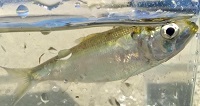 4/11 – Hudson River Watershed: Fish-of-the-Week for Week 215 is the American shad (Alosa sapidissima) number 25 (of 230) on our watershed list of fishes. If you would like a copy of our list, e-mail: trlake7@aol.com. 4/11 – Hudson River Watershed: Fish-of-the-Week for Week 215 is the American shad (Alosa sapidissima) number 25 (of 230) on our watershed list of fishes. If you would like a copy of our list, e-mail: trlake7@aol.com.
American shad is the largest of the river herrings (Alosa sp.). Their body is strongly compressed, bright silvery on the sides, blueish to greenish above, with silvery deciduous scales. Their scientific name comes from Latin as Alosa (shad) sapidissima (sapidus = savory). Their native range on the east coast stretches from Labrador south to the Saint John’s River in Florida.
Shad are anadromous, in that they spend most of their life in salt water, wintering offshore along the coast south to the Carolinas, but returning to inland freshwater, often their natal river, to spawn. Their popularity as a food fish prompted a successful transport of 35,000 Hudson River shad into the Sacramento River in July 1873, where the species became well established on the West Coast.
As the water warms in late March, shad enter the estuary in pulses, each intent on reaching their spawning grounds. The shadbush (Amelanchier sp.) has been, at least colloquially on the East Coast, considered a harbinger of their arrival from the sea. The males, or buck shad, begin nosing up the river, a sinuous journey, that allowed them to slowly acclimate to the lessening salinity. In the weeks that follow, more and more females, or roe shad, ascend the river, all heading above the salt to a 70-mile freshwater reach from Hyde Park to the head of tide at Green Island (Troy). Eventually, the run evens out—similar numbers of bucks and roe—before concluding in late May, dominated by roe shad.
American shad have a well-earned reputation as being a bony and difficult fish to process–they have 769 bones; humans have 208. Over the millennia, to extend the shelf life of this springtime protein resource, a cottage industry for smoking shad was developed. Archaeological remnants of smoking huts, dating to at least 5,000 years ago, have been excavated along the river. As a result, smoked, pickled, and planked (baked) shad have long been springtime favorites in our Hudson Valley. A major attraction with shad, however, has always been its eggs; in historic times shad roe has been a springtime culinary delight. (Photo of American shad courtesy of Tom Lake)
- Tom Lake
[American shad stocks are managed through the Atlantic States Marine Fisheries Commission (ASMFC). Due to significant declines in coastal landings of American shad, ASMFC recommended a closure of all ocean fishing in 2005. Shortly after, the 2007 ASMFC stock assessment indicated the Hudson River American shad population was severely depleted, prompting a complete closure of recreational and commercial fishing in the Hudson River in 2010. Since the closure, the Hudson River population remains depleted based on findings from the most recent 2020 ASMFC benchmark stock assessment.
On March 23, 2023, DEC released the final Recovery Plan for Hudson River American Shad. This plan outlines the efforts undertaken to recover the stock since its collapse and develops a transparent and science-based roadmap for re-opening the shad fisheries. The success of this plan could renew our culinary relationship with shad. NYSDEC]
[Many excellent scholarly books have been written on the American shad. One of the best is The Founding Fish (John McPhee 2003), a blend of personal history, natural history, and American history including the shad's cameo role in the lives of George Washington and Henry David Thoreau. The Founding Fish is a fitting companion to McPhee’s The Survival of the Bark Canoe (1982), an ode to the Common Loon (Gavia immer). Tom Lake]
4/11 – Yonkers, HRM 18: Our staff at the Sarah Lawrence Center for the Urban River at Beczak, with the assistance of 9th and 10th grade students from the Homestead School (Hurleyville), tended to our glass eel fyke net that we had set overnight in the Beczak tidemarsh. The students were thrilled to count out 47 glass eels and our first elver of the season (yearling glass eel), a marked improvement over recent days. Five gorgeous mummichogs (30-35 millimeters) were a bonus for the students.
The water temperature was 48 degrees Fahrenheit (F), the salinity was 6.4 parts-per-thousand (ppt), and the dissolved oxygen (DO) was 10.6 parts-per-million (ppm).
- Jason Muller, Emily Orr, Christina Edsall, Katie Lamboy
[Note: One-inch equals 25.4 millimeters (mm). Tom Lake]
4/12 – Newcomb, HRM 302: We still had some ice on the lakes and ponds, but with very warm weather in the forecast, the ice may not last. I was excited to see four green-winged teal on the small patch of open water on Rich Lake. They are not common, and were just a migration stop, but are beautiful little birds. Evening grosbeaks were still hanging around at the bird feeder. The yellow-bellied sapsucker was the latest spring arrival.
- Charlotte Demers
4/12 – Minerva, HRM 284: This morning I heard two neat sounds of spring: eastern phoebe and common loon (trying to return to Minerva Lake, which is still iced over). Also, with the warmish weather this evening, I heard a few hesitant spring peepers. Most places are still icy, but some little ephemeral ponds have opened. I will be listening for the calls of wood frogs next.
- Mike Corey
4/12 – New Paltz, HRM 79: Several American toads could be heard along the Wallkill Valley Rail Trail north of the village of New Paltz. Curiously, the warbling calls of the males were more evident than usual. It may have been due to the spring peepers being nearly silent. The wood frogs were quiet as well and may have finished their mating rituals, depositing the next generation. The dry conditions may have had a stifling effect on the spring peepers. An evening of rain would go a long way in stimulating the spring peepers to reach their crescendo of calls. It had yet to happen in this area.
- Roland Bahret
4/12 – Ulster County, HRM 86: Viewed from across the river at Norrie Point, this was post-hatch Day 26, heading toward 72-90 days for fledging, for bald eagle nest NY142. It was warm enough (82 degrees F) that the nestlings did not need cover, but they were not yet quite large enough to show their little gray “bobble heads."
- Dave Lindemann
4/12 – Hook Mountain, HRM 31: Among 23 north-migrating raptors at the Hook Mountain Hawkwatch today, broad-winged hawk was high count with twelve. Turkey vulture (46) was the high count among non-raptor migrants. For the most part, the birds were not migrating.
- Tom Fiore
4/12 – Yonkers, HRM 18: Our staff at the Sarah Lawrence Center for the Urban River at Beczak tended to our glass eel fyke net that we had set overnight in the Beczak tidemarsh. Glass eel numbers had again dipped reflecting either a hole in the run or nearing the end of it. As a result, the highlight of our catch was an Atlantic marsh fiddler crab (Uca pugnax). The water temperature was 57 degrees F, the salinity had fallen lower to 2.7 ppt, and the dissolved oxygen (DO) was 11.6 ppm.
- Jason Muller, Katie Lamboy
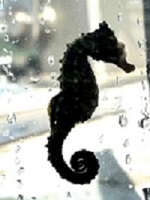 4/12 – Manhattan, HRM 1-2: Hudson River Park’s River Project staff checked our research gear (pots and traps) that we deploy at Piers 26 and 40 as part of our fish ecology survey. We were delighted to find a northern pipefish (175 mm) in a minnow trap, our first of the year. We also found a second lined seahorse (65 mm) clinging to a crab pot. It is a very good sign to see indicator species like the seahorse and pipefish present at both of our trap checking locations. The fishes were held briefly in a water-filled glass viewing wedge, which allows for photos to be taken with the animal held still while remaining in water. We typically see these unique fish early in the spring and summer before they head to deeper waters in fall. (Photo of lined sea horse courtesy of Zoe Kim) 4/12 – Manhattan, HRM 1-2: Hudson River Park’s River Project staff checked our research gear (pots and traps) that we deploy at Piers 26 and 40 as part of our fish ecology survey. We were delighted to find a northern pipefish (175 mm) in a minnow trap, our first of the year. We also found a second lined seahorse (65 mm) clinging to a crab pot. It is a very good sign to see indicator species like the seahorse and pipefish present at both of our trap checking locations. The fishes were held briefly in a water-filled glass viewing wedge, which allows for photos to be taken with the animal held still while remaining in water. We typically see these unique fish early in the spring and summer before they head to deeper waters in fall. (Photo of lined sea horse courtesy of Zoe Kim)
- Zoe Kim, Siddhartha Hayes, Toland Kister, Sivan Gordon-Buxbaum, Sierra Drury
4/13 – Kingston, HRM 92: The air temperature reached 90 degrees F today establishing a new record high for the date. The previous record was 86 degrees F.
- National Weather Service
4/13 – Little Stony Point Preserve, HRM 55: The tide was nicely low, the river was flat calm, the water was 54 degrees F, but the fish were elsewhere. After a half-dozen hauls or our seine, we began to wilt in the 92-degree heat, although getting in the cool river certainly helped.
Seth and Ellie Dinitz came upon a 3½-inch-long alewife (Alosa pseudoharengus) laying on the sand. The fish was too small to be a part of the in-from-the-sea spring spawning population. This was a holdover, a member of year class 2022 that did not go to the sea in the fall. Salinity was 1.0 ppt, which was within the margin of error for being zero salinity.
- Tom Lake, Seth Dinitz, Ellie Dinitz
4/13 – Hook Mountain, HRM 31: Among 33 north-migrating raptors at the Hook Mountain Hawkwatch today, broad-winged hawk was high count with 15. Turkey vulture (14) was the high count among non-raptor migrants. A common loon in gorgeous full-breeding plumage passed directly by the summit going rapidly north in the earlier hours of the day.
- Tom Fiore
4/13 – Yonkers, HRM 18: Our staff at the Sarah Lawrence Center for the Urban River at Beczak tended to our glass eel fyke net that we had set overnight in the Beczak tidemarsh. Our number of glass eels (4) continued to suggest their upriver run from saltwater was slacking off.
Later, we made five hauls of our 30-foot seine and caught our first striped bass of the year, a yearling (105 mm). This was a member of the 2022 striped bass year class that may have wintered under the westside piers of Manhattan in the Upper Bay of New York Harbor. Also in the net was a 20-millimeter soft-shelled clam (Mya arenaria). The water temperature was 54 degrees F, the salinity was still low at 3.3 ppt, and the dissolved oxygen (DO) was 11.7 ppm.
- Jason Muller, Ishika Joshi, Wilson Barlow
[Bivalve measurements (size) are taken in millimeters (mm) from the hinge to the top of the valve. Tom Lake]
4/13 – Manhattan, New York City: At either end of the Hudson River estuary, Albany (89 degrees F) and New York City (90 degrees F), tied their record high air temperatures for the date.
- National Weather Service
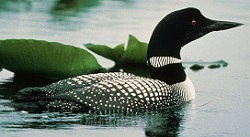 4/14 – Newcomb, HRM 302: Rich Lake was still three-quarters iced-over but was melting fast. I was there the last few days but saw no returning common loons yet. But they are nearby— Long Lake had three, a few days ago. Today might be the day for Rich Lake in Newcomb. (Photo of common loon courtesy of Mary Holland) 4/14 – Newcomb, HRM 302: Rich Lake was still three-quarters iced-over but was melting fast. I was there the last few days but saw no returning common loons yet. But they are nearby— Long Lake had three, a few days ago. Today might be the day for Rich Lake in Newcomb. (Photo of common loon courtesy of Mary Holland)
- Charlotte Demers
[The view and calls of the common loon are iconic sights and sounds of the High Peaks wilderness area. To most of us, the loon authenticates the wildness of the Adirondacks. Tom Lake]
4/14 – Town of Poughkeepsie: In mid-afternoon, our thermometer recorded an air temperature of 95 degrees F. We felt the oppressive heat standing in the sun monitoring bald eagle nest NY62. The adult nest-watcher was sitting on the rim. With three rapidly growing nestlings, extra space was limited. All four were panting, the nestling like puppies, their collective mode of cooling off. There was just enough leafing out to offer some shade to the nest.
- Tom Lake, Phyllis Lake
4/14 – Yonkers, HRM 18: Our staff at the Sarah Lawrence Center for the Urban River at Beczak tended to our glass eel fyke net that we had set overnight in the Beczak tidemarsh. This was yet another low count day with just three glass eels. The rest of the fyke held one amphipod (Gammarus sp.) and a white-fingered mud crab.
Later we made five hauls of our beach seine with markedly better results, including the first five blue crabs (20-50 mm) of the season. More indicators of a season change included Atlantic silverside and our second yearling striped bass (95 mm). And there was the obligatory, single, albeit huge (110 mm), mummichog. The water temperature was 54 degrees F, the salinity continued low at 2.9 ppt, and the dissolved oxygen (DO) was 11.5 ppm.
- Jason Muller, Emily Orr, Diane McKay, Louisa Hausslein, Emily Leonard, Dylan Sandow, Jieru Wang
[Crab measurements (size) are calculated in millimeters (mm) point-to-point across their carapace. Tom Lake]
4/14 – Manhattan, New York City: For the second day, at either end of the Hudson River estuary, Albany (91 degrees F) and New York City (91 degrees F), tied their record high air temperatures for the date.
- National Weather Service
[March of 2023 was the planet’s second-warmest month in recorded history, registering average global temperatures 0.92 degrees Fahrenheit above normal high temperatures. Polar sea ice saw its second-smallest March coverage on record. National Oceanic and Atmospheric Administration (NOAA)]
Spring 2023 Natural History Programs and Events
Norrie Point Environmental Center Open House
Ever wonder what is in that stone building in the corner of the new parking lot at Mills-Norrie State Park? Come in and see the exhibits and ask any questions you may have about the river. Then take a hike along the river on the miles of scenic trails nearby. Located at Mills-Norrie State Park, on route 9 in Staatsburg, NY. Open house dates and times:
Saturday, April 22, 10:00 am-2:00 pm
Saturday, April 29, 10:00 am-2:00 pm
Saturday, May 6, 10:00 am-2:00 pm
Volunteer for Hudson River Eel Project
This is the 16th year of the Hudson River Eel Project. This community science projects trains students and volunteers to research migratory American eels along the estuary. For information on this project, check out: https://www.dec.ny.gov/lands/72898.html#Eel
If you are interested in participating, email eelproject@dec.ny.gov and include a little about yourself and where you live so we can match you with a nearby site.
Volunteer for Hudson River Striped Bass Cooperative Angler Program
Do you fish for striped bass in the Hudson River? Whether you catch-and-release or take home a keeper, you can be part of the Cooperative Angler Program. Share your fishing trip information and help biologists understand and manage our striped bass fishery.
Here's how it works: Fill out a logbook we provide or record your trips on your smartphone using DEC's Hudson River online logbook (PDF) whenever you fish on the tidal Hudson River (by boat or on the shore). Record general location, time, gear used, what you caught (or if you didn't catch anything), and return the logbook when you are done fishing.
Join today! For more information on the angler program and instructions on installing the Survey123 App to access the online logbook, visit Hudson River Cooperative Angler or email hudsonangler@dec.ny.gov.
Note: If you primarily fish for striped bass in New York waters south of the George Washington Bridge, the DEC has a separate Striped Bass Cooperative Anglers Program.
Hudson River Miles
The Hudson is measured north from Hudson River Mile 0 at the Battery at the southern tip of Manhattan. The George Washington Bridge is at HRM 12, the Tappan Zee 28, Bear Mountain 47, Beacon-Newburgh 62, Mid-Hudson 75, Kingston-Rhinecliff 95, Rip Van Winkle 114, and the Federal Dam at Troy, the head of tidewater, at 153. The tidal section of the Hudson constitutes a bit less than half the total distance – 315 miles – from Lake Tear of the Clouds to the Battery. Entries from points east and west in the watershed reference the corresponding river mile on the mainstem.
To Contribute Your Observations or to Subscribe
The Hudson River Almanac is compiled and edited by Tom Lake and emailed weekly by DEC's Hudson River Estuary Program. Share your observations by e-mailing them to trlake7@aol.com. To subscribe to the Almanac (or to unsubscribe), use the links on DEC's Hudson River Almanac or DEC Delivers web pages.
Useful Links
National Oceanic and Atmospheric Administration online tide and tidal current predictions are invaluable when planning Hudson River field trips. For real-time information on Hudson River tides, weather, and water conditions from sixteen monitoring stations, visit the Hudson River Environmental Conditions Observing System website.
DEC's Smartphone app for iPhone and Android is now available at New York Fishing, Hunting & Wildlife App.
|