A Project of the Hudson River Estuary Program
Compiled and edited by Tom Lake, Consulting Naturalist
Love Our NY Lands
State Lands Belong to All of Us
All New Yorkers and visitors should be able to access, enjoy, and feel welcome on state lands. These lands belong to all of us, our families, and our neighbors. While enjoying these shared spaces, be respectful of other visitors. Share trails, treat people with kindness, and leave things as you found them for others to enjoy. All of us have a responsibility to protect State lands for future generations. For more information, visit DEC's website.
Overview
Last week’s rare duck captured another county-first this week, while in the company of another uncommon to rare duck. This is the season to scan the river for waterfowl from faraway places. We also may have bid adieu to the harbor seal that had been a significant contributor to the Hudson River and the Almanac for more than three years.
Highlight of the Week
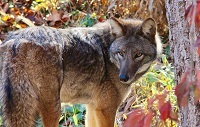 1/8 – Orange County, HRM 47-41: I always enjoy watching eastern coyotes (Canis latrans). This morning I watched a pair at sunrise out in a field in the Black Dirt area, a discreet agricultural region of southwest Orange County growing farm produce such as onions, potatoes, lettuce, radishes, cabbage, carrots, corn, pumpkin, and squash. 1/8 – Orange County, HRM 47-41: I always enjoy watching eastern coyotes (Canis latrans). This morning I watched a pair at sunrise out in a field in the Black Dirt area, a discreet agricultural region of southwest Orange County growing farm produce such as onions, potatoes, lettuce, radishes, cabbage, carrots, corn, pumpkin, and squash.
Two things stood out to me as I watched the coyotes: The first was how acutely aware they both were of me. Despite the great distance, both kept a very close eye on me as they made their way across the field. The second was the size difference between the two canines: the lead coyote was much smaller, likely a female, followed by a noticeably larger presumed male. (Photo of eastern coyote courtesy of Ed McGowan)
- Matt Zeitler
[The eastern coyote is a variety that grows to a larger size and often has darker fur than is generally associated with the species. Two separate teams of researchers studying the genes of coyotes in the Northeast reported evidence that some of these animals, that have for decades been thought of as coyotes, are in fact coyote-wolf hybrids (Canis latrans x C. lupus). Roland W. Kays, Curator of Mammals at the New York State Museum, studied coyotes from New Jersey to Maine. Jonathan Way, wildlife biologist with the Eastern Coyote Research consulting firm, examined coyotes around Cape Cod and Boston. Both teams found that some animals carry both wolf and coyote DNA. The findings may explain why some coyotes in the East are generally larger than their Western counterparts – that is, more wolf-like in size – and why they are so much more varied in coat color as might be expected from a creature with a more diverse genome. As a result, we coyote fans like to refer to them as “woyotes.” Tom Lake]
Natural History Entries
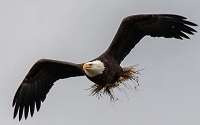 1/6 – Poughkeepsie, HRM 75: Back-casting a week — Ten hikers from the Mid-Hudson Adirondack Mountain Club made our annual New Year’s Day walk around Vassar College. As we walked along the edge of the campus, we noticed a large immature red-tailed hawk several feet away standing between two ancient thick-trunked pines looking about in all directions. The raptor had just swooped down in a sideways glide around the trees as if in hot pursuit. We marveled at the hawk’s size and proximity to us, and we could see that it was eyeing the surroundings. After a short while the red-tail grew bored took off. As we moved closer to the pines, spread-eagled on the trunk of one, flat as a pancake, not moving a muscle, seemingly holding its breath, was a very lucky gray squirrel. (Photo of bald eagle courtesy of Bob Rightmyer) 1/6 – Poughkeepsie, HRM 75: Back-casting a week — Ten hikers from the Mid-Hudson Adirondack Mountain Club made our annual New Year’s Day walk around Vassar College. As we walked along the edge of the campus, we noticed a large immature red-tailed hawk several feet away standing between two ancient thick-trunked pines looking about in all directions. The raptor had just swooped down in a sideways glide around the trees as if in hot pursuit. We marveled at the hawk’s size and proximity to us, and we could see that it was eyeing the surroundings. After a short while the red-tail grew bored took off. As we moved closer to the pines, spread-eagled on the trunk of one, flat as a pancake, not moving a muscle, seemingly holding its breath, was a very lucky gray squirrel. (Photo of bald eagle courtesy of Bob Rightmyer)
- Annette Caruso
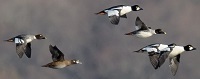 1/6 – Rhinecliff, HRM 89: The female harlequin duck (Histrionicus histrionicus), first reported in the Hudson River off Ulster County on December 30 by Wendy Tocci, was now seen in Dutchess County waters. We spotted the rare duck in the river off Rhinecliff today in the company of no fewer than forty common goldeneye including one hen Barrow’s goldeneye. (Photo of harlequin duck courtesy of Jim Yates) 1/6 – Rhinecliff, HRM 89: The female harlequin duck (Histrionicus histrionicus), first reported in the Hudson River off Ulster County on December 30 by Wendy Tocci, was now seen in Dutchess County waters. We spotted the rare duck in the river off Rhinecliff today in the company of no fewer than forty common goldeneye including one hen Barrow’s goldeneye. (Photo of harlequin duck courtesy of Jim Yates)
- John Askildsen, et al.
[A male harlequin duck is a treat to see, one of the most handsome ducks. In the East, they are normally found in the ocean farther north. In the winter, some are off Long Island and along shores of the Great Lakes, particularly near Niagara Falls preferring fast moving water and rocky shores. Previously, they were rarely found in New York; however, since the 1950s, sightings offshore have increased significantly. This female harlequin is a record for Dutchess County and is the first known sighting on the Hudson River. Stan DeOrsey]
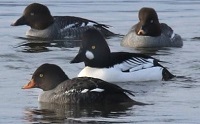 1/6 – Rhinecliff, HRM 89: Concurrent with the above harlequin duck sighting was a female Barrow’s goldeneye. This was only the fifth documented Barrow’s goldeneye for Dutchess County. Normally found in western North America, a small part of the Barrow's goldeneye population nests along the Labrador coast. This population winters along the Atlantic coast south to Massachusetts and on some rivers, including the Saint Lawrence River. The female Barrow's is very similar to the female common goldeneye, making extralimital female sightings infrequent. The Barrow’s goldeneye is considered a casual visitant to the Hudson Valley. (Photo of Barrow's goldeneye courtesy of Justin Schmidt) 1/6 – Rhinecliff, HRM 89: Concurrent with the above harlequin duck sighting was a female Barrow’s goldeneye. This was only the fifth documented Barrow’s goldeneye for Dutchess County. Normally found in western North America, a small part of the Barrow's goldeneye population nests along the Labrador coast. This population winters along the Atlantic coast south to Massachusetts and on some rivers, including the Saint Lawrence River. The female Barrow's is very similar to the female common goldeneye, making extralimital female sightings infrequent. The Barrow’s goldeneye is considered a casual visitant to the Hudson Valley. (Photo of Barrow's goldeneye courtesy of Justin Schmidt)
- Stan DeOrsey
1/6 – Town of Poughkeepsie: There has been a spark of life at bald eagle nest NY62. This is the season for refurbishing their nests and both adult eagles have been bringing grass and sticks to the nest for a week, a recognizable start to their breeding season. This will be year 23 for the female and year seven for the male (the original male was fatally struck by Amtrak on February 24, 2017).
- Bob Rightmyer
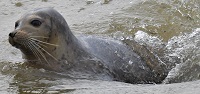 1/7 – Saugerties, HRM 102: The male harbor seal that chose to make Hudson River tidewater its home in the vicinity the Saugerties Lighthouse, appears to have moved on. Lighthouse Keeper Patrick Landewe last saw the seal 84 days ago on October 13 hauled out on a small rock island at low tide just upriver from the lighthouse. That was day number 1,149 , more than three years that the harbor seal, a marine mammal, had chosen to recognize tidewater Esopus Creek and environs as his home base, 110 miles from the sea. This April, harbor seal tagged 246 will be four-years-old. Male Harbor Seals can live to 25 years, so he is still a youngster. (Photo of harbor seal courtesy of KaraLynn Lamb) 1/7 – Saugerties, HRM 102: The male harbor seal that chose to make Hudson River tidewater its home in the vicinity the Saugerties Lighthouse, appears to have moved on. Lighthouse Keeper Patrick Landewe last saw the seal 84 days ago on October 13 hauled out on a small rock island at low tide just upriver from the lighthouse. That was day number 1,149 , more than three years that the harbor seal, a marine mammal, had chosen to recognize tidewater Esopus Creek and environs as his home base, 110 miles from the sea. This April, harbor seal tagged 246 will be four-years-old. Male Harbor Seals can live to 25 years, so he is still a youngster. (Photo of harbor seal courtesy of KaraLynn Lamb)
- Tom Lake
[This harbor seal (Phoca vitulina) was rescued on April 28, 2018, from Lower Goose Island, Harpswell, Maine. The pup had been abandoned by its mother for reasons unknown, although it was suspected the pup may have been a premature birth. Medical rehabilitation followed at the Mystic Aquarium Animal Rescue Program (Connecticut). A satellite tag as well as a white tag on its rear flipper (number 246) was applied before being released at Charlestown, Rhode Island on January 17, 2019.
Once released, the satellite tag imagery revealed that the seal traveled 81 miles up the Connecticut River to the Holyoke Dam, the river’s first impassable barrier. The seal then reversed its course exiting downriver into Fishers Island Sound, across Long Island Sound, to the Peconic Bays before going offshore. The seal traveled down along the south shore of Long Island into the New York Bight and eventually into New York Harbor and the Hudson River estuary.
Heading upstream into freshwater on August 21, 2019, he found a home in Esopus Creek at Saugerties, river mile 102. From then until this past October, he fed on the abundant fish in the creek and the river, taking occasional trips up and downriver.
One such trip occurred in 2021. On June 17, Maxine Montello, Rescue Program Director with the New York Marine Rescue Center, told us she had picked up a male harbor seal with a tag number 246 on Atlantic Beach, Nassau County, Long Island, 140 miles seaward of Saugerties. The seal was getting a lot of unwanted attention from the public, had some superficial scaring on his body, and it was decided that in the best interest of the seal to give him some rehabilitation.
He was transported to the Marine Rescue center in Riverhead, Suffolk County, Long Island. He stayed at the rescue center for two months and was treated for an infection as well as seal pox (a cutaneous skin) condition caused by a Parapoxvirus. On August 14, after being given a second blue tag number 105, he was released at Hampton Bays, Suffolk County. From there he began a 210-mile journey from Hampton Bays to New York Harbor and on upriver to Saugerties, where Lighthouse Keeper Patrick Landewe welcomed him home for another year. Tom Lake]
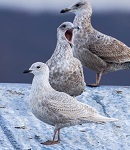 1/7 – Newburgh, HRM 61: Birding at the Newburgh waterfront today, I was able to locate two first winter Iceland gulls. These were Kumlien's gulls (Larus glaucoides kumlieni), a subspecies of the Iceland gull. (Photo of Iceland gull courtesy of Matt Zeitler) 1/7 – Newburgh, HRM 61: Birding at the Newburgh waterfront today, I was able to locate two first winter Iceland gulls. These were Kumlien's gulls (Larus glaucoides kumlieni), a subspecies of the Iceland gull. (Photo of Iceland gull courtesy of Matt Zeitler)
- Matt Zeitler
[The Iceland Kumlien's gull (Larus glaucoides) is a medium-sized gull that breeds in the Arctic regions of Canada and Greenland. They are migratory, wintering in the northernmost states of the eastern U.S. The subspecies is named after the naturalist Ludwig Kumlien (Brewster 1883). When we talk of “white-winged gulls” in the eastern United States, we are referring to Iceland and glaucous gulls.
Curt McDermott]
*** Fish-of-the-Week ***
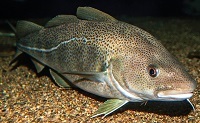 1/9 – Hudson River Watershed: Fish-of-the-Week for Week 202 is the Atlantic cod (Gadus morhua), number 105 (of 237), on our Hudson River Watershed List of Fishes. If you would like a copy of our list, e-mail: trlake7@aol.com 1/9 – Hudson River Watershed: Fish-of-the-Week for Week 202 is the Atlantic cod (Gadus morhua), number 105 (of 237), on our Hudson River Watershed List of Fishes. If you would like a copy of our list, e-mail: trlake7@aol.com
The Atlantic cod is one of three codfishes (Gadidae) documented for our watershed. The others are Atlantic tomcod and pollock. In the northwest Atlantic, cod range from Greenland to North Carolina. In U.S. waters, cod is most common on Georges Bank and in the western Gulf of Maine. Bigelow & Schroeder (Fishes of the Gulf of Maine, 1953) cite the most noticeable external characteristic of the cods is three dorsal and two anal fins. While they are known to reach seven-feet-long and weigh 200 lb., adult cod are most commonly 25-40 lb. They feed on shellfish, squid, and fish, most favorably Atlantic herring.
There are scant records for Atlantic cod in the Hudson River Watershed. The 17th century Dutch spoke of cod in the East River and legendary commercial fisherman Ace Lent reportedly caught cod in the river off Verplanck in the 1960s (Boyle 1969). The head of an Atlantic cod was recovered (minus scattered skeletal bones) on December 3, 1982, at Croton Point (Lake, in C.L. Smith 1990). Extrapolating from the size from the head, the live cod may have been two-feet-long. J.R. Greeley (A Biological Survey of the Lower Hudson Watershed, 1937), found no evidence of Atlantic cod in the estuary. (Photo of Atlantic cod courtesy of NOAA)
- Tom Lake
[Atlantic cod is an iconic fish of New England but in recent times their stocks have declined dramatically. Historically, cod was so abundant off New England that early explorers named Cape Cod for the fish. Gloucester (MA) was established by a colonial charter issued to profit from cod fishing, and a painted “sacred cod” carved from pine has been hung in the Massachusetts State House since 1784 as a symbol of prosperity. Due to high fishing pressure throughout the latter part of the 20th century, there are now fewer fish in the U.S. stocks of Atlantic cod than the average for the past four decades.
The National Oceanic and Atmospheric Administration (NOAA) Fisheries is working to rebuild these stocks. As with all fish populations, the primary source of rebuilding stocks is by recruitment, increasing the number of young fish coming into the population. However, both the George’s Banks and the Gulf of Maine stocks are subject to overfishing. In the last 2-3 decades, recruitment has varied for the Gulf of Maine stock, and has been well below average for the Georges Bank stock. Commercial fishing is still allowed, but at reduced levels. NOAA]
1/10 – Hudson River Valley: The sun rose at 7:19 this morning, one minute earlier than yesterday. This was the first dawn of additional light since June18, when we lost one minute of sunrise.
- National Weather Service
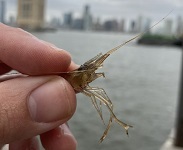 1/11 – Manhattan, HRM 1-2: Our Hudson River Park’s River Project staff checked our research gear (pots and traps) that we deploy at Piers 26 and 40 as part of our fish ecology survey. Our traps and pots at both locations had failed to attract any fish. However, we did find a variety of invertebrates including grass shrimp, sand shrimp, mud crabs, Pacific shore crab, isopods, and a long-clawed hermit crab. The grass shrimp we caught were identified as Palaemon vulgaris (Gosner 1971:526). (Photo of shore shrimp courtesy of Zoe Kim) 1/11 – Manhattan, HRM 1-2: Our Hudson River Park’s River Project staff checked our research gear (pots and traps) that we deploy at Piers 26 and 40 as part of our fish ecology survey. Our traps and pots at both locations had failed to attract any fish. However, we did find a variety of invertebrates including grass shrimp, sand shrimp, mud crabs, Pacific shore crab, isopods, and a long-clawed hermit crab. The grass shrimp we caught were identified as Palaemon vulgaris (Gosner 1971:526). (Photo of shore shrimp courtesy of Zoe Kim)
- Zoe Kim
[“Grass shrimp” is a collective noun (common names) for three species of native caridean or true shrimp commonly found in the salty and brackish waters of the estuary. These include sand shrimp (Crangon septemspinosa) and two species of shore shrimp (Palaemon pugio) and (P. vulgaris). Another, much less common native shrimp in the Hudson River, is the brown shrimp (Penaeus aztecus). We also have an invasive species, the Oriental shrimp (Palaemon macrodactylus), native to estuaries and coastal Pacific Ocean waters of Russia, Japan, and South Korea. The “grass” reference comes from one of their preferred habitats, submerged aquatic vegetation in the estuarine shallows, such as wild celery colloquially referred to as “grass.” Tom Lake]
1/12 – Ulster-Dutchess: The 12th annual Ulster/Dutchess County Christmas Bird Count was held on December 28. Forty-four birders in 18 field parties along with four feeder watchers contributed. Counties included were Hurley, Woodstock, Saugerties, City of Kingston, towns of Rhinebeck and Red Hook, towns of Clermont and Germantown, and the tiniest slice of Greene County near Cementon.
We counted 19,643 individual birds representing 83 species; this bird count has averaged 84 species and 17,500 individuals in its first eleven years. Two new species were added to the composite list now standing at 133 species, including a pair of green-winged teal and a drake redhead duck, part of a diverse waterfowl day where 16 species were identified.
While a female Barrow’s goldeneye put many eyes on the Hudson River and confirmed this great sighting, it led us to an the even better discovery of a female harlequin duck, the first Ulster County record of this species.
- Mark DeDea
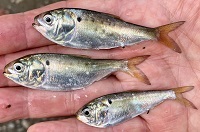 1/13 – Hudson River Estuary: The DEC Region 3 Fisheries Unit conducted a summer-long 2022 young-of-year Striped Bass Beach Seine Surveys in the lower Hudson River estuary. During many of our beach seine operations across 125 miles of estuary — Albany to the Tappan Zee — we captured young-of-year and adult Atlantic menhaden (Brevoortia tyrannus). It was not uncommon to net menhaden by the hundreds, even thousands in a single haul. Thirteen of our hauls exceeded 1,000 fish, one with a high count of 10,273 young-of-year. (Photo of Atlantic menhaden courtesy of Phyllis Lake) 1/13 – Hudson River Estuary: The DEC Region 3 Fisheries Unit conducted a summer-long 2022 young-of-year Striped Bass Beach Seine Surveys in the lower Hudson River estuary. During many of our beach seine operations across 125 miles of estuary — Albany to the Tappan Zee — we captured young-of-year and adult Atlantic menhaden (Brevoortia tyrannus). It was not uncommon to net menhaden by the hundreds, even thousands in a single haul. Thirteen of our hauls exceeded 1,000 fish, one with a high count of 10,273 young-of-year. (Photo of Atlantic menhaden courtesy of Phyllis Lake)
- ElizaBeth Streifeneder
[Adult Atlantic menhaden are known, regionally, by colloquial names such as bunker, mossbunker, and pogies. Their silvery young-of-year, with a yellow-tinged caudal (tail) fin, are known colloquially as peanut bunker or penny bunker.
Young-of-year menhaden are found by the many millions in the estuary in summer as they surge upriver. This may be an adaptation for survival: a small silvery fish in the clear Atlantic has a limited chance of survival as they provide forage for osprey, eagles, seals, whales, and many other predators. Being filter feeders, the estuary may also provide them with a more consistent supply of plankton. Tom Lake]
Winter 2022 Natural History Programs and Events
Women in Science
Please join the DEC’s Hudson River Estuary Program’s free virtual Women in Science series this winter. Meet and learn from scientists, community leaders, and environmental educators who work at the intersection of research, education, and environmental and social justice. Engage in discussions about data literacy, sea level rise and sediment accumulation, wetland restoration, oysters, and field-based research. For information and how to register visit here.
Applied Water Research Webinars
Every year, the New York State Water Resources Institute (NYSWRI) at Cornell supports applied research that addresses critical water resource problems in New York State and the nation. This seminar series highlights collaborative and interdisciplinary work between water resource scientists, educators, and managers to improve water management. Speakers will present on water engineering and infrastructure, climate and flood resilience, and aquatic ecosystems, focusing on ways in which robust science can support on-ground policy outcomes. The series runs from January 26 to March 09 (seven lectures), with a talk every Thursday from 1:00 PM to 2:15 PM, please refer to the attached poster for the speaker line-up, topics, and more information! Register for the online public lectures here.
Hudson River Education
Teachers and students will enjoy our new Hudson River K-12 Unit of Study. This carefully curated group of lesson plans, arranged by topic and/or grade, brings together great learning tools developed by the DEC and dozens of estuary partners.
Hudson River Miles
The Hudson is measured north from Hudson River Mile 0 at the Battery at the southern tip of Manhattan. The George Washington Bridge is at HRM 12, the Tappan Zee 28, Bear Mountain 47, Beacon-Newburgh 62, Mid-Hudson 75, Kingston-Rhinecliff 95, Rip Van Winkle 114, and the Federal Dam at Troy, the head of tidewater, at 153. The tidal section of the Hudson constitutes a bit less than half the total distance – 315 miles – from Lake Tear of the Clouds to the Battery. Entries from points east and west in the watershed reference the corresponding river mile on the mainstem.
To Contribute Your Observations or to Subscribe
The Hudson River Almanac is compiled and edited by Tom Lake and emailed weekly by DEC's Hudson River Estuary Program. Share your observations by e-mailing them to trlake7@aol.com. To subscribe to the Almanac (or to unsubscribe), use the links on DEC's Hudson River Almanac or DEC Delivers web pages.
Useful Links
National Oceanic and Atmospheric Administration online tide and tidal current predictions are invaluable when planning Hudson River field trips. For real-time information on Hudson River tides, weather, and water conditions from sixteen monitoring stations, visit the Hudson River Environmental Conditions Observing System website.
DEC's Smartphone app for iPhone and Android is now available at New York Fishing, Hunting & Wildlife App.
|