The Fishing Line - January 13th Issue
The New York State Department of Environmental Conservation sent this bulletin on 01/13/2023 01:00 PM EST |
| DEC Delivers - Information to keep you connected and informed from the NYS Department of Environmental Conservation |
| Share or view as a web page || Update preferences or unsubscribe |
The Fishing Line - January 13th Issue |
Freshwater Fishing, Fisheries Management, and Fishing Access NewsIn This Issue:
Ice Safety Tips
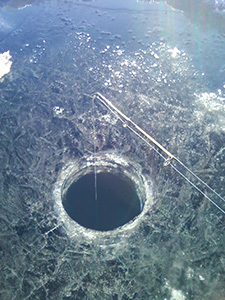
Much of New York is experiencing a milder than usual winter leading to unsafe ice conditions on many waters, please be extra cautious when heading out for a day of fishing. Tips & Guidance:
Getting out there during the hard water season is fun, but definitely not worth risking your life! Angler Survey Opportunity - Lake Erie Walleye Minimum Size
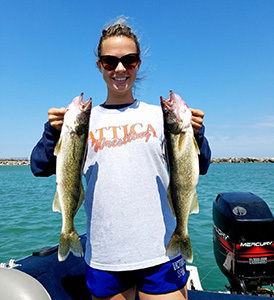
Over the last decade, the Lake Erie walleye population has produced consistently strong hatches resulting in an increase in the number of sub-legal walleye being caught and released by anglers. Survival of these fish is low due to barotrauma (injuries caused from a change in pressure when fish are reeled up from deep water) and results in anglers having to release sub-legal fish that are already dead or not likely to survive. DEC is in the early stages of evaluating potentially lowering the minimum size limit of walleye in Lake Erie from 15 inches to 12 inches. As a first step, we're conducting a survey to better determine angler support for this regulation change consideration. Your input will help inform the decision-making process. Take the Lake Erie Walleye Minimum Size Survey. The survey deadline is January 27, 2023. Lake Champlain Ice Fishing Creel Survey - Year 3
From January through March 2023 DEC Fisheries staff will be surveying anglers coming off the ice to collect data on target species, number caught, and size. Participation in the program is voluntary but strongly encouraged. The 2023 ice fishing survey will take place at four access points: King's Bay (Point Au Fer Road); Willsboro Bay Boat Launch; Bulwagga Bay Campground; and South Bay Boat Launch. Having an understanding of what anglers are catching and targeting will help us continue to best manage the Lake Champlain fishery as one of the top fishing destinations in the state. The 2023 ice fishing survey report will be made available later next year. Lake Champlain Ice Fishing Creel Survey Plan (PDF) Fisheries Staff Spotlight - Richard Zimar, Senior Fish & Wildlife Technician
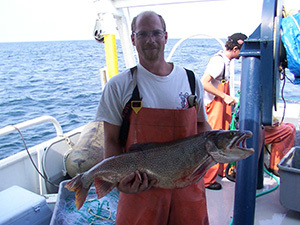
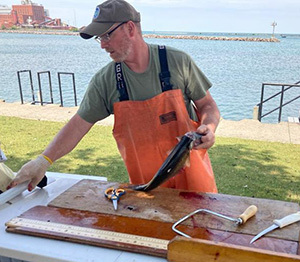
I am a Senior Fish and Wildlife Technician at the DEC Lake Erie Fisheries Research Unit in Dunkirk, NY. My career at DEC has been long and rewarding. After attending college at FLCC in Canandaigua and receiving my Bachelor’s degree from SUNY College of Environmental Science and Forestry in Syracuse, I started my career as a Seasonal Fish and Wildlife Technician with Region 4 as a Fisheries Creel Technician on the East Branch of the Delaware River. My first permanent position was at Randolph State Fish Hatchery as a Fish and Wildlife Technician. In 1990 I transferred from the hatchery to the Lake Erie Research Unit and have been here ever since. I am a native of New York State having grown up in Hammondsport, NY at the southern end of Keuka Lake. During much of my childhood, I could be found outdoors. I was the kid who was in the nearest creek with my brothers flipping stones in search of crayfish or whatever surprising new discovery could be found. In kindergarten, I took a train ride from Hammondsport to the Bath State Fish Hatchery. At that point, I considered being a train engineer until I stepped off the train and took a tour of the hatchery. It made a big impression. As I got older, I learned how to fish and hunt with family and friends. By the time I was a junior in high school, I knew every inch of Cold Brook, the inlet to Keuka Lake. At least, I thought I did. During an ecology course in my junior year of high school, we went on a field trip to assist the DEC Region 8 Fisheries staff with their annual electrofishing survey of the spring run of rainbow trout in Cold Brook. I was amazed by the size and number of adult trout that were captured from places in that stream that many anglers would not consider good places to fish. More impressive to me was my exposure to this group of biologists and technicians who were having a great time doing what they obviously loved to do. From that time on I knew that I wanted a career in fisheries.
In my current position, I work closely with our Research Vessel Captain to fix, maintain and upgrade our fleet of boats including the RV Argo. We keep our gear ready for use for long-term sampling programs for the management of the fisheries of Lake Erie. Working at a research unit has given me the opportunity to help develop new and innovative ways to sample Lake Erie’s fish species. I really enjoy working in support of and in collaboration with the biologists and other staff at my unit. I have worked on SCUBA surveys of nesting bass, radio tracking of bass, and acoustic telemetry tracking of walleye, lake trout, and lake herring. I have done a lot of electrofishing in streams, rivers, and lakes and maintained, modified, and developed equipment for various sampling programs. Our unit is currently studying lake trout natural reproduction in Lake Erie with an emphasis on identifying, manipulating, and creating habitat to enhance it. We are adapting existing technology and developing new ways to sample eggs and larval lake trout in a large lake environment. |
|
The New York State Department of Environmental Conservation respects your right to privacy and welcomes your feedback | Update preferences or unsubscribe | Learn more about DEC Delivers |
|
Connect with DEC:     
|
|
| Basil Seggos, Commissioner | |