A Project of the Hudson River Estuary Program
Compiled and edited by Tom Lake, Consulting Naturalist
Love Our NY Lands
State Lands Belong to All of Us
All New Yorkers and visitors should be able to access, enjoy, and feel welcome on state lands. These lands belong to all of us, our families, and our neighbors. While enjoying these shared spaces, be respectful of other visitors. Share trails, treat people with kindness, and leave things as you found them for others to enjoy. All of us have a responsibility to protect State lands for future generations. For more information, visit DEC's website.
Overview
Happy New Year!
Welcome back from our holiday hiatus. We truly appreciate the continued flow of your natural history stories and photos while we were away. In addition to many wonderful wildlife entries, this was the week of the Winter Solstice as well as Hudson Valley Christmas Bird Counts.
Highlight of the Week
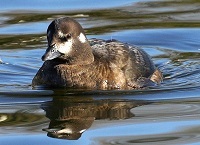 12/30 – Ulster County, HRM 86: From along River Road in the Town of Esopus, Wendy Tocci spotted a female harlequin duck (Histrionicus histrionicus) swimming in the Hudson River. The duck was in with a flock of common goldeneye along with a single female Barrow’s goldeneye. This harlequin duck represented the first documented record for this species in Ulster County. As a winter visitor, away from coastal Long Island or the Niagara River, it is an excellent sighting anywhere in New York. (Photo of harlequin duck courtesy of Chris Young) 12/30 – Ulster County, HRM 86: From along River Road in the Town of Esopus, Wendy Tocci spotted a female harlequin duck (Histrionicus histrionicus) swimming in the Hudson River. The duck was in with a flock of common goldeneye along with a single female Barrow’s goldeneye. This harlequin duck represented the first documented record for this species in Ulster County. As a winter visitor, away from coastal Long Island or the Niagara River, it is an excellent sighting anywhere in New York. (Photo of harlequin duck courtesy of Chris Young)
- Mark DeDea
[The harlequin is a small, boldly patterned diving duck. Males are striking and unmistakable. Roger Tory Peterson (1934) calls them “Dark and bizarre.” Their species name (Histrionicus histrionicus) reflects the riotous colors of the drake, from the Latin histrio, suggesting a colorfully dressed-up actor like a performer at Mardi Gras. Females are dark brown with small white patches on their face; they are much like female scoters but note their smaller size and the smaller bill of the harlequin. They gather in small flocks on rocky coastlines in winter feeding on fish and aquatic invertebrates. In eastern North America, harlequin ducks are regularly seen at sea from the north shore of Long Island and occasionally around the Great Lakes. Stan DeOrsey, Mark DeDea, Tom Lake]
Natural History Entries
12/17 – Schenectady County, HRM 157: Our 92nd annual Schenectady Christmas Bird Count was held today with a final tally of 57 species. Notable sightings included snow goose, ring-necked duck, common goldeneye, hooded merganser, red-throated loon, common loon, double-crested cormorant, American kestrel. Expected, but missed, species were northern harrier, hermit thrush, and snow bunting. On the other hand, common ravens seemed to be everywhere, with double digit numbers for the first time.
- Larry Alden
[The Christmas Bird Count (CBC) was inaugurated on Christmas day in 1900 by Frank Chapman of the National Audubon Society. The purpose of this annual census, now enjoyed by over 50,000 participants throughout the western hemisphere each year, is to gather data that can be used to identify bird population trends from year to year, which in turn can help scientists understand environmental impacts of weather, habitat loss, industrialization, human expansion, and other factors.
For the Christmas Bird Count, the Americas are divided into circles that are 15 miles in diameter. Within each circle, a team of volunteers spends an entire day (in the second half of December or in early January) counting all bird species and individuals within each species. The results are compiled at the end of the day for each circle, and then sent to the National Audubon Society for inclusion in the complete records. Richard Guthrie]
12/17 – Ulster County: We held our 73rd annual Ulster County Mohonk Lake-Ashokan Reservoir Audubon Christmas Bird Count today. Twenty field parties with 56 participants counted 11,798 individual birds representing 72 species. For historical context, diversity was eight species below our ten-year average (80), and total abundance was down 2,846 individuals (14,644 ten-year average). Our record high count for this circle remains at 87 species and 22,307 individuals, both recorded in 2017.
Ten species were detected in sufficient numbers to tie or establish new record-high counts, including gadwall 17 (16 in 2016), ring-necked duck 62 (28 in 2014), bald eagle 24 (18 in 2015), red-shouldered hawk 14 (9 in 2017), red-tailed hawk 94 (84 in 2018) , barred owl 9 (ties 9 in 2018), belted kingfisher 12 (11 in 2020), tufted titmouse 554 (419 in 2015), winter wren 16 (12 in 2017), Carolina wren 129 (ties 121 in 2018), and eastern bluebird 205 (195 in 2014)
- Steve M. Chorvas
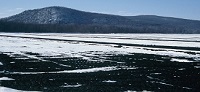 12/17 – Orange County, HRM 40: Across the eight miles from Florida to Pine Island we counted eleven red-tailed hawk, in the air, stooping on prey, or perched on poles and wires. We were sure we missed several. That short drive through the heart of the Black Dirt region of Orange County is especially striking in a snowy winter. The highly organic black dirt, as black as night, capped with pure white snow, always reminds me of an Oreo cookie with the lid off. On a cold day made even colder by a strong north wind, two black vultures, mimicking cormorants, were perched with their wings fully outstretched, facing the sun, gathering warmth, in a “Dracula” pose. (Photo of black dirt courtesy of Tom Lake) 12/17 – Orange County, HRM 40: Across the eight miles from Florida to Pine Island we counted eleven red-tailed hawk, in the air, stooping on prey, or perched on poles and wires. We were sure we missed several. That short drive through the heart of the Black Dirt region of Orange County is especially striking in a snowy winter. The highly organic black dirt, as black as night, capped with pure white snow, always reminds me of an Oreo cookie with the lid off. On a cold day made even colder by a strong north wind, two black vultures, mimicking cormorants, were perched with their wings fully outstretched, facing the sun, gathering warmth, in a “Dracula” pose. (Photo of black dirt courtesy of Tom Lake)
- Tom Lake
[“Black Dirt” is an area of southwest Orange County between Florida and Pine Island. The region is an important agricultural area growing farm produce such as onions, potatoes, lettuce, radishes, cabbage, carrots, corn, pumpkin, and squash in the rich black soil. The Black Dirt topsoil is immensely organic, essentially a compost heap, originating from the decaying flora and fauna of a 10,000-year-old late Pleistocene lake and swampland. Tom Lake]
 12/18 – Manhattan, New York City: Our Randall's Island Park Alliance Staff conducted our Christmas Bird Count today, with assistance from New York City Audubon's Rosyln Rivas. 12/18 – Manhattan, New York City: Our Randall's Island Park Alliance Staff conducted our Christmas Bird Count today, with assistance from New York City Audubon's Rosyln Rivas.
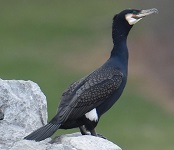
We saw a total of 1,412 birds of 38 species. Some were exciting, such as common raven, while a few of our regular species, like loons and mergansers, failed to show. Wintering brant (57) had a disappointingly low number compared to previous years. Other waterfowl and waders included Canada geese (505), gadwall (17), bufflehead (2), mallard (36), double-crested cormorant (36), great cormorant (1) and one great blue heron. Raptors were few with three red-tailed hawks, a Cooper’s hawk, and one bald eagle. (Photo of great cormorant courtesy of Mike Kalin)
- Jackie Wu
12/19 – Town of Wappinger, HRM 67: [Look back to this date in 2008] In the midst of a bitter cold whiteout, the female from bald eagle nest NY62 was perched alongside her nest facing a brutally cold northwest wind. The windchill was near zero degrees Fahrenheit (F). Such resiliency. I was wearing a hooded parka rated good to thirty-below. Mama eagle had her feathers and eons of evolutionary adaptations to the cold. When the snow stopped, there would be a foot of snow piled up against her tall tulip tree.
- Tom Lake
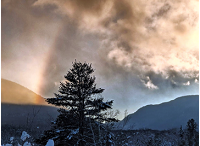 12/20 – Greene County: While driving through the Catskill Mountains at sunset today, the starkly winter cold air created two natural phenomena in the sky: a snowbow as well as a solar light pillar, created as the sunlight reflected off the surface of millions of falling ice crystals associated with thin, high-level clouds. (Photo of winter snowbow courtesy of Arlo Meier) 12/20 – Greene County: While driving through the Catskill Mountains at sunset today, the starkly winter cold air created two natural phenomena in the sky: a snowbow as well as a solar light pillar, created as the sunlight reflected off the surface of millions of falling ice crystals associated with thin, high-level clouds. (Photo of winter snowbow courtesy of Arlo Meier)
- Arlo Meier
12/20 – Hook Mountain, HRM 31: Among the five south-migrating raptors we counted today at the Hook Mountain Hawkwatch, red-tailed hawk with high count with four. The other migrant was an immature bald eagle. At least three non-migrating bald eagles were also spotted. Non-raptors migrants included no fewer than 300 Canada geese in smallish skeins passing high and headed southwest, two common ravens, and two turkey vultures.
- Tom Fiore
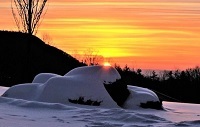 12/21 – Hudson River Watershed: The Winter Solstice arrived at 4:48 pm today. Sunset last night was 4:31; sunrise today on the Solstice was 7:16, giving us 14 hours and 45 minutes of night. Sunset today was one minute later at 4:32, giving us 9 hours and 16 minutes of daylight — long night, short day, aptly named by the Mohican people as the month of the Long Night. (Photo of winter solstice courtesy of Mario Meier) 12/21 – Hudson River Watershed: The Winter Solstice arrived at 4:48 pm today. Sunset last night was 4:31; sunrise today on the Solstice was 7:16, giving us 14 hours and 45 minutes of night. Sunset today was one minute later at 4:32, giving us 9 hours and 16 minutes of daylight — long night, short day, aptly named by the Mohican people as the month of the Long Night. (Photo of winter solstice courtesy of Mario Meier)
- Tom Lake
[The Winter Solstice is the astronomical moment when the path of the sun in the sky is angled farthest south (23.5 degrees south latitude) relative to the Northern Hemisphere. The Winter Solstice marks the beginning of slowly lengthening days and shortening nights. Tom Lake]
12/21 – Greene County: While astronomically, the moment of the Solstice arrival was this afternoon, ancient cultures celebrated the sunrise as the moment light begins its return. Stonehenge and many ancient structures were built with the Winter Solstice sunrise alignments integral to their designs.
At predawn, the slightest sickle of a new moon showed, and the glowing red sky indicated where the sun would rise. At Elka Park, we had a sight-line out to the southeast of 40 miles over the Hudson Valley with a view all the way to the Taconic ridges. With this amazing vista, the sun rose precisely at 7:16. The axis of the earth would now, in the Northern Hemisphere, begin tilting back toward the sun and by mid-January the days would be seconds to minutes longer per day; we will notice brighter mornings at first and then brighter evenings. For indigenous Americans, this day also marked a turning point of the seasons. Although intense winter months were ahead, there was hope as the life-giving sunlight began its return.
- Mario Meier
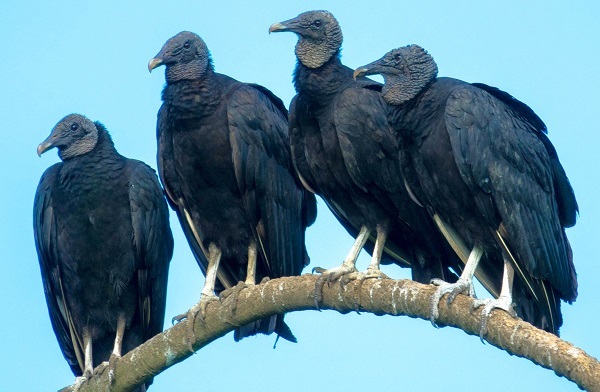
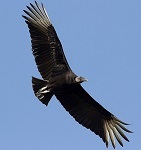 12/21 – Town of Wappinger, HRM 68: It was sunny early morning, the air temperature was in the mid-20s Fahrenheit, and last thing we figured we see was a half dozen black vultures (Coragyps atratus) laboriously climbing very weak thermals to get aloft. Vultures are known to be late risers from their night roost in cold weather, usually content to wait until the sun warms the air and creates adequate thermals. These vultures were flapping furiously, expending much more effort than they’d prefer. Once aloft, vultures tend to soar in circles on teetering wings, often forming kettles, with a birds’ eye view below for foraging and scavenging prospects. (Photo of black vulture courtesy of Anne Brokelman) 12/21 – Town of Wappinger, HRM 68: It was sunny early morning, the air temperature was in the mid-20s Fahrenheit, and last thing we figured we see was a half dozen black vultures (Coragyps atratus) laboriously climbing very weak thermals to get aloft. Vultures are known to be late risers from their night roost in cold weather, usually content to wait until the sun warms the air and creates adequate thermals. These vultures were flapping furiously, expending much more effort than they’d prefer. Once aloft, vultures tend to soar in circles on teetering wings, often forming kettles, with a birds’ eye view below for foraging and scavenging prospects. (Photo of black vulture courtesy of Anne Brokelman)
- Tom Lake, T.R. Jackson
[“Kettle” is a birding term that describes an aggregation of birds, usually raptors or vultures, often circling overhead in warm, rising thermals. It is the circular movement of the group that appears like a cauldron of birds being “stirred” by the wind, thus a kettle. While kettles can occur almost any time of the year, they are particularly common during fall migration. Tom Lake]
12/21 -- Manhattan, HRM 1-2: Hudson River Park’s River Project staff checked our research gear (pots and traps) that we deploy at Piers 26 and 40 as part of our fish ecology survey. Our gear at Pier 26 was empty, not surprising as winter arrives. At Pier 40, a crab pot caught a female blue crab (100 mm). Today was the last day of the season for our seventh-month seasonals, and their last trap checking. Thank you, Gabby Belaya, Jack Kranes, Maddy Molina, and Sally Rodgers for all their work this year.
- Zoe Kim
[The standard research measurement for blue crabs is millimeters (mm) point-to-point, laterally, across their carapace.]
*** Fish-of-the-Week ***
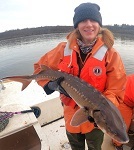 12/22 – Hudson River Watershed: Fish-of-the-Week for Week 201 is the shortnose sturgeon (Acipenser brevirostrum), number 12 (of 237), on our Hudson River Watershed List of Fishes. If you would like a copy of our list, e-mail: trlake7@aol.com 12/22 – Hudson River Watershed: Fish-of-the-Week for Week 201 is the shortnose sturgeon (Acipenser brevirostrum), number 12 (of 237), on our Hudson River Watershed List of Fishes. If you would like a copy of our list, e-mail: trlake7@aol.com
Sturgeon, including the shortnose, are long-lived fishes. They are the stuff of myth and legend. In terms of evolution, they are a very ancient class of cartilaginous (non-bony) fishes whose ancestry can be traced back several hundred million years. Many estuaries from the Saint John’s River in Nova Scotia to the Saint John’s River in Florida have distinct shortnose sturgeon populations, most of which have been in decline for a century or more from over-harvesting. However, many fisheries experts rate the Hudson River shortnose sturgeon population as the most stable.
While Hudson River Atlantic sturgeon are known to reach 14-feet-long, adult shortnose sturgeon, on average, are much smaller usually less than four-feet-long and averaging 15 lb. They feed primarily on benthic crustaceans, insects, and mollusks. Female shortnose can live to 67 years. As with other sturgeon, shortnose eggs have been historically harvested as caviar. While there is archaeological evidence that indigenous peoples in the northeast captured sturgeon for sustenance, considerable research has failed to indicate that the three species were harvested in any order other than random availability. (Photo of shortnose sturgeon courtesy of Chris Bowser)
- Tom Lake
 [We have three species of sturgeon documented for the Hudson River watershed: Lake sturgeon (Acipenser fulvescens), Atlantic sturgeon (A. oxyrinchus), and the shortnose (A. brevirorostrum). The latter two are federally endangered species primarily found in Hudson River tidewater. Each of the three have unique life histories: lake sturgeon is generally a freshwater species found in lakes Champlain and Ontario and in the Mohawk River; shortnose sturgeon is considered an estuarine species in that they spend most of their lives in the brackish and freshwater reaches of the estuary where they spawn, they can, however, enter marine waters; Atlantic sturgeon is anadromous, spending most of its life in marine waters, but returning to the freshwater reach of the estuary to spawn. Tom Lake] (Photo of Atlantic sturgeon courtesy of Len Tantillo) [We have three species of sturgeon documented for the Hudson River watershed: Lake sturgeon (Acipenser fulvescens), Atlantic sturgeon (A. oxyrinchus), and the shortnose (A. brevirorostrum). The latter two are federally endangered species primarily found in Hudson River tidewater. Each of the three have unique life histories: lake sturgeon is generally a freshwater species found in lakes Champlain and Ontario and in the Mohawk River; shortnose sturgeon is considered an estuarine species in that they spend most of their lives in the brackish and freshwater reaches of the estuary where they spawn, they can, however, enter marine waters; Atlantic sturgeon is anadromous, spending most of its life in marine waters, but returning to the freshwater reach of the estuary to spawn. Tom Lake] (Photo of Atlantic sturgeon courtesy of Len Tantillo)
12/23 – Washington County, HRM 209: We had a productive late afternoon birding in the Washington County grasslands. Notable sightings included a snowy owl, short-eared owl, American kestrel, red-tailed hawk, sharp-shinned hawk, and several flocks of snow buntings.
- Yana Levchinsky-Grimmond (Hudson-Mohawk Bird Club)
 12/24 – Town of Wappinger, HRM 67: We spotted two immature bald eagles on the tidewater Wappinger Creek in midday. One was perched creek-side while the other took sorties over the water finally diving at a fish but coming up empty. They were no more than a few hundred feet from bald eagle nest NY459, which may have just been a coincidence. 12/24 – Town of Wappinger, HRM 67: We spotted two immature bald eagles on the tidewater Wappinger Creek in midday. One was perched creek-side while the other took sorties over the water finally diving at a fish but coming up empty. They were no more than a few hundred feet from bald eagle nest NY459, which may have just been a coincidence.
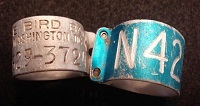
The adult pair from NY459 have been in the area doing nest refurbishing prior to the 2023 breeding season. In their first four seasons, 2019-2022, the adult pair have had eight nestlings. The two immature eagles hanging around near to the nest conjures up a question we get each winter: Are these immatures the fledglings from 2022 coming back to where memory offers them an easy meal? Or are they just wintering birds from points north? Prior to 2010, DEC banded young eagles in their nest, providing some tracking for future identification of immatures. (Photo of bald eagle bands courtesy of Tom Lake)
- Tom Lake, T.R. Jackson
12/25 – Town of Poughkeepsie: It was Christmas Day, the morning following the third night of deep-freeze — the air was 12 degrees Fahrenheit at first light. Overnights like these always make me wonder how wildlife copes with weather extremes. The adult pair at bald eagle nest NY62 were perched on either side of their nest tree, a tall, lightning scared, but still grand tulip tree. The adults’ presence had been scarce all summer and fall, but now they were back, likely biding time until the start of their breeding season next month.
- Tom Lake
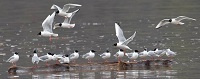 12/26 – Orange County, HRM 59: It was the season to look back on notable 2022 sightings and their accompanying photographs. One of those was April 23, when no fewer than twenty Bonaparte’s gulls assembled on a deadfall in the shallows off Plum Point at New Windsor. (Photo of Bonaparte's gulls courtesy of Matt Zeitler) 12/26 – Orange County, HRM 59: It was the season to look back on notable 2022 sightings and their accompanying photographs. One of those was April 23, when no fewer than twenty Bonaparte’s gulls assembled on a deadfall in the shallows off Plum Point at New Windsor. (Photo of Bonaparte's gulls courtesy of Matt Zeitler)
- Matt Zeitler
12/27 – Saratoga Lake, HRM 182: I visited a cove at Saratoga Lake today that is somewhat adjacent to the Isaac Jogues Chapel. There were at least 1,200 total waterfowl on the water representing at least eleven species of ducks and Canada Geese. Among the notables were two pairs of canvasbacks, at least six drake redhead ducks, two black scoters, and large numbers of scaup, particularly lesser scaup. The energy of the waterfowl was amazing as they fed and interacted. Cold temperatures will freeze the lake over sooner than I would like, but in the meantime, I will not grow tired of watching them.
- Ron Harrower
12/28 – Rensselaer County: We held our 55th annual Southern Rensselaer County Christmas Bird Count on Christmas Eve. Seventeen participants faced bitter cold that began in single digits and then crawled to mid-teens (F) by afternoon.
The previous day had seen heavy rain then a flash-freeze, leaving some secondary roads ice-covered. Lakes and some streams had completely frozen over in recent days, sending most waterfowl off and leaving just a few in open patches. Diversity was down from other years. Big misses included black vultures, that seemed to have abandoned their habitual winter roost at Hudson Valley Community College, as well as a total lack of falcons. The winter finch irruption had not reached us. We ended up with 53 species, a 10-year (possibly longer) low.
- Naomi Lloyd
12/29 – Sandy Hook, NJ: [Look back to this date in 2009] We were bracing against 50 knot northeast winds [57 mph, “strong gale”] that had Raritan Bay looking like a scene from “Victory at Sea” in the North Atlantic. Many great black-backed, herring and ring-billed gulls, as well as a raft of red-breasted mergansers were actively feeding in the wash created as the waves continually pounded the bay-side rip-rap at Fort Hancock. For the life of me, I could not get a look at what they were so actively feeding on. Legendary naturalist Dery Bennett and I had talked many times about this gull behavior. Thirty or so brant had taken up their usual winter residence in the salt pond at the base of the Hook, and greater scaup were beginning to congregate in earnest in Spermaceti Cove, all normal for this time of year.
- Jeff Dement
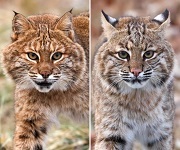 12/30 – Orange County: I was driving to a local birding area in Orange County today and as I rounded a corner there were two bobcats in the middle of the road. I was speechless. I parked my car and was hoping to get a few photos of the beautiful animals. Little did I know that they would happily oblige and trot right towards me, with one coming to within ten feet. It was a truly wonderful sight and a great memory that will stay with me for the rest of my life. (Photo of bobcats courtesy of Kyle Knapp) 12/30 – Orange County: I was driving to a local birding area in Orange County today and as I rounded a corner there were two bobcats in the middle of the road. I was speechless. I parked my car and was hoping to get a few photos of the beautiful animals. Little did I know that they would happily oblige and trot right towards me, with one coming to within ten feet. It was a truly wonderful sight and a great memory that will stay with me for the rest of my life. (Photo of bobcats courtesy of Kyle Knapp)
- Kyle Knapp
[Seven bobcats were seen locally in just the last few days. In addition to this pair, four were photographed on a frozen pond in Rensselaer County and one more at Pound Ridge in Westchester County. All were seen in daylight despite their tendency to be more ephemeral, ghostly shadows darting across the road at dawn or dusk or appearing in headlights in the dark of night. They are seen so uncommonly that when sighted, observers unfamiliar with bobcats sometims believe they are seeing a mountain lion. Tom Lake]
12/31 – Troy, HRM 153: Our field parties found 64 bird species during our Troy Christmas Bird Count, well below the average of the previous ten years. Notable sightings included snow goose, northern pintail, green-winged teal, ruddy duck, horned grebe, great blue heron, Iceland gull, black vulture, barred owl, eastern screech-owl, and American kestrel. High counts went to European starling (7,617), Canada goose (2,466), and American crow (2,249).
- Larry Alden (Hudson-Mohawk Bird Club)
12/31 – Kingston, HRM 92: The female harlequin duck, first sighted yesterday, was now in the river off Kingston Point Beach in early afternoon with five common goldeneye and one canvasback duck.
- Carena Pooth (Ralph T. Waterman Bird Club)
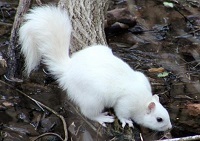 1/1 – Town of Poughkeepsie: I was out hiking today when I came upon a pure white squirrel on the trail. From what I can tell, this gray squirrel apparently hangs out in the area. Despite the lack of pink eyes, often associated with albinism, this one was certainly an albino. Not all mammals with albinism have pink or red eyes. (Photo of gray squirrel courtesy of Maris Kristapsons) 1/1 – Town of Poughkeepsie: I was out hiking today when I came upon a pure white squirrel on the trail. From what I can tell, this gray squirrel apparently hangs out in the area. Despite the lack of pink eyes, often associated with albinism, this one was certainly an albino. Not all mammals with albinism have pink or red eyes. (Photo of gray squirrel courtesy of Maris Kristapsons)
- Maris Kristapsons
[On occasion, the exact location of an entry is intentionally left vague. Usually, it is done to protect the sensitivity of the subject from the all-to-often unbridled zeal of collectors. Among the most common examples are rattlesnake dens, vulnerable nests, especially of bald eagles, osprey and shorebirds, fields of prickly pear, stands of orchids, choice mushrooms (foragers would rather give you their car keys than disclose a location where prime mushrooms were appearing), archaeological investigations, and a rare albino gray squirrel. Tom Lake]
 1/2 – Manhattan, HRM 1-2: Hudson River Park’s River Project staff checked our research gear (pots and traps) that we deploy at Piers 26 and 40 as part of our fish ecology survey. We kicked off the new year with a quiet day at Pier 40 — our traps and pots were empty of fish — but we saw some familiar invertebrates including grass shrimp, blue mussels, sea squirts, and sponges. The sea squirts (Ascidiacea, a class of marine invertebrate filter feeders) were somewhat unexpected at this time of year, but it is possible that some of our traps were high enough in the water column to make phytoplankton levels worth the sea squirts’ presence. 1/2 – Manhattan, HRM 1-2: Hudson River Park’s River Project staff checked our research gear (pots and traps) that we deploy at Piers 26 and 40 as part of our fish ecology survey. We kicked off the new year with a quiet day at Pier 40 — our traps and pots were empty of fish — but we saw some familiar invertebrates including grass shrimp, blue mussels, sea squirts, and sponges. The sea squirts (Ascidiacea, a class of marine invertebrate filter feeders) were somewhat unexpected at this time of year, but it is possible that some of our traps were high enough in the water column to make phytoplankton levels worth the sea squirts’ presence.
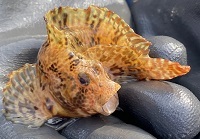
We had an exciting find at Pier 26, a beautifully patterned 110-millimeter feather blenny (Hypsoblennius hentz), a seasonally resident marine species. This fish was much larger than we typically see and exceeded the maximum size of 100 mm listed in most literature. Pier 26 traps also caught invertebrate species such as grass shrimp, sand shrimp, mud crabs, and a hermit crab. (Photo of feather blenny courtesy of Zoe Kim)
- Zoe Kim
[Note: One-inch equals 25.4 millimeters (mm)].
1/4 – Town of Warwick, HRM 41: Morning dense fog shrouded the 335-acre Liberty Marsh, part of the U.S. Fish and Wildlife Service’s Wallkill River National Wildlife Refuge Complex, adjacent to and near the headwaters of the Wallkill River. Waterfowl at any distance were just dark shapes. I watched two female northern harriers flying, dipping, swaying, teetering, then hovering over hummocks — always listening for prey — showing off their incredible aerial dexterity. First one, then the other, would appear rising out of the swales, making slow glides over the marsh, and then dissolve back in the gloom, their white rumps glowing in the diffuse light. Altogether, it seemed like a scene from Brigadoon (1954).
- Tom Lake
1/4 – Town of Wawayanda, HRM 47: While the mile-long string of cornfields along Pierce Circle were empty of geese, they were not empty of all migrants. Acre after acre of blackbirds, including common grackles, red-winged blackbirds, European starlings, and brown-headed cowbirds, nervously hop-scotched over the corn stubbles. As the morning fog dissipated, six high-flyer Vs of Canada geese passed over. The huge contingents of snow geese, thousands of birds, were still biding their time to the north, waiting for the heavy hand of winter to urge them south.
- Tom Lake
1/4 – Manhattan, New York City: The air temperature reached 66 degrees F today, tying the record high for the date.
- National Weather Service
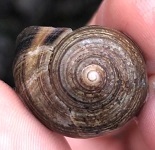 1/4 – Manhattan, New York City: We came upon four red-breasted mergansers out on the Harlem River between Randall's Island and Mill Rock, taking turns diving. Later, we found a lovely common periwinkle (Littorina littorea) along the rocky shoreline of the East River. (Photo of common periwinkle courtesy of Jackie Wu) 1/4 – Manhattan, New York City: We came upon four red-breasted mergansers out on the Harlem River between Randall's Island and Mill Rock, taking turns diving. Later, we found a lovely common periwinkle (Littorina littorea) along the rocky shoreline of the East River. (Photo of common periwinkle courtesy of Jackie Wu)
- Jackie Wu
1/5 – Gardiner, HRM 73: I witnessed the most magnificent sight and accompanying sound today. Thousands of blackbirds, including grackles, starlings, brown-headed cowbirds, and red-winged blackbirds, were flying over my house, landing in trees, before moving on. There must have been more than 10,000 birds. The calls were deafening! We have seen them flock up in late-fall, but today’s sight darkened the sky.
- Rebecca Houser
1/6 – Hudson River Watershed: Among indigenous peoples, full moons have long been labeled with fanciful names that are rooted in oral traditions, indigenous memories, and ethnographic accounts. Among Mohican people, whose ancestral homeland lies wholly within the Hudson River watershed, the January full moon is known as the Cracking Tree Moon, Pathe'naawe mtok keesoox/neepã'ak. The “Cracking Tree” refers particularly to apple, maple, and willows.
On a cold, dark, winter night, when we are indoors away from the freezing air, we may hear a loud CRACK! This sound is caused by frost cracks in trees. When air temperatures drop below zero, trees will make all kinds of popping and cracking noises, especially if the temperature drops very quickly. A frost cracks occurs when sap inside the tree freezes, causing it to expand in volume. Frost cracks most often occur after very cold, sunny days.
- Larry Madden, Stockbridge-Munsee Band of Mohican Indians
[Tribal translations of full moons pre-date colonization and generally reflect the seasonality of the lunar phase. Moon phases, in fact, were used by indigenous people as measurements of time. Tom Lake]
Winter 2022 Natural History Programs and Events
Women in Science
Please join the DEC’s Hudson River Estuary Program’s free virtual Women in Science series this winter. Meet and learn from scientists, community leaders, and environmental educators who work at the intersection of research, education, and environmental and social justice. Engage in discussions about data literacy, sea level rise and sediment accumulation, wetland restoration, oysters, and field-based research. For information and how to register visit here.
Hudson River Education
Teachers and students will enjoy our new Hudson River K-12 Unit of Study. This carefully curated group of lesson plans, arranged by topic and/or grade, brings together great learning tools developed by the DEC and dozens of estuary partners.
Hudson River Miles
The Hudson is measured north from Hudson River Mile 0 at the Battery at the southern tip of Manhattan. The George Washington Bridge is at HRM 12, the Tappan Zee 28, Bear Mountain 47, Beacon-Newburgh 62, Mid-Hudson 75, Kingston-Rhinecliff 95, Rip Van Winkle 114, and the Federal Dam at Troy, the head of tidewater, at 153. The tidal section of the Hudson constitutes a bit less than half the total distance – 315 miles – from Lake Tear of the Clouds to the Battery. Entries from points east and west in the watershed reference the corresponding river mile on the mainstem.
To Contribute Your Observations or to Subscribe
The Hudson River Almanac is compiled and edited by Tom Lake and emailed weekly by DEC's Hudson River Estuary Program. Share your observations by e-mailing them to trlake7@aol.com. To subscribe to the Almanac (or to unsubscribe), use the links on DEC's Hudson River Almanac or DEC Delivers web pages.
Useful Links
National Oceanic and Atmospheric Administration online tide and tidal current predictions are invaluable when planning Hudson River field trips. For real-time information on Hudson River tides, weather, and water conditions from sixteen monitoring stations, visit the Hudson River Environmental Conditions Observing System website.
DEC's Smartphone app for iPhone and Android is now available at New York Fishing, Hunting & Wildlife App.
|