A Project of the Hudson River Estuary Program
Compiled and edited by Tom Lake, Consulting Naturalist
Love Our NY Lands
State Lands Belong to All of Us
All New Yorkers and visitors should be able to access, enjoy, and feel welcome on state lands. These lands belong to all of us, our families, and our neighbors. While enjoying these shared spaces, be respectful of other visitors. Share trails, treat people with kindness, and leave things as you found them for others to enjoy. All of us have a responsibility to protect State lands for future generations. For more information, visit DEC's website.
Overview
Following the release of this weekly Almanac, we will be taking a two-week Holiday Hiatus. However, our Hudson River Almanac team is working every day of the year, so we will continue compiling stories and photos. We send our thanks for the incredible support we received in 2022, as well as our best wishes for a Happy Holiday season.
Highlight of the Week
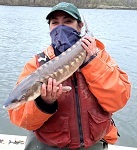 12/13 – Hudson River Tidewater: In the spring of 2021, and then again in 2022, academic, federal, and state research scientists embarked on a large-scale project to provide an updated estimate for the Hudson River’s shortnose sturgeon (Acipenser brevirorostrum) population, a federally endangered species. Our technology includes acoustic telemetry and side-scan sonar. Acoustic telemetry uses stationary receivers to detect signals emitted from tagged marine species such as sturgeon. The side-scan sonar uses sound to create an image of the river bottom and objects in the water column, an accurate protocol for counting fish. 12/13 – Hudson River Tidewater: In the spring of 2021, and then again in 2022, academic, federal, and state research scientists embarked on a large-scale project to provide an updated estimate for the Hudson River’s shortnose sturgeon (Acipenser brevirorostrum) population, a federally endangered species. Our technology includes acoustic telemetry and side-scan sonar. Acoustic telemetry uses stationary receivers to detect signals emitted from tagged marine species such as sturgeon. The side-scan sonar uses sound to create an image of the river bottom and objects in the water column, an accurate protocol for counting fish.
One aspect of the project focuses on shortnose sturgeon wintering locations. Because shortnose are far more gregarious in winter, we take advantage of a time when the sturgeon congregate in large numbers. We survey for shortnose in a shallow reach of the Hudson between Ulster and Dutchess counties. Our winter survey continues as long as the river remains ice-free.
During the side-scanning surveys of the sturgeon’s wintering area, we also use gill nets to capture fish allowing us to both ground truth the species that we are seeing on the side-scan imagery, and that they are using the area we are surveying. Thus far, we have caught only shortnose sturgeon in these wintering locations during our surveys.
In spring 2022, we tagged 100 shortnose sturgeon in their spawning reach near Albany; this is another occasion when large numbers come together. Later, post-tagging, these fish are detected on a river-wide array of acoustic receivers as the fish move throughout the estuary. There is also a small array near their wintering area. The receivers store the unique tag number, and the date and time that a fish swims past a receiver (not unlike like E-Z Pass for sturgeon). All data are used to mathematically estimate population numbers in wintering areas as well as the overall Hudson River tidewater.
In mid-October of fall 2022, the acoustic receivers heard just one or two pings from tagged fish. However, by the end of November we had heard from 17 tagged fish. Our assessment was that the sturgeon had settled in their wintering area. Last year we had a high count of 19 fish during a one-day survey. (Photo of shortnose sturgeon courtesy of Amanda Higgs)
- Amanda Higgs, Hudson River Fisheries Unit.
[We have three species of sturgeon documented for the Hudson River watershed: Lake sturgeon (Acipenser fulvescens), Atlantic sturgeon (A. oxyrinchus), and the shortnose (A. brevirorostrum). The latter two are federally endangered species.
The history of shortnose sturgeon harvesting began with indigenous fishermen catching both shortnose and Atlantic sturgeon for their meat and eggs (roe) as long ago as 7,000 years. However, there is no evidence that their catches exceeded sustainable levels.
The history of shortnose sturgeon exploitation extends back to the 17th century with the Jamestown settlers (1607) who utilized sturgeon as a primary food source for survival. Profitable fishery business using shortnose sturgeon began to grow in the 1800s leading to a rapid decline of the species population and distribution. By the late-1800s, all sturgeon were being over-exploited. In 1890, over seven million pounds of sturgeon were harvested in one year and, as a result, in 1920 only 23,000 pounds of sturgeon were caught. The shortnose sturgeon is presently in danger of extinction throughout its range and was listed as endangered under the Endangered Species Act on March 11, 1967. Shortnose sturgeon are protected in accordance with Section 1(c) of the Endangered Species Preservation Act of October 15, 1966 (80 Stat. 926: 16 U.S.C. 668aa(c)) after consulting the States, interested organizations and individual scientists, and finding that it was threatened with extinction. The IUCN has listed the shortnose sturgeon as a vulnerable species in 2004 with increasing action plans needed.[8] NatureServe similarly lists the species as Vulnerable. NOAA (2010), NMFS (2020)]
Natural History Entries
12/10 – Hudson River Watershed: The sun set at 4:29 this evening, one minute later than yesterday. This was the first day of additional evening light since July 4, when we lost one minute of sunset.
- National Weather Service
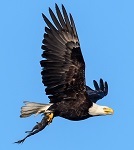 12/10 – Ulster County, HRM 85: I stopped by Sturgeon Pool on the Wallkill River today for an update on bald eagle nest NY92 (and several iterations of NY92), designated as the “Rifton” nest by DEC. The pair has built a fifth nest, a tree or two west from NY92. I guess they keep moving hoping to be successful. I’m pretty sure the eggs are being pirated in spring by a local fisher (Pekania pennanti). If the lake (river) freezes over this winter, I will walk across the ice and put up 3-4 feet of flashing (predator guard) on the nest tree. (Photo of bald eagle courtesy of Jim Yates and Bob Ottens) 12/10 – Ulster County, HRM 85: I stopped by Sturgeon Pool on the Wallkill River today for an update on bald eagle nest NY92 (and several iterations of NY92), designated as the “Rifton” nest by DEC. The pair has built a fifth nest, a tree or two west from NY92. I guess they keep moving hoping to be successful. I’m pretty sure the eggs are being pirated in spring by a local fisher (Pekania pennanti). If the lake (river) freezes over this winter, I will walk across the ice and put up 3-4 feet of flashing (predator guard) on the nest tree. (Photo of bald eagle courtesy of Jim Yates and Bob Ottens)
- Jim Yates
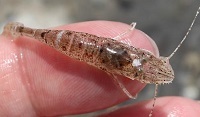 12/10 – Yonkers, HRM 18: Our staff at the Sarah Lawrence Center for the Urban River at Beczak made our final hauls of the year this week with our 30-foot seine. We finished 2022 with a total of 685 hauls between February 9 and December 10. Our top ten catches were Atlantic silverside (2,608), Atlantic menhaden (1,964), moon jellyfish (1,543), comb jelly (1,283), blue crab (658), mummichog (545), grass shrimp (354), striped bass (114), sand shrimp (113), and white perch (73). We hope to be back in the water in February, ice permitting. (Photo of sand shrimp courtesy of Molly Jacobson) 12/10 – Yonkers, HRM 18: Our staff at the Sarah Lawrence Center for the Urban River at Beczak made our final hauls of the year this week with our 30-foot seine. We finished 2022 with a total of 685 hauls between February 9 and December 10. Our top ten catches were Atlantic silverside (2,608), Atlantic menhaden (1,964), moon jellyfish (1,543), comb jelly (1,283), blue crab (658), mummichog (545), grass shrimp (354), striped bass (114), sand shrimp (113), and white perch (73). We hope to be back in the water in February, ice permitting. (Photo of sand shrimp courtesy of Molly Jacobson)
- Jason Muller
*** Fish-of-the-Week ***
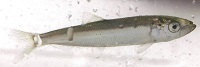 12/11 – Hudson River Watershed: Fish-of-the-Week for Week 200 is the Atlantic herring (Clupea harengus), number 29 (of 234), on our Hudson River Watershed List of Fishes. If you would like a copy of our list, e-mail: trlake7@aol.com 12/11 – Hudson River Watershed: Fish-of-the-Week for Week 200 is the Atlantic herring (Clupea harengus), number 29 (of 234), on our Hudson River Watershed List of Fishes. If you would like a copy of our list, e-mail: trlake7@aol.com
The Atlantic herring is one of nine fishes in the herring family (Clupeidae) documented for the Hudson River watershed. These include the anadromous sub-family Alosinae of Hudson River herrings: American shad, hickory shad, alewife, and blueback herring.
The Atlantic herring, a marine species, ranges from the edge of the polar ice in Northern Labrador to North Carolina. Traveling in schools of thousands, they are one of the world’s most important commercial species. As plankton-feeders (copepods are a favorite), they can reach 17-inches.
Across their range, they spawn from summer into late autumn from Massachusetts Bay down along Cape Cod. Farther north, where they are known as sea herring, Bigelow and Schroeder (1957) note that they spawn from fall into winter from the Gulf of Maine to the Nantucket Shoals. Briggs and Waldman (2002) found them common to abundant in Long Island Sound and they are not uncommonly taken in seines in the East River.
They are known from the estuary from occasional catches as far upriver as Indian Point. In the last two years, a dozen or more have been caught at Yonkers (Jason Muller). These were likely late-autumn or winter young-of-year fish, spawned in the New York Bight or along the northern New England coast. (Photo of Atlantic herring courtesy of Jackie Wu)
- Tom Lake
 12/12 – Beacon, HRM 61: The skeletal remains of a fish (150 mm) were recovered today in the tideline on the beach at Long Dock Park. Was this a new species? Our conclusions, after searching and applying a dichotomous key, were quite inconclusive. (Photo of mystery fish courtesy of Tom Lake) 12/12 – Beacon, HRM 61: The skeletal remains of a fish (150 mm) were recovered today in the tideline on the beach at Long Dock Park. Was this a new species? Our conclusions, after searching and applying a dichotomous key, were quite inconclusive. (Photo of mystery fish courtesy of Tom Lake)
- Tom Lake
[Note: One-inch equals 25.4 millimeters (mm)].
12/12 – Hook Mountain, HRM 31: Among the seven south-migrating raptors we counted today at the Hook Mountain Hawkwatch, red-tailed hawk was high count with four. The others were bald eagle (one adult, one immature), and an adult male northern harrier, a “gray ghost,” a beauty, moving quite quickly in the wind making small adjustments with its wings to keep on a rather steady southwest flight line.
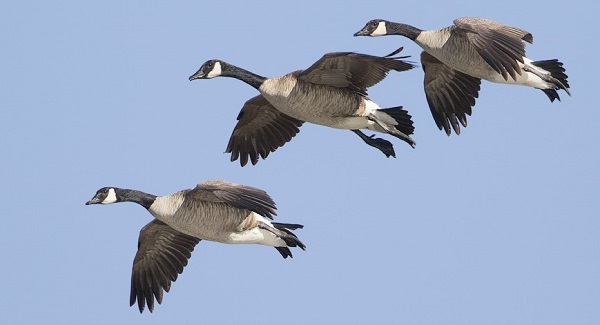
Migrants, non-migrants, and other birds seen from the summit included a great blue heron (flew south, down-river, at the level of the summit), Canada geese, more than 400, plus other extremely distant skeins and groups of waterfowl, many, or all of which may have been geese. The sounds of honking were nearly constant at the summit. Two common ravens were around, one of which was very vocal and quite acrobatic. A small flock of cedar waxwings came past and headed down toward Nyack village.
- Tom Fiore
 12/14 – Greene County: The annual Geminids meteor shower has been underway for several weeks, but this morning was the peak with 120 sightings per-hour. In predawn, I saw about 30 good-sized meteors with several fireballs in a frigid half hour while looking at only a portion of the sky. Several neighbors joined me as the “Ooohs” and “Aaahs” accompanied yet another bright streak. 12/14 – Greene County: The annual Geminids meteor shower has been underway for several weeks, but this morning was the peak with 120 sightings per-hour. In predawn, I saw about 30 good-sized meteors with several fireballs in a frigid half hour while looking at only a portion of the sky. Several neighbors joined me as the “Ooohs” and “Aaahs” accompanied yet another bright streak.
These blazing “shooting stars” are remnants of an asteroid debris trail that we pass through annually; the particles, traveling at 78,000 miles-per-hour, burn up as they hit earth’s atmosphere. The radiant of this shower appears to streak out from the constellation Gemini (thus Geminid) made up of the twin stars Castor and Pollux. We also noticed several different colors some green and others red, another hallmark of this meteor shower. It was something special when the dawn glow showed red in the east and a “blazer” meteor steaks came down over the Catskill Mountain’s skyline. (Photo of Geminids courtesy of Michael Woyton)
- Mario Meier
12/14 – Manhattan, HRM 1-2: Hudson River Park’s River Project staff checked our research gear (pots and traps) that we deploy at Piers 26 and 40 as part of our fish ecology survey. Our catch at Pier 40 was very light with a winter flounder (220 millimeters) in a crab pot and a single young-of-year black sea bass (85 mm) in one of our minnow traps. We found even less of a catch at Pier 26, as the pots and traps were empty. The river water temperature was dropping daily toward winter levels, now at 42 degrees Fahrenheit.
- Zoe Kim
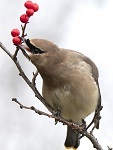 12/15 – Hudson River Watershed: Cedar waxwings are among the most frugivorous (fruit-eating) birds in North America. During the winter their diet is almost completely fruit. Historically cedar berries (hence their name) were the fruit of choice, and still is where cedars are plentiful, but ornamental fruit trees such as Mountain Ash, crabapples, and hawthorns as well as alien honeysuckles have become a major source of food for Cedar Waxwings in recent years in the Northeast. 12/15 – Hudson River Watershed: Cedar waxwings are among the most frugivorous (fruit-eating) birds in North America. During the winter their diet is almost completely fruit. Historically cedar berries (hence their name) were the fruit of choice, and still is where cedars are plentiful, but ornamental fruit trees such as Mountain Ash, crabapples, and hawthorns as well as alien honeysuckles have become a major source of food for Cedar Waxwings in recent years in the Northeast.
Research shows that in May an abrupt change in waxwing diet composition occurs, with fruit dropping to about 15% of their diet, while flowers comprise 44%. In June, frugivory [fruit foraging] spikes back up to about 65% as current-season fruits ripen, and fruit use progressively rises for the remainder of the summer until it nears 100% for several winter months. (Photo of cedar waxwing courtesy of Mary Holland)
- Mary Holland
 12/16 – Black Creek, HRM 85: We had a very high, full moon, spring tide today, and with no wind a dense, whiteout, fog settled on the river. Near shore was the ghostly image of the remnants of a very old, partially submerged barge, a “skeleton” in river parlance, perfectly mirrored on the flat water. It always seems incredible to me how the river changes from hour to hour based on weather, tides, and other factors. (Photo of barge skeleton courtesy of Zach Hulleatt) 12/16 – Black Creek, HRM 85: We had a very high, full moon, spring tide today, and with no wind a dense, whiteout, fog settled on the river. Near shore was the ghostly image of the remnants of a very old, partially submerged barge, a “skeleton” in river parlance, perfectly mirrored on the flat water. It always seems incredible to me how the river changes from hour to hour based on weather, tides, and other factors. (Photo of barge skeleton courtesy of Zach Hulleatt)
- Zach Huleatt
[Those who work on the river have a theory, one that is difficult to prove, but almost certainly true: Due to a nearly unimaginable number of environmental factors, no one moment on the tidewater river will ever come together, coalesce, in the same way. Every moment is unique, for all time. Poets and river watchers believe it makes the estuary quite the mystical and magical experience. Tom Lake]
Winter 2022 Natural History Programs and Events
Women in Science
Please join the DEC’s Hudson River Estuary Program’s free virtual Women in Science series this winter. Meet and learn from scientists, community leaders, and environmental educators who work at the intersection of research, education, and environmental and social justice. Engage in discussions about data literacy, sea level rise and sediment accumulation, wetland restoration, oysters, and field-based research. For information and how to register visit here.
Hudson River Education
Teachers and students will enjoy our new Hudson River K-12 Unit of Study. This carefully curated group of lesson plans, arranged by topic and/or grade, brings together great learning tools developed by the DEC and dozens of estuary partners.
Hudson River Miles
The Hudson is measured north from Hudson River Mile 0 at the Battery at the southern tip of Manhattan. The George Washington Bridge is at HRM 12, the Tappan Zee 28, Bear Mountain 47, Beacon-Newburgh 62, Mid-Hudson 75, Kingston-Rhinecliff 95, Rip Van Winkle 114, and the Federal Dam at Troy, the head of tidewater, at 153. The tidal section of the Hudson constitutes a bit less than half the total distance – 315 miles – from Lake Tear of the Clouds to the Battery. Entries from points east and west in the watershed reference the corresponding river mile on the mainstem.
To Contribute Your Observations or to Subscribe
The Hudson River Almanac is compiled and edited by Tom Lake and emailed weekly by DEC's Hudson River Estuary Program. Share your observations by e-mailing them to trlake7@aol.com. To subscribe to the Almanac (or to unsubscribe), use the links on DEC's Hudson River Almanac or DEC Delivers web pages.
Useful Links
National Oceanic and Atmospheric Administration online tide and tidal current predictions are invaluable when planning Hudson River field trips. For real-time information on Hudson River tides, weather, and water conditions from sixteen monitoring stations, visit the Hudson River Environmental Conditions Observing System website.
DEC's Smartphone app for iPhone and Android is now available at New York Fishing, Hunting & Wildlife App.
|