A Project of the Hudson River Estuary Program
Compiled and edited by Tom Lake, Consulting Naturalist
Love Our NY Lands
State Lands Belong to All of Us
All New Yorkers and visitors should be able to access, enjoy, and feel welcome on state lands. These lands belong to all of us, our families, and our neighbors. While enjoying these shared spaces, be respectful of other visitors. Share trails, treat people with kindness, and leave things as you found them for others to enjoy. All of us have a responsibility to protect State lands for future generations. For more information, visit DEC's website.
Overview
In a prelude to the 2023 nesting season, our bald eagles were active this week both at their nests and in harassing other wildlife. Their attention to the details of nesting will only increase as winter arrives. Adult bald eagles are consummate professionals in their work. A beautiful and very uncommon late-season warbler appeared in Orange County. A life-bird for some.
Highlight of the Week
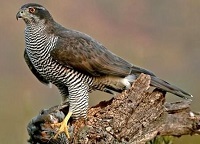 11/19 – Hook Mountain, HRM 31: Among the 26 south-migrating raptors we counted today at the Hook Mountain Hawkwatch, red-shouldered hawk was high count with 15. An immature female (by plumage and hefty size) northern goshawk came straight through the summit’s trees, moving west by southwest with nary a glance over at the great horned owl decoy high on its pole. The raptor had all the markings making it a goshawk: darkly barred and streaked through all the underwings and body right into its undertail coverts. There was not a trace of red or cinnamon in the underparts. The eye line was evident as well but was less obvious in the fast view of a raptor. 11/19 – Hook Mountain, HRM 31: Among the 26 south-migrating raptors we counted today at the Hook Mountain Hawkwatch, red-shouldered hawk was high count with 15. An immature female (by plumage and hefty size) northern goshawk came straight through the summit’s trees, moving west by southwest with nary a glance over at the great horned owl decoy high on its pole. The raptor had all the markings making it a goshawk: darkly barred and streaked through all the underwings and body right into its undertail coverts. There was not a trace of red or cinnamon in the underparts. The eye line was evident as well but was less obvious in the fast view of a raptor.
Two hikers did not quite know what to make of the big boreal bird less than two feet above their heads that could simply tear right through tangles of branches of our small oaks and other summit-top trees. The glow of the goshawk lingered long safter it left.
Other non-raptor migrants included snow buntings. They came by and looked as if to land, and possibly did so on the southwest upper slope of the mountain where there were patches of appropriate habitat. This is a species that we have seen in prior late fall seasons although hardly one that can be called expected at the Hook. (Photo of Northern goshawk courtesy of Robert Post)
- Tom Fiore, Felicia Napier
Natural History Entries
11/19 – Town of Poughkeepsie: In a good sign for the 2023 season, both adults from bald eagle nest NY62 were at the nest today actively working on refurbishing, adding new sticks, and tossing old ones.
- Debbie Sheehy
 11/19 – Goshen, HRM 41: The first thing this morning I went to Goshen to follow up on a confirmed eBird report of a yellow-throated warbler (Setophaga dominica). After an hour with no sign of the bird, I left. A while later, Jeanne Cimorrelli reported on the Mearns Bird Club App that the bird was present. I joined a good number of birders as we waited for the bird to show itself. After an hour wait, it did. The bird flitted around for only a minute before it flew off. I was happy to have been lucky enough to see the bird, a life bird for me. (Photo of yellow-throated warbler courtesy of Matt Zeitler) 11/19 – Goshen, HRM 41: The first thing this morning I went to Goshen to follow up on a confirmed eBird report of a yellow-throated warbler (Setophaga dominica). After an hour with no sign of the bird, I left. A while later, Jeanne Cimorrelli reported on the Mearns Bird Club App that the bird was present. I joined a good number of birders as we waited for the bird to show itself. After an hour wait, it did. The bird flitted around for only a minute before it flew off. I was happy to have been lucky enough to see the bird, a life bird for me. (Photo of yellow-throated warbler courtesy of Matt Zeitler)
- Matt Zeitler
[Yellow-throated Warblers, casual visitants to our area, are a slender, long-billed wood warbler with distinctive pattern, including a yellow throat, black mask, and black streaks on its sides. They are southern warblers that have slowly expanded their range north to Pennsylvania and New Jersey in recent decades. They were first found nesting in New York State in 1984. They are seen annually, usually in the spring, on Long Island. Stan DeOrsey]
11/19 – Buchanan, HRM 42: In past years, we’ve seen small flocks of wild turkeys in the area around Verplanck’s Lake Meahagh, but this year has been different. As we were walking yesterday, a flock of 21 wild turkeys crossed our path, walked up a driveway and around to the back of the neighbor’s house! As if that wasn’t surprising enough, we counted more than 30 in our backyard today, foraging in the grass. We watched as they proceeded to the front of the house, half of them going on one side and the other half to the other side. Then they formed a line and paraded up the middle of the street. Such precision. Other neighbors have been graced with their appearance as well.
- Dorothy Ferguson, Bob Ferguson
11/19 – Bedford, HRM 35: We counted 34 south-migrating raptors today at the Bedford Audubon Chestnut Ridge Hawkwatch; red-shouldered hawk was high count with 22. Turkey vulture (52) showed well. The highlight of the day was our thirteenth golden eagle of the season. It was a juvenile that cruised directly toward us out of the blue. Then, just before passing over the trees behind the platform and out of sight, it did several slow circles almost directly overhead at low altitude offering good photo opportunities. We had a decent late-season number for northern harrier (3). Other non-raptor migrants were Canada geese (460), American robin (148), and red crossbills (4).
- Richard Aracil, Barbara Phillips, Chris Jaeger, David Villa
*** Fish of the Week ***
 11/19 – Hudson River Watershed: Fish-of-the-Week for Week 197 will begin with a Family-of-Fishes, the North American catfishes (Ictaluridae), numbers 78-85 (of 237) on our Hudson River Watershed List of Fishes. If you would like a copy of our list, e-mail: trlake7@aol.com. 11/19 – Hudson River Watershed: Fish-of-the-Week for Week 197 will begin with a Family-of-Fishes, the North American catfishes (Ictaluridae), numbers 78-85 (of 237) on our Hudson River Watershed List of Fishes. If you would like a copy of our list, e-mail: trlake7@aol.com.
Among indigenous Mohican people, whose ancestral homeland lies entirely within our watershed, the generic native catfish is known as Stãabaw. There are eight species of Ictaluridae (Ictalurids), documented for our watershed. With its ancestral origins, we can speculate as to which species were the original Stãabaw.
Of our eight Ictalurids, three are nonnative: stonecat, channel catfish, and brindled madtom. Two others are small species in small waters, tadpole and margined madtom, unlikely to economically inspire the Mohican people. The final three species, white catfish, and brown and yellow bullheads, all fit the conditions. Any, or all, could be Stãabaw.
Since the Almanac has previously featured white catfish and brown bullhead, we will choose yellow bullhead, Ameiurus natalis, number 80 on our Hudson River Watershed List of Fishes, a species that is known to have been, and still is, present in the Mohican ancestral homeland.
The yellow bullhead is native to the Atlantic and Gulf coast watersheds from New York to northern Mexico, including the Great Lakes and Mississippi River where they can reach 15 inches. They favor ponds and clear streams, and while silty water is not conducive to their presence, they are found in the turbid waters of the tidewater Hudson River.
All our Ictalurid species have four pairs of barbels (commonly referred to as "whiskers") and their skin does not have any scales. In fish anatomy, a barbel is a slender, whisker-like sensory organ near the mouth. Barbels house the taste buds of fish and are used to search for food in turbid water. The word barbel comes from Middle Latin barbula, for "little beard," and the Latin barbus, referencing carp.
J.R. Greeley, in his A Biological Survey of the Lower Hudson Watershed (1937), lists the yellow bullhead as “rare,” with most of the records collected coming from the Wallkill River watershed. The original description of the yellow bullhead (Lesueur 1819) was as Pimelodus natalis. The Type site is listed, simply, as “Upper Canada” with no specific locality. Lesueur’s holotype (the original fish described) has been lost.
The yellow bullhead is one of my favorite fishes, primarily because of how seldom we see one. In the field, it is often tricky to distinguish a yellow bullhead from the far more common brown bullhead. One of the best field marks are their chin barbels: mottled white-yellow for the yellow bullhead; dusky brown or black for the brown bullhead. In many instances, the “yellow” of the yellow bullhead is instantly recognizable as it was this summer during a seining program with fourth-graders when we caught a ten-inch yellow bullhead that was as yellow as a lemon drop. (Photo of yellow bullhead courtesy of Luke Ovgard)
- Tom Lake
11/20 – Ulster County: We saw our first sign of maintenance today on bald eagle nest NY142. The two adults had been around but now they were bringing new sticks to the nest. This is their refurbishing season.
- Bill Bollinger
11/20 – Bedford, HRM 35: We counted 20 south-migrating raptors today at the Bedford Audubon Chestnut Ridge Hawkwatch; bald eagle was high count with eight. Turkey vulture (82) was the numerical high count among non-raptor migrants. We passed our all-time one season high count for turkey vulture (4,774) and today we broke 19,000 for overall total birds making this our best season since 2011.
- Richard Aracil, Karen Troche, Kevin McGrath, Pedro Troche
11/20 – Hook Mountain, HRM 31: We counted a single raptor today, a bald eagle, at the Hook Mountain Hawkwatch. High count among migrating non-raptors went to turkey vulture (3).
- Phil Ribolow, Anne Ribolow, Max Miller, Raimund Miller
11/21 – Brockway, HRM 62: We made a field visit today to check on bald eagle nest NY377. We have dubbed the riverside site “Brockway” for the long abandoned late 19th and early 20th century brick factory, the ruins of which are nearby. The nest was first noticed in 2015 near the crown of a large cottonwood on a broad, heavily-wooded, peninsula, but we saw no activity. In 2016, the adults were not seen, but the nest tree had plenty of whitewash both on the tree and all around indicating their presence. In 2017, the adults were seen on eggs, but nestlings were not spotted.
In both 2018 and 2019, there was no activity at NY377. In 2020, a pair of adults were seen in the nest, but the resolution of that season was a mystery. After a gap of two years, there was no way of knowing if this was the 2017 pair, or a new pair. Once again, nestlings were not spotted.
Years 2021 and 2022 was another two-year gap of no activity. Today we concluded that the nest had been abandoned … for now. However, having been actively used several times in the last decade, it will remain a designated bald eagle territory.
- Tom Lake, Paige Lewandowski, Tony Russo
11/21 – Bedford, HRM 35: We counted 22 south-migrating raptors today at the Bedford Audubon Chestnut Ridge Hawkwatch; red-shouldered hawk was high count with four. Turkey vulture (85) and black vulture (2) showed well. The highlight of the day was our fourteenth golden eagle of the season, a juvenile. High count among non-raptor migrants was Canada geese (1,358).
- Richard Aracil, Steve Rappaport, Tom Burns
11/22 – Bedford, HRM 35: We counted 14 south-migrating raptors today at the Bedford Audubon Chestnut Ridge Hawkwatch; red-shouldered hawk was high count with eight. Canada geese (560) was the high count among non-raptor migrants.
- Richard Aracil, Karen Troche, Kevin McGrath, Mitchell Goldfarb, Pedro Troche
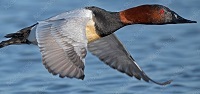 11/22 – Hook Mountain, HRM 31: We counted just five south-migrating raptors today at the Hook Mountain Hawkwatch. The first migrants of the day were two turkey vultures floating over Hemlock Ridge in mid-morning. A short while later a juvenile red-shouldered hawk flew southwest high over the summit and a tight formation of four black vultures flew straight southwest vanishing over the distant Hackensack drainage. Not long after, a high duck flew very fast east to west over Rockland Lake. My best guess was canvasback. 11/22 – Hook Mountain, HRM 31: We counted just five south-migrating raptors today at the Hook Mountain Hawkwatch. The first migrants of the day were two turkey vultures floating over Hemlock Ridge in mid-morning. A short while later a juvenile red-shouldered hawk flew southwest high over the summit and a tight formation of four black vultures flew straight southwest vanishing over the distant Hackensack drainage. Not long after, a high duck flew very fast east to west over Rockland Lake. My best guess was canvasback.
Near noon, we spotted two adult red-tailed hawks over Croton Point; I believe they were a local nesting pair. The hawks circled up endlessly and vanished with height. After noon, while viewing a group of vultures over the west summit, I spied a very high adult bald eagle traveling east. Later a very high immature red-tailed hawk soared southwest. In the one o'clock hour, I counted five high back vultures streaming southwest. Ten minutes later, however, five came floating back so I deleted their entry as migrants.
Out of the corner of my eye, I caught a large bird flying through the west summit woods. It landed in a low tree next to the Blue Trail 100 feet below the summit, obscured by a thicket. I stalked to within 60 feet and was rewarded with a clear view of a large (female) immature Cooper's hawk perched in the sun, peering out over the Nyack Gulf, long, rounded, white-tipped tail iconic as a field guide illustration. (Photo of canvasback courtesy of Brian Kushner)
- John Phillips
11/22 – Yonkers, HRM 18: With the daytime air warming up a bit today to 51 degrees Fahrenheit (F), our staff at the Sarah Lawrence Center for the Urban River at Beczak went down to the river for some seining. We weren’t expecting much after several cold nights but ended up getting a decent late November catch. The tide was super low which made it difficult to get the net out very far. We’ve been experiencing blowout tides with persistent northerly winds and the effects of the upcoming new moon.
In five hauls of our seine, we caught one fish, an Atlantic silverside (80 millimeters[mm]), our signature fish of summer. Invertebrates, however, showed well. Six comb jellies were high count, along with four young-of-season blue crabs (15-25 mm). Rounding out the catch were sand shrimp (3), moon jellyfish (2), and a lone amphipod.
The water temperature was 53 degrees F, salinity was 10.4 parts-per-thousand (ppt), and the dissolved oxygen (DO) was 8.5 parts-per-million (ppm).
- Jason Muller, Rachel Lynch
[The standard research measurement for blue crabs (mm) is point-to-point, laterally, across their carapace.]
11/23 – Town of Wappinger, HRM 67: Both adults from bald eagle nest NY459, known to nest-watchers as the “Bridge Nest”, were around today. One was perched in the nest tree. This was “getting ready” time for the adults, to refurbish the nest and rekindle the ardor that will lead to breeding in early February. In their first four breeding seasons, 2019-2022, the adult pair at NY459 have had eight nestlings.
- Judy Winter
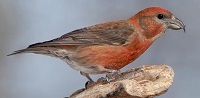 11/23 – Bedford, HRM 35: We counted 23 south-migrating raptors today at the Bedford Audubon Chestnut Ridge Hawkwatch; red-shouldered hawk was high count with 14. Turkey vulture (52) was the numerical high count among non-raptor migrants. It was just a modest movement today. We thought it was going to be a bit busier given the light northwest wind. The highlight of the day was six red crossbills heard and seen as they zipped over the platform. (Photo of red crossbill courtesy of Tom Lawler) 11/23 – Bedford, HRM 35: We counted 23 south-migrating raptors today at the Bedford Audubon Chestnut Ridge Hawkwatch; red-shouldered hawk was high count with 14. Turkey vulture (52) was the numerical high count among non-raptor migrants. It was just a modest movement today. We thought it was going to be a bit busier given the light northwest wind. The highlight of the day was six red crossbills heard and seen as they zipped over the platform. (Photo of red crossbill courtesy of Tom Lawler)
- Richard Aracil, Karen Troche, Pedro Troche
11/23 – Hook Mountain, HRM 31: Among the 16 south-migrating raptors we counted today at the Hook Mountain Hawkwatch, bald eagle was high count with five. Turkey vulture (32) and black vulture (9) showed well. The nine black vultures counted as migrants came over the Hudson River and continued southwest with no hesitation.
A single red crossbill called, and then came in just west of the summit area, perhaps to check out the conifers on the hillside. This was a very uncommon sighting for the county, much less Hook Mountain itself. We spotted one snow goose flying apart from flocks of Canada geese, of which there were hundreds in flocks of 20, 30, 40 up to one flock of 80, all flying far beyond the local area, all headed south by southwest.
- Tom Fiore, Ari Weiss
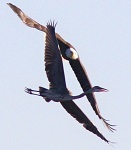 11/24 – Ulster County: I saw the two adults from bald eagle nest NY142 over the river today. One of them chased a great blue heron out from shore north of their nest, swooping at it a couple of times forcing it into the water (great blue herons are quite good swimmers, when necessary). That eagle flew back to the nest. The second eagle appeared flying low over the heron that was sitting in the water, but then shied away. After five minutes, the heron flew back to shore, looking uninjured, well upriver of the nest. Either the eagles were just playing, or they decided that a great blue heron was just too much work. (Photo of bald eagle and great blue heron courtesy of Steve Decker) 11/24 – Ulster County: I saw the two adults from bald eagle nest NY142 over the river today. One of them chased a great blue heron out from shore north of their nest, swooping at it a couple of times forcing it into the water (great blue herons are quite good swimmers, when necessary). That eagle flew back to the nest. The second eagle appeared flying low over the heron that was sitting in the water, but then shied away. After five minutes, the heron flew back to shore, looking uninjured, well upriver of the nest. Either the eagles were just playing, or they decided that a great blue heron was just too much work. (Photo of bald eagle and great blue heron courtesy of Steve Decker)
- Steve Decker
11/24 – Bedford, HRM 35: We counted 34 south-migrating raptors today at the Bedford Audubon Chestnut Ridge Hawkwatch; red-shouldered hawk was high count with 18. Turkey vulture (52) showed well. Canada geese (58) were high count among non-raptors migrants.
- Tait Johansson, Karen Troche, Pedro Troche
 11/24 – Hook Mountain, HRM 31: Among the 38 south-migrating raptors we counted today at the Hook Mountain Hawkwatch, red-shouldered hawk was high count with 28. Turkey vulture (22) was the numerical high count among non-raptor migrants. Northern harrier made a nice showing today (5), and the last of those seen was an adult male, a gray ghost. (Photo of Northern harrier courtesy of John Badura) 11/24 – Hook Mountain, HRM 31: Among the 38 south-migrating raptors we counted today at the Hook Mountain Hawkwatch, red-shouldered hawk was high count with 28. Turkey vulture (22) was the numerical high count among non-raptor migrants. Northern harrier made a nice showing today (5), and the last of those seen was an adult male, a gray ghost. (Photo of Northern harrier courtesy of John Badura)
- Tom Fiore
[The male northern harrier, or marsh hawk, pale with black wing tips, is a light-colored raptor that birders refer to as the “gray ghost.” Tom Lake]
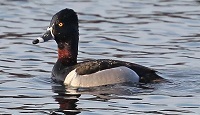 11/25 – Dutchess County, HRM 68: I counted 300 ring-necked ducks on Sylvan Lake in midday. (Photo of ring-necked duck courtesy of Deborah Tracy Kral) 11/25 – Dutchess County, HRM 68: I counted 300 ring-necked ducks on Sylvan Lake in midday. (Photo of ring-necked duck courtesy of Deborah Tracy Kral)
- Carena Pooth (Ralph T. Waterman Bird Club)
11/25 – Bedford, HRM 35: We counted just four south-migrating raptors today at the Bedford Audubon Chestnut Ridge Hawkwatch; red-tailed hawk was high count with two. By far the main species moving was turkey vulture. A kettle of 41 was seen off to our southeast. High count among non-raptor migrants was Canada geese (570), seen flying low to our southeast.
- Richard Aracil
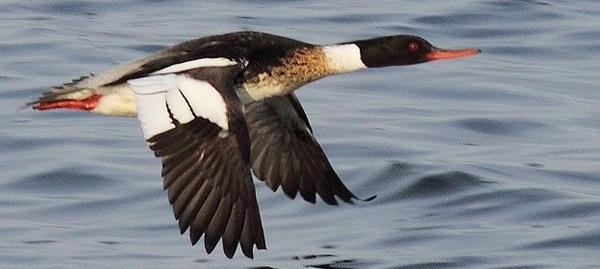
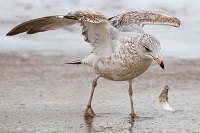 11/25 – Sandy Hook, NJ: I spent the morning after Thanksgiving birding at Sandy Hook. While I was a little disappointed with my waterfowl count (I only identified nine species: Canada goose, brant, mallard, American black duck, bufflehead, common goldeneye, red-breasted merganser, black scoter, and common loon), I was really impressed with the number of gulls present. There many, many Bonaparte’s gulls, as well as herring gulls, great black-backed gulls, laughing gulls, and ring-billed gulls — a five-gull day. 11/25 – Sandy Hook, NJ: I spent the morning after Thanksgiving birding at Sandy Hook. While I was a little disappointed with my waterfowl count (I only identified nine species: Canada goose, brant, mallard, American black duck, bufflehead, common goldeneye, red-breasted merganser, black scoter, and common loon), I was really impressed with the number of gulls present. There many, many Bonaparte’s gulls, as well as herring gulls, great black-backed gulls, laughing gulls, and ring-billed gulls — a five-gull day.
There was an absolute a load of fish in the surf, mostly Atlantic menhaden, and the gulls experienced easy fishing — it was unusual to see a bird come up without a fish. While many of them were eating on the wing, some took their prize to the sand. Beside the gulls, it was easy to pick out the incredible diving northern gannets. (Photo of ring-billed gull courtesy of Matt Zeitler)
- Matt Zeitler
Winter 2022 Natural History Programs and Events
Hudson River Education
Teachers and students will enjoy our new Hudson River K-12 Unit of Study. This carefully curated group of lesson plans, arranged by topic and/or grade, brings together great learning tools developed by the DEC and dozens of estuary partners.
Hudson River Miles
The Hudson is measured north from Hudson River Mile 0 at the Battery at the southern tip of Manhattan. The George Washington Bridge is at HRM 12, the Tappan Zee 28, Bear Mountain 47, Beacon-Newburgh 62, Mid-Hudson 75, Kingston-Rhinecliff 95, Rip Van Winkle 114, and the Federal Dam at Troy, the head of tidewater, at 153. The tidal section of the Hudson constitutes a bit less than half the total distance – 315 miles – from Lake Tear of the Clouds to the Battery. Entries from points east and west in the watershed reference the corresponding river mile on the mainstem.
To Contribute Your Observations or to Subscribe
The Hudson River Almanac is compiled and edited by Tom Lake and emailed weekly by DEC's Hudson River Estuary Program. Share your observations by e-mailing them to trlake7@aol.com. To subscribe to the Almanac (or to unsubscribe), use the links on DEC's Hudson River Almanac or DEC Delivers web pages.
Useful Links
National Oceanic and Atmospheric Administration online tide and tidal current predictions are invaluable when planning Hudson River field trips. For real-time information on Hudson River tides, weather, and water conditions from sixteen monitoring stations, visit the Hudson River Environmental Conditions Observing System website.
DEC's Smartphone app for iPhone and Android is now available at New York Fishing, Hunting & Wildlife App.
|