
Managing Migratory Fish in the Hudson River Estuary
The New York State Department of Environmental Conservation sent this bulletin on 11/29/2022 10:00 AM EST |
| DEC Delivers - Information to keep you connected and informed from the NYS Department of Environmental Conservation |
| Share or view as a web page || Update preferences or unsubscribe |
Hudson RiverNet
|
In This Issue:Managing Migratory Fish in the Hudson River Estuary
Managing Migratory Fish in the Hudson River Estuary
Estuaries are among the most productive of Earth's ecosystems, and the Hudson River estuary is no exception. The Hudson's signature migratory and resident species—Atlantic sturgeon, river herring, striped bass, blue crab, and shortnose sturgeon—depend on rare and important tidal habitat for spawning, feeding, and wintering. The Hudson River Estuary Action Agenda 2021-2025 establishes specific measures to conserve, protect, and restore these signature species and their valuable habitat DEC's Hudson and Delaware Marine Fisheries staff have been managing the migratory and resident fishes of the estuary since the 1980s through numerous long-term monitoring surveys. Long-term data are extremely valuable for documenting population trends over time, as they can reveal patterns in abundance not evident from single-survey events or short-term studies. Migratory species are managed in collaboration with other coastal states through the Atlantic States Marine Fisheries Commission (ASMFC). The status of each major species has been very dynamic, influenced by local and coastal conditions. Read about some of this year's significant research findings and new developments in this newsletter. Do Breaching Sturgeon Indicate Population Abundance?
Atlantic sturgeon historic populations have declined by 99% due to the combined effects of overharvest, habitat loss, and human interactions. Recovery efforts have been on-going for over two decades; however, logistical, endangered status and fiscal constraints make it difficult to estimate population size and evaluate the efficacy of conservation. What can breaching sturgeon tell us about population recovery? During 2022, in collaboration with academics, federal scientists and a local Yacht Club, we embarked on a novel project to monitor adult spawning Atlantic sturgeon for breaching in the Hudson River. There has been an increase in the number of reports of breaching sturgeon near the spawning area. Could the number of breaching adults serve as an index of abundance? We are using a remote camera to film Atlantic sturgeon breaching at a known spawning site in the Hudson River, NY. We will correlate the number of breaching sturgeon to a suite of environmental variables and estimates of local spawner abundance. Results will be used to determine if breaching behavior occurs more often during certain times of day or tides. The data will also provide outreach material to help minimize human-sturgeon interactions. Photo of breaching Atlantic sturgeon courtesy of Heaton Johnson. River Herring Coastwide Stock Assessment Underway
Hudson River Fisheries Unit staff began participation in the 2023 Atlantic States Marine Fisheries Commission (ASMFC) Coastwide Benchmark Stock Assessment for River Herring. Anadromous river herring are comprised of two closely related and jointly managed species, Alewife (Alosa pseudoharengus) and Blueback Herring (Alosa aestivalis), that range from Newfoundland to North Carolina and from Cape Breton, Nova Scotia to the St. John’s River in Florida. The 2023 ASMFC River Herring Benchmark Stock Assessment (PDF) will evaluate the current stock status of both river herring species across their entire ranges including the Hudson River and will be used to inform future management actions. Several surveys conducted by Hudson River Fisheries Unit staff will provide crucial data during this assessment.
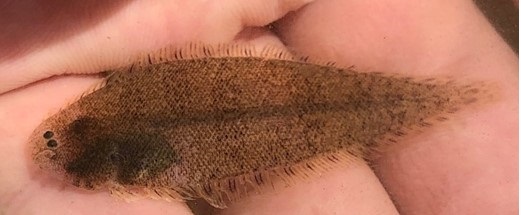
New Hudson River Fish FindThe Hudson River Fisheries Unit conducts annual monitoring for young-of-year striped bass (Morone saxitilis) during its beach seine survey from July to November in Haverstraw Bay and Tappan Zee. Although striped bass are the target species, numerous estuarine fish and some invertebrates are also caught while beach seining and are identified, measured, and enumerated for the survey records. On September 12, 2022 the Hudson River Fisheries Unit caught its first blackcheek tonguefish (Symphurus plagiusa) near Kingsland Point Park. Two previous records of the species exist from further south in the Hudson River watershed: one from 1991 in the Arthur Kill and the second from the East River in 2000. Since September, the Hudson River Fisheries Unit has caught four individuals with total lengths ranging from 38mm to 67mm at sites between River Mile 23 near the Dobbs Ferry train station up to River Mile 35 at Croton Point this year. Several tonguefish were also caught further south by other Hudson River educators: near Yonkers (River Mile 18) and Coney Island Creek near Brooklyn. Blackcheek tonguefish belong to the family Cynoglossidae, the tonguefishes, a group of flatfishes with both eyes on the left side of the body. These bottom-dwelling fish inhabit marine and estuarine waters from the Gulf of Mexico to New York State and prefer soft bottom and reef habitats between 1-30 meters deep. The blackcheek tonguefish is relatively small, with a maximum length of 23 cm. The individuals captured this year have been preserved as part of the New York State Museum collection and will be used to expand our understanding of the species in the river. The Fisheries Unit will continue to record and share news about blackcheek tonguefish and other novel species in the river during future annual monitoring.
|


|
The New York State Department of Environmental Conservation respects your right to privacy and welcomes your feedback | Update preferences or unsubscribe | Learn more about DEC Delivers |
|
Connect with DEC:     
|
|
| Basil Seggos, Commissioner | |