A Project of the Hudson River Estuary Program
Compiled and edited by Tom Lake, Consulting Naturalist
Love Our NY Lands
State Lands Belong to All of Us
All New Yorkers and visitors should be able to access, enjoy, and feel welcome on state lands. These lands belong to all of us, our families, and our neighbors. While enjoying these shared spaces, be respectful of other visitors. Share trails, treat people with kindness, and leave things as you found them for others to enjoy. All of us have a responsibility to protect State lands for future generations. For more information, visit DEC's website.
Overview
Fall color in the forests and fields lit up the watershed as a backdrop to all else. In the sky, large numbers of vultures were moving south, instinctively aware of the limited forage to be found on the soon to be snow and ice-covered roads. The first of the winter waterfowl were passing with many more to come, and in most instances sticking around. In the river, young-of-year fishes like striped bass and river herring were heading south, unaware of the gauntlet of predators from bluefish to humpback whales they faced before reaching a sanctuary in the sea.
Highlight of the Week
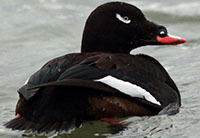 10/19 – Rhinecliff, HRM 89: In late afternoon, I counted 20 south-bound white-winged scoters flying low on the river from the Rhinecliff Train Station. These were quickly followed by a mixed flock of waterfowl including pintail and wigeon. (Photo of white-winged scoter courtesy of Margaret Bream) 10/19 – Rhinecliff, HRM 89: In late afternoon, I counted 20 south-bound white-winged scoters flying low on the river from the Rhinecliff Train Station. These were quickly followed by a mixed flock of waterfowl including pintail and wigeon. (Photo of white-winged scoter courtesy of Margaret Bream)
- Kyle Bardwell
[Scoters are “sea ducks,” Arctic breeders that are primarily found as spring and fall migrants along the Hudson River estuary. The white-winged scoter (Melanitta deglandi) is the largest of our three species of scoter. The genus translates from Greek as “black duck.” Our other scoters are black scoter (M. americana) and surf scoter (M. perspicillata). The latter have white bills and a white patch on the back of their heads. When seen through binoculars in the dim light of dawn, bobbing between swells, they look like “double-faced” ducks. The presence of scoters reminds us how faraway places are connected by the Hudson River flyway. Tom Lake]
Natural History Entries
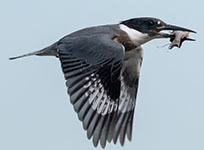 10/15 – Ulster County, HRM 86: I had a perfect look at a belted-kingfisher flying past with a redbreast sunfish in its beak. It seemed that I saw the same bird several times as I scouted upriver for more photos. (Photo of belted kingfisher courtesy of Jim Yates) 10/15 – Ulster County, HRM 86: I had a perfect look at a belted-kingfisher flying past with a redbreast sunfish in its beak. It seemed that I saw the same bird several times as I scouted upriver for more photos. (Photo of belted kingfisher courtesy of Jim Yates)
- Jim Yates
10/15 – Beacon, HRM 61: I caught and released after measuring them, two channel catfish (12 and 17 inches) in a three-hour fishing session off Long Dock. Again today, the activity occurred only during the incoming tide. Despite my offerings of prime bait, common carp were conspicuous, either by their absence or obstinance.
- Bill Greene
 10/15 – Little Stony Point Preserve, HRM 55: The river was shrouded in fog when we arrived on the beach. The air was 48 degrees Fahrenheit (F), sixteen degrees colder than the water causing a type of temperature inversion, thus the fog. By sunrise the fog had lifted over Storm King Mountain. At the turn of the tide, we were able to see why the river is often referred to as “the river that flows both ways.” Inshore the flood current was speeding up along the beach; out in the channel, flotsam was still drifting downriver in the last of the ebb. 10/15 – Little Stony Point Preserve, HRM 55: The river was shrouded in fog when we arrived on the beach. The air was 48 degrees Fahrenheit (F), sixteen degrees colder than the water causing a type of temperature inversion, thus the fog. By sunrise the fog had lifted over Storm King Mountain. At the turn of the tide, we were able to see why the river is often referred to as “the river that flows both ways.” Inshore the flood current was speeding up along the beach; out in the channel, flotsam was still drifting downriver in the last of the ebb.
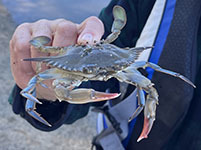
In addition to the amazing ambiance, we hauled our seine in the seasonably warmed water. While the diversity was limited — young-of-year striped bass and Atlantic silverside — there was a net full of both. Scurrying across the sand after escaping the seine was a male semi-softshell blue crab (the scurrying was half-hearted). The salinity was 2.0 ppt. (Photo of blue crab courtesy of Phyllis Lake)
- Lauren Martin, Valerie Knowles, Tom Lake, Phyllis Lake
[The standard research measurement for blue crabs is in millimeters (mm), point-to-point, laterally, across their carapace.]
10/15 – Bedford, HRM 35: We counted 108 south-migrating raptors today at the Bedford Audubon Chestnut Ridge Hawkwatch; sharp-shinned hawk was high count with 60. Cooper’s hawk (23) also showed well. Turkey vulture (69) was the numerical high-count among non-raptors. Other non-raptor migrants included 54 American robins, 66 Canada geese, 30 cedar waxwings, 13 blue jays, 11 purple finches, 5 tree swallows, 5 monarch butterflies, and a single late season chimney swift.
- Richard Aracil, Adam Bradley, Ginger Bernardin, Karen Troche, Kevin McGrath, Louisa Gagliardi, Nicholas DeLuca, Pedro Troche
10/15 – Hook Mountain, HRM 31: Among 75 south-migrating raptors today at the Hook Mountain Hawkwatch, sharp-shinned hawk was high count with 36. The highlight of the day was the appearance of bald eagles in good numbers, both migrants (4) and locals.
- Raimund Miller, Howie Waldman, Max Miller, Michael Morse
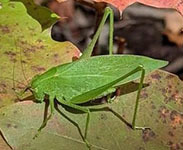 10/16 – Greene County: If you hear an insect “sawing away” in the tree tops, likely it’s a male katydid (Scudderia spp.). In October as the nights get cooler the speed of the repetitious three bars of katydid’s “stridulating” chirps gets slower and slower, relative to the air temperature. 10/16 – Greene County: If you hear an insect “sawing away” in the tree tops, likely it’s a male katydid (Scudderia spp.). In October as the nights get cooler the speed of the repetitious three bars of katydid’s “stridulating” chirps gets slower and slower, relative to the air temperature.
My wife and I walked the trail up to Paradise Point today and then on to Huckleberry Point on the east shoulder of the Catskill Mountain range. The fall vista was absolutely stunning with “the Clove” far below us. The views stretched south toward Overlook Mountain, Ashokan and in the distance Mohonk and the Shawangunk’s.
We were happy to see many people, including families, teens, and younger children, all out to breathe in the beauty. Overhead a variety of migrating raptors whistled as they circled on the updrafts and then soared out of sight down the ridge without a flap of the wing. On an oak leaf along the trail a katydid crouched with its emerald-green leaf-like wings and long hind legs. Up in the treetops the last of its kin were buzzing their fall finale. (Photo of katydid courtesy of Mario Meier)
- Mario Meier
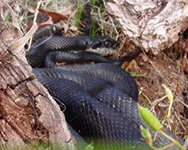 10/16 – Ulster County, HRM 78: During mid-afternoon, while walking through an oak allée [walkway] on Mohonk Preserve, we came upon a beautiful black rat snake (Pantherophis obsoletus) tucked against the inside of a rotting pin oak stump. The air temperature was 68 degrees F, with a fair amount of shade over the stump. While I snapped a few photos the snake remained motionless probably enjoying the ground warmth from the morning’s sun. (Photo of black rat snake courtesy of Bob Ottens) 10/16 – Ulster County, HRM 78: During mid-afternoon, while walking through an oak allée [walkway] on Mohonk Preserve, we came upon a beautiful black rat snake (Pantherophis obsoletus) tucked against the inside of a rotting pin oak stump. The air temperature was 68 degrees F, with a fair amount of shade over the stump. While I snapped a few photos the snake remained motionless probably enjoying the ground warmth from the morning’s sun. (Photo of black rat snake courtesy of Bob Ottens)
- Bob Ottens
[The black rat snake gets to be up to six feet in length and are a common species in New York’s woods and agriculture areas. Residents can often see them near barns, because of the local rodent populations, the rat snake’s preferred diet. NYSDEC]
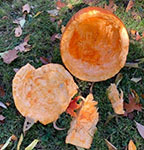 10/16 – Town of Wappinger, HRM 67: In the dark of night, it may have been a black bear of unknown size and sex that took delight in turning over our recycle container and rummaging through the newspapers, cans, and aluminum foil that held a scent of pizza. The size and the heft of the container seemed to eliminate a raccoon, and most other mid-sized mammals, as the bandit. However, I was still uncertain as to the perpetrator. 10/16 – Town of Wappinger, HRM 67: In the dark of night, it may have been a black bear of unknown size and sex that took delight in turning over our recycle container and rummaging through the newspapers, cans, and aluminum foil that held a scent of pizza. The size and the heft of the container seemed to eliminate a raccoon, and most other mid-sized mammals, as the bandit. However, I was still uncertain as to the perpetrator.
The bandit's next stop was to our front porch where our 10 lb. pumpkin had been rolled onto the lawn. Between the porch and the lawn, in soft dirt sprinkled with grass seed, there were two dinner-plate-size paw-claw impressions — circumstantial but rather compelling evidence. The pumpkin had been broken open and the entire inside, seeds and all, had been scooped out. My immediate thought was Pooh Bear and his Honey Pot. (Photo of pumpkin courtesy of Tom Lake)
- Tom Lake
[A few days earlier, while walking our dog in a park less than a mile away, we came upon some rather fresh bear scat. Tom Lake, Phyllis Lake]
10/16 – Bedford, HRM 35: We counted 147 south-migrating raptors today at the Bedford Audubon Chestnut Ridge Hawkwatch; sharp-shinned hawk was high count with 67. Cooper’s hawk (34) also showed well. Turkey vulture was the numerical high-count (202) among non-raptors. It was their best day of the season thus far with lots of them streaming and forming some nice kettles of up to 60 birds. This has also been an excellent season for merlin. We had four today, and now 103 on the season, approaching a record number for that species. Other non-raptor migrants included 15 cedar waxwings, 39 purple finches, and three monarch butterflies
- Richard Aracil, Adam Bradley, Glenn Kaufmann, Harry Wales, Karen Troche, Pedro Troche, Steve Ricker, Tait Johansson, Tom Burns
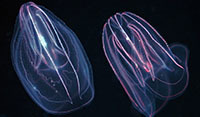 10/16 – Manhattan, HRM 13.5: We were fishing in the Hudson River from Inwood Park’s Dyckman Pier this afternoon when we were surrounded by a swarm of comb jellies. For an hour and a half thousands of them swarmed past heading downstream on the falling tide. There were so many that they filled the bottom of my large drop net. It was an amazing sight. (Photo of comb jellies courtesy of MacKenzie Bubel) 10/16 – Manhattan, HRM 13.5: We were fishing in the Hudson River from Inwood Park’s Dyckman Pier this afternoon when we were surrounded by a swarm of comb jellies. For an hour and a half thousands of them swarmed past heading downstream on the falling tide. There were so many that they filled the bottom of my large drop net. It was an amazing sight. (Photo of comb jellies courtesy of MacKenzie Bubel)
- Nicola Lagonigro, Anthony Logonigro
[Comb jellies (Phylum Ctenophora) are marine invertebrate that swim by beating rows of cilia that resemble combs. The name Ctenophora comes from Greek, meaning "comb carrying." They are often mistaken for jellyfish but differ in that they have no tentacles and do not sting. Like true jellyfish, comb jellies are translucent, gelatinous, fragile, essentially planktonic, drifting at the whim of the wind and current. They are peanut to walnut-sized, often occur in swarms, and are common in warm, brackish estuarine shallows. Nicola’s comb jellies were either Beroe's comb jelly (Beroe cucumis) or Leidy’s comb jelly (Mnemiopsis leidyi). Tom Lake]
10/17 – Bedford, HRM 35: We counted 173 south-migrating raptors today at the Bedford Audubon Chestnut Ridge Hawkwatch; sharp-shinned hawk was high count with 80. Cooper’s hawk (33) and American kestrel (18) also showed well. Turkey vulture was the numerical high-count (122) among non-raptors; many were seen in kettles and large, streaming groups. Four more merlins today, 107 on the season, still approaching a record number for that species. Other non-raptor migrants included 100 American robins and two monarch butterflies
- Richard Aracil, Adam Bradley, Shelly Culbertson
10/17 – Yonkers, HRM 18: Our staff at the Sarah Lawrence Center for the Urban River at Beczak, with the able assistance of eleventh-graders from the Dwight School in Manhattan, made eight seine hauls off our beach. The visual aspect of the first haul was immediate before we even opened the net: scores of wiggling, gleaming Atlantic silverside flashing their exquisite silver sides. These streamlined, terete in cross-section fish, were high count (64) for the day. Another treat was three young-of-year striped bass. Invertebrates included blue crabs and comb jellies. The river temperature was 62 degrees F, salinity was 10.3 parts-per-thousand (ppt), and the dissolved oxygen (DO) was 7.6 parts-per-million (ppm).
- Jason Muller, Christina Edsall
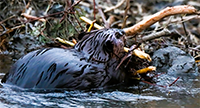 10/18 – Hudson River Watershed: Late October and early November is the busiest time of the year for beavers. Their entire winter’s food supply must be cut, gathered, transported, and piled next to their lodge so that they will have access to it. Mud, sticks, wads of grass and stones are collected to reinforce the lodge’s thick walls against the cold as well as coyotes and other predators. Dams, the structures that create their ponds, must be patched, and strengthened to withstand the rigors of winter. 10/18 – Hudson River Watershed: Late October and early November is the busiest time of the year for beavers. Their entire winter’s food supply must be cut, gathered, transported, and piled next to their lodge so that they will have access to it. Mud, sticks, wads of grass and stones are collected to reinforce the lodge’s thick walls against the cold as well as coyotes and other predators. Dams, the structures that create their ponds, must be patched, and strengthened to withstand the rigors of winter.
The importance of maintaining a dam in good condition cannot be overstated, for without it, the pond would cease to exist, and no pond means no beavers. A beaver pond is a highway, canal, escape route, hiding place, vegetable garden, food storage facility, refrigerator/freezer, water storage tank, bathtub, swimming pool and water toilet (they defecate only in water). (Photo of beaver courtesy of Mary Holland)
- Mary Holland
10/18 – Bedford, HRM 35: We counted 115 south-migrating raptors today at the Bedford Audubon Chestnut Ridge Hawkwatch; sharp-shinned hawk was high count with 42. Red-shouldered hawk (29) and Cooper’s hawk (22) also showed well. Turkey vulture was the numerical high-count (210) among non-raptors migrants. We also had a surprise straggler, a late-season migrating broad-winged hawk. Other non-raptor migrants included 97 American robins.
- Richard Aracil
10/18 – Hook Mountain, HRM 31: Among 25 south-migrating raptors today at the Hook Mountain Hawkwatch, sharp-shinned hawk was high count with 11. Red-shouldered hawk (7) showed well. Among other non-raptor migrants were two monarch butterflies.
- John Phillips
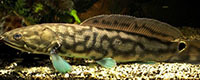 10/18 – Hudson River Watershed: In taxonomic news, our bowfin (genus Amia), has been split into two species. Our bowfin, formerly known as Amia calva, has been changed to Amia ocellicauda. Bowfin are nonnative to our watershed but they have reached us through the Great Lakes, Lake Champlain, and are found in the Hudson River from introductions. 10/18 – Hudson River Watershed: In taxonomic news, our bowfin (genus Amia), has been split into two species. Our bowfin, formerly known as Amia calva, has been changed to Amia ocellicauda. Bowfin are nonnative to our watershed but they have reached us through the Great Lakes, Lake Champlain, and are found in the Hudson River from introductions.
The species name Amia calva is retained by bowfin south of the Hudson River through Florida and west to the Mississippi River. (Photo of bowfin courtesy of Solomon David)
- Bob Schmidt
[Bowfin is an ancient and rugged predator species in the taxonomic realm of sturgeon and gars. Their order (Amiiformes) arose in the Triassic Period 250 million years ago and their family (Amiidae) is known from the Cretaceous 100 million years ago. The bowfin lineage has endured many global cataclysms and carries an adaptation from those times by its ability to breathe (assimilate) atmospheric oxygen using their swim bladder to survive in waters with very low dissolved oxygen. Tom Lake]
10/18 – Yonkers, HRM 18: Our staff at the Sarah Lawrence Center for the Urban River at Beczak, with the able assistance of a third-grade class from Fieldston Ethical Culture School in the Bronx, conducted eight hauls of our seine in the shallows off our beach. Again today, Atlantic silverside was high count (27). Other fish included, one each, young-of-year striped bass and Atlantic menhaden. Students had the opportunity to see the difference between a moon jellyfish (a true jellyfish), and a comb jelly. The river temperature was 61 degrees F, salinity was 8.7 ppt, and the dissolved oxygen (DO) was 8.1 ppm.
- Katie Lamboy, Christina Edsall, Jason Muller
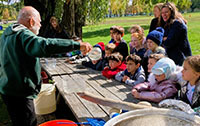 10/19 – Croton Point, HRM 35: Suzanne Milano and her enthusiastic second-graders from Byram Hills Elementary in Westchester County gave us the emotional support we needed to haul our 45-foot seine in the shallows at Mother’s Lap, a small cove on the north side of Croton Point. As we pulled the net up on the sand, the mesh was sparkling in the sun with reflections off hundreds of three-inch-long Atlantic silverside. We soon lost count and slid many of them back into the water and keeping just a few to show the students in our hand-held viewing tank. 10/19 – Croton Point, HRM 35: Suzanne Milano and her enthusiastic second-graders from Byram Hills Elementary in Westchester County gave us the emotional support we needed to haul our 45-foot seine in the shallows at Mother’s Lap, a small cove on the north side of Croton Point. As we pulled the net up on the sand, the mesh was sparkling in the sun with reflections off hundreds of three-inch-long Atlantic silverside. We soon lost count and slid many of them back into the water and keeping just a few to show the students in our hand-held viewing tank.
Also, in the net were young-of-year striped bass and an immature female “sally” blue crab. The river was 60 degrees F, and the salinity was 4.5 ppt. (Photo of school program courtesy of Tom Lake)
- Christopher Letts, John Phillips, Tom Lake
10/19 – Bedford, HRM 35: Of the 48 south-migrating raptors today at the Bedford Audubon Chestnut Ridge Hawkwatch, sharp-shinned hawk was high count with 24. It was an overall a slow day aside from turkey vultures (151), the numerical high-count among non-raptors. We also had five black vultures. Among other non-raptor migrants, purple finch seemed to be having a pretty good flight during the morning with many birds heard and seen in small flocks.
- Richard Aracil, Pat Eskow, Saidah Niblack
10/19 – Hook Mountain, HRM 31: Among 77 south-migrating raptors today at the Hook Mountain Hawkwatch, red-shouldered hawk was high count with 18. Vultures were the highlight with turkey vulture 370 (high count) and black vulture (5) accounting for 83% of the flight. Among other non-raptor migrants, double-crested cormorant numbered more than 150 in afternoon flocks.
- Tim Brew, Tom Fiore
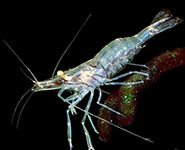 10/19 – Yonkers, HRM 18: A third-grade class from Fieldston Ethical Culture School (Bronx) joined our staff at the Sarah Lawrence Center for the Urban River at Beczak for ten hauls of our beach seine. There is always the hope (and some expectations) that setting and working our net through the inshore shallows will result in a catch that is a good representation of the river life. 10/19 – Yonkers, HRM 18: A third-grade class from Fieldston Ethical Culture School (Bronx) joined our staff at the Sarah Lawrence Center for the Urban River at Beczak for ten hauls of our beach seine. There is always the hope (and some expectations) that setting and working our net through the inshore shallows will result in a catch that is a good representation of the river life.
Today’s effort produced some decent diversity with three invertebrate and two fish species. High count went to blue crabs (16). Among the fishes were young-of-year striped bass and Atlantic silverside. However, the smallest animals, grass shrimp, may have generated the most interest. The river temperature had dropped a bit to 60 degrees F, salinity had dropped to 8.7 ppt, and the dissolved oxygen (DO) was 8.7 ppm. (Photo of grass shrimp courtesy of Richard Key)
- Jason Muller, Katie Lamboy, Christina Edsall
[“Grass shrimp” is a collective common name for three species of native caridean or true shrimp found in the salty and brackish waters of the estuary. These include sand shrimp (Crangon septemspinosa), as well as two species of shore shrimp (Palaemon pugio) and (P. vulgaris). Another, much less common native shrimp in the Hudson River is the brown shrimp (Penaeus aztecus). We also have an invasive species, the Oriental shrimp (Palaemon macrodactylus), native to estuaries and coastal Pacific Ocean waters of Russia, Japan, and South Korea. The “grass” in their common name comes from one of their preferred habitats, submerged aquatic vegetation in the estuarine shallows, such as wild celery, colloquially referred to as “grass.” Tom Lake]
** Fish of the Week **
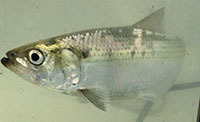 10/20 – Hudson River Watershed: Fish-of-the-Week for Week 192 is the hickory shad (Alosa mediocris) number 25 (of 237) on our watershed list of fishes. If you would like a copy of our list, e-mail trlake7@aol.com. 10/20 – Hudson River Watershed: Fish-of-the-Week for Week 192 is the hickory shad (Alosa mediocris) number 25 (of 237) on our watershed list of fishes. If you would like a copy of our list, e-mail trlake7@aol.com.
Hickory shad is one of nine herrings (Clupeidae) documented for the watershed. Other better-known Clupeids include American shad, blueback herring, alewife, and Atlantic menhaden. Their life histories vary from anadromy (lives in the sea, spawns in natal inland waters), which includes the hickory shad, to temperate marine strays (lives in the sea but visits inland waters, especially as young-of-year), to predominantly freshwater, such as the gizzard shad. The four genus Alosa herrings, alewife, blueback herring, American shad and hickory shad are further assigned, taxonomically, to the sub-family, Alosinae.
Hickory shad range along the Atlantic Coast from the Bay of Funday (Canadian waters) to the Saint John's River in Florida. However, Bigelow and Schroeder in their Fishes of the Gulf of Maine (1953) admit that they rarely see hickory shad in their region of the North Atlantic. Like most other migratory marine fishes, their population fluctuates, and their range expands and contracts due to a myriad of ecological factors. Most often, their center of abundance is along the coastal Carolinas. Wherever they are found, they are a superior gamefish.
Like many herring, hickory shad are silvery with a contrasting dark greenish back. They are thin, fusiform in shape, built to escape-and-evade predators rather blend in or hide. With fish in hand, it is easy to see how their lower jaw extends upward and beyond their upper jaw when closed. They always appear to me, with their jutting jaw, as a “fish with an attitude,” just begging anyone to argue.
The hickory shad’s trivial (species) name mediocris, comes from Latin meaning “middling or ordinary.” This refers to the opinion of Samuel Mitchill (1814), the ichthyologist who named the hickory shad, and speaks to their supposed poor culinary quality. Most connoisseurs of fish will tell you that matched against American shad, they come in a very poor second. I have smoked hickory shad and would rate them well below American shad for taste, but considerably above Atlantic menhaden, a fish that is revered only by humpback whales. Until the fishery was closed in 2010, the “American Shad Bake” was a centuries-long spring tradition along the tidewater Hudson River. There has also been a similar long-time shad bake tradition in the Carolinas for hickory shad. Sometimes traditions transcend good taste.
The presence of hickory shad in the Hudson River is a very sporadic. Our first encounter with hickory shad occurred while commercial American shad fishing in the 1980s. Hickory shad very closely resemble the American shad and with a net full of the former, it is easy to overlook the latter. But after a while we did notice, and we took a few of them to C. Lavett Smith, Curator of Fishes at the American Museum of Natural History in Manhattan. He confirmed our guess that these were adult hickory shad that had been migrating up the river mixed in small numbers with American shad
In the 1980s and 1990s, in addition to the weak spring “run” of adults, it was a common autumn occurrence to find juvenile hickory shad mixed in with young-of-year bluefish and striped bass from the Tappan Zee 40 miles upriver to Diamond Reef at New Hamburg. Such a presence does not seem to have occurred since. (Photo of hickory shad courtesy of Laken Fournier)
- Tom Lake
10/20 – Bedford, HRM 35: Of the 116 south-migrating raptors today at the Bedford Audubon Chestnut Ridge Hawkwatch, sharp-shinned hawk was high count with 62. Turkey vulture (190) was the numerical high-count among non-raptors. There were also five black vultures. Today was our best day thus far this season for merlin (12) tying our 2017 one-day record. Among other non-raptor migrants were 32 American robins, 6 cedar waxwing, and one monarch butterfly.
- Richard Aracil, Adam Bradley
10/20 – Hook Mountain, HRM 31: Among 44 south-migrating raptors today at the Hook Mountain Hawkwatch, sharp-shinned hawk was high count with 17. An adult northern goshawk (our first), with a gray back and light beneath, flew from below the summit in the southeast, then over the summit and barely missing our heads. It moved so quickly on the south wind that our view was less than satisfying — we did not get to see much of the approach. This pathway was used by many of the hawks early in the day. Even a bald eagle came close to that path but stayed just off the summit on the south side.
- Trudy Battaly, Drew Panko
10/20 – Yonkers, HRM 18: A third-grade class from Fieldston Ethical Culture School in the Bronx joined our staff at the Sarah Lawrence Center for the Urban River at Beczak for ten hauls of our beach seine. Collectively, invertebrates were high count with grass shrimp (33) and blue crabs (25). We saw good diversity among the fish with young-of-year striped bass, as well as mummichogs, and one naked goby. The river temperature had dropped a bit to 59 degrees F, salinity had risen to 12.9 ppt, and the dissolved oxygen (DO) was 8.6 ppm.
- Jason Muller, Christina Edsall, Ishika Joshi, Dylan Sandow
10/21 – Bedford, HRM 35: Of the 107 south-migrating raptors today at the Bedford Audubon Chestnut Ridge Hawkwatch, sharp-shinned hawk was high count with 45. Turkey vulture (291) was the numerical high-count among non-raptors. It was overall a very good day, but the blue, featureless sky almost certainly cost us detections. Among other non-raptor migrants were 22 American robins and three monarch butterflies.
- Richard Aracil, Adam Bradley, Glenn Kaufman
10/21 – Hook Mountain, HRM 31: Among 51 south-migrating raptors today at the Hook Mountain Hawkwatch, sharp-shinned hawk was high count with 22. Turkey vulture (29) was the numerical high-count among non-raptors. There were also seven black vultures. Red-shouldered hawk (13) showed well.
- Nadav Snir-Zelniker, Eugene Gardner
10/21 – Yonkers, HRM 18: Volunteers from Regeneron’s “Day for Doing Good” program joined our staff at the Sarah Lawrence Center for the Urban River at Beczak for five hauls of our seine. Our efforts produced a seldom seen oddity: a fishless day. Among invertebrates, blue crab (11) was high count. Others included grass shrimp and comb jellies. The river temperature was 59 degrees F, salinity had risen sharply to 15.1 ppt, and the dissolved oxygen (DO) was 8.1 ppm.
- Jason Muller, Christina Edsall
Autumn 2022 Natural History Programs and Events
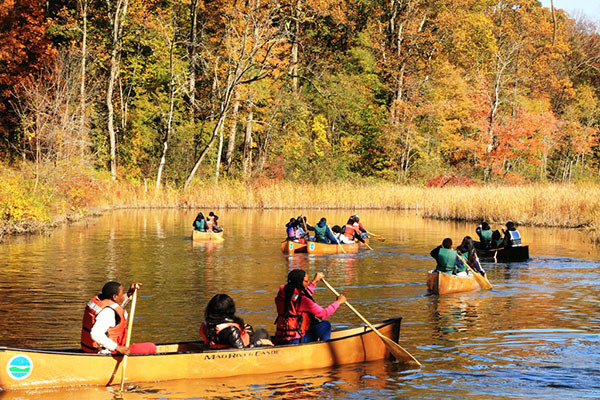
Come Canoeing with the National Estuarine Research Reserve
Free public canoe program in the tidal marshes of the Hudson River estuary. Learn about the wildlife and dynamic system of the tidal wetlands. Information and registration link:
https://2022-nysdec-canoeprogram.eventbrite.com
November 17, 7:00 p.m. The River Before Henry: First Nations Last Elephants
Glens Falls- Saratoga Chapter of the Adirondack Mountain Club
Saratoga Public Library, Saratoga Springs
Tom Lake (DEC Hudson River Estuary Program)
Hudson River Education
Teachers and students will enjoy our new Hudson River K-12 Unit of Study. This carefully curated group of lesson plans, arranged by topic and/or grade, brings together great learning tools developed by the DEC and dozens of estuary partners.
Hudson River Miles
The Hudson is measured north from Hudson River Mile 0 at the Battery at the southern tip of Manhattan. The George Washington Bridge is at HRM 12, the Tappan Zee 28, Bear Mountain 47, Beacon-Newburgh 62, Mid-Hudson 75, Kingston-Rhinecliff 95, Rip Van Winkle 114, and the Federal Dam at Troy, the head of tidewater, at 153. The tidal section of the Hudson constitutes a bit less than half the total distance – 315 miles – from Lake Tear of the Clouds to the Battery. Entries from points east and west in the watershed reference the corresponding river mile on the mainstem.
To Contribute Your Observations or to Subscribe
The Hudson River Almanac is compiled and edited by Tom Lake and emailed weekly by DEC's Hudson River Estuary Program. Share your observations by e-mailing them to trlake7@aol.com. To subscribe to the Almanac (or to unsubscribe), use the links on DEC's Hudson River Almanac or DEC Delivers web pages.
Useful Links
National Oceanic and Atmospheric Administration online tide and tidal current predictions are invaluable when planning Hudson River field trips. For real-time information on Hudson River tides, weather, and water conditions from sixteen monitoring stations, visit the Hudson River Environmental Conditions Observing System website.
DEC's Smartphone app for iPhone and Android is now available at New York Fishing, Hunting & Wildlife App. The HuntFishNY app, includes the new Tackle Box feature, which provides a one-stop location for nearly all State fishing regulations, waterbodies, State-operated fishing access sites, stocking information, and other useful features like photos to help identify fish likely found in a certain river, lake, or stream. Tackle Box allows users to search for waterbodies by name or by panning and zooming. In addition, the new 'navigate' feature gives users driving directions to the boating access site of their choice. The Tackle Box also includes an offline feature that allows anglers to use it when cell service is not available.
|