A Project of the Hudson River Estuary Program
Compiled and edited by Tom Lake, Consulting Naturalist
Love Our NY Lands
State Lands Belong to All of Us
All New Yorkers and visitors should be able to access, enjoy, and feel welcome on state lands. These lands belong to all of us, our families, and our neighbors. While enjoying these shared spaces, be respectful of other visitors. Share trails, treat people with kindness, and leave things as you found them for others to enjoy. All of us have a responsibility to protect State lands for future generations. For more information, visit DEC's website.
Overview
It was a busy week on the river that included our 20th annual Day-in-the-Life of the River and Harbor. With many reports from many participating sites, we will add several to the Almanac each week as they come available. We also added fish species number 237 to our Hudson River Watershed Fish List. The last of the monarchs seem to have fluttered by and the woolly bear caterpillars are still prognosticating a mild winter.
Highlight of the Week
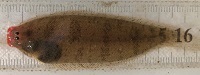 10/8 – Westchester County, HRM 23: On September 12, 2022, the blackcheek tonguefish (Symphurus plagiusa) was added to our Hudson River Watershed List of Fishes as number 237. The fish (53 millimeters) was caught in a seine by the DEC Region 3 Fisheries Unit near the Dobbs Ferry train station. (Photo of blackcheek tonguefish courtesy of ElizaBeth Strefeneder) 10/8 – Westchester County, HRM 23: On September 12, 2022, the blackcheek tonguefish (Symphurus plagiusa) was added to our Hudson River Watershed List of Fishes as number 237. The fish (53 millimeters) was caught in a seine by the DEC Region 3 Fisheries Unit near the Dobbs Ferry train station. (Photo of blackcheek tonguefish courtesy of ElizaBeth Strefeneder)
- ElizaBeth Streifeneder
[As Bob Schmidt checked the fish collection of the New York State Museum in Albany for prior records, he discovered that there were two for the blackcheek tonguefish: NYSM 75317 from the Arthur Kill in 1991, and NYSM 51415 from the East River in 2000. Either of these would have qualified the species for inclusion on our list. At the time, however, there was some skepticism that the Arthur Kill and the East River, now accepted as Hudson River tributaries, were not a part of the watershed.
While the blackcheek tonguefish has been eligible for inclusion since 2000, in the 21 years since, until this September, there had been no documented records. However, during September 2022, no fewer than five were captured in seines by the DEC Region 3 Fisheries Unit and river educators from Yonkers to Croton Point (river miles 18-35). An additional tonguefish was caught at Coney Island Creek in Brooklyn in early October. It is unclear why we saw none for 21 years, and then six in about one month. Tom Lake]
[Note: One-inch equals 25.4 millimeters (mm).]
Natural History Entries
10/8 – Bedford, HRM 35: We counted 163 south-migrating raptors today at the Bedford Audubon Chestnut Ridge Hawkwatch; sharp-shinned hawk was high count with 103.Turkey vulture (29) showed well. Given the northwest winds and the excellent conditions, I thought it was going to be a bigger day than it was.
- Richard Aracil
10/8 – Hook Mountain, HRM 31: Among 69 south-migrating raptors today at the Hook Mountain Hawkwatch, sharp-shinned hawk was high count with 39. Non-raptor migrants included 150 Canada geese, common raven, chimney swifts, one monarch butterfly, and purple finches, male and female, eating the flowers on the chinkapin oak that had lost many leaves from the drought, but recovered after the rains by producing new flowers.
- Trudy Battaly, Drew Panko, Alexander Kalogerakis, Betsy Wiesendanger
10/9 – Hudson River Watershed: Among indigenous peoples, full moons have long been labeled with fanciful names that are rooted in oral traditions, indigenous memories, and ethnographic accounts.
Among Mohican people, whose ancestral homeland lies wholly within the Hudson River watershed, the October full moon is known as the Hunting Moon, Paʔpeepmãat Neepãʔuk, in the Mohican dialect.
Tribal translations of full moons pre-date colonization and generally reflect the seasonality of the lunar phase. Moon phases, in fact, were used by indigenous people as measurements of time.
- Larry Madden, Stockbridge-Munsee Band of Mohican Indians
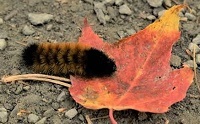 10/9 – Greene County: I took the short walk down from the upper parking lot to the Katterskill Falls viewing platform, between Haines Falls and Palenville. The woods glowed with sunlight through the vibrant fall foliation. Along the walk I saw three woolly bear caterpillars (Pyrrharctia Isabella) rumbling along as if there was important business to attend. These black-and-brown bristled creatures are preparing to hole up and, with their fur coats, can withstand cold to ninety-degrees below zero Fahrenheit. They can easily be held, curl up when they sense danger, but soon crawl along again. They are alleged to be winter forecasters: a wider red/brown middle band predicts a milder winter while more dominant wider black bands at the head or tail predict harsher winters. 10/9 – Greene County: I took the short walk down from the upper parking lot to the Katterskill Falls viewing platform, between Haines Falls and Palenville. The woods glowed with sunlight through the vibrant fall foliation. Along the walk I saw three woolly bear caterpillars (Pyrrharctia Isabella) rumbling along as if there was important business to attend. These black-and-brown bristled creatures are preparing to hole up and, with their fur coats, can withstand cold to ninety-degrees below zero Fahrenheit. They can easily be held, curl up when they sense danger, but soon crawl along again. They are alleged to be winter forecasters: a wider red/brown middle band predicts a milder winter while more dominant wider black bands at the head or tail predict harsher winters.
In spring these larva will pupate in a fuzzy cocoon and then metamorphose into an Isabella tiger moth. Every species in our woods has a role to play and each time I see a woolly bear I get a warm vibe. (Photo of wooly bear caterpillars courtesy of Mario Meier)
- Mario Meier
10/9 – Buchanan, HRM 42: Although the blossoms on our butterfly bush are fading, we were delighted to see a lone monarch butterfly on one of the flowers. It returned today to the same spot. We’re concerned that it was left behind as its relatives should have already departed for their trip to Mexico. Usually, we see droves of monarchs at Cape May at this time of the year, stopping off on their way south.
- Dorothy Ferguson, Bob Ferguson
[The monarchs will be fine. They were seasonally migrating long before we were here to fuss over them. They are still moving through, the laggards mostly, but there are some still keeping pace ahead of heavy frost. It will get critical next month. I recall a decade ago, after a late October killing frost, I walked along the beach at Little Stony Point Preserve and came upon the tattered orange and black wings of monarchs in the receding tideline. They had failed to stay one step ahead of winter. Tom Lake]
10/9 – Bedford, HRM 35: We counted 196 south-migrating raptors today at the Bedford Audubon Chestnut Ridge Hawkwatch; sharp-shinned hawk was high count with 129. Sharp-shinned hawk was still going strong with consistent movement throughout most of the watch. Turkey vulture (127) was the numerical high-count among non-raptors. This was our highest turkey vulture count yet with most birds streaming low and sometimes kettling to our south-southeast.
Other non-raptor migrants included 15 Canada geese, 2 monarch butterflies, 14 American robins, 17 cedar waxwings, and 22 purple finches,
- Adam Bradley, Richard Aracil, Dean and Liz, Diane and Christine, Nicholas DeLuca
10/9 – Hook Mountain, HRM 31: Among nine south-migrating raptors today at the Hook Mountain Hawkwatch, sharp-shinned hawk was high count with seven.
- Tom White, Raimund Miller
10/10 – Bedford, HRM 35: We counted 78 south-migrating raptors today at the Bedford Audubon Chestnut Ridge Hawkwatch; sharp-shinned hawk was high count with 48. Turkey vulture (91) was the high-count among non-raptors. Other non-raptor migrants included 58 Canada geese and one monarch butterfly.
- Adam Bradley
** Fish of the Week **
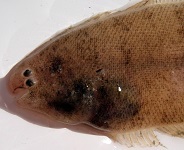 10/11 – Hudson River Watershed: Fish-of-the-Week for Week 191 is the blackcheek tonguefish (Symphurus plagiusa) number 229 (of 237) on our watershed list of fishes. If you would like a copy of our list, e-mail trlake7@aol.com. 10/11 – Hudson River Watershed: Fish-of-the-Week for Week 191 is the blackcheek tonguefish (Symphurus plagiusa) number 229 (of 237) on our watershed list of fishes. If you would like a copy of our list, e-mail trlake7@aol.com.
The blackcheek tonguefish is a flatfish, somewhat related to flounders and soles. Along with the northern tonguefish (S. pusillus), they are the only members of the tonguefish family (Cynoglossidae) in the watershed where they are designated as temperate marine strays. Tonguefishes are a lefteyed flatfish with both eyes on the left side of their head. [See 10/13–Yonkers for more on lefteyed flatfish.]
The blackcheek tonguefish is very abundant in shallow coastal waters and estuaries from the New York Bight south through the Florida Keys, the Gulf of Mexico to Cuba. They favor soft, muddy bottoms feeding mainly on small benthic invertebrates, principally small crabs, polychaetes, copepods, amphipods, and ostracods. Their maximum total length is 210 mm. (Photo of blackcheek tonguefish with permission by North American Native Fishes)
- Tom Lake
10/11 – Bedford, HRM 35: We counted 130 south-migrating raptors today at the Bedford Audubon Chestnut Ridge Hawkwatch; sharp-shinned hawk was high count with 82. Turkey vulture (60) was the numerical high-count among non-raptors. Other non-raptor migrants included 11 Canada geese and one monarch butterfly.
- Adam Bradley
10/11 – Hook Mountain, HRM 31: Among 27 south-migrating raptors today at the Hook Mountain Hawkwatch, sharp-shinned hawk was high count with 21. The first raptor of the day was a juvenile northern harrier rowing steadily overhead from the northeast then looping back around for a closer look. The harrier swooped in so close and so low and that its facial discs could be eyeballed as it passed and continued steadily southwest. Three sharp-shinned hawks circled up a cliff face, interacting playfully and spiraling to great heights, before streaming southwest.
Early morning trees held many blue jays as well as a few white-breasted nuthatches, tufted titmice, and migrating black-throated green warblers. In the eleven o'clock hour, a flock of a dozen purple finches arrived and fed on the red berries of bush honeysuckle (Lonicera sp.). Many yellow-rumped warblers and ruby-crowned kinglets also appeared. In early afternoon, two v-skeins of forty-plus migrating Canada geese were spotted several miles away to southwest.
- John Phillips, Raimund Miller
10/11 – Yonkers, HRM 18: A jump in salinity gave our staff at the Sarah Lawrence Center for the Urban River at Beczak expectations. However, that did not seem to help our five seine hauls as high count went to comb jellies (55). Blue crabs (11) were next. Among the fishes we found were Atlantic silverside (10), American eel, white perch, and young-of-year bay anchovies and striped bass. The river temperature was 64 degrees Fahrenheit (F), salinity was 14.8 parts-per-thousand (ppt), and the dissolved oxygen (DO) was 7.3 parts-per-million (ppm).
- Jason Muller, Rachel Lynch, Kiki Quiros
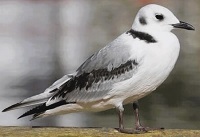 10/12 – Delmar, HRM 143: It was reported in the Hudson River Almanac on September 29 that the National Veterinary Services Laboratory concluded that the waterfowl found dead at The Crossings Park of Colonie in Loudonville, including the rare-in-the-area black-legged kittiwake, died of bird flu. 10/12 – Delmar, HRM 143: It was reported in the Hudson River Almanac on September 29 that the National Veterinary Services Laboratory concluded that the waterfowl found dead at The Crossings Park of Colonie in Loudonville, including the rare-in-the-area black-legged kittiwake, died of bird flu.
With some additional investigation, it was determined that the black-legged kittiwake (Rissa tridactyla) recovered from the Crossings Park in Colonie did not test positive for HPAI (bird flu). The carcass was submitted to the New York State Museum that allowed us to perform AI testing, take some radiographs, and perform an external exam (no necropsy was performed). This bird was markedly underweight quite possibly the result of being blown or traveled outside of its normal habitat/range. However, our examination and testing of this bird was limited. I think it was mere coincidence that this kittiwake was found at a site of an active HPAI outbreak in mallards and Canada geese.
HPAI is widespread across New York with virus currently moving through in migrating mallards and other waterfowl. It appears to be especially affecting Canada and snow geese, vultures, and raptors including bald eagles (24 eagles dead from HPAI this year so far). (Photo of black-legged kittiwake courtesy of Cornell Lab Orinthology)
- Kevin Hynes, Wildlife Health Program Leader, Division of Fish and Wildlife (Delmar)
10/12 – Bedford, HRM 35: We counted 179 south-migrating raptors today at the Bedford Audubon Chestnut Ridge Hawkwatch; sharp-shinned hawk was high count with 96. Turkey vulture (107) was the numerical high-count among non-raptors.
Other non-raptor migrants included three chimney swifts, one monarch butterfly, and a good flight of purple finches. The other highlight was a flyover red-headed woodpecker, a first for me at the Hawkwatch.
- Richard Aracil, Adam Bradley, Glenn Kaufmann
10/12 – Hook Mountain, HRM 31: Among 77 south-migrating raptors today at the Hook Mountain Hawkwatch, sharp-shinned hawk was high count with 41. When I came up over the last crest of the hill to the summit, there were three northern harriers flying by in formation in a triangle with a kestrel out front. A little before 3:00 p.m., six eagles arrived en masse, and hung around and chased each other for 15-20 minutes before moving on.
- Steve Sachs
10/12 -- Yonkers, HRM 18: A class of fourth-graders from the Trinity School in Manhattan became indispensable for our staff at the Sarah Lawrence Center for the Urban River at Beczak as we made eleven hauls of our seine. Blue crabs were high count with 26, making for several exciting moments. Among the fishes, flashy Atlantic silverside were high with 19. Others included white perch and young-of-year striped bass. The river temperature was 62 degrees F, salinity was13.4 ppt, and the dissolved oxygen was 6.8 ppm.
- Jason Muller, Christina Edsall, Katie Lamboy
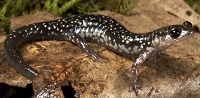 10/13 – Albany County, HRM 145: Amphibian migration is not just a spring phenomenon. I usually check a few roads on warm rainy nights in the fall as well. At 9:00 p.m. this evening it was 54 degrees and raining, so I checked my local roads in the Town of New Scotland below Thatcher Park for road-crossing amphibians. Sadly, I found more dead than live. With so many fallen leaves on the road, spotting them was not easy even when walking. 10/13 – Albany County, HRM 145: Amphibian migration is not just a spring phenomenon. I usually check a few roads on warm rainy nights in the fall as well. At 9:00 p.m. this evening it was 54 degrees and raining, so I checked my local roads in the Town of New Scotland below Thatcher Park for road-crossing amphibians. Sadly, I found more dead than live. With so many fallen leaves on the road, spotting them was not easy even when walking.
The tally included:
- Spotted salamander (3 dead on road, 1 alive on road).
- Wood Frog (4 dead on road; 3 alive on road).
- Gray treefrog (5 dead on road.
- Spring peeper (2 alive on road).
- Northern slimy salamander (1 alive on road).
- Bullfrog (1 alive on road).
- Common garter snake (1 dead on road).
The most surprising find was the northern slimy salamander (Plethodon glutinosus), an upland species that does not move far from its normal habitat. In 40 years of surveying this stretch of road, I cannot recall ever finding a slimy salamander on the road although I do find them within a couple hundred feet in the area up-slope from the road. (Photo of northern slimy salamander courtesy of Todd Pierson)
- Alvin Breisch
[For more information, see The Amphibians and Reptiles of New York State, Al Breisch (2007)]
10/13 – Saugerties, HRM 102: We had our most recent sighting today of the male harbor seal (flipper tagged 246), via Alan Beebe. I was able to confirm the sighting with binoculars from the Saugerties Lighthouse. He was on the smaller and more southerly of two rock islands, in a bay, just upriver and only at low tide.
- Patrick Landewe
[We had not seen the seal since September 10. Today’s sighting was day number 1,165 (since August 5, 2019) that this male harbor seal, a marine mammal, has chosen to recognize tidewater Esopus Creek and environs as his home base, 110 miles from the sea. Tom Lake]
10/13 -- Hudson River Estuary: The 20th Annual Day-in-the-Life of the River and Harbor hosted 80 participating schools with 4,400 students, from sites along 160 river miles from Troy, at the head of tide, to Great Kills Gateway National Recreation Area, Staten Island.
Day-in-the-Life of the River and Harbor has become an opportunity to blend science, education, and almost a poetic reverence to our connection to the world we share. It is a day to pay homage to our educators and scientists and recognize their roles. Naturalist Teilhard de Chardin said it well when he reasoned that “the future belongs to those who give the next generation reason for hope.”
- Tom Lake
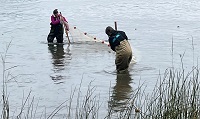 10/13 – New Baltimore, HRM 131.5: For their contribution to the 20th annual Day-in-the-Life of the River and Harbor, a fourth-grade class from the Ravena-Coeymans Elementary School traveled to New Baltimore Conservancy’s Hudson River Interpretive Tail to learn about the Hudson River. Volunteers from the Conservancy, DEC, and the New York State Museum hosted several stations where students learned, among many other topics, how plate tectonics helped shape the Hudson Valley. Other station topics included invasive plants, the first recycled plastic bridge, water quality parameters, and beach seining. Our net captured many young-of-year river herring and striped bass as well as several blue crabs. During our program we were visited by the Hudson Riverkeeper vessel as well as a DEC fish-shocking boat crew. (Photo of Day-in-the-Life of the River and Harbor courtesy of Dan Drazan) 10/13 – New Baltimore, HRM 131.5: For their contribution to the 20th annual Day-in-the-Life of the River and Harbor, a fourth-grade class from the Ravena-Coeymans Elementary School traveled to New Baltimore Conservancy’s Hudson River Interpretive Tail to learn about the Hudson River. Volunteers from the Conservancy, DEC, and the New York State Museum hosted several stations where students learned, among many other topics, how plate tectonics helped shape the Hudson Valley. Other station topics included invasive plants, the first recycled plastic bridge, water quality parameters, and beach seining. Our net captured many young-of-year river herring and striped bass as well as several blue crabs. During our program we were visited by the Hudson Riverkeeper vessel as well as a DEC fish-shocking boat crew. (Photo of Day-in-the-Life of the River and Harbor courtesy of Dan Drazan)
- Dan Drazan
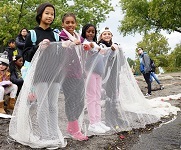 10/13 – Cornwall Landing, HRM 57: Sixty fourth-grade students and staff from Willow Avenue Elementary, with teacher Christine Cleeves, joined us on the beach at Cornwall Landing for our contribution to the 20th annual Day-in-the-Life of the River and Harbor. 10/13 – Cornwall Landing, HRM 57: Sixty fourth-grade students and staff from Willow Avenue Elementary, with teacher Christine Cleeves, joined us on the beach at Cornwall Landing for our contribution to the 20th annual Day-in-the-Life of the River and Harbor.
We were met by a stiff and stormy east wind pushing us one step ahead of promised thunderstorms. The beach is directly under Storm King Mountain, adding to the intrigue. Ravens that nest on the mountain serenaded us and an osprey, a fish hawk with expectations, pirouetted overhead. As we discussed the river, I could sense that our words were blowing away in the wind. Students and staff were sitting on deadfalls across 100 feet of beach. The rising tide, pushed by the wind, was encroaching on our space until by program’s end the river was only inches from the students.
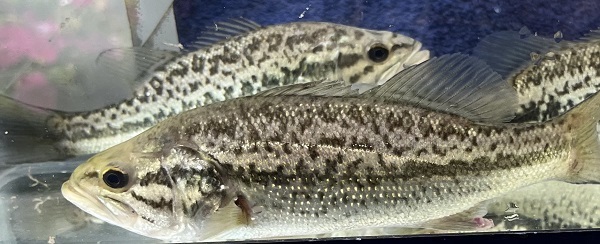
Our catch with a 30-foot-long seine, expertly hauled by Jill Connors and Christian Owens, was impressive by any measure. Among the fishes were young-of-year American shad, blueback herring, striped bass, and Atlantic silverside. Others included three seven-inch-long largemouth bass, spottail shiners, white perch, and one male blue crab. The river was a very comfortable 64 degrees F, but the salinity had fallen to 2.0 parts-per-thousand. (Photo of Day-in-the-Life of the Hudson and Harbor courtesy of Conor Dobson)
- Tom Lake, Christopher O’Sullivan, Conor Dobson
[Deadfall is a tree that has fallen and, in this instance, driven up on the beach by storm surge. Tom Lake]
10/13 – Bedford, HRM 35: We counted 63 south-migrating raptors today at the Bedford Audubon Chestnut Ridge Hawkwatch; sharp-shinned hawk was high count with 25. Despite the unfavorable wind, there was good movement of sharp-shinned hawk, Cooper’s hawk, and turkey vulture until noon when the rain moved in. It was not a very birdy day for non-raptor migrants. Turkey vulture (57) was among the numerical high-counts among non-raptors. Others included 7 chimney swifts, 33 tree swallows, 169 American robins, 27 cedar waxwings, and 6 purple finches.
- Richard Aracil
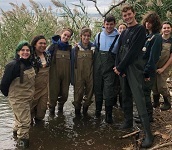 10/13 – Piermont, HRM 25: Despite impending storms, 97 students from Pearl River, Spring Valley, Clarkstown North, and Clarkstown South High Schools joined us on the pier at Piermont for an incredible Day-in-the-Life of the Hudson and Harbor. The students measured the tides, currents, and turbidity, and tested the water for salinity, dissolved oxygen, pH, and more. Additionally, they pulled on chest waders and jumped into the river to do sediment coring and seining! 10/13 – Piermont, HRM 25: Despite impending storms, 97 students from Pearl River, Spring Valley, Clarkstown North, and Clarkstown South High Schools joined us on the pier at Piermont for an incredible Day-in-the-Life of the Hudson and Harbor. The students measured the tides, currents, and turbidity, and tested the water for salinity, dissolved oxygen, pH, and more. Additionally, they pulled on chest waders and jumped into the river to do sediment coring and seining!
The rising tide and diminishing beach along the north side of the pier made seining challenging, but the cooler oxygen-rich waters (66 degrees F), dissolved oxygen at 9.0 ppm) helped the students catch 253 Atlantic silverside, as well as young-of-year fishes including 5 striped bass, 4 Atlantic Menhaden, and one Atlantic Herring (the latter is a rare catch at Piermont and it was wonderful for the students to get to experience this rare occasion. Our seine also caught 8 blue crabs and an estimated 1,500 moon jellyfish. The salinity was 11.0 ppt. (Photo of Day-in-the-Life of the Hudson and Harbor courtesy of Marisa Annunziato)
- Marisa Annunziato
 10/13 – Yonkers, HRM 18: Our staff at the Sarah Lawrence Center for the Urban River at Beczak, with assistance from a class of fourth-graders from St. Hilda’s School in Manhattan, made our contribution to the 20th annual Day-in-the-Life of the River and Harbor. We made sixteen hauls of our seine partially for the day, but mostly to the excitement of the students. The daily “high count” cooperated, moving from invertebrates to fish with Atlantic silverside (59). Other fishes included young-of-year striped bass and bay anchovies, as well as white perch and resident mummichogs. Blue crabs and comb jellies also showed well. 10/13 – Yonkers, HRM 18: Our staff at the Sarah Lawrence Center for the Urban River at Beczak, with assistance from a class of fourth-graders from St. Hilda’s School in Manhattan, made our contribution to the 20th annual Day-in-the-Life of the River and Harbor. We made sixteen hauls of our seine partially for the day, but mostly to the excitement of the students. The daily “high count” cooperated, moving from invertebrates to fish with Atlantic silverside (59). Other fishes included young-of-year striped bass and bay anchovies, as well as white perch and resident mummichogs. Blue crabs and comb jellies also showed well.
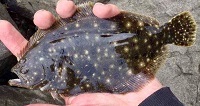
However, the show-stopper, an eleven-inch-long summer flounder, was caught as we made a haul in the Beczak tidemarsh. It was a gorgeous lefteyed flatfish with tooth studded jaws — a serious predator among bottom-dwelling aquatic life. The river temperature was 64 degrees F, salinity had dropped a bit to 12.2 ppt, and the dissolved oxygen (DO) was 7.9 ppm. (Photo of summer flounder courtesy of Anthony Ferino)
- Jason Muller, Ishika Joshi, Ryan Palmer, Christina Edsall
[Flounder are born with one eye on each side of their head, as with most fishes. As they grow from their larval to juvenile stage, through a process called metamorphosis, they lie flat on the bottom and one eye migrates to the opposite side of their head. As a result, both eyes are then on the side that faces up. If the eyes end up on the left side, they are a lefteyed flounder, such as summer flounder; if on the right side, a righteyed flounder, such as winter flounder. Which way the eyes go is predetermined by their DNA.
This odd arrangement of eyes is a wonderful example of evolutionary adaptation through natural selection and favored traits. As a further adaptation for concealment, the topside of most flounders can almost precisely mimic the substrate providing excellent camouflage from predators. Tom Lake]
 10/13 – Manhattan, HRM 11: Michelle Madera and 72 of her fifth-grade students from Dos Puentes Elementary School joined us at Swindler Cove for our contribution to the 20th annual Day-in-the-Life of the Hudson and Harbor. 10/13 – Manhattan, HRM 11: Michelle Madera and 72 of her fifth-grade students from Dos Puentes Elementary School joined us at Swindler Cove for our contribution to the 20th annual Day-in-the-Life of the Hudson and Harbor.
We investigated the Harlem River documenting water quality data during the midday flood tide. The infusion of new water from downriver resulted in the water temperature rising from 62 to 65 degrees F., the salinity rising from 16 to 18 ppt., and the dissolved oxygen lowering from 8.0 to 7.0 ppm.
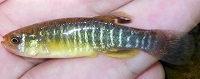
With the students’ assistance and charged by their enthusiasm, we made four seine hauls. Mummichogs (killifish, up to 60 mm) were the high count (21). Other fishes included young-of-year Atlantic silverside (60 mm) and Atlantic menhaden (40 mm). Two blue crabs (80 mm) were the major invertebrates. In the last 20 minutes of the program, despite some rain coming down, we managed to hand-catch a medium-size (250 mm carapace length) snapping turtle. Thank you Harlem River! (Photo of mummichog courtesy of Tom Lake)
- Chris Bowser
[We were also joined by Assistant Principal Alcira Jaar and her teaching staff of Kristen Minno, Karen Mondol, Yesenia Moreno, and Irvin Mota, DEC’s Jesenia Laureano and Adanna Roberts, NYRP’s Maxwell Tetrault, and SCA educators Olivia Castaneda, Natalie Schults, and Nick Ventre. Chris Bowser]
[The standard research measurement for blue crabs (millimeters) is point-to-point, laterally, across their carapace.]
10/14 – Bedford, HRM 35: We counted 70 south-migrating raptors today at the Bedford Audubon Chestnut Ridge Hawkwatch; sharp-shinned hawk was high count with 25. Turkey vulture (100) and black vulture (4), collectively New World Vultures (Cathartidae), were the numerical high count among non-raptor migrants. Other non-raptor migrants included 4 monarch butterflies, 100 American robins, and 2 purple finches.
- Richard Aracil, Diane Faber, Jack Kozuchowski, Tom Burns
10/14 -- Yonkers, HRM 18: Our staff at the Sarah Lawrence Center for the Urban River at Beczak, with the able assistance of a fourth-grade class from the Martin Luther King in Yonkers, made ten hauls of our seine today. If you ignore comb jellies (which we did), with 35, Atlantic silverside (well-named with their long, silvery lateral stripe) were high count with 29. We also had two delightful moon jellyfish, and six blue crabs. The river temperature had dropped a bit to 62 degrees F, salinity was 13.5 ppt, and the dissolved oxygen (DO) was 7.1 ppm.
- Christina Edsall, Jason Muller, Kinza Siddiqui
Fall 2022 Natural History Programs and Events
Come Canoeing with the National Estuarine Research Reserve
Free public canoe program in the tidal marshes of the Hudson River estuary. Learn about the wildlife and dynamic system of the tidal wetlands. Information and registration link:
https://2022-nysdec-canoeprogram.eventbrite.com
November 17, 7:00 p.m. The River Before Henry: First Nations Last Elephants
Glens Falls- Saratoga Chapter of the Adirondack Mountain Club
Saratoga Public Library, Saratoga Springs
Tom Lake (DEC Hudson River Estuary Program)
Hudson River Education
Teachers and students will enjoy our new Hudson River K-12 Unit of Study. This carefully curated group of lesson plans, arranged by topic and/or grade, brings together great learning tools developed by the DEC and dozens of estuary partners.
Hudson River Miles
The Hudson is measured north from Hudson River Mile 0 at the Battery at the southern tip of Manhattan. The George Washington Bridge is at HRM 12, the Tappan Zee 28, Bear Mountain 47, Beacon-Newburgh 62, Mid-Hudson 75, Kingston-Rhinecliff 95, Rip Van Winkle 114, and the Federal Dam at Troy, the head of tidewater, at 153. The tidal section of the Hudson constitutes a bit less than half the total distance – 315 miles – from Lake Tear of the Clouds to the Battery. Entries from points east and west in the watershed reference the corresponding river mile on the mainstem.
To Contribute Your Observations or to Subscribe
The Hudson River Almanac is compiled and edited by Tom Lake and emailed weekly by DEC's Hudson River Estuary Program. Share your observations by e-mailing them to trlake7@aol.com. To subscribe to the Almanac (or to unsubscribe), use the links on DEC's Hudson River Almanac or DEC Delivers web pages.
Useful Links
National Oceanic and Atmospheric Administration online tide and tidal current predictions are invaluable when planning Hudson River field trips. For real-time information on Hudson River tides, weather, and water conditions from sixteen monitoring stations, visit the Hudson River Environmental Conditions Observing System website.
DEC's Smartphone app for iPhone and Android is now available at New York Fishing, Hunting & Wildlife App. The HuntFishNY app, includes the new Tackle Box feature, which provides a one-stop location for nearly all State fishing regulations, waterbodies, State-operated fishing access sites, stocking information, and other useful features like photos to help identify fish likely found in a certain river, lake, or stream. Tackle Box allows users to search for waterbodies by name or by panning and zooming. In addition, the new 'navigate' feature gives users driving directions to the boating access site of their choice. The Tackle Box also includes an offline feature that allows anglers to use it when cell service is not available.
|