Forever Chemicals, EVs and Cleaner Air – Air Mail!
The New York State Department of Environmental Conservation sent this bulletin on 10/21/2022 02:00 PM EDT |
| DEC Delivers - Information to keep you connected and informed from the NYS Department of Environmental Conservation |
| Share or view as a web page || Update preferences or unsubscribe |
This Month's Topics: |
|
Public & Stakeholder Participation Information:
Air Mail! is the publication to announce public and stakeholder information about air quality topics. All NYS residents are environmental stakeholders – we welcome anyone to join the information sessions and other opportunities posted here. Air Pollution Spotlight: Forever Chemicals
What do non-stick pans, firefighting foam, microwave popcorn bags, cleaning products, fast food containers and wrappers, cosmetics, and stain-resistant carpets have in common? They all may contain forever chemicals called PFAS. PFAS is the acronym for a diverse group of man-made chemicals called Per- and Poly-FluoroAlkyl Substances, mainly used as waterproof and non-stick coatings, degreasers, and fire retardants. PFAS can enter the body by ingesting contaminated food or water, or by breathing in PFAS released during manufacturing or other industrial processes. Once in the body, PFAS collect and stay in the cells of animals and people for a long time and they can build up to toxic levels if there is enough exposure to PFAS pollution. Due to decades of global PFAS use and their long-lived nature, these chemicals have now spread worldwide. These persistent chemicals are found in the environment and organisms of even the most remote areas of our planet. The US Centers for Disease Control and Prevention (CDC) estimates that 97-98% of the US population may have detectable levels of PFAS in their blood. Areas surrounding facilities that have used PFAS in their manufacturing for many decades have among the highest concentrations of PFAS contamination in the water and soil, including locations in NY. Exposure to toxic levels of certain PFAS can lead to liver damage, thyroid disease, decreased fertility, reproductive and developmental effects, high cholesterol, decreased immune response, obesity, hormone suppression, and even certain types of cancer. The Environmental Protection Agency (EPA) continues to review the toxicity of individual PFAS compounds to determine exposure limits for them as part of their overall PFAS Strategic Roadmap. EPA developed its first-ever air sampling technique in early 2021, called the Other Test Method-45 (OTM-45), which can measure PFAS levels in air. This new technique will be an important tool for facilities and regulators to ensure that airborne PFAS are not being released from facilities at concerning levels. Although some of the legacy PFAS compounds are being replaced with less persistent PFAS, many of these compounds are still found in everyday household items. While totally preventing exposure to PFAS would be very difficult, given the extent of their continued and historical use and environmental contamination, you can still take steps to reduce your exposure. Look for PFAS-Free cookware when it's time to replace old, scratched, non-stick pots and pans. Instead of pre-packaged microwave popcorn, make your own by popping plain kernels in a paper bag or using an air popper. Making educated choices in our daily lives will help protect not only your health but also the health of our air and environment. Photo Caption: Due to its fire suppression properties, PFAS were added to firefighting foam called AFFF. AFFF was used to fight electrical and aviation fires. Authorities began a voluntary phase-out of AFFF in 2006. Quieter Roadways and Cleaner Air
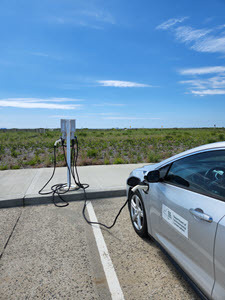
NYS is moving into a cleaner future by increasing the number of zero-emission vehicles (ZEV) on the road. ZEVs include battery electric, hydrogen fuel cell, and plug-in hybrid electric-powered vehicles. Governor Hochul directed DEC to propose the adoption of California’s Advanced Clean Cars II (ACC II) regulations. Starting in 2035, all new passenger cars, pickup trucks, and SUVs sold in NYS must be ZEV. The regulation mandates minimum percentages of ZEV sales within NYS from 2026-2035, which will improve air quality statewide by significantly reducing vehicle tailpipe emissions. These emissions reductions will be particularly significant in communities disproportionately impacted by transportation-related air pollution. The regulation will also help address disproportionate risks and health and pollution burdens affecting communities. ACC II would augment existing rules by progressively increasing the number of electric vehicles over time. The light-duty passenger ZEV sales requirements will increase to 35 percent in 2026, 68 percent by 2030, and 100 percent by 2035. During that same period (2026-2034), new internal combustion engine emission standards will also slash tailpipe emissions even further. These actions support NY’s Climate Leadership and Community Protection Act (CLCPA) goal of reducing greenhouse gas emissions by 85 percent by 2050, as well as helping NY meet National Ambient Air Quality Standards (NAAQS). To support the adoption of ACC II, NYS will expand upon existing programs and tap into additional funding sources. The Drive Clean Rebate program was increased by $10 million to help New Yorkers purchase or lease electric vehicles. The EVolve NY Fast Charging Network, administered by the New York Power Authority, has installed over 100 direct current “fast” charger ports across the state. Additionally, $175 million in federal funding from the National Electric Vehicle Infrastructure (NEVI) Plan will allow for further expansion of NYS’ electric vehicle charging network. Using NYS Volkswagen Settlement funds, $11 million was dedicated to direct current fast charging station installations along travel corridors throughout NYS, and $6.2 million was used to fund the Charge Ready NY Level 2 charging program. In 2035, our roadways around the state will be filled with quiet, emissions-free electric vehicles giving us all cleaner air to enjoy well into the future. Photo Caption: In order to have more electric vehicles on the road, we first need to build out our charging network across the state to help us reach our goals. Through grants and other funding sources, NYS is doing just that. Helpful Links:
Dates to Remember:
Stay Informed about Your Air QualityNYS ozone season runs from April through September. DEC publishes ground-level ozone forecasts during ozone season and particulate matter pollution forecasts year-round using a scale called the Air Quality Index (AQI). DEC sends out an air quality alert when there is a high AQI value, which indicates polluted air. Individuals with pre-existing respiratory or cardiovascular conditions and people who exercise outdoors should take caution during an air quality alert. Find out if an Air Quality Alert is in effect by calling the toll-free Ozone Hotline: 1-800-535-1345. The AQI can be accessed in three ways:
Connect with us at Air Mail!Did you enjoy reading this issue? Perhaps your friends and family would too. Share Air Mail! by using the “Share” button below. If you would like to receive Air Mail! in your own email box, sign up now! We would also like to know what you think. Send your Air Mail! questions and comments to the team at DAR.web@dec.ny.gov. |

|
The New York State Department of Environmental Conservation respects your right to privacy and welcomes your feedback | Update preferences or unsubscribe | Learn more about DEC Delivers |
|
Connect with DEC:     
|
|
| Basil Seggos, Commissioner | |