A Project of the Hudson River Estuary Program
Compiled and edited by Tom Lake, Consulting Naturalist
Love Our NY Lands
State Lands Belong to All of Us
All New Yorkers and visitors should be able to access, enjoy, and feel welcome on state lands. These lands belong to all of us, our families, and our neighbors. While enjoying these shared spaces, be respectful of other visitors. Share trails, treat people with kindness, and leave things as you found them for others to enjoy. All of us have a responsibility to protect State lands for future generations. For more information, visit DEC's website.
Overview
Hot weather and warm water highlighted the week on the river where young-of-year fishes dominated.
Highlight of the Week
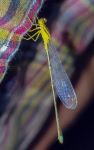
7/29 – Ulster County, HRM 86: We had a surprising find during a night of light-trapping for moths at Shaupeneak Ridge: a first record of a vesper bluet (Enallagma vesperum). The curious damselfly approached the backlit canvas for a few moments before perching on Tim Whitney's shirt, of all places.
In addition to our surprise damselfly, hundreds of species embraced the pond-side lights. We observed incredible moth diversity: several Catacola spp. including a mournful underwing, many clymene moths, a Hebrew, small-eyed sphinx, angle shades, and a few semi-aquatic polymorphic pondweed moths. Other finds included fishflies, tiny and unidentifiable Dipterans, scarab beetles, diving beetles, a green mantis fly, and the occasional green frog looking for a free late-night dinner beneath our setup.
Our thanks go to Scenic Hudson for allowing us to explore this unique location after hours for National Moth Week. (Photo by Frank Beres)
- Frank Beres, Mathew Rymkiewicz, Tim Whitney
[Light-trapping involves suspending a white sheet between two trees or posts and then shining lights across different spectrums, such as black light on the sheet. Moths are responsive to that spectrum. In the dark of night, moths and other flying insects are attracted by the light and land on the white sheet. - Frank Beres]
Natural History Entries
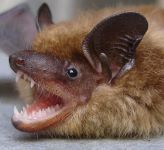
7/30 – Minerva, HRM 284: A little brown bat (Myotis lucifugus), measuring 8.5-inches (wingspan) by 3.5- inches (nose to tail), materialized in our kitchen. It was disoriented, hanging out on the floor. I have no idea how it came to be there — whooshed in when we opened a door, maybe? Knowing it had to leave, and likely needed help, I poked at the little bat. In response, the bat bared its fangs, moved some, spread its wings, and made other threatening (defensive) gestures. I ushered it into a coffee can and moved it back outside. (Photo courtesy of USFWS)
- Mike Corey
[The little brown bat or little brown myotis is an endangered species of mouse-eared microbat found in North America. It has a small body size and glossy brown fur. It is similar in appearance to several other mouse-eared bats, including the Indiana bat and the northern long-eared bat.
A leading source of mortality in the little brown bat is white-nose syndrome first identified in 2006. The disease is caused by a fungus, Pseudogymnoascus destructans, that infects the skin of the muzzle, ears, and wings of hibernating bats. Prior to 2006, the little brown myotis was the most common bat in New York State. However, with the advent of white-nose syndrome, by 2012 only 10% of the statewide numbers of Myotis lucifugus remained.
Current data (2022) suggests that the number of little brown bats hibernating in New York has doubled since 2012. Little brown bats are dealing with the disease much better these days than they did in those early years. Every individual bat contracts the disease each winter, but the severity is much less than it was, and relatively few die as a result. Hibernation counts suggest that a substantial recovery is underway. While that sounds encouraging, we are still only at 20% of their former number. Little browns are not out of the woods yet, but we are cautiously optimistic. Carl Herzog]
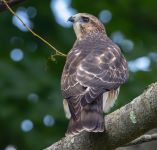 7/30 – Orange County, HRM 41: I finally added a new yard bird to my 2022 bird list this week. Early in the week, I was hearing a broad-winged hawk calling somewhere in the vicinity. On Friday, I heard it again and it was loud. I went out my side door and the bird, a broad-winged hawk, was perched in a large maple tree in the corner of our yard in Goshen. (Photo by Matt Zeitler) 7/30 – Orange County, HRM 41: I finally added a new yard bird to my 2022 bird list this week. Early in the week, I was hearing a broad-winged hawk calling somewhere in the vicinity. On Friday, I heard it again and it was loud. I went out my side door and the bird, a broad-winged hawk, was perched in a large maple tree in the corner of our yard in Goshen. (Photo by Matt Zeitler)
- Matt Zeitler
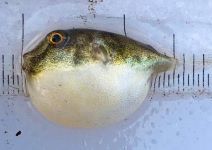
7/31 – Tappan Zee, HRM 31-18: Our Hudson River Fisheries Unit’s young-of-year Striped Bass Beach Seine Survey sampled several beaches in the Tappan Zee reach of the river. In addition to our target species, we caught 24 northern kingfish that ranged 60-135 millimeters (mm), young-of-year bluefish, Atlantic needlefish, striped sea robins, and two very small northern puffers (19 mm). (Photo by Peter Park)
- ElizaBeth Streifeneder
Note: One-inch equals 25.4 millimeters (mm)].
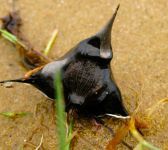
7/31 – Hudson River Estuary: After a week of consulting with ecologists on Eurasian water chestnut, we were not much closer to arrive at a consensus of how Trapa natans seeds found their way up on sand dunes, far from the surf, at Sandy Hook (NJ).
Dave Taft offered that the Jamaica Bay Wildlife Refuge, a sister estuary on the north side of the Lower Bay of New York Harbor has Trapa seeds as well. Those were also transported, perhaps by the same mechanism as Sandy Hook’s.
Erik Kiviat suggested that the Trapa seeds might have drifted in from the Hackensack-Passaic (NJ) system. There is some Eurasian water chestnut in the Kearny Marshes at the junction of the two rivers, and there may be Trapa elsewhere in that watershed.
The net flow of the tidewater Hudson River is seaward. The theory with the most support at present seems to be that the seeds, over time, washed out of the Hudson River and drifted into the Lower Bay of New York Harbor. From there, some were swept northward into Jamaica Bay while others went south and were deposited up on the Sandy Hook dunes by the storm surge of a strong nor’easter. (Photo by Tom Lake)
- Tom Lake

8/1 – Westchester County: I had my camera with me today while hiking in a county park when I spotted an attractive flower with orange and red spots that I had not seen before. The flower was blackberry lily (Iris domestica), also known as the leopard lily. The lily is a perennial ornamental (cultivated) plant in the family Iridaceae, native to eastern Asia. In the fall the seed pod opens to reveal small round black seeds that are a bit smaller than currents or elderberries, which gives it its name. Thomas Jefferson grew blackberry lily in his garden in Monticello. (Photo by Jim Steck)
- Jim Steck
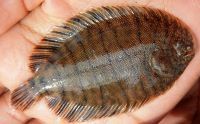
8/1 – Hudson River Watershed: Fish-of-the-Week for Week 181 is the hogchoker (Trinectes maculatus), species number 222 (of 236) on our watershed list of fishes. If you would like a copy of our list, e-mail - trlake7@aol.com.
Hogchokers are flatfish, delightful little soles (Soleidae), found in marine, brackish, and freshwater coastal waters from Cape Cod to Venezuela. They range in size from a penny to the palm of your hand. Their dorsal surface is mottled light-and-dark with “squiggly” patterns of perfect camouflage; their ventral surface is almost always white, although, in some instances, the underside will also be pigmented. Like fingerprints and snowflakes, it appears that no two hogchokers are exactly alike.
There is a fanciful story, with elements of truth, of how Trinectes maculatus got its name. There was a time when the Northeast had a more agrarian economy. Farmers supplemented their livestock feed by visiting tidewater areas to catch or otherwise acquire these little flatfish by the wagonful. However, the readily available little flatfish came with a warning: When you stroke them from head-to-tail, they are incredibly smooth. But, if you run your finger tail-to-head, it will feel like the fine teeth on a saw as their tiny scales, at a micro level, rise and resist. In the wild, wise predators have instinctively learned to swallow them headfirst to avoid “choking.” For domestic livestock, swallowing them the wrong way could result in their pigs choking. Thus, the colloquial or common name of hogchoker.
We once offered a thesis, “... that the bottom of the river in places was carpeted with hogchokers." This came from an observation by Chris Letts, and I, in the 1980s after we completed an otter trawl in Haverstraw Bay. We could barely lift the net’s bag-end out of the water at which point we asked the question, “How many hogchokers could fit in a five-gallon bucket?” (The five-gallon bucket has long been a standard unit of measure for “rivermen.”) The answer was 957 hogchokers. (Note: No hogchokers were injured during this research.) (Photo by Chris Bowser)
- Tom Lake
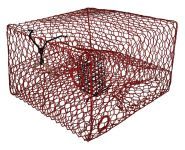
8/1 – Manhattan, HRM 1-2: Our Hudson River Park’s River Project staff checked our research gear (pots and traps) that we deploy off Piers 40 and 26. In a crab pot on Pier 26, we found an interesting mixed faunal community: a blackfish or tautog (260 mm), a black sea bass (155 mm), mud dog whelk snails, and plenty of sea squirts. Also, notable this week was the presence of young-of-year oyster toadfish and juvenile skilletfish (both 20 mm).
- Zoe Kim
8/2 – Beacon, HRM 61: I believe that if you catch just a single fish, by whatever means, it represents an opportunity to learn — every fish has a story to tell. We hauled our net today at Long Dock Park and, try as we may, every time we brought the net up on the sand, we found only young-of-year spottail shiners (41-56 mm). Rather than be disappointed, we told the “spottail story” to a dozen onlookers.
- Tom Lake, Phyllis Lake
[Spottail shiner (Notropis hudsonius), a native Hudson River fish, is one of 32 species of carps and minnows (Cyprinidae) the largest family of fishes in the watershed. Spottail shiner was described to science by DeWitt Clinton in 1824, between his two terms as the sixth and eighth governor of New York State (1817-1822, 1825-1828).
Clinton's very detailed description of the fish was submitted to the forerunner of the International Commission on Zoological Nomenclature in 1824 with a proposed name of Clupea hudsonius. (Clupea is Latin for herring-like fish.) Over the next 69 years, other scientific names were offered with varying evidence for change, but ichthyologists settled on Notropis hudsonius. The spottail type site location is the Hudson River, making the species a true Hudson River fish. However, the type specimen (by which others are systemically compared) was lost in 1866 when a fire destroyed the Lyceum of Natural History (now The New York Academy of Sciences), in Manhattan.
Spottail shiner is found across a wide swath of North America from far west Canada southeast through the American Midwest, the Great Lakes, through our area, and then south along the coast to Georgia. They are common throughout our watershed from ponds, lakes, reservoirs, and rivers, even venturing into the tidal brackish water of the lower estuary. Tom Lake
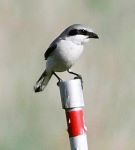
8/2 – Croton Point, HRM34: I came upon a rare loggerhead shrike at Croton Point early this morning. Either sitting on poles on the Croton Point Landfill or perching on mullein it ended up being seen by at least thirty birders. This sighting came seven weeks after a June 17 sighting at Croton Point. Birder John Askildsen believes this was the same bird. The loggerhead shrike hung around all day with the last report at dusk. But, like the June 17 sighting, the shrike was gone the next day. (Photo by Mitchell Goldfarb)
- Larry Trachtenberg
[The last documented Westchester County loggerhead shrike, prior to June 17, occurred 32 years ago at Marshlands Conservancy (Rye) in 1990. The last loggerhead shrike at Croton Point occurred in 1975. Larry Trachtenberg]
8/3 – Orange County, HRM 63: To reach the beach at Hathaway’s Glen, we had to climb over several large deadfalls, slog across a low tide marsh, and wade through a soft-bottom tide pool, all in 92-degree heat, toting our heavy gear. But the payoff never disappoints. The panorama from the beach provides a serene look at a 20-mile reach of the river.
Our seine netted many quarter-sized blue crabs as well as five native fishes, all young-of-year, including tessellated darters, banded killifish, spottail shiners, striped bass (33-48 mm), and our first blueback herring of the season (40-52 mm). The salinity was 3.0 parts-per-thousand (ppt).
On the way out we checked the plunge pool at the head of tide that was teeming with young-of-year banded killifish. The water exiting Hathaway’s Glen today was 66 degrees F; 250 feet away, the river temperature was 86 degrees.
- Tom Lake, Phyllis Lake
[Hathaway’s Glen is the terminus of a small, cold-water brook, a tributary of the Hudson, a cool-water sanctuary for killifish, that spills down the fall line into a short run to the river. The beach at Hathaway’s Glen is a strand, and in the ebbing tide, it rises out of the river like Brigadoon. Tom Lake]
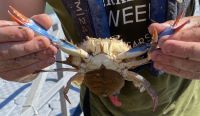
8/3 – Manhattan, HRM 1-2: Our Hudson River Park’s River Project staff checked our research gear (pots and traps) that we deploy off Piers 40 and 26. At Pier 40, a minnow pot held a small oyster toadfish (115 mm). Sharing a crab pot were three large blue crabs, two males and one gravid female carrying eggs (colloquially referred to as a sponge crab). The blue crabs averaged 115 mm.
Invertebrates were plentiful as well, including grass shrimp, mud crabs, sea squirts, other tunicates, a Pacific shore crab, and five spider crabs spread between several crab pots. We have found many well-decorated spider crabs this season, many of which are residing in the WetLab aquarium on the south side of Pier 40. (Photo by Zoe Kim)
- Zoe Kim
[“Decorator crabs” are crabs of several different species, belonging to the superfamily Majoidea (not all of which are decorators), that use materials from their environment to hide from, or ward off, predators. They decorate themselves by sticking mostly sedentary animals and plants to their bodies as camouflage, or if the attached organisms are noxious, to ward off predators. (Hultgren and Stachowicz, 2011).]
[The standard research measurement for blue crabs (mm) is point-to-point, laterally, across their carapace.]
8/4 – Hudson Valley, HRM 145: The air temperature reached 99 degrees Fahrenheit today at several locations tying the record high for the date. In mid-afternoon, the Town of Wappinger reached 100 degrees.
- National Weather Service
8/4 – Manhattan, HRM 1-2: Our Hudson River Park’s River Project staff checked our research gear (pots and traps) that we deploy off Piers 40 and 26. At Pier 26, our staff, alongside our high school interns from the Science Leadership Program, found two large adult oyster toadfish (225, 300 mm) in two crab pots. An impressive assemblage of invertebrates included mud crabs, grass shrimp, mud dog whelks, black star tunicates, orange sheath tunicates, and a hearty presence of sea squirts.
- Zoe Kim
8/5 – Beacon, HRM 61: It was yet another stifling summer day (96 degrees F) where getting in the river (87 degrees F) made little difference for cooling. Since we had dragged our gear to the water’s edge, we felt curiously obligated to see what was at home in the simmering shallows. Our estimation for the resiliency of young-of-year striped bass was enhanced by the three young-of-year we caught (43-54 mm). The salinity was 3.0 ppt.
- Tom Lake, T.R Jackson, B.J. Jackson
 8/5 – Manhattan, HRM 1-2: While our Hudson River Park’s River Project staff checked our research gear (pots and traps) that we deploy off Piers 40 and 26, a live broadcast for NYC Parks’ social media was being filmed. 8/5 – Manhattan, HRM 1-2: While our Hudson River Park’s River Project staff checked our research gear (pots and traps) that we deploy off Piers 40 and 26, a live broadcast for NYC Parks’ social media was being filmed.
The first crab pot at Pier 40 had two blue crabs clinging on the side; both fell before we could sex or measure them. Inside the pot were a spider crab, mud crabs, and our favorite, sea squirts. Two gorgeous, young-of-year black sea bass (55 mm) were next in a minnow trap. (Photo by Tom Lake)
- Zoe Kim
8/5 – Check out and download the State's new 'Tackle Box' smartphone app which provides a one-stop location for nearly all State fishing regulations, waterbodies, State-operated fishing access sites, stocking information, and other useful features like photos to help identify fish likely found in a certain river, lake, or stream.
Tackle Box allows users to search for waterbodies by name or by panning and zooming. Highlighted waters are clickable, providing information on special fishing regulations, fish stocking, and boating/fishing access sites owned by DEC, the State Office of Parks, Recreation, and Historic Preservation, New York State Canal Corporation, and New York City Department of Environmental Protection. In addition, the new 'navigate' feature gives users driving directions to the boating access site of their choice. The Tackle Box also includes an offline feature that allows anglers to use it when cell service is not available.
Check out How to Access Tackle Box in the HuntFishNY App on DEC's YouTube Channel. Watch Introducing the Tackle Box on DEC's YouTube channel for a brief demonstration on features of the Tackle Box. For more information on the HuntFishNY app and new Tackle Box feature, visit DEC's website. For technical assistance with the app, users can call the DECALS helpline at 866-933-2257. For specific questions about fishing, users can email fwfish@dec.ny.gov.
The HuntFishNY app, which includes the Tackle Box, is free-of-charge and available through the Apple App store (iOS) and Google Play (Android) platforms for anyone to download on their tablet or smartphone. To access HuntFishNY with the new Tackle Box feature, users will need to create a DECALS account but do not need to be fishing or hunting license holders.
Summer 2022 Natural History Programs and Events
Come Canoeing with the National Estuarine Research Reserve
Free public canoe program in the tidal marshes of the Hudson River estuary. Learn about the wildlife and dynamic system of the tidal wetlands. Information and registration link:
https://2022-nysdec-canoeprogram.eventbrite.com
September 18, 11:00 a.m. 22nd Hudson River Ramble
Hudson Highlands State Park
Little Stony Point, Route 9D, Cold Spring
Hudson River Education
Teachers and students will enjoy our new Hudson River K-12 Unit of Study. This carefully curated group of lesson plans, arranged by topic and/or grade, brings together great learning tools developed by the DEC and dozens of estuary partners.
Hudson River Miles
The Hudson is measured north from Hudson River Mile 0 at the Battery at the southern tip of Manhattan. The George Washington Bridge is at HRM 12, the Tappan Zee 28, Bear Mountain 47, Beacon-Newburgh 62, Mid-Hudson 75, Kingston-Rhinecliff 95, Rip Van Winkle 114, and the Federal Dam at Troy, the head of tidewater, at 153. The tidal section of the Hudson constitutes a bit less than half the total distance – 315 miles – from Lake Tear of the Clouds to the Battery. Entries from points east and west in the watershed reference the corresponding river mile on the mainstem.
To Contribute Your Observations or to Subscribe
The Hudson River Almanac is compiled and edited by Tom Lake and emailed weekly by DEC's Hudson River Estuary Program. Share your observations by e-mailing them to trlake7@aol.com. To subscribe to the Almanac (or to unsubscribe), use the links on DEC's Hudson River Almanac or DEC Delivers web pages.
Useful Links
National Oceanic and Atmospheric Administration online tide and tidal current predictions are invaluable when planning Hudson River field trips. For real-time information on Hudson River tides, weather, and water conditions from sixteen monitoring stations, visit the Hudson River Environmental Conditions Observing System website.
DEC's Smartphone app for iPhone and Android is now available at New York Fishing, Hunting & Wildlife App.
|