Freshwater Fishing, Fisheries Management, and Fishing Access News
In This Issue:
- Fishing information at your fingertips – there’s an app for that!
- Black Bass Survey Opportunity- St. Lawrence River/Eastern Basin Lake Ontario
- Lake Erie Open Lake Angler Survey Update - July 2022
- Fishing During the Dog days of Summer
- Attention Trout Anglers: High Heat Warning
- Tackle Tips - Tube Baits
Fishing information at your fingertips – there’s an app for that!
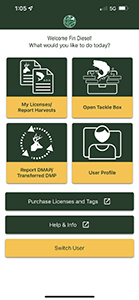
DEC's official app, HuntFishNY has been updated with a handy new feature called "The Tackle Box." Now you can instantly access all sorts of helpful information such as fishing regulations, fish stocking, and fishing access locations throughout New York State- all within an easy-to-use map-based interface.
Helpful features:
- Options to pan and zoom to a water or search by name.
- Driving directions to state-owned boating/fishing access sites.
- An offline version to use when cell service isn't available.
The HuntFishNY app provides mobile access to your sporting licenses, privileges, and permits, as well as the ability to report game harvests immediately while afield. The HuntFishNY app, which includes the Tackle Box, is free of charge and available through the Apple App store (iOS) and Google Play (Android) platforms to download on your tablet or smartphone. For more information on the HuntFishNY app and new Tackle Box feature, visit the DEC website.
For technical assistance, call the DECALS Help Line at 866-933-2257. For specific questions about fishing, email fwfish@dec.ny.gov.
So grab your "Tackle Box" and get out fishing today!
Black Bass Survey Opportunity-
St. Lawrence River/Eastern Basin Lake Ontario
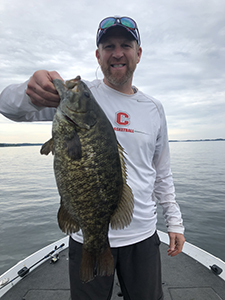
It's no secret that Lake Ontario’s Eastern Basin and St. Lawrence River largemouth and smallmouth bass fisheries are among the best in the country. Information on angling participation associated with these fisheries has not been collected in several years.
DEC is in the early stages of evaluating these fisheries for the development of potential management strategies. As a first step, we're conducting a survey to better understand and characterize current angler use of these fisheries. Input on your use of these fisheries will help inform the approach we take toward reexamining black bass management in these waters.
Take the St. Lawrence River/Eastern Basin Lake Ontario Black Bass survey.
The survey deadline is August 19, 2022.
Lake Erie Open Lake Angler Survey Update - July 2022
Angler effort in July 2022 was just below the 20-year average (88,534 angler-hours) but more than 20,000 angler hours over the effort seen last July. A large majority of July anglers (83%) targeted walleye.
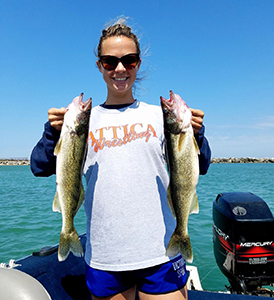
Walleye: Daytime walleye angling effort was the 6th highest in the last 20 years, with 70,669 angler hours spent (average = 59,570 angler hours). July angling effort was distributed more evenly than in recent months, with Buffalo (27%), Barcelona (24%), and Cattaraugus Creek (21%) all accounting for at least twenty percent of the effort. Anglers targeting walleye harvested 4.4 fish per boat trip on average, with a catch rate of 0.47 fish per hour, the 3rd highest July catch rate for walleye in the last 20 years, behind only 2018 and 2019. About 10% of daytime walleye anglers achieved a 6-fish limit with an average size of 20.5 inches.
Smallmouth Bass: Effort in July (8,050 angler hours) was well below the 20-year average (13,490 angler hours), but higher than each of the past four years. Most (82%) of the bass fishing effort in July occurred out of Buffalo. The July bass fishing quality was well above average in 2022, with anglers targeting bass catching an average of 10 bass per boat trip with a catch rate of 1.01 fish per hour, the 2nd best catch rate for smallmouth bass in the last 20 years (July average = 0.64 fish per hour).
Yellow Perch: Yellow perch fishing effort was very low in July 2022, with only 2 perch angler interviews for the entire month.
Fishing During the Dog Days of Summer
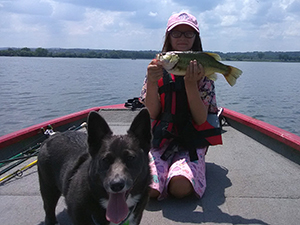
The dog days of summer are officially upon us- where it can be easier to catch rays than it can be to catch fish. Check out the tips below that just might help ensure you next trip out on the water is a successful one!
-
Fish early or late in the day. Fish are usually more active under these low light conditions plus there is also, typically, less recreational activity. Recreational activity tends to increase after 11:00 AM.
-
Slow down. Though reaction lures still work, with the warm water temperatures and an abundance of forage sometimes showing the fish an “easy meal” can elicit more strikes. This is especially true if fishing during the midday period. Lure choices would be things like a wacky rig, drop-shot or Texas rigged worm. This is also a good time to try live bait.
-
Watch the weather. A span of days with consistent weather is common for this period. Going on an “off” day that’s rainy, overcast, or cooler can be good. There also tends to be less boat traffic on these days.
-
Deep water. Though there are still plenty of fish in shallow waters, fishing outside the weed edges can be good during this period. Deep water is relative to the water you’re fishing with 10, 15, 20, or 30+ feet being considered deep. If the weed edge is at 10 feet, fishing 15 feet would be a good starting point. This is a cover water activity looking for active fish so try a drop shot rig or crankbait.
Attention Trout Anglers: High Heat Warning
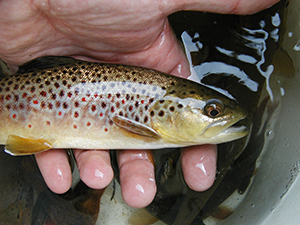
In the July 15 edition, we asked trout stream anglers to follow our Beat the Heat tips to help trout survive the dog days of summer. DEC is reiterating that plea in this issue given the abnormally high air temperatures we're currently experiencing. Please think twice before venturing to your favorite fishing hole for some catch and release fishing during these stressful conditions. Also, be sure to avoid thermal refuge areas that congregate trout, as those fish are also stressed.
Giving trout a break now will help ensure they are there to catch when conditions become more favorable.
Tackle Tips - Tube Baits
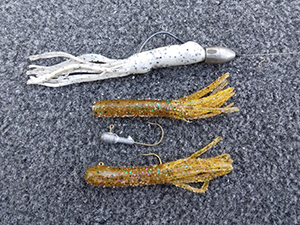
Despite their strange squid-like appearance, tube baits do a great job of mimicking crayfish or small baitfish. They're a mainstay for anglers fishing for smallmouth bass but can also work well for largemouth bass and a variety of other species.
Profile: they vary in size from 2” to 4.5” and are usually hollow or mostly hollow (some for flipping have a solid head). Natural colors, like green pumpkin or watermelon, tend to be the most popular.
Technique: Tubes can be fished in several ways, but the two most popular are:
- using an internal jig head; or
- Texas-rigged with a worm sinker and a wide gap hook.
When using a jig head, cast out and allow to free fall to the bottom and then hop it by raising and lowering the rod (jigging), or slowly drag it along the bottom. It’s weedless with the Texas-rig, so it can be fished the same way, but you can also cast into holes in the vegetation and allow it to fall to the bottom and then raise and lower it a few inches. This method is generally called flipping or pitching.
Tips:
- Internal jig heads take longer to rig, so rigging up a few beforehand can save some time.
- Wetting the jig head before sliding it inside the tube makes it easier to rig.
- Try to rig the tube as straight as possible.
|