
DEC Adirondack Outdoor Recreation Bulletin – June 30, 2022
The New York State Department of Environmental Conservation sent this bulletin on 06/30/2022 04:45 PM EDT |
| DEC Delivers - Information to keep you connected and informed from the NYS Department of Environmental Conservation |
| Share or view as a web page || Update preferences or unsubscribe |
DEC Adirondack Outdoor Recreation BulletinJune 30, 2022 |
|
Emergency Situations: If you get lost or injured; keep calm and stay put. If you have cell service, call 911 or the DEC Forest Ranger Emergency Dispatch, 833-NYS-RANGERS. Welcome to the Adirondacks. The Welcome to the Adirondacks webpage provides information about the Forest Preserve, conservation easement lands, outdoor recreation, and Leave No TraceTM. Love Our NY Lands: All New Yorkers and visitors should be able to access, enjoy, and feel welcome on state lands. While enjoying these shared spaces, be respectful of other visitors. Share trails, treat people with kindness, and leave things as you found them for others to enjoy. All of us have a responsibility to protect State lands for future generations. Learn more about how you can Love Our NY Lands. @NYSDECAlerts: @NYSDECAlerts on Twitter provides real-time updates from DEC-managed lands across New York State. In This Issue
Recent NoticesThe following are only the most recent notices pertaining to public lands in the Adirondacks. Please check the Adirondack Backcountry Information web pages for a full list of notices, including seasonal road statuses, rock climbing closures, specific trail conditions, and other pertinent information. Last Week: Silver Lake Wilderness: Working with our partners at the Adirondack Mtn Club, a volunteer trail crew recently helped close and relocate two primitive tent sites from the south shore of Woods Lake to the north shore. The objective of the project was to spread out use and improve camping opportunities for NPT thru-hikers. This project was part of a larger trail work effort that ADK Mtn Club organized on June 4, National Trails Day. General Notices
Visit the main Adirondack Backcountry Information page for more trip-planning resources. Know Before You Go (06/30):
Hiker Information Stations: Stop by a Hiker Information Station for information about parking, alternative hiking locations, local land use rules and regulations, safety and preparedness, and Leave No TraceTM. Please visit us at the following locations this weekend:
Check the Weather: Check the forecast for your destination and pack and plan accordingly. Check the National Weather Service Northern Adirondacks and Southern Adirondacks Mountain Point Forecasts for select summit forecasts. Check both daytime and nighttime temperatures and remember that temperatures will drop as you gain elevation. Fire Danger: As of 06/30, fire danger is low for much of the Adirondacks with areas on the eastern, western, and southern borders rising to moderate. Check the fire rating map. Water Conditions: Water levels throughout the Adirondack region range from average to above average for this time of year. Check the USGS Current Water Data for New York for stream flow of selected waters. Personal Flotation Devices (PFDs aka lifejackets) are strongly recommended to be worn. Hiking with Dogs: Dogs hiking in warm temperatures are at risk of experiencing heat exhaustion and death. If your dog does collapse, quickly move to create shade for the dog and cool their feet and stomach – this is the most effective way to help an overheated dog. The best way to protect your pet is to leave them at home. Ticks: Wear light-colored clothing with a tight weave to spot ticks easily. Wear enclosed shoes, long pants and a long-sleeved shirt. Tuck pant legs into socks or boots and shirt into pants. Check clothes and any exposed skin frequently for ticks while outdoors. Consider using insect repellent. Stay on cleared, well-traveled trails and walk in the center of trails. Avoid dense woods and bushy areas. Additional tips for tick prevention. Bear Canisters Required: NYSDEC requires the use of bear-resistant canisters by overnight users in the Eastern High Peaks Wilderness between April 1 and November 30. NYSDEC encourages campers to use bear-resistant canisters throughout the Adirondack backcountry. Bear canisters should be used to store all food, food garbage, toiletries, and other items with a scent. Canisters should be stored a minimum of 100ft from tents, lean-tos and cooking sites and kept closed whenever they are not being accessed. Learn more about bear canisters and avoiding human-bear conflicts. Adirondack Rock Climbing Closures: DEC closes certain rock climbing routes in the Adirondacks to protect nesting peregrine falcons. For a full list of closures, visit Adirondack Rock Climbing Route Closures. Once peregrine nest sites are determined, climbing routes that will not disturb nesting will be reopened. Routes that remain closed will reopen after the young have fledged. Thank you for your cooperation. For more information please contact the Bureau of Wildlife at (518) 623-1240. Adirondack Mountain Reserve: Parking reservations will be required May 1 through Oct. 31 for single-day and overnight access to the parking lot, trailheads, and trails located on the privately owned, 7,000-acre AMR property in the town of Keene in the High Peaks region. For a list of frequently asked questions and to register, visit AMR's website. Safety & Education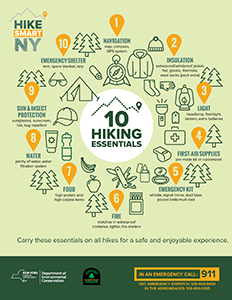
Summer is here! Whether you’re going for a hike, a bike, a paddle, or fishing, Hike Smart NY can help you prepare with a list of 10 essentials, guidance on what to wear, and tips for planning your trip with safety and sustainability in mind. Save a Bear – Store Your FoodThe best way to keep yourself, your food, and our resident bears safe is to keep your food (and everything with a scent) stored safely and securely while camping. When a bear – or any other animal – is able to repeatedly get a “food reward” from people, whether that be from intentional feeding or poor food storage, they begin to rely on humans for all their meals. Not only does that make it harder for those animals to survive on their own, but it can also lead to them being unafraid of people and aggressive when it comes to getting food. In short, nobody likes a pushy bear. One of the best ways to store your food while camping in the backcountry is in a bear-resistant canister. Bear-resistant canisters are cylindrical and made of hard, smooth plastic, making it hard for the bear to grab hold with its claws or teeth. They have a locking lid and many come with carrying cases for easy transportation. They are required to be used by campers in the Eastern High Peaks Wilderness between April 1 and November 30 and are recommended throughout the Adirondack backcountry. To use your bear canister effectively:
Your canister should be stored on level ground and at least 100 feet from both where you sleep and where you cook and eat. It should be placed on its own and out of sight from a passing animal. For more information on reducing human-bear conflict and bear resistant canisters, visit the DEC webpages. Leave No Trace
Follow the Seven Principles of Leave No Trace to maintain minimal impact on the environment and the natural resources of the Adirondacks. Use proper trail etiquette to ensure an enjoyable experience for yourself and others and tread lightly! Geo-tagging Social Media Posts - The 8th Principle Geo-tagging remains one of the easiest ways of sharing outdoor adventures with your friends and followers on social media. Quickly providing a location by geo-tagging allows the bulk of the post to focus on anything from diving into a locale’s past and culture, highlighting new happenings, or simply letting people know where you’ve been. However, with the ability to reach potentially millions of users, posting responsibly is key to protecting natural resource and other visitors who might wish to duplicate your experience. Consider the followings:
Your posts have the power to inspire the change you wish to see. As you venture into the comments, remember that everyone that ventures into the great outdoors has a different experience. Be considerate of other users – bullying and shaming have no place in the Leave No Trace™ community! Recreation Highlight: Sharing Cliffs with Peregrine Falcons
The stunning cliffs of the Adirondacks are home to many things – billion-year-old rock, a wide variety of outdoor enthusiasts, and a fragile but growing population of the endangered peregrine falcon. For Adirondack rock climbers, this means sharing cliffs with the birds that build their nests high on the wall. By 1960, the use of pesticides had reduced the breeding population of peregrines in the Adirondacks to zero. Since then, the state has taken great efforts to provide protection for the endangered species while they establish themselves in the Adirondacks once again. Peregrine falcons are an incredible and interesting species of predatory bird. Nesting between 20 and 200 feet above the ground and waterways below, peregrines use their keen eyesight to spot and dive on their prey. As they approach the ground, these nimble birds can reach speeds close to 200 mph, snatch their prey, and pull back up towards the sky. Peregrines have been recorded living up to 12 years, though the average life expectancy is around six. This long lifespan allows the birds to return to the same nests (known as eyries) year after year, making it even more important to take extra care to tread lightly in their breeding ground. What can you do to help?
For more information on peregrine falcons and their breeding, visit the NYS DEC Peregrine Falcon webpage, or go to the Peregrine Falcons and the Adirondack Rock Climber info page for more information on recreating near breeding areas. |
 This bulletin provides only the most recent notices. Check the
|
The New York State Department of Environmental Conservation respects your right to privacy and welcomes your feedback | Update preferences or unsubscribe | Learn more about DEC Delivers. |
|
Connect with DEC:    
|
|
| Basil Seggos, Commissioner | |