A Project of the Hudson River Estuary Program
Compiled and edited by Tom Lake, Consulting Naturalist
Love Our NY Lands
State Lands Belong to All of Us
All New Yorkers and visitors should be able to access, enjoy, and feel welcome on state lands. These lands belong to all of us, our families, and our neighbors. While enjoying these shared spaces, be respectful of other visitors. Share trails, treat people with kindness, and leave things as you found them for others to enjoy. All of us have a responsibility to protect State lands for future generations. For more information, visit: https://www.dec.ny.gov/outdoor/119881.html
Overview
May 23 was World Turtle Day. New York State Department of Environmental Conservation (DEC) Commissioner Basil Seggos reminded New Yorkers that turtles are nesting in May and June, and he asked motorists to "give turtles a brake." In New York, thousands of turtles are killed each year by unsuspecting drivers as turtles cross roads to find nesting areas.
Highlight of the Week
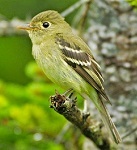 5/20 – Saratoga County, HR 157: As I was sitting on a log today at Vischer Ferry Nature Preserve listening to multiple bird songs, I kept thinking of William James' famous phrase "Blooming, buzzing confusion. Looking at my notes and Merlin recordings [bird identifier app from Cornell Lab of Ornithology], I can report most of the same birds that Susan Beaudoin reported yesterday. I would add northern parula, northern waterthrush, and Canada warbler, though I missed the mourning and Nashville. My favorite find was yellow-bellied flycatcher. When I play my recording back, it sounded like least flycatcher but closer to "che-wink" than "che-bek". (Photo of yellow-bellied flycatcher courtesy of Ed Schneider) 5/20 – Saratoga County, HR 157: As I was sitting on a log today at Vischer Ferry Nature Preserve listening to multiple bird songs, I kept thinking of William James' famous phrase "Blooming, buzzing confusion. Looking at my notes and Merlin recordings [bird identifier app from Cornell Lab of Ornithology], I can report most of the same birds that Susan Beaudoin reported yesterday. I would add northern parula, northern waterthrush, and Canada warbler, though I missed the mourning and Nashville. My favorite find was yellow-bellied flycatcher. When I play my recording back, it sounded like least flycatcher but closer to "che-wink" than "che-bek". (Photo of yellow-bellied flycatcher courtesy of Ed Schneider)
- John Hershey (Hudson-Mohawk Bird Club)
[Earlier, I had identified 15 warbler species including, Wilson’s, Nashville, bay-breasted, blackburnian, Cape May, back-and-white, Tennessee, chestnut-sided, black-throated green, magnolia, American redstart, yellow warbler, yellow-rumped, mourning, and common yellow throat. If you add the Canada and blackpoll, that were there but I did not see, plus ovenbird, which I know was present, and the black-throated blue that John Hershey heard, they expand our list for the day to an amazing 20 warblers, seen or heard, and with help from Merlin!
- Susan Beaudoin]
Natural History Entries
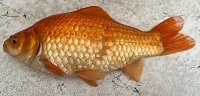 5/12 – Catskill, HRM 113: Our DEC Region 3 Hudson River Fisheries Unit was haul seining the river (500-foot net), for our spawning stock survey with a focus on striped bass and American shad. However, we caught other species as well. Among them were goldfish, not an everyday occurrence but fun when we get one because of their bright color, rudd, with their bright orange fins, and freshwater drum. Goldfish and rudd were introduced, while freshwater drum are a canal immigrant from the Great Lakes region. (Photo of goldfish courtesy of Amanda Higgs) 5/12 – Catskill, HRM 113: Our DEC Region 3 Hudson River Fisheries Unit was haul seining the river (500-foot net), for our spawning stock survey with a focus on striped bass and American shad. However, we caught other species as well. Among them were goldfish, not an everyday occurrence but fun when we get one because of their bright color, rudd, with their bright orange fins, and freshwater drum. Goldfish and rudd were introduced, while freshwater drum are a canal immigrant from the Great Lakes region. (Photo of goldfish courtesy of Amanda Higgs)
- Jess Best, Amanda Higgs, Gregg Kenney, Kelsey Gustafson, Sarah LaLumiere, Kristyn Gessner, Todd Padilla, Billy Benedict
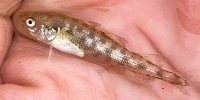 5/12 – Manhattan, New York City: The Randall’s Island Park Alliance Staff went seining along the Harlem River today. At the Little Hell Gate Salt Marsh our three hauls caught 21 mummichog (gravid females and males with breeding colors), an Atlantic silverside, five Atlantic tomcod (43 millimeters (mm)), a grass shrimp, three mud dog whelk snails, and two sea gooseberries. The water temp was 60 degrees Fahrenheit (F), dissolved oxygen (DO) was 11.9 parts-per-million (ppm), and salinity was 20.0 parts-per-thousand (ppt). 5/12 – Manhattan, New York City: The Randall’s Island Park Alliance Staff went seining along the Harlem River today. At the Little Hell Gate Salt Marsh our three hauls caught 21 mummichog (gravid females and males with breeding colors), an Atlantic silverside, five Atlantic tomcod (43 millimeters (mm)), a grass shrimp, three mud dog whelk snails, and two sea gooseberries. The water temp was 60 degrees Fahrenheit (F), dissolved oxygen (DO) was 11.9 parts-per-million (ppm), and salinity was 20.0 parts-per-thousand (ppt).
At the Water's Edge Garden, also on the Harlem River, we netted Atlantic silverside, three more Atlantic tomcod, a striped bass, a small blue crab (25 mm), grass and sand shrimp, mud dog whelk snails, clusters of both chain and star tunicates, 33 sea gooseberries, a clump of hydroids, and 41 lion's mane jellyfish. The latter ranged from the size of a golf ball to the diameter of a tennis ball. The water temperature here was 60 degrees F, the dissolved oxygen was 8.25 ppm, salinity was 22.0 ppt.
Lastly, the team did our first pollinator monitoring of the season. Most of the blooms we saw were red dead-nettle (Lamium purpureum), vetches, catchweed, and chickweed. Not many pollinators were out but we did see a few common bumblebees and two western honeybees. We also spotted a fourteen-spotted lady beetle and an Asian lady beetle larvae. (Photo of Atlantic tomcod courtesy of Jackie Wu)
- Jackie Wu
[Note: One-inch equals 25.4 millimeters (mm); the standard research measurement for blue crabs is point-to-point across their carapace.]
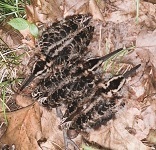 5/13 – Rensselaer County, HRM 163: We were in the Town of Brunswick wild turkey hunting–found none today–when we came upon an American woodcock nest. There were three precocial young in the nest. We startled the noticeably larger female, and she flew off a short distance where she pretended that she was “injured,” a common ploy to distract possible predators. We had been hunting there for ten years and had never come across a woodcock. (Photo of American woodcock courtesy of Gregor Fowler) 5/13 – Rensselaer County, HRM 163: We were in the Town of Brunswick wild turkey hunting–found none today–when we came upon an American woodcock nest. There were three precocial young in the nest. We startled the noticeably larger female, and she flew off a short distance where she pretended that she was “injured,” a common ploy to distract possible predators. We had been hunting there for ten years and had never come across a woodcock. (Photo of American woodcock courtesy of Gregor Fowler)
- Greg Fowler, Chad Fowler
[Precocial refers to just-hatched nestlings, waiting to dry. These are birds, hatched or born, in an advanced state and able to feed itself and move independently almost immediately. Richard Guthrie]
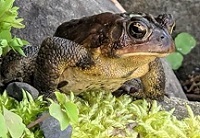 5/14 – Greene County, HRM 114: We were on the shore of a freshwater lake in the Catskills and witnessed the arrival of dozens of American toads (Anaxyrus americanus) migrating to the water for their annual mating and egg-laying. They were so intent on business that they seemed unaware of us. 5/14 – Greene County, HRM 114: We were on the shore of a freshwater lake in the Catskills and witnessed the arrival of dozens of American toads (Anaxyrus americanus) migrating to the water for their annual mating and egg-laying. They were so intent on business that they seemed unaware of us.
The males blow out their bubble-like throats and issue a piercing 30-second sustained trill to attract available females. Up close, the sound of dozens of these strident songsters joining in chorus was almost deafening. We noticed the males use rock pockets along the shore to amplify the volume of their mating call. We saw dozens of pairs of these toads, with the male clinging to the back of the larger females, as they deposited and fertilized a large volume of eggs. Within minutes these strings of eggs coiled up in helical patterns all over the shallow rocky bottom. Within days these amphibious creatures will return to the dry forest litter catching insects with their long sticky tongues while their eggs hatch and turn into tadpoles. (Photo of American toad courtesy of Mario Meier)
- Mario Meier, Robin Meier
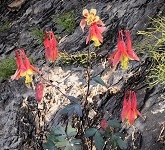 5/14 – Columbia County: Wild columbine (Aquilegia canadensis), a gorgeous native flowering plant, was blooming along the river. I remember many shad seasons ago, in mid-May, sitting on the rocky shoreline rip-rap alongside commercial fisherman Everett Nack waiting for the right tide to set our drift net. Wild columbine would be blooming all around us. Everett would stab a stick in the sand and watch the tide move to just the right point where it was time to go. (Photo of wild columbine courtesy of Susan Petrie) 5/14 – Columbia County: Wild columbine (Aquilegia canadensis), a gorgeous native flowering plant, was blooming along the river. I remember many shad seasons ago, in mid-May, sitting on the rocky shoreline rip-rap alongside commercial fisherman Everett Nack waiting for the right tide to set our drift net. Wild columbine would be blooming all around us. Everett would stab a stick in the sand and watch the tide move to just the right point where it was time to go. (Photo of wild columbine courtesy of Susan Petrie)
- Tom Lake
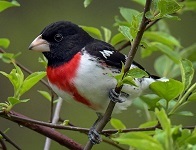 5/14 – Westchester County, HRM 43: Spawning carp were making a giant ruckus at the surface of Muscoot Reservoir in Goldens Bridge today. A large snapping turtle floated nearby and did not seem to mind. A painted turtle basked on a log, as did a green frog. Several more painted turtles poked their noses through the duckweed. Birds included rose-breasted grosbeak, yellow warbler, gray catbird, and American redstart. (Photo of rose-breasted grosbeak courtesy of Deborah Tracy Kral) 5/14 – Westchester County, HRM 43: Spawning carp were making a giant ruckus at the surface of Muscoot Reservoir in Goldens Bridge today. A large snapping turtle floated nearby and did not seem to mind. A painted turtle basked on a log, as did a green frog. Several more painted turtles poked their noses through the duckweed. Birds included rose-breasted grosbeak, yellow warbler, gray catbird, and American redstart. (Photo of rose-breasted grosbeak courtesy of Deborah Tracy Kral)
- Krista Munger
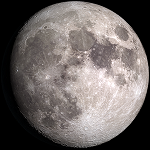 5/15 – Hudson River Watershed: Among indigenous peoples, full moons have long been labeled with fanciful names that are rooted in oral traditions, indigenous memories, and ethnographic accounts. Among Mohican people, whose ancestral homeland lies wholly within the Hudson River watershed, the May full moon is known as the Planting Moon, or Aʔkeʔaat Neepãʔuk in the Mohican dialect. Tribal translations of full moons pre-date colonization and generally reflect the seasonality of the lunar phase. Moon phases, in fact, were used by indigenous people as measurements of time. (Photo of full moon courtesy of NASA Goddard) 5/15 – Hudson River Watershed: Among indigenous peoples, full moons have long been labeled with fanciful names that are rooted in oral traditions, indigenous memories, and ethnographic accounts. Among Mohican people, whose ancestral homeland lies wholly within the Hudson River watershed, the May full moon is known as the Planting Moon, or Aʔkeʔaat Neepãʔuk in the Mohican dialect. Tribal translations of full moons pre-date colonization and generally reflect the seasonality of the lunar phase. Moon phases, in fact, were used by indigenous people as measurements of time. (Photo of full moon courtesy of NASA Goddard)
- Larry Madden, Stockbridge-Munsee Band of Mohican Indians
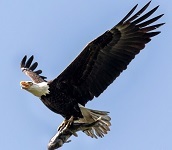 5/16 – Town of Poughkeepsie: One of the adults in bald eagle nest NY62 came back from the river this morning—a few hundred yards away—with a large channel catfish. The fish seemed large enough to feed both of their nestlings with leftovers as well. (Photo of bald eagle with channel catfish courtesy of Bob Rightmyer) 5/16 – Town of Poughkeepsie: One of the adults in bald eagle nest NY62 came back from the river this morning—a few hundred yards away—with a large channel catfish. The fish seemed large enough to feed both of their nestlings with leftovers as well. (Photo of bald eagle with channel catfish courtesy of Bob Rightmyer)
- Bob Rightmyer
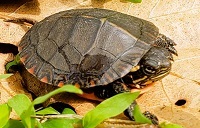 5/16 – Rockland County, HRM 42: I was hiking in Harriman State Park near Black Ash swamp and Tri Trail Corner when I saw a baby painted turtle about the size of a poker chip next to a stream. I sat down quietly for several minutes but then heard something. I looked up and there was a black bear moving down a trail across the stream 30 feet away. It paused for a second, looking behind where it had come, and then disappeared into the brush. Five minutes later two people and a dog walked down the same trail. They had not seen the bear, but they may have spooked it. I was amazed by how quietly the big animal was able to move and then disappear. Half an hour later, on a different trail, I saw a yellowish-olive bird flutter onto a stump, and I thought, "that looks like a female scarlet tanager." Seconds later a blazing red male landed nearby. I am so grateful for parks that preserve nature for these woodland creatures. (Photo of painted turtle courtesy of Ricki Gore) 5/16 – Rockland County, HRM 42: I was hiking in Harriman State Park near Black Ash swamp and Tri Trail Corner when I saw a baby painted turtle about the size of a poker chip next to a stream. I sat down quietly for several minutes but then heard something. I looked up and there was a black bear moving down a trail across the stream 30 feet away. It paused for a second, looking behind where it had come, and then disappeared into the brush. Five minutes later two people and a dog walked down the same trail. They had not seen the bear, but they may have spooked it. I was amazed by how quietly the big animal was able to move and then disappear. Half an hour later, on a different trail, I saw a yellowish-olive bird flutter onto a stump, and I thought, "that looks like a female scarlet tanager." Seconds later a blazing red male landed nearby. I am so grateful for parks that preserve nature for these woodland creatures. (Photo of painted turtle courtesy of Ricki Gore)
- Ricki Goe
5/16 – Manhattan, HRM 1-2: Our Hudson River Park's River Project staff, alongside our two Harbor School interns, checked our sampling and collection gear that we deploy off Piers 26 and 40 in Hudson River Park. At Pier 40, we caught three adult oyster toadfish in one crab pot (230-300 mm), as well as an adult tautog (320 mm) in another crab pot. We also caught a small skilletfish (55 mm) in our oft-empty umbrella trap. There were also a few different invertebrates including grass shrimp, comb jelly, isopods, and mud dog whelks. At Pier 26, we caught one oyster toadfish (290 mm) in a crab pot—this was the first fish we caught in our newly deployed Pier 26 traps. The invertebrates caught by minnow traps included grass shrimp, sand shrimp, mud dog whelks, mud crabs, and isopods.
- Zoe Kim
5/17 – Bedford, HRM 35: The great blue heron rookery was progressing nicely. One nest had two young about the size of a robin, and another had three about the size of a small chicken. The nestlings grow very quickly and are being fed by partly digested food that is regurgitated into the bottom of the nest. As the nestlings get larger, the parents will feed them small fish. Two other nests had an adult settled down in the nest, either incubating or protecting nestlings, and other nests had an adult perched on the nest watching over its nestlings.
- Jim Steck
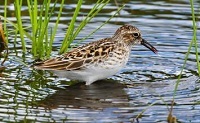 5/18 – Albany County, HRM 153: In the last two days, I made visits to see the shorebirds at The Crossings in Colonie. With most of the birds on the flooded grass, they were easily seen from the paved path. A highlight was an aerial flock of least sandpiper. (Photo of least sandpiper courtesy of John Hershey) 5/18 – Albany County, HRM 153: In the last two days, I made visits to see the shorebirds at The Crossings in Colonie. With most of the birds on the flooded grass, they were easily seen from the paved path. A highlight was an aerial flock of least sandpiper. (Photo of least sandpiper courtesy of John Hershey)
- John Hershey (Hudson-Mohawk Bird Club
5/18 – Albany, HRM 145: With my three grandchildren along, I experienced the first journey to water of a mallard brood today, a journey that is so well detailed in Robert McCloskey’s classic: Make way for Ducklings.
In April, a mallard female had made her nest under some old tomato cages in our fenced garden near Washington Park. Today was hatching day. We opened the gate and off they went, only hours out of the shell, seven yellow-brown fluff balls. Their proud mother held her head high as she led the way over our lawn and gravel courtyard, across a thousand-foot trek through the park down to Washington Park Lake.
En route to the water, they encountered a drop off a 5-foot-high brick wall. The female flew down and called to the tightly packed cluster of offspring up on the wall. One after another they took the leap trusting the maternal call. We had to stop a biker who might have run them over while crossing a park road. Make way for ducklings! They then took to the water as if they had done it all their lives. Off they swam in a close cluster following their mother as there are plenty of dangers yet to face. What a privilege it was to witness their amazing journey.
- Mario Meier
5/18 – Yonkers, HRM 18: The staff for the Sarah Lawrence Center for the Urban River at Beczak, with the able assistance of 3rd grade students from Manhattan’s Dalton School, made eight hauls of our 30-foot seine. Although we failed to catch a fish, we did catch some remarkable river life, including blue crabs, grass shrimp, and Leidy’s comb jellies (pea to golf ball size). The river temperature finally reached 60 degrees F, the salinity had risen again to 8.9 ppt, and the dissolved oxygen was 9.0 ppm.
Our fyke net that we set each day in the Beczak tidemarsh continued to produce a few glass eels, some elvers, and lots of various crabs and shrimp.
- Jason Muller, Katie Lamboy, Christina Edsall
5/18 – Manhattan, HRM 1-2: Our Hudson River Park's River Project staff, alongside our two Harbor School interns, checked our sampling and collection gear that we deploy off Piers 26 and 40 in Hudson River Park. At Pier 40, we caught a small black sea bass (38 mm) in a minnow pot. Invertebrates were few this day—some grass shrimp and a single, white-fingered mud crab. At Pier 26, we had a full house in our crab pots: two oyster toadfish (215, 300 mm), a lined seahorse (60 mm), and a tautog (280 mm). Our minnow traps also caught grass shrimp and sand shrimp.
- Zoe Kim
*** Fish of the Week ***
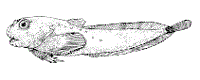 5/19 – Hudson River Watershed: Fish-of-the-Week for Week 173 is the inquiline snailfish (Liparis inquilinus), number 142 (of 235) on our watershed list of fishes. If you would like a copy of our list, e-mail - trlake7@aol.com. 5/19 – Hudson River Watershed: Fish-of-the-Week for Week 173 is the inquiline snailfish (Liparis inquilinus), number 142 (of 235) on our watershed list of fishes. If you would like a copy of our list, e-mail - trlake7@aol.com.
This week’s fish, a temperate marine stray, was technically a “new find,” and added to our Watershed List of Fishes in January 2019. Ichthyologists Bob Schmidt, Jeremy Wright, and Bryan Weatherwax had examined three tiny snailfish specimens (Liparis sp.) at the New York State Museum. The three fish had been collected from the lower estuary (Manhattan and Queens) and saved in the NYSM Collection of Fishes.
Two of the three fishes were adults while the third was an immature (10 mm). They also discovered that all three were inquiline snailfish (Liparis inquilinus), rather than the Atlantic snailfish (L. atlanticus), that was currently on our list of watershed fishes. Thus, Liparis inquilinus replaced L. atlanticus for which there were no records. There was also a change in its taxonomic family from Cyclopteridae to Lipardidae (the snailfishes). These changes may seem like esoterica, but science requires a modicum of order in the midst of biological chaos.
The inquiline snailfish is found in the Atlantic from the Gulf of St. Lawrence in Canada and Georges Bank south to Cape Hatteras in North Carolina. They can get to 71 mm in length, feeding on small benthic organisms and living in the mantle cavity of the scallop (Placopecten magellanicus). Their common name, inquiline, comes from the Latin inquilinus, meaning lodger or tenant. (Photo of inquiline snailfish with permission from Fish Base)
- Tom Lake
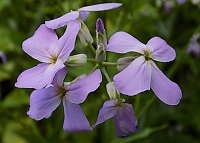 5/19 – Town of Poughkeepsie, HRM 69: One of the signs of the waning spring season is the appearance of dame’s rocket (Hesperis matronalis) on upland roadsides and along the river and its tributaries. This naturalized wildflower, native to Eurasia and brought to North America in the 17th century, comes in white, pink, violet, and purple. Carried by spring breezes, its wonderfully sweet fragrance fills the air from mid-May through early June. (Photo of dame's rocket courtesy of Tom Lake) 5/19 – Town of Poughkeepsie, HRM 69: One of the signs of the waning spring season is the appearance of dame’s rocket (Hesperis matronalis) on upland roadsides and along the river and its tributaries. This naturalized wildflower, native to Eurasia and brought to North America in the 17th century, comes in white, pink, violet, and purple. Carried by spring breezes, its wonderfully sweet fragrance fills the air from mid-May through early June. (Photo of dame's rocket courtesy of Tom Lake)
- Tom Lake, T.R. Jackson
[This flower’s species name, Hesperis matronalis, defines its other common name, Maid of the Evening. Its genus, Hesperis, from the Greek hesperos, translates as evening; the trivial name, matronalis, from Latin, translates as maid. Tom Lake]
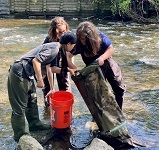 5/20 – Poestenkill, HRM 151.5: A couple of my Earth Science students from Averill Park High School, their families, and some community members from the Troy area came together at low tide this afternoon to check our fyke net the mouth of Poestenkill Creek. The water temperature was 58 degrees F. We counted 22 glass eels and one elver (glass eel class of 2021). We released the eels a mile upstream, to not count them a second time tomorrow, and help get them above barriers to their upstream migration. (Photo of students with glass eels courtesy of Darlene Hunter) 5/20 – Poestenkill, HRM 151.5: A couple of my Earth Science students from Averill Park High School, their families, and some community members from the Troy area came together at low tide this afternoon to check our fyke net the mouth of Poestenkill Creek. The water temperature was 58 degrees F. We counted 22 glass eels and one elver (glass eel class of 2021). We released the eels a mile upstream, to not count them a second time tomorrow, and help get them above barriers to their upstream migration. (Photo of students with glass eels courtesy of Darlene Hunter)
- Darlene Hunter
5/20 – Saugerties, HRM 102: A resident of Dock Street, overlooking the tidewater Esopus Creek below the dam, reported seeing a seal swimming around this afternoon. The Hudson River Almanac has chronicled the unprecedented presence of a marine mammal, a harbor seal (flipper tagged 246) to the freshwater of Esopus Creek for nearly 2½ years (883 days). There is no compelling evidence, yet, that today’s seal is the same seal. Estuaries provide great hunting opportunities for seals each spring as large schools of river migrate in from the sea to spawn in freshwater tributaries like Esopus Creek.
- Patrick Landewe
[January 6 was the last day that we saw the flipper-tagged male harbor seal in Esopus Creek, 110 miles from the sea. The river was experiencing the onset of real winter; ice had become thick and unbroken, both out in the river and in Esopus Creek. The Saugerties harbor seal had previously endured three winters of relatively modest-ice cover (2019-2021), but it was beginning to look as though winter 2022 could be a challenge. Since January 20, we had not seen him for 120 days. Patrick Landewe]
5/20 – Annandale-on-Hudson, HRM 98.5: I visited the Saw Kill (Hudson River tributary) today. It appeared that white suckers had given up spawning for the year. I did see a rather anemic run of alewives and witnessed three spawning bouts of these river herring.
Smallmouth bass were still present in the stream, and I saw three massive carp swimming in the fast water at the head of tide. We don't think of them as migratory spawners however, but I have seen carp move into tributaries and subsequently spawn. This happens yearly in the Sawmill River (river mile 18). Carp spawning in tributaries, however, is trivial compared to the huge spawning events they create in the water chestnut beds later in the season.
- Bob Schmidt
5/20 – Manhattan, HRM 1-2: Our Hudson River Park's River Project staff checked our sampling and collection gear that we deploy off Piers 26 and 40 in Hudson River Park. At Pier 40, we caught an oyster toadfish (260 mm) in a crab pot. We found grass shrimp, mud crab, and another long-clawed hermit crab in our minnow traps. At Pier 26, our traps yielded no fish, but a wide variety of invertebrates: grass shrimp, sand shrimp, isopod, mud dog whelks, amphipods, and long clawed hermit crab.
- Zoe Kim
Spring 2022 Natural History Programs and Events
June 11: Come out fishing for World Fish Migration Day
Come out for family-friendly and free fishing programs around the lower Hudson and NY Harbor. Multiple sites will be celebrating World Fish Migration Day at various times on June 11 with seining (netting) and angling activities. Confirmed sites include:
• Hudson River Field Station, Piermont Pier (Lamont Doherty Earth Observatory of Columbia Climate School)
• Fort Washington Park at 172nd Street, Manhattan (Clearwater) 12:30-2:30 pm
• Randall's Island, North of 103rd St. Bridge, Manhattan (Randall's Island Park Alliance) 10:30-12:00 pm
• Sarah Lawrence Center for the Urban River at Beczak, Yonkers (Beczak) 10:00-12:00 pm
• Lemon Creek Park, Seguine Avenue, Staten Island (NYSDEC) 1:00-2:30pm
Announcing the 2022 Hudson River Striped Bass Cooperative Angler Program
You can share your fishing trip information and help biologists understand and manage our Hudson River striped bass fishery. Here’s how it works: Fill out a logbook provided by us whenever you fish on the Hudson River (by boat or from shore). You can also use our survey123 app and record your trips using a smart phone or computer. Record general location, time, gear used, what you caught (or if you didn’t catch anything) and return the logbook when you are done fishing for the season. You’ll receive an annual newsletter summarizing the information in addition to the latest news regarding regulations and the river. Whether you catch-and-release or take home a keeper, you can be part of the Cooperative Angler Program. Online logbook instructions can be found here: https://www.dec.ny.gov/docs/remediation_hudson_pdf/hrcoopanglerelogbook.pdf
Join today by contacting: hudsonangler@dec.ny.gov or call 845-256-3009
Hudson River Education
Teachers and students will enjoy our new Hudson River K-12 Unit of Study. This carefully curated group of lesson plans, arranged by topic and/or grade, brings together great learning tools developed by the DEC and dozens of estuary partners:
https://www.dec.ny.gov/education/25386.html
Hudson River Miles
The Hudson is measured north from Hudson River Mile 0 at the Battery at the southern tip of Manhattan. The George Washington Bridge is at HRM 12, the Tappan Zee 28, Bear Mountain 47, Beacon-Newburgh 62, Mid-Hudson 75, Kingston-Rhinecliff 95, Rip Van Winkle 114, and the Federal Dam at Troy, the head of tidewater, at 153. The tidal section of the Hudson constitutes a bit less than half the total distance – 315 miles – from Lake Tear of the Clouds to the Battery. Entries from points east and west in the watershed reference the corresponding river mile on the mainstem.
To Contribute Your Observations or to Subscribe
The Hudson River Almanac is compiled and edited by Tom Lake and emailed weekly by DEC's Hudson River Estuary Program. Share your observations by e-mailing them to trlake7@aol.com. To subscribe to the Almanac (or to unsubscribe), use the links on DEC's Hudson River Almanac or DEC Delivers web pages.
Useful Links
National Oceanic and Atmospheric Administration online tide and tidal current predictions are invaluable when planning Hudson River field trips. For real-time information on Hudson River tides, weather and water conditions from sixteen monitoring stations, visit the Hudson River Environmental Conditions Observing System website.
DEC's Smartphone app for iPhone and Android is now available at: New York Fishing, Hunting & Wildlife App.
|