
DEC Adirondack Outdoor Recreation Bulletin - May 20, 2022
The New York State Department of Environmental Conservation sent this bulletin on 05/20/2022 01:12 PM EDT |
| DEC Delivers - Information to keep you connected and informed from the NYS Department of Environmental Conservation |
| Share or view as a web page || Update preferences or unsubscribe |
DEC Adirondack Outdoor Recreation Bulletin
|
|
This bulletin provides only the most recent notices. Check the Adirondack Backcountry Information webpages for more detailed information on access, outdoor recreation infrastructure, and conditions. Emergency Situations: If you get lost or injured; keep calm and stay put. If you have cell service, call 911 or the DEC Forest Ranger Emergency Dispatch, 833-NYS-RANGERS. Welcome to the Adirondacks. The Welcome to the Adirondacks webpage is the place to go if you are interested in learning more about the Adirondacks. It provides information about the Forest Preserve, conservation easement lands, outdoor recreation, and Leave No TraceTM. Love Our NY Lands: All New Yorkers and visitors should be able to access, enjoy, and feel welcome on state lands. These lands belong to all of us, our families, and our neighbors. While enjoying these shared spaces, be respectful of other visitors. Share trails, treat people with kindness, and leave things as you found them for others to enjoy. All of us have a responsibility to protect State lands for future generations. Learn more about how you can Love Our NY Lands. Recreation Highlight: If You Care, Leave It There.
As the weather warms up, it’s common to encounter local wildlife while walking, hiking, or biking. When you see these critters, leave them be and do your best not to disturb their natural routine. Fawns are a great example of animals that may appear around your lawn, garden, or local trails. Newly born whitetail deer spend many of their early days hidden and protected among the tall grass, leaf litter, or other natural and man-made shelters. You may find them laying in a flower bed, alongside a trail, or even curled up in an open field. Mother deer will return to their fawns regularly to nurse but may delay their next visit if they detect human activity nearby. For that reason, fawns and other animals should never be picked up. Young wildlife should never be fed, kept as a pet, or transported to a different location except by trained professionals. Wild animals are poorly adapted to living in captivity and can carry diseases that are harmful to humans. Leaving them where they are protects both you and the animals. It’s very rare that the animals you encounter will be sick, injured, or abandoned. If you do suspect something is wrong, reach out to your local DEC wildlife office. Recent NoticesThe following are the most recent notices pertaining to public lands in the Adirondacks. Please check the Adirondack Backcountry Information webpages for comprehensive and up-to-date information on seasonal road statuses, rock climbing closures, specific trail conditions, and other pertinent information. NEW THIS WEEK:High Peaks Wilderness: Conditions, 05/19: Conditions are a mix of rotten snow and lots of mud. Dress in layers and bring extra so you can keep yourself dry. Ice may persist in places above 4,000 feet, so microspikes are still recommended. Recent rains may have swollen waterways making bridgeless water crossing difficult or even dangerous. Please avoid all trails above 2,500 feet while DEC’s muddy trails advisory is in effect. Correction: Saranac Lakes Wild Forest: Public access to the lock between Middle and Lower Saranac Lakes is tentatively set to close May 15 so work on the lock can begin. It is expected the work will be completed mid-June. There will be no boat access during this time. Canoes and kayaks can carry around the locks. DEC will continue to provide updates as they are available. Sable Highlands Easement: D&H Road and Piney Ridge Road gates have been open for the season for access by cars and trucks. Please note that public ATVs & UTVs are prohibited on the property with the exception of Wolf Pond Road, which is a Town road. Independence River Wild Forest (Stillwater Reservoir, Big Moose & Three Lakes Conservation Easement Tracts):
William C. Whitney Wilderness: The Lake Lila Access Road is now open for public use. Moose River Plains Complex: DEC anticipates opening the Moose River Plains gates the week prior to Memorial Day weekend. Santa Clara Conservation Easement:
Speculator Tree Farm and Perkins Clearing:
Township 19: O’Neil Flow and Barker Pond Road are open to the public. Grass River Wild Forest: All seasonal access roads on Conservation Easement & Forest Preserve lands are now or will be opened in the near future. Please be aware of the recreational rights allowed on each individual property or at each area. Raquette Boreal Complex: All seasonal access roads on Conservation Easement & Forest Preserve lands are now or will be opened in the near future. Please be aware of the recreational rights allowed on each individual property or at each area. White Hill Wild Forest: All seasonal access roads on Conservation Easement & Forest Preserve lands are now or will be opened in the near future. Please be aware of the recreational rights allowed on each individual property or at each area. Bog River Complex: All seasonal access roads on Conservation Easement & Forest Preserve lands are now or will be opened in the near future. Please be aware of the recreational rights allowed on each individual property or at each area. Cranberry Lake Wild Forest: All seasonal access roads on Conservation Easement & Forest Preserve lands are now or will be opened in the near future. Please be aware of the recreational rights allowed on each individual property or at each area. LAST WEEK: High Peaks Wilderness:
Perkins Clearing/Speculator Tree Farm Conservation Easement Tracts:
Lake George Wild Forest:
Essex Chain of Lakes Complex:
General Notices
Visit the main Adirondack Backcountry Information page for more trip-planning resources, including travel information, weather resources, and seasonally-specific information about Adirondack recreation. Know Before You Go (05/19): After frequent storms and rain in the last week, trails are wet and muddy in places. DEC’s Muddy Trails Advisory encourages visitors to continue avoiding all trails above 2,500 feet, including all High Peaks, to help prevent trail damage and erosion as those trails continue to dry and harden. Temperatures may vary significantly depending on your location, the time of day and your elevation. Waterways may be fast and swollen, making crossing difficult or dangerous. Despite warm air temperatures, water may still be extremely cold. Check the Weather: Check the forecast for your destination and pack and plan accordingly. Check the National Weather Service Northern Adirondacks and Southern Adirondacks Mountain Point Forecasts for select summit forecasts. Check both daytime and nighttime temperatures and remember that temperatures will drop as you gain elevation. Check wind chill temperatures and prepare for colder, windier summits. Muddy Trails: Walk straight through mud rather than around it to prevent trail widening and vegetation damage. Opt for low elevation trails until high elevations have time to dry and harden. Follow the muddy trails advisory. Seasonal Roads: Some seasonal access roads are still closed for spring mud season. Where seasonal access roads are open to public motor vehicles, the use of four-wheel drive vehicles is strongly recommended. Fire Danger: Check the fire rating map. Water Conditions: Water levels throughout the Adirondack region are mostly average for this time of year. Check the USGS Current Water Data for New York for stream flow of selected waters. Water temperatures will be very cold. Personal Flotation Devices (PFDs aka lifejackets) are strongly recommended to be worn. Where bridges are not available, do not attempt stream crossings during periods of high, fast-moving water. Hiking with Dogs: DEC warns pet owners to avoid bringing their dogs hiking with them in the summer. Dogs hiking in warm temperatures are at risk of experiencing heat exhaustion and death. If your dog does collapse, quickly move to create shade for the dog and cool their feet and stomach – this is the most effective way to help an overheated dog. The best way to protect your pet is to leave them at home. Bear Canisters Required: NYSDEC requires the use of bear-resistant canisters by overnight users in the Eastern High Peaks Wilderness between April 1 and November 30. NYSDEC encourages campers to use bear-resistant canisters throughout the Adirondack backcountry. Bear canisters should be used to store all food, food garbage, toiletries, and other items with a scent. Canisters should be stored a minimum of 100ft from tents, lean-tos and cooking sites and kept closed whenever they are not being accessed. Learn more about bear canisters and avoiding human-bear conflicts. Adirondack Rock Climbing Closures: DEC closes certain rock climbing routes in the Adirondacks to protect nesting peregrine falcons. For a full list of closures, visit Adirondack Rock Climbing Route Closures. Once peregrine nest sites are determined, climbing routes that will not disturb nesting will be reopened. Routes that remain closed will reopen after the young have fledged. Thank you for your cooperation. For more information please contact the Bureau of Wildlife at (518) 623-1240. Adirondack Mountain Reserve: Parking reservations will be required May 1 through Oct. 31 for single-day and overnight access to the parking lot, trailheads, and trails located on the privately owned, 7,000-acre AMR property in the town of Keene in the High Peaks region. For a list of frequently asked questions and to register, visit AMR's website. Safety & Education
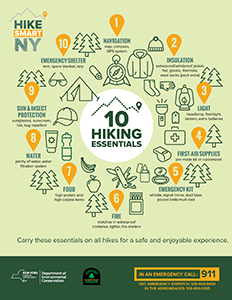
Spring is in full swing. Whether you’re going for a hike, a bike, a paddle, or fishing, Hike Smart NY can help you prepare with a list of 10 essentials, guidance on what to wear, and tips for planning your trip with safety and sustainability in mind. Buy It Where You Burn It Campfire season is upon us, which means it’s time to review best practices for sourcing our firewood. While all firewood may seem safe, it’s important to remember that bugs, bacteria, and other organisms can be transported in, on, and around the logs we bring camping. These species can become invasive and are extremely harmful to our forests. To have a safe and enjoyable fire this summer, remember to:
Learn more about Firewood and Invasive Pests page on DEC's website. Leave No Trace™
Follow the Seven Principles of Leave No Trace to maintain minimal impact on the environment and the natural resources of the Adirondacks. Use proper trail etiquette to ensure an enjoyable experience for yourself and others and tread lightly! Trash Timeline We all know how important it is to keep our favorite outdoor places litter-free. We pack out what we bring in, minimize our impact, and pick up litter when we see it. Have you ever wondered how long that trash can remain in our ecosystem if it's not picked up? Many common items can take much longer than expected to decompose. Consider how long on average it takes these items to biodegrade:
All of this trash sticks around for quite some time. Even items that are often considered “natural” or “biodegradable” can impact the plants, animals, and people that use the land for several years. During that time, that waste is more than likely to find its way into the diet of an unsuspecting animal, provide abnormal nutrients to plants and water bodies, or impact the wilderness experience of a passing hiker. Visit the Leave No TraceTM website for more information on how to minimize the impact of trash and other waste on our wild spaces. |


|
The New York State Department of Environmental Conservation respects your right to privacy and welcomes your feedback | Update preferences or unsubscribe | Learn more about DEC Delivers |
|
Connect with DEC:     
|
|
| Basil Seggos, Commissioner | |