The Fishing Line - May 13th Edition
The New York State Department of Environmental Conservation sent this bulletin on 05/13/2022 02:20 PM EDT |
| DEC Delivers - Information to keep you connected and informed from the NYS Department of Environmental Conservation |
| Share or view as a web page || Update preferences or unsubscribe |
The Fishing Line - May 13th Edition |
Freshwater Fishing, Fisheries Management, and Fishing Access NewsIn This Issue:
Quick Clips: Measuring Your Fish
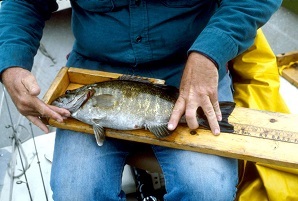
With the recent statewide minimum size limit increase for crappie (from 9" to 10") we thought we'd set the record straight on the age-old question- "To pinch the tail, or not to pinch the tail?" Check out this quick demo from DEC Fisheries Biologist Chris Powers for the answer.
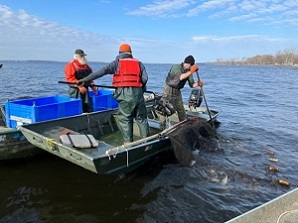
Spring 2022 Egg Collections RecapDEC Fisheries staff recently completed three significant egg collection efforts. Check out the summary below for more details. Spoiler alert: these programs are off to great starts, which bodes well for future fishing opportunities! Steelhead - Salmon River Fish Hatchery
Walleye - Oneida Fish Hatchery
Happening alongside the egg collection efforts this year was Cornell University's triennial mark-recapture study where research staff fin clipped 20,000 walleye. This study is conducted to estimate the number of adult walleye in the lake. Stayed tuned for a future video highlighting this effort. Muskellunge - Chautauqua Fish Hatchery
Lake Erie Angler Survey Updates - April 2022
Tributary Angler Survey Update In the Lake Erie tributaries, the steelhead runs have pretty much shut down for the Spring with the exception of Cattaraugus Creek. April catch rates were exceptional (> 1.0 fish/hr), and the cool, wet weather should keep the steelhead in the creeks well into May. Smallmouth bass have moved into the lower reaches of the larger tributaries including Chautauqua, Canadaway, Cattaraugus, and Eighteen Mile Creeks. Catfish have also moved into lower Cattaraugus Creek. Tributary bass and catfish provide exciting fishing opportunities for those that are not able to get out and fish on the open lake. Open Lake Angler Survey Update Total angler effort in April 2022 was 38,000 angler hours, nearly twice the effort seen in April 2021. Sixty-eight percent of April anglers focused on yellow perch spending over 25,000 hours on the water, nearly matching the total effort from April through October last year. April anglers were rewarded with an average of 32 perch harvested per boat and a catch rate of 2.4 fish per hour, which are both well above average (13.8 perch harvested per boat; 1.5 perch caught per hour) for the survey. About 1.7% of April yellow perch anglers achieved a 50 fish limit with an average length of 11.3 inches. Anglers were also out targeting pre-spawn smallmouth bass, catching bass at a rate of 1.11 fish per hour, which is above the survey average (1.05 bass caught per hour). Lake Erie & Tributaries Fishing Resources Smallmouth Bass Fishing on Lake Erie Attention St. Lawrence River and Lake Ontario Walleye Anglers!
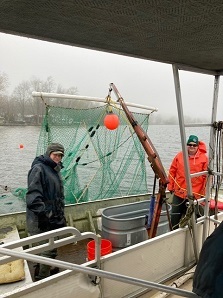
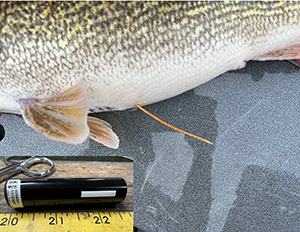
Early this spring, DEC Region 6 Fisheries in partnership with the U.S. Fish and Wildlife Service (USFWS) New York Field Office began a walleye acoustic telemetry study to better understand walleye populations in the St. Lawrence River and the Eastern Basin of Lake Ontario. The study is designed to assess walleye movements, relative use of important spawning sites, and determine how different spawning populations mix within the system. This information is important to inform management and habitat restoration decisions needed to protect and enhance this important fishery. Walleye collected from the Black River, Chaumont River, Oswegatchie River, Brandy Brook, and Little Sucker Brook were implanted with an internal tag that will be detected by acoustic receivers deployed throughout the system along with a visible Floy® tag on their underside to identify it as a study fish. If you catch a tagged fish, you are not required to release it, but we strongly encourage it. Releasing it will allow the fish to continue to be part of the ongoing research project as the tags have a ten-year battery life. If you catch a tagged fish or harvest a tagged fish, please report the tag number and capture location to the USFWS at (607)753-9334. |

|
The New York State Department of Environmental Conservation respects your right to privacy and welcomes your feedback | Update preferences or unsubscribe | Learn more about DEC Delivers |
|
Connect with DEC:     
|
|
| Basil Seggos, Commissioner | |