A Project of the Hudson River Estuary Program
Compiled and edited by Tom Lake, Consulting Naturalist
Love Our NY Lands
State Lands Belong to All of Us
All New Yorkers and visitors should be able to access, enjoy, and feel welcome on state lands. These lands belong to all of us, our families, and our neighbors. While enjoying these shared spaces, be respectful of other visitors. Share trails, treat people with kindness, and leave things as you found them for others to enjoy. All of us have a responsibility to protect State lands for future generations. For more information, visit: https://www.dec.ny.gov/outdoor/119881.html
Overview
When commercial fishing nets dotted the river in April, we knew when the river herring and American shad had arrived from the sea to spawn. With those options limited through regulations aimed at protecting the species, an interesting way to learn of their arrival is when we see bald eagles bringing them to their nests to feed their young. In a reminder of the deep time of river, any week where we can learn something new about sturgeon is a good one. For a fish that has been around for many thousands of years, they still produce surprises. Also, our snakes have awakened.
Highlight of the Week
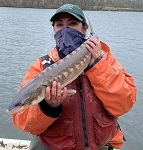 4/23 – Albany, HRM 145: Recently, our DEC Region 3 Hudson River Fisheries Unit was in the Albany reach of the river catching, tagging, and releasing shortnose sturgeon (Acipenser brevirostrum), a Federally Endangered Species, to help us develop an estimate of their abundance for the Hudson River. For each fish, we make an incision to insert an acoustic tag that will monitor her movements for the next ten years. For the next two years, we will use her acoustic tag detection data to develop a population estimate. 4/23 – Albany, HRM 145: Recently, our DEC Region 3 Hudson River Fisheries Unit was in the Albany reach of the river catching, tagging, and releasing shortnose sturgeon (Acipenser brevirostrum), a Federally Endangered Species, to help us develop an estimate of their abundance for the Hudson River. For each fish, we make an incision to insert an acoustic tag that will monitor her movements for the next ten years. For the next two years, we will use her acoustic tag detection data to develop a population estimate.
We noticed that one of the captured females had eggs that were developed to spawn this year, as well as eggs that will be spawned next year, or even the year after. We had come upon a similar sturgeon the day before that had fewer black eggs (this year’s) and more pinkish white eggs (future spawning). We now have a sample size from two female shortnose sturgeon that can be “staged” to verify the intended time of spawning.
To acquire an expert’s opinion on dual egg-staging, we contacted biologist Joel Van Eenennaam, University of California at Davis (retired). Van Eenennaam’s expertise includes histology (the study of biological tissues and cells) and the staging of eggs and milt. (Photo of shortnose sturgeon courtesy of NYS DEC Region 3 Fisheries)
- Amanda Higgs, Dewayne Fox, Rich Pendleton, Kelsey Gustafson
[Joel Van Eenennaam remarked that finding eggs in multiple stages of development is quite common in sturgeon species. The two fish we encountered were about to spawn, after which the pink eggs would be the next batch to go. We had caught them at precisely the right time to observe this phenomenon. Amanda Higgs]
Natural History Entries
4/23 – Hudson River Watershed: The river herring run picked up this week and we captured good numbers of both alewives and blueback herring. We also began seeing “spent” alewives [spawned], typical for this time of the season. We also continued to see good numbers of American shad, possibly the result of the 2014-year class. That was the only year, since the collapse of the stocks in 2002, with recruitment above the 25th percentile benchmark.
- Ben Gahagan, Diadromous Fish Biologist, Massachusetts Division of Marine Fisheries
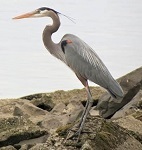 4/23 – Selkirk, HRM 135: While shore fishing at Henry Hudson Park, a great blue heron made a bold move to scavenge herring chunks left by anglers. Flying right along the shore, it swooped in and landed just yards from me. The black crest and long plumes offset the bright yellow spear-shaped beak. With its amazing wingspan, long, supple neck and legs, it made quite a spectacle as it flew, landed, and stalked its prey. (Photo of great blue heron courtesy of Mario Meier) 4/23 – Selkirk, HRM 135: While shore fishing at Henry Hudson Park, a great blue heron made a bold move to scavenge herring chunks left by anglers. Flying right along the shore, it swooped in and landed just yards from me. The black crest and long plumes offset the bright yellow spear-shaped beak. With its amazing wingspan, long, supple neck and legs, it made quite a spectacle as it flew, landed, and stalked its prey. (Photo of great blue heron courtesy of Mario Meier)
- Mario Meier
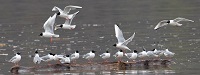 4/23 – Orange County, HRM 60: The highlight of my birding weekend in Orange County was spotting 19 Bonaparte’s gulls at Plum Point-Kowawese, in New Windsor, early Saturday afternoon. (Photo of Bonaparte's gulls courtesy of Matt Zeitler) 4/23 – Orange County, HRM 60: The highlight of my birding weekend in Orange County was spotting 19 Bonaparte’s gulls at Plum Point-Kowawese, in New Windsor, early Saturday afternoon. (Photo of Bonaparte's gulls courtesy of Matt Zeitler)
- Matt Zeitler
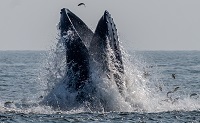 4/23 – New York Bight: The 2022 Whale Watching Season in the New York Bight and Lower Bay of New York Harbor opened today. Whale watching cruises frequently encounter seals, dolphins, and porpoises. Among whales, we typically find humpback (Megaptera novaeangliae), minke (Balaenoptera acutorostrata) and, in 2021, among the most endangered whales in the world, the north Atlantic right whale (Eubalaena glacialis). The latter species is protected under the U.S. Endangered Species Act (there are fewer than 366 individuals in existence, the lowest number in twenty years). There are opportunities to go whale watching in New York Harbor. (Photo of humpback whale courtesy of Artie Raslich) 4/23 – New York Bight: The 2022 Whale Watching Season in the New York Bight and Lower Bay of New York Harbor opened today. Whale watching cruises frequently encounter seals, dolphins, and porpoises. Among whales, we typically find humpback (Megaptera novaeangliae), minke (Balaenoptera acutorostrata) and, in 2021, among the most endangered whales in the world, the north Atlantic right whale (Eubalaena glacialis). The latter species is protected under the U.S. Endangered Species Act (there are fewer than 366 individuals in existence, the lowest number in twenty years). There are opportunities to go whale watching in New York Harbor. (Photo of humpback whale courtesy of Artie Raslich)
- Paul L. Sieswerda
4/24 – Coxsackie Creek, HRM 127.5: We spotted a trumpeter swan at the mouth of Coxsackie Creek today. It flew from the west shore to the east side, low over the water. (Photo of trumpeter swan courtesy of Michael Kalin)
- Julie Elson
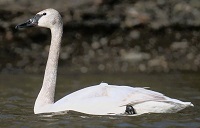 [This trumpeter swan may not be a wild bird. My neighbor in Selkirk bought a pair of them for his pond in 2020. Last year, the pair successfully raised three cygnets. He attempted to clip their wings, but for at least two of the three he apparently didn't clip thoroughly enough. All three took off and have been loose, though they have been returning to their home pond. The owner has been trying to capture them. John Kent] [This trumpeter swan may not be a wild bird. My neighbor in Selkirk bought a pair of them for his pond in 2020. Last year, the pair successfully raised three cygnets. He attempted to clip their wings, but for at least two of the three he apparently didn't clip thoroughly enough. All three took off and have been loose, though they have been returning to their home pond. The owner has been trying to capture them. John Kent]
4/24 – Ulster County, HRM 85: It was a gorgeous spring day at Black Creek with a water temperature of 54 degrees Fahrenheit (F). We had a solid catch of glass eels, but only four slightly larger elvers (class of 2021).
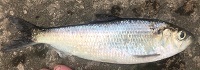 As we worked the fyke net, we caught a glint of silver in the water. It was an expiring foot-long alewife (river herring), lying and dying on the stream bottom. A closer look gave clues: a through-and-through puncture wound just behind its head, larger on the top, smaller on the bottom. They suggested something tapered, such as the talon of a bird of prey, or the spear-like beak of a heron. A predator had lost its meal. We put the herring back in the water so the gift of its ocean-fed-nutrients could benefit the river. (Photo of alewife courtesy of Chris Bowser) As we worked the fyke net, we caught a glint of silver in the water. It was an expiring foot-long alewife (river herring), lying and dying on the stream bottom. A closer look gave clues: a through-and-through puncture wound just behind its head, larger on the top, smaller on the bottom. They suggested something tapered, such as the talon of a bird of prey, or the spear-like beak of a heron. A predator had lost its meal. We put the herring back in the water so the gift of its ocean-fed-nutrients could benefit the river. (Photo of alewife courtesy of Chris Bowser)
- Chris Bowser, Ann, Brianna, Cherokee, and Kanye’
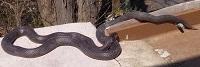 4/24 – Ulster County, HRM 78: Early this afternoon, while on a family bike ride crossing over to the Oak Allee on the Mohonk Preserve, my wife spotted a large eastern rat snake (Pantherophis alleghaniensis), more commonly known as the black rat snake, stretched out sunning itself. This was the first snake of the spring we had seen other than garter snakes. It was warming its body on one of the protective metal I-beams of the Butterville Road Bridge. With the air temperature at 68 degrees F, with bright sun, I suspect the snake got too warm and moved to one of the nearby concrete bridge abutments. The snake was a fine specimen about six feet in length with a slightly chewed tail, probably done by rodents while hibernating. (Photo of black rat snake courtesy of Jason Ruhe) 4/24 – Ulster County, HRM 78: Early this afternoon, while on a family bike ride crossing over to the Oak Allee on the Mohonk Preserve, my wife spotted a large eastern rat snake (Pantherophis alleghaniensis), more commonly known as the black rat snake, stretched out sunning itself. This was the first snake of the spring we had seen other than garter snakes. It was warming its body on one of the protective metal I-beams of the Butterville Road Bridge. With the air temperature at 68 degrees F, with bright sun, I suspect the snake got too warm and moved to one of the nearby concrete bridge abutments. The snake was a fine specimen about six feet in length with a slightly chewed tail, probably done by rodents while hibernating. (Photo of black rat snake courtesy of Jason Ruhe)
- Bob Ottens. Jason Ruhe
4/24 – Beacon, HRM 61: Across four hours today, I caught, measured, and released two channel catfish (17-19 inches). Using my usual carp bait, I was bothered throughout by constant bait-stealing, strongly indicating the presence of small golden shiners.
It may be time to try shore-fishing downriver where the water may be saltier. The salt tends to discourage most freshwater bait-stealers. Brackish water species such as white perch do not seem to find my corn and dough carp bait attractive.
- Bill Greene
4/25 – Annandale-on-Hudson, HRM 98.5: I visited the mouth of the Saw Kill in Dutchess County today. The water was high, and the visibility was less than great. I did not see any migratory fishes, but I did verify the presence of a few smallmouth bass that had made their spring upstream journey from tidewater, a spawning strategy we call potamodromy.
- Bob Schmidt
4/25 – Yonkers, HRM 18: Our staff at the Sarah Lawrence Center for the Urban River at Beczak made our daily check of the glass eel fyke net that we set overnight in the Beczak tide marsh. The numbers continued to be notable, today with 89 glass eels. At this stage of their life, glass eels, tiny, translucent immature American eels, weigh, on average, only 0.15 grams. The water temperature was 51 degrees F, the salinity was still very low at 1.2 parts-per-thousand (ppt), and the dissolved oxygen was 10.6 parts-per-million (ppm).
- Jason Muller
** Fish of the Week **
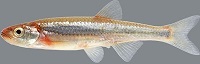 4/26 – Hudson River Watershed: Fish-of-the-Week for Week 170 is the rosyface shiner (Notropis rubellus) number 58 (of 236), on our Hudson River Watershed List of Fishes. If you would like a copy of our list, e-mail: trlake7@aol.com 4/26 – Hudson River Watershed: Fish-of-the-Week for Week 170 is the rosyface shiner (Notropis rubellus) number 58 (of 236), on our Hudson River Watershed List of Fishes. If you would like a copy of our list, e-mail: trlake7@aol.com
The rosyface shiner is a small elongate, streamlined, and a bit slab-sided minnow. They are a member of Cyprinidae (carps & minnows), our largest family of fishes in the watershed. They are native to the Atlantic Slope from the Saint Lawrence drainage in Quebec to the James River drainage in Virginia. They are most common in the Midwest, the Mississippi drainage, and the Great Lakes. Their type site is Lake Superior, MI. Where found, they favor rocky runs, flowing pools of small to medium rivers, and clear streams with a fast current where they feed on aquatic and terrestrial insects. They can grow to 110 millimeters (mm).
J.R. Greeley, in his A Biological Survey of the Lower Hudson Watershed (1937), used the common name rosyface minnow. He considered them rare in the lower Hudson River finding just two, both in the Rondout Creek system. Breeding males become bright rosy-red on their snout, chin, head, and the base of their fins; this leads to their common name, rosyface, as well as their trivial name rubellus (from Latin ruber, meaning red, or reddish). (Photo of rosyface shiner courtesy of David Park)
- Tom Lake
4/26 – Yonkers, HRM 18: Our staff at the Sarah Lawrence Center for the Urban River at Beczak counted 23 glass eels in our fyke net this morning, as well as a single mummichog. Switching to our beach seine, we captured three yearling (class of 2021) striped bass (106 mm) and a white perch (175 mm). There were also the usual invertebrates including grass shrimp and a comb jelly. The water temperature was 53 degrees F, the salinity was 2.35 ppt, and the dissolved oxygen was 10.19 ppm.
- Jason Muller, Christina Edsall
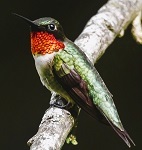 4/27 – Hyde Park, HRM 85: It was a wonderful moment when our first ruby-throated hummingbird showed up at our nectar feeder today. It was a male, and he was three days earlier than last year. (Photo of ruby-throated hummingbird courtesy of Jim Yates) 4/27 – Hyde Park, HRM 85: It was a wonderful moment when our first ruby-throated hummingbird showed up at our nectar feeder today. It was a male, and he was three days earlier than last year. (Photo of ruby-throated hummingbird courtesy of Jim Yates)
- Peter Fanelli
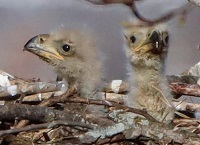 4/27 – Town of Poughkeepsie: We are monitoring the two nestlings in bald eagle nest NY62, both of which look like half-size chickens. Our projected fledge date remains at June 5-24 (72-90 days post hatch). (Photo of bald eagles courtesy of Joseph Licari) 4/27 – Town of Poughkeepsie: We are monitoring the two nestlings in bald eagle nest NY62, both of which look like half-size chickens. Our projected fledge date remains at June 5-24 (72-90 days post hatch). (Photo of bald eagles courtesy of Joseph Licari)
- Joseph Licari
[The weather has been kind and the new leaves on the tulip tree have been slow to obscure, so the world-class photographers in our Soul of NY62 group were still getting good looks from a far distance with exceptional optics. Tom Lake]
4/27 – Bedford, HRM 35: The great blue heron rookery was now up to seven occupied nests. It was a windy day and in one of the deep nests, all I could see was a feather moving. It is a bit late in the nesting season, but the urge to find or build a suitable nest is very strong. Hatching should occur soon with the early nesters, but the nestlings will remain out of sight for a while.
- Jim Steck
4/27 – Yonkers, HRM 18: Our staff at the Sarah Lawrence Center for the Urban River at Beczak counted only nine (steep decline) glass eels in our fyke net today, as well as three mummichogs. Our seining results were very similar to yesterday’s catch with one each striped bass, white perch, and mummichog. The only new face was a small blue crab. The water temperature was 56 degrees F, the salinity was 2.15 ppt, and the dissolved oxygen was 8.91 ppm.
- Jason Muller, Louisa Hausslein, Emily Leonard
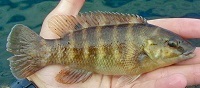 4/27 – Manhattan, HRM 2: Our Hudson River Park's River Project staff, with support from two Harbor School interns, checked the sampling and collection gear that we deploy off Pier 40 in Hudson River Park. Our minnow pot had collected a beautiful, juvenile black sea bass (60 mm) in addition to a young-of-season blue crab (20 mm). We were very excited to find a cunner (50 mm) in our minnow pot. Last year, our traps caught only one larval cunner (10 mm) in mid-July, so we were intrigued to see one so early in the season. (Photo of cunner courtesy of J.D. Wilson) 4/27 – Manhattan, HRM 2: Our Hudson River Park's River Project staff, with support from two Harbor School interns, checked the sampling and collection gear that we deploy off Pier 40 in Hudson River Park. Our minnow pot had collected a beautiful, juvenile black sea bass (60 mm) in addition to a young-of-season blue crab (20 mm). We were very excited to find a cunner (50 mm) in our minnow pot. Last year, our traps caught only one larval cunner (10 mm) in mid-July, so we were intrigued to see one so early in the season. (Photo of cunner courtesy of J.D. Wilson)
- Zoe Kim, Juliet Wiley, Demolyn Ramirez
[Cunner (Tautogolabrus adspersus) is one of two members of the wrasse family (Labridae) in the estuary and are closely related to tautog or blackfish (Tautoga onitis). Cunner range from Newfoundland to Chesapeake Bay. In New England, where they are the bait-stealing bane of jetty anglers, they are called “chogies.” Local anglers know them colloquially as “bergalls.”
They are commonly found in the lower estuary and New York Harbor preferring rocky, sheltered areas where they feed on small shellfish and mollusks. While they can reach 16 inches, most caught in local waters are less than ten. Cunner develop dark bars at night, an adaptation that breaks up their profile, confusing nocturnal predators. Tom Lake]
4/28 – Yonkers, HRM 18: Our staff at the Sarah Lawrence Center for the Urban River at Beczak counted sixteen glass eels in our fyke net today, as well as a mummichog, a white-fingered mud crab, and a slew of invertebrates. Our seining catch continued to mimic recent days with one each striped bass and white perch. Today’s new face was a softshell clam (130 mm valve height). The water temperature was 54 degrees F, the salinity was 2.31 ppt, and the dissolved oxygen was 10.29 ppm.
- Jason Muller, Bryan Coppede, Ruby Alcorn, Annie Bingham
[Soft-shell clam (Mya arenaria) is an edible bivalve common in the lower estuary. In the North Atlantic, they range from the Carolinas north through New England and into Canada. In the market, they are frequently referred to as "steamers" or "softshells." New York State recreational regulations for soft-shell clam include a minimum size of 1.0-1.5 inches (25-37 mm) valve height and no more than a half-bushel per day. Tom Lake]
4/29 – Hudson, HRM 118: I had lunch at the river today just below the Hudson Boat Launch. Across the channel, I could see bald eagle nest NY301 with two adults perched on the edge. Even with binoculars, I was unable to see if there was a nestling inside. However, given the attention of the adults, I suspected there was. There was also a fierce west wind blowing; I had never seen the river “flowing” west to east.
- Cathy Poluski
4/29 – New Paltz, HRM 78: This was Arbor Day as well as "potting up" day for the Hudson River Estuary Program’s “Trees 4 Tribs” initiative. At the DEC Region 3 headquarters, staff, members of the Student Conservation Association (SCA), and other volunteers gathered to plant nearly 3,000 bare-root plants into pots that will be used at twelve designated stream-buffer planting sites during the upcoming season. Among the native trees potted up were buttonbush, black walnut, chokeberry, butternut, dogwood, silver maple, and sugar maple. For information about the Hudson River Estuary Program’s “Trees for Tribs” program, visit: https://www.dec.ny.gov/lands/43668.html
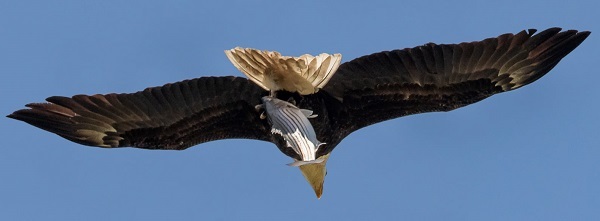
4/29 – Town of Poughkeepsie: There were two “firsts” today at bald eagle nest NY62: In the morning, one of the adults brought the first alewife of the season, as far as we could tell, to the nest for the two nestlings. Nutrients from the sea had arrived. In the afternoon, one of the adults brought the first striped bass of the season, a hefty specimen, to the nest. After a spring of gizzard shad, their menu had stepped up a notch.
- Dan Tooker, Bob Rightmyer
4/29 – Yonkers, HRM 18: This was our last haul of the week for the staff at the Sarah Lawrence Center for the Urban River at Beczak. Glass eels (13) numbers remained low from our fyke net in the Beczak tide marsh. Other fishes included a winter founder and an elver (glass eel class of 2021). Our five seine hauls were rather bleak with only a single mummichog (70 mm). The water temperature was 51 degrees F, the salinity was 2.62 ppt, and the dissolved oxygen was 10.9 ppm.
- Jason Muller, Emma Salada, John Perez, Christina Torres, Matthew Wagler, Ishika Joshi, Gabrielle Krieger, Kiki Quiros
4/29 – Manhattan, HRM 2: Our Hudson River Park's River Project staff checked the sampling and collection gear that we deploy off Pier 40 in Hudson River Park. Overnight, our minnow pots had caught three juvenile black sea bass (60-65 mm), in addition to the regular retinue of grass shrimp and a couple of comb jellies.
- Zoe Kim, Toland Kister
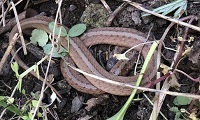 4/29–Manhattan, New York City: The Natural Areas team at Randall’s Island Park spotted a Dekay's brown snake (Storeria dekayi) today while they were working on a restoration project in our freshwater wetland. We knew they were around, but we rarely get to see them, so this was an exciting treat. (Photo of Dekay's brown snake courtesy of Matt Garafalo) 4/29–Manhattan, New York City: The Natural Areas team at Randall’s Island Park spotted a Dekay's brown snake (Storeria dekayi) today while they were working on a restoration project in our freshwater wetland. We knew they were around, but we rarely get to see them, so this was an exciting treat. (Photo of Dekay's brown snake courtesy of Matt Garafalo)
- Jackie Wu
[The DeKay’s brown snake is native to Southern Ontario, Quebec, and most of the eastern half of the United States. They rarely get to be more than a foot-long and feed on slugs, snails, and earthworms. The common name, as well as the species, dekayi, is in honor of American zoologist James Ellsworth De Kay (1792–1851). The genus, Storeria, honors zoologist David Humphreys Storer (Ellin Beltz, 2006). Tom Lake]
[Note to Almanac readers and contributors: Our “Almanac week” begins on Saturday and concludes the following Friday, seven days. When you send us your ivory-billed woodpecker sighting on a Saturday, you may not see it in the Almanac for at least a week. Tom Lake]
Spring 2022 Natural History Programs and Events
Announcing the 2022 Hudson River Striped Bass Cooperative Angler Program
You can share your fishing trip information and help biologists understand and manage our Hudson River striped bass fishery. Here’s how it works: Fill out a logbook provided by us whenever you fish on the Hudson River (by boat or from shore). You can also use our survey123 app and record your trips using a smart phone or computer. Record general location, time, gear used, what you caught (or if you didn’t catch anything) and return the logbook when you are done fishing for the season. You’ll receive an annual newsletter summarizing the information in addition to the latest news regarding regulations and the river. Whether you catch-and-release or take home a keeper, you can be part of the Cooperative Angler Program. Online logbook instructions can be found here: https://www.dec.ny.gov/docs/remediation_hudson_pdf/hrcoopanglerelogbook.pdf
Join today by contacting: hudsonangler@dec.ny.gov or call 845-256-3009
Hudson River Education
Teachers and students will enjoy our new Hudson River K-12 Unit of Study. This carefully curated group of lesson plans, arranged by topic and/or grade, brings together great learning tools developed by the DEC and dozens of estuary partners:
https://www.dec.ny.gov/education/25386.html
Hudson River Miles
The Hudson is measured north from Hudson River Mile 0 at the Battery at the southern tip of Manhattan. The George Washington Bridge is at HRM 12, the Tappan Zee 28, Bear Mountain 47, Beacon-Newburgh 62, Mid-Hudson 75, Kingston-Rhinecliff 95, Rip Van Winkle 114, and the Federal Dam at Troy, the head of tidewater, at 153. The tidal section of the Hudson constitutes a bit less than half the total distance – 315 miles – from Lake Tear of the Clouds to the Battery. Entries from points east and west in the watershed reference the corresponding river mile on the mainstem.
To Contribute Your Observations or to Subscribe
The Hudson River Almanac is compiled and edited by Tom Lake and emailed weekly by DEC's Hudson River Estuary Program. Share your observations by e-mailing them to trlake7@aol.com. To subscribe to the Almanac (or to unsubscribe), use the links on DEC's Hudson River Almanac or DEC Delivers web pages.
Useful Links
National Oceanic and Atmospheric Administration online tide and tidal current predictions are invaluable when planning Hudson River field trips. For real-time information on Hudson River tides, weather and water conditions from sixteen monitoring stations, visit the Hudson River Environmental Conditions Observing System website.
DEC's Smartphone app for iPhone and Android is now available at: New York Fishing, Hunting & Wildlife App.
|