A Project of the Hudson River Estuary Program
Compiled and edited by Tom Lake, Consulting Naturalist
Love Our NY Lands
State Lands Belong to All of Us
All New Yorkers and visitors should be able to access, enjoy, and feel welcome on state lands. These lands belong to all of us, our families, and our neighbors. While enjoying these shared spaces, be respectful of other visitors. Share trails, treat people with kindness, and leave things as you found them for others to enjoy. All of us have a responsibility to protect State lands for future generations. For more information, visit: https://www.dec.ny.gov/outdoor/119881.html
Overview
This week’s feature was our 53rd annual Earth Day. Reminders of its spirit were blooming in the forest, swimming in the river, and flying in the sky. Glass eels (juvenile American eels) continued to pulse up the river in prodigious numbers. As the river warmed, alewives were likewise surging in from the sea (greeted by harbor seals) seeking upriver freshwater to spawn. From many bald eagle nests along the river, nestlings were growing to near chicken-size.
Highlight of the Week
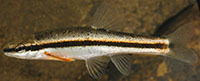 4/18 – Poughkeepsie, HRM 75.5: Even as the cold wind rolled wave after wave into the mouth of the Fall Kill, we had a great day checking our glass eel fyke net. The tide was falling, and the water temperature of 55 degrees Fahrenheit (F) was only slightly warmer than the air at 53 F. 4/18 – Poughkeepsie, HRM 75.5: Even as the cold wind rolled wave after wave into the mouth of the Fall Kill, we had a great day checking our glass eel fyke net. The tide was falling, and the water temperature of 55 degrees Fahrenheit (F) was only slightly warmer than the air at 53 F.
In addition to a nice crop of glass eels, we had eleven "elvers", a life stage likely a year or so older than the glass eels we had collected. Our fyke net often catches other small fish as well. Today we had an inch-long banded killifish and a slightly larger blacknose dace. The dace is a handsome fish with tidy fins, a pointed head, and a three-tone scheme of darker topside and lighter belly separated by a bold black stripe. The dace was a reminder that upstream, beyond the head of tide, our tributaries harbor fishes we rarely see in the estuary. Small but interesting fish like cutlip minnow, fall fish, creek chub, and dace thrive, but only occasionally get swept downstream as unwitting ambassadors. However, today’s mascot, the eel, weaves through it all and back again. (Photo of blacknose dace courtesy of Robert Criswell)
- Chris Bowser, Helena Alvarez, Tara Roy, Kaitlin Vezos
Natural History Entries
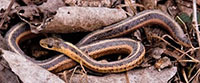 4/15 – Albany County, HRM 143.5: As I was walking along the Normanskill near Albany I nearly stepped on an 18-inch-long eastern garter snake (Thamnophis sirtalis sirtalis) coiled up in the leaves. They are entirely harmless, and its bright orange and brown parallel stripes define it well. (Photo of eastern garter snake courtesy of Mario Meier) 4/15 – Albany County, HRM 143.5: As I was walking along the Normanskill near Albany I nearly stepped on an 18-inch-long eastern garter snake (Thamnophis sirtalis sirtalis) coiled up in the leaves. They are entirely harmless, and its bright orange and brown parallel stripes define it well. (Photo of eastern garter snake courtesy of Mario Meier)
- Mario Meier
4/16 – Newcomb, HRM 302: It was mid-April, yet it was spitting snow today. In recent years, it seems more likely that we will have snow on Easter than on Christmas Day.
- Charlotte Demers
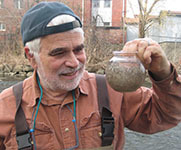 4/16 – Hudson River Estuary: All along Hudson River tidewater, students, volunteers, and scientists are counting juvenile American eels for the DEC Hudson River Eel Project. Juvenile eels (Anguilla rostrata) are hatched in the Sargasso Sea north of Puerto Rico, and every spring they arrive in estuaries like the Hudson River as translucent, two-inch long "glass eels." 4/16 – Hudson River Estuary: All along Hudson River tidewater, students, volunteers, and scientists are counting juvenile American eels for the DEC Hudson River Eel Project. Juvenile eels (Anguilla rostrata) are hatched in the Sargasso Sea north of Puerto Rico, and every spring they arrive in estuaries like the Hudson River as translucent, two-inch long "glass eels."
This spring, eels are being counted at 12 stream sites along the Hudson River from New York Harbor to the Poestenkill in Troy. Trained volunteers don waders and venture into tributary streams to check 10-foot cone-shaped nets ("fyke nets") specifically designed to catch this small life-stage of the eel. The eels are gently counted, taken from the net, and placed in a bucket of stream water before being released. Most of the eels are released above dams, waterfalls, and other barriers to their migration, so that they have better access to habitat. Eels will live in freshwater rivers and streams for up to 30 years before returning to the sea to spawn. To volunteer at a site, email eelproject@dec.ny.gov.
Now in its 15th year, the Hudson River Eel Project was initiated by the Hudson River Estuary Program and Hudson River National Estuarine Research Reserve to gather data for multi-state management plans for eel conservation. Eel collection takes place at most sites daily from early April through mid-May. Since the project began, volunteers have caught, counted, and released more than one million juvenile eels into upstream habitat. For more information, go to: https://www.dec.ny.gov/lands/72898.html#Eel (Photo of glass eels courtesy of Tommy Jackson)
- Sarah Mount, Chris Bowser
4/16 – Hudson River Watershed: Among indigenous peoples, full moons have long been labeled with fanciful names that are rooted in oral traditions, indigenous memories, and ethnographic accounts. Among Mohican people, whose ancestral homeland lies wholly within the Hudson River watershed, the April full moon is known as the Grass and Geese Moon, or Othkeethkwun wãak Pkwaaxowãpthowuk Neepãʔuk in the Mohican dialect. Tribal translations of full moons pre-date colonization and generally reflect the seasonality of the lunar phase. Moon phases, in fact, were used by indigenous people as measurements of time.
- Larry Madden, Stockbridge-Munsee Band of Mohican Indians
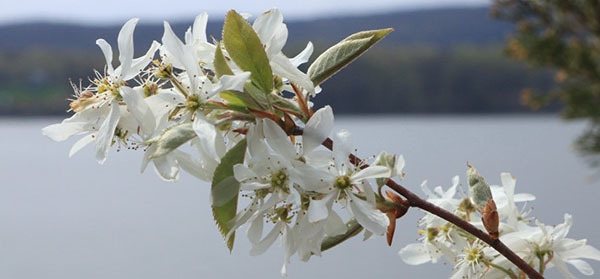
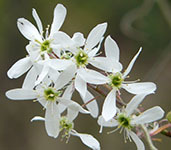 4/17 – Hudson River Watershed: One of the joys of spring is watching the forests and fields come alive with color. We began this week being treated to a soft, hazy white glow in the woods that is the shadbush (Amelanchier sp.). This native species has been, at least colloquially on the East Coast, considered a harbinger for the arrival of spawning American shad into estuaries from the sea. Indigenous peoples knew it was time to set their fish weirs when shadbush began to bloom. There is an ecological timing between those two events: Shadbush blooms when the soil warms in late March at the same time the river reaches a temperature that signals the beginning of fish migration. 4/17 – Hudson River Watershed: One of the joys of spring is watching the forests and fields come alive with color. We began this week being treated to a soft, hazy white glow in the woods that is the shadbush (Amelanchier sp.). This native species has been, at least colloquially on the East Coast, considered a harbinger for the arrival of spawning American shad into estuaries from the sea. Indigenous peoples knew it was time to set their fish weirs when shadbush began to bloom. There is an ecological timing between those two events: Shadbush blooms when the soil warms in late March at the same time the river reaches a temperature that signals the beginning of fish migration.
Magnolia and forsythia had already been in bloom for more than a week along much of the tidewater Hudson. Blooming moves north in an orderly manner from magnolia to forsythia to shadbush to flowering dogwood, with lilac being the final signal that spring is ready for summer. This process is called phenology, the study of nature through the appearance of seasonal phenomena. The word comes from the Greek word “phaino,” meaning “to appear,” or the Latin “phenomenon,” meaning “appearance, happening or display. (Photo of shadbush courtesy of Tom Lake)
- Tom Lake
*** Fish of the Week***
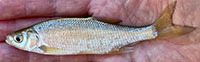 4/17 – Hudson River Watershed: Fish-of-the-Week for Week 169 is the golden shiner (Notemigonus crysoleucas) number 50 (of 236), on our Hudson River Watershed List of Fishes. If you would like a copy of our list, e-mail: trlake7@aol.com 4/17 – Hudson River Watershed: Fish-of-the-Week for Week 169 is the golden shiner (Notemigonus crysoleucas) number 50 (of 236), on our Hudson River Watershed List of Fishes. If you would like a copy of our list, e-mail: trlake7@aol.com
The golden shiner is one of the widest raging fish species in the U.S. They are native to the Atlantic and Gulf Slope drainages from Nova Scotia in Canada to southern Texas, and from the Great Lakes, Hudson Bay, and Mississippi River basins west to Saskatchewan in Canada, Montana, Oklahoma, and Texas. They are one of 35 members of the largest family of fishes documented for our watershed, the carps & minnows (Cyprinidae). They are easy to recognize in field among other minnows by their d-curved lateral line
The golden shiner gained it reputation as a prime live-bait species for anglers, often farm raised and sold commercially. While they can grow to a foot-long, most average six-inches or less. Golden shiners feed primarily on zooplankton and considerable amounts of filamentous algae. (Photo of golden shiner courtesy of Tom Lake)
- Tom Lake
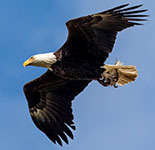 4/17 – Town of Poughkeepsie: The two, 22-day-old, nestlings in bald eagle nest NY62 were dining well. This morning one of the adults carried a plump pumpkinseed sunfish to the nest. (Photo of bald eagle courtesy of Bob Rightmyer) 4/17 – Town of Poughkeepsie: The two, 22-day-old, nestlings in bald eagle nest NY62 were dining well. This morning one of the adults carried a plump pumpkinseed sunfish to the nest. (Photo of bald eagle courtesy of Bob Rightmyer)
- Bob Rightmyer
4/18 – Minerva, HRM 284: I heard my first phoebe of the year in a nearby wetland. During a hike down Route 28N last night with Freya (dog), I heard a fox howling. The sound was a higher pitch compared to a coyote. After reading the red fox story in last week’s Almanac, I'll be listening for “soft and sustained shrieks, whines, and bark-like screams” as well!
- Mike Corey
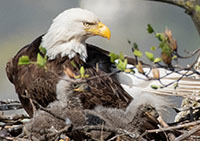 4/18 – Town of Poughkeepsie: An adult in bald eagle nest NY62, likely the female, was in attendance today and caring for her two, gray and fuzzy, chicken-size, nestlings. A fish, likely a catfish, had been delivered earlier. 4/18 – Town of Poughkeepsie: An adult in bald eagle nest NY62, likely the female, was in attendance today and caring for her two, gray and fuzzy, chicken-size, nestlings. A fish, likely a catfish, had been delivered earlier.
- Jack Currie
4/18 – Town of Wappinger: As I watched bald eagle nest NY459, I saw a change-over of the adults. One brought in a huge fish (species unknown) as the other left to go shopping. The adult in the nest flew up to a nearby branch before flying overhead in circles. As if being summoned, the “shopper” eagle soon swooped in and landed in the nest. We continue to have difficulty seeing if there is more than one nestling. With new leaves on the trees, that will only get more difficult. If all continues to go well, we can expect a fledge between June 21 and July 9. (Photo of bald eagle nestlings courtesy of Jack Currie)
- Judy Winter
4/19 – Newcomb, HRM 302: After a gorgeous sunny day with temperatures hitting 52 degrees F, winter returned this morning depositing just over 13 inches of heavy, wet, unwelcome snow on the landscape. The storm resulted in much damage to trees, bending over smaller saplings and snapping branches. It seemed like more damage was done during this spring storm than an entire winter's worth of wind, snow, and ice. Seed-eating birds were cramming the feeders while robins and flickers were trying to find bits to eat along building foundations. Vernal pools that were filled with croaking wood frogs and spring peppers the day before, were now filled with a cold slush.
- Charlotte Demers
4/19 – Minerva, HRM 284: A serious spring snowstorm left 14 inches of sloppy, heavy, wet snow. Trees and large branches came down all over the place, wreaking havoc with power lines and roads. Some back roads in Minerva were still impassable this morning.
- Mike Corey
4/19 – Albany County, HRM 145: Adding to the several reports documenting an influx of podicipedids
[aquatic diving birds, e.g., grebes] in our area, I found a flock of 27 horned grebes with three red-necked grebes mixed in a little north of the Port of Albany. A bit farther upriver along the waterfront were three more horned grebes.
Also notable for this location were twenty bufflehead ducks and a snow goose feeding on the grass with Canada Geese at Corning Riverfront Park.
- Tristan Lowery (Hudson-Mohawk Bird Club)
4/19 – Yonkers, HRM 18: Our staff at the Sarah Lawrence Center for the Urban River at Beczak checked our glass eel fyke net that we had set in our tidemarsh overnight. Today’s glass eel numbers (105) were good. Other fish included five winter flounder and a mummichog. Invertebrates were represented by 13 grass shrimp and a bunch of amphipods.
Later, we made our daily five hauls of our seine which came in light with just three mummichogs and a large (more than 17 inches long) white sucker. The river temperature was 49 degrees F, the salinity continued low at 2.23 parts-per-thousand (ppt), and the dissolved oxygen (sometimes called “DO” for short) was 11.00 parts-per-million (ppm).
- Jason Muller, Emma Salada, Zensu Nguyen
4/20 – Yonkers, HRM 18: Our staff at the Sarah Lawrence Center for the Urban River at Beczak, with assistance from students from The Art of Teaching class, checked our glass eel fyke net that we set in our tidemarsh overnight. Despite a steep drop in salinity that apparently had little effect, we counted 217 glass eels. Elsewhere in the net, we found one winter founder and nearly two dozen amphipods.
Our daily seine hauls were likewise light on fishes with only three mummichog. The water temperature was 53 degrees F, the salinity had nearly disappeared at 0.84 ppt, and the dissolved oxygen was 12.55 ppm.
- Jason Muller, Emma Salada, Zensu Nguyen
4/20 – Manhattan, HRM 2: Our Hudson River Park’s River Project staff checked our sampling and collection gear that we deploy off Pier 40 in Hudson River Park. This trap-checking session collected five juvenile black sea bass (50-70 millimeters), three of which were in a single minnow pot. Our minnow pots also caught a veritable menagerie of invertebrates including grass shrimp, isopods, amphipods, comb jellies and a leech. It was an exciting day for our Harbor School interns, who were learning the gear-checking procedures.
– Zoe Kim, Toland Kister, Demolyn Ramirez, Juliet Wiley
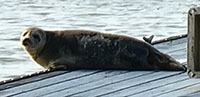 4/21 – New Baltimore, HRM 131.5: Kathy Donovan, Shady Harbor Marina co-owner, spotted a harbor seal hauled out on one of her docks this morning. Kathy said the “happy little guy” first appeared on the dock soaking in the sunshine for 45 minutes. The seal looked healthy and hung out on the dock looking around before dipping back into the Hudson River. The sighting was a first at the marina, made even more special with a return to the same dock later at night. (Photo of harbor seal courtesy of Kathy Donovan) 4/21 – New Baltimore, HRM 131.5: Kathy Donovan, Shady Harbor Marina co-owner, spotted a harbor seal hauled out on one of her docks this morning. Kathy said the “happy little guy” first appeared on the dock soaking in the sunshine for 45 minutes. The seal looked healthy and hung out on the dock looking around before dipping back into the Hudson River. The sighting was a first at the marina, made even more special with a return to the same dock later at night. (Photo of harbor seal courtesy of Kathy Donovan)
- Shayla Colon
[Marine mammal sightings in the tidewater Hudson River are not rare. In spring, they can be almost common. Seals have been finding their way upriver in spring before any of us were here to see them. Spring is the season for ocean fish species such as herring, shad, and striped bass to migrate in from the sea and head upriver to spawn in freshwater. Seals have been aware of this annual occurrence for as long as there has been a Hudson River and welcome the dining opportunities. Tom Lake]
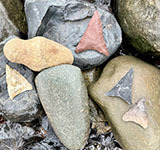 4/21 – Dutchess County, HRM 67.5: Hunter’s Brook is an idyllic little stream that tumbles down the fall line entering a 300-foot-long reach of tidewater through a dense canopy of hardwoods. The brook is a tributary of Wappinger Creek, in turn a tributary of the Hudson River. At 54 degrees F today, the water felt cool, but not cold, and very comfortable. 4/21 – Dutchess County, HRM 67.5: Hunter’s Brook is an idyllic little stream that tumbles down the fall line entering a 300-foot-long reach of tidewater through a dense canopy of hardwoods. The brook is a tributary of Wappinger Creek, in turn a tributary of the Hudson River. At 54 degrees F today, the water felt cool, but not cold, and very comfortable.
Shadbush was blooming in the forest and the gorgeous yellow flowers of lesser celandine lined the stream edge growing up between pebbles and cobbles. Some of the cobbles were purple quartzite and various cherts displaying chipping, flaking, grinding, and intentional fractures, shaped by human hands into hammerstones, hearthstones, net sinkers, and other stone tools. Stone Age peoples knew this brook well and found raw material in the rocks and sustenance in the water.
I listened closely for splashes among the bird song indicating spawning fishes. Every so often, a few alewives would splash up along the shore, the males following the females to spawn. River herring favor the pulse of rising tides and the dark of night.
A stone’s throw across the way from the confluence of Hunter’s Brook, and Wappinger Creek stands a tall, white-barked sycamore. In the crown were three great blue heron nests, with a single adult standing in each. (Photo of stone tools courtesy of Tom Lake)
- Tom Lake
4/21 – Yonkers, HRM 18: Our staff at the Sarah Lawrence Center for the Urban River at Beczak made our daily check of the glass eel fyke net that we set overnight in our tidemarsh. The glass eel numbers (88) showed a significant, but not unanticipated, drop from yesterday. Other fish in the net included a mummichog and a winter flounder. The water temperature was 52 degrees F, the nearly disappearing salinity had dropped further to 0.66 ppt, and the dissolved oxygen was 11.03 ppm.
- Jason Muller, Rachel Lynch, Ruby Alcorn
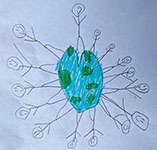 4/22 – Hudson River Watershed: Our first Earth Day was celebrated on April 22, 1970, 53 years ago today. It was an occasion to be optimistic. 4/22 – Hudson River Watershed: Our first Earth Day was celebrated on April 22, 1970, 53 years ago today. It was an occasion to be optimistic.
That initial Earth Day did indeed increase environmental awareness in America: By July of 1970 the Environmental Protection Agency was established by special executive order to regulate and enforce national pollution legislation. Earth Day also led to the passage of the Clean Water (1972) and Endangered Species (1973) acts.
However, if Earth Day is to have any lasting impact, a movement for change, the celebration must go far beyond the banners, parades, speeches, and hoopla. Our species name, Homo sapiens, translates from Latin as "wise,” or “prudent man.” It is way past time that we, collectively, begin to act as such and become willing and responsible stewards of our air, land, and water.
Authors, such as Rachel Carson and her seminal work Silent Spring (1962)—about the effects of pesticides on wildlife, including bald eagles—are often cited as the beginning of the modern environmental movement in the United States. Others have written volumes on how we should recognize our place in the Earth’s biosphere. But on Earth Day, for a very poignant and succinct recipe, I look to the first stanza in English poet William Blake’s Auguries of Innocence (1803):
To see a World in a Grain of Sand
And a Heaven in a Wild Flower
Hold Infinity in the palm of your hand
And Eternity in an hour.
(Photo of Earth Day student contribution courtesy of Tom Lake)
- Tom Lake
4/22 – Saugerties, HRM 102: I was sitting on a bench early this Earth Day morning on the lighthouse dock watching a lone osprey on its nest at the offshore channel marker. At one point, the bird looked inshore at the mouth of Esopus Creek and then swooped down to snatch a stick that was floating by. Nesting material. As I was about to leave, the other osprey came in; they sat looking at each other. I wondered what they were thinking.
- Alan Beebe
[This will be the fifth year for this nesting pair on the channel market. They have been successful in only one of their four previous seasons. Patrick Landewe]
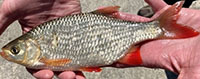 4/22 – Norrie Point, HRM 85: Red Hook High School students joined our Norrie Point staff on Earth Day to discover what was home in the river. We began the day treated to the soft, hazy, white glow in the woods of shadbush (Amelanchier sp.), a native species. Our seining resulted in nine fish species, including, American eel, golden shiner, spottail shiner, goldfish, banded killifish, tessellated darter, redbreast sunfish, bluegill sunfish, and pumpkinseed sunfish. The ten-inch goldfish showed head trauma most likely from an eagle’s talons. What began as a meal for the eagle ended up with a drop. The river was 54 degrees F. 4/22 – Norrie Point, HRM 85: Red Hook High School students joined our Norrie Point staff on Earth Day to discover what was home in the river. We began the day treated to the soft, hazy, white glow in the woods of shadbush (Amelanchier sp.), a native species. Our seining resulted in nine fish species, including, American eel, golden shiner, spottail shiner, goldfish, banded killifish, tessellated darter, redbreast sunfish, bluegill sunfish, and pumpkinseed sunfish. The ten-inch goldfish showed head trauma most likely from an eagle’s talons. What began as a meal for the eagle ended up with a drop. The river was 54 degrees F.
Recreational anglers on the back deck of the Environmental Education Center filled a five-gallon bucket with fourteen-inch-long rudd (Scardinius erythrophthalmus), a large minnow. We discussed “type sites” with the students, where a species was first described to science. Rudd was a good example of a nonnative species type site, in this case Northern Europe. (Photo of rudd courtesy of Tom Lake)
- Benjamin Harris, Madeline McDonald, Maija Niemisto, Tom Lake
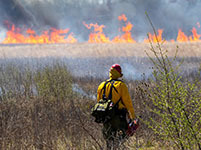 4/22 – Galeville, HRM 74: The U.S. Fish & Wildlife Service conducted a prescribed burn at the 4/22 – Galeville, HRM 74: The U.S. Fish & Wildlife Service conducted a prescribed burn at the
Shawangunk Grasslands National Wildlife Refuge on Earth Day. The use of prescribed burns is part of the Wildlife Refuge habitat management program. The objectives of the burn are to maintain and enhance migratory and wintering habitat for grassland breeding birds and foraging raptors by stimulating growth of native warm-season grasses and reducing undesirable plants. (Photo of Shawangunk NWR courtesy of Karen Maloy Brady)
- Karen Maloy Brady
[The practice of “prescribed burns” in the Hudson Valley and the Northeast have their origins in prehistory. Indigenous people understood their ecological value, not from a scientific perspective but from logic through observation. Such “burns” encourage secondary growth of edge habitat in grasslands adjacent to forests, biomes that are favored by wildlife. Tom Lake]
4/22 – Yonkers, HRM 18: It was Earth Day, and our staff at the Sarah Lawrence Center for the Urban River at Beczak recognized our contribution to a better understanding of our Hudson River estuary. Our first stop was to check our glass eel fyke net that we had set overnight in our tidemarsh. The 115 glass eels we counted, though a modest number, seemed extra significant on Earth Day.
Then we made our five seine hauls where our catch was much more diverse. Among the fish were eight mummichogs (75-110 mm), two white perch (160, 210 mm), and a yearling striped bass (100 mm). The water temperature was 54 degrees F, the salinity was still very low at 1.15 ppt, and the dissolved oxygen was 9.92 ppm.
- Jason Muller, Emma Salada, Zensu Nguyen, Mia Harada, Gabrielle Krieger
4/22 – HRM 2: It was on Earth Day as our Hudson River Park’s River Project staff checked our sampling and collection gear that we deploy off Pier 40 in Hudson River Park. While we had caught no fish, we did collect a variety of invertebrates in our minnow pots including grass shrimp, white-fingered mud crabs, isopods, and amphipods. Additionally, we found a blue crab claw (from a moult?) caught in an eel mop that we rig off the pier.
- Zoe Kim, Toland Kister, Siddhartha Hayes
Spring 2022 Natural History Programs and Events
Announcing the 2022 Hudson River Striped Bass Cooperative Angler Program
You can share your fishing trip information and help biologists understand and manage our Hudson River striped bass fishery. Here’s how it works: Fill out a logbook provided by us whenever you fish on the Hudson River (by boat or from shore). You can also use our survey123 app and record your trips using a smart phone or computer. Record general location, time, gear used, what you caught (or if you didn’t catch anything) and return the logbook when you are done fishing for the season. You’ll receive an annual newsletter summarizing the information in addition to the latest news regarding regulations and the river. Whether you catch-and-release or take home a keeper, you can be part of the Cooperative Angler Program. Online logbook instructions can be found here: https://www.dec.ny.gov/docs/remediation_hudson_pdf/hrcoopanglerelogbook.pdf
Join today by contacting: hudsonangler@dec.ny.gov or call 845-256-3009
Hudson River Education
Teachers and students will enjoy our new Hudson River K-12 Unit of Study. This carefully curated group of lesson plans, arranged by topic and/or grade, brings together great learning tools developed by the DEC and dozens of estuary partners:
https://www.dec.ny.gov/education/25386.html
Hudson River Miles
The Hudson is measured north from Hudson River Mile 0 at the Battery at the southern tip of Manhattan. The George Washington Bridge is at HRM 12, the Tappan Zee 28, Bear Mountain 47, Beacon-Newburgh 62, Mid-Hudson 75, Kingston-Rhinecliff 95, Rip Van Winkle 114, and the Federal Dam at Troy, the head of tidewater, at 153. The tidal section of the Hudson constitutes a bit less than half the total distance – 315 miles – from Lake Tear of the Clouds to the Battery. Entries from points east and west in the watershed reference the corresponding river mile on the mainstem.
To Contribute Your Observations or to Subscribe
The Hudson River Almanac is compiled and edited by Tom Lake and emailed weekly by DEC's Hudson River Estuary Program. Share your observations by e-mailing them to trlake7@aol.com. To subscribe to the Almanac (or to unsubscribe), use the links on DEC's Hudson River Almanac or DEC Delivers web pages.
Useful Links
National Oceanic and Atmospheric Administration online tide and tidal current predictions are invaluable when planning Hudson River field trips. For real-time information on Hudson River tides, weather and water conditions from sixteen monitoring stations, visit the Hudson River Environmental Conditions Observing System website.
DEC's Smartphone app for iPhone and Android is now available at: New York Fishing, Hunting & Wildlife App.
|