|
This bulletin provides only the most recent notices. Check the Adirondack Backcountry Information webpages for more detailed information on access, outdoor recreation infrastructure, and conditions.
Emergency Situations: If you get lost or injured; keep calm and stay put. If you have cell service, call 911 or the DEC Forest Ranger Emergency Dispatch, 833-NYS-RANGERS.
Welcome to the Adirondacks. The Welcome to the Adirondacks webpage is the place to go if you are interested in learning more about the Adirondacks. It provides information about the Forest Preserve, conservation easement lands, outdoor recreation, and Leave No Trace.
Love Our NY Lands: All New Yorkers and visitors should be able to access, enjoy, and feel welcome on state lands. These lands belong to all of us, our families, and our neighbors. While enjoying these shared spaces, be respectful of other visitors. Share trails, treat people with kindness, and leave things as you found them for others to enjoy. All of us have a responsibility to protect State lands for future generations. Learn more about how you can Love Our NY Lands.
Recreation Highlight: Reservation System Resumes at Adirondack Mountain Reserve
The pilot parking reservation system at the Adirondack Mountain Reserve (AMR) opened for 2022 reservations on Sunday, April 17. Visitors can now register and make reservations at the AMR website.
The reservation system first launched last year as part of the ongoing efforts to help protect public safety along Route 73 and improve visitors' trip planning and preparation by ensuring guaranteed parking upon arrival. No-cost reservations can be made as far as two weeks in advance. Additional days will become available on a 24-hour rolling basis. Seventy reservations, including several overnight reservations, are available per day.
Reservations will be required May 1 through Oct. 31 for single-day and overnight access to the parking lot, trailheads, and trails located on the privately owned, 7,000-acre AMR property in the town of Keene in the High Peaks region.
DEC and AMR continue to work together to adaptively manage the pilot to improve public safety, ensure equitable access, and promote sustainable use of this popular hiking destination. Additional hiking opportunities and parking lots can be found throughout the 2.6 million acres of public lands within the Adirondack Forest Preserve on a first-come, first-served basis.
Learn more about the Adirondack Mountain Reserve on DEC's website. For a list of frequently asked questions and to register, visit AMR's website.
Recent Notices
The following are the most recent notices pertaining to public lands in the Adirondacks. Please check the Adirondack Backcountry Information webpages for comprehensive and up-to-date information on seasonal road statuses, rock climbing closures, specific trail conditions, and other pertinent information.
NEW THIS WEEK:
High Peaks Wilderness: Snow Conditions, 04/18: Snowshoes are still required for most higher and north-facing trails where snow remains deeper than 8 inches. Crampons and microspikes are still essential – many trails are still icy, especially above 3,000 feet. Trails are extremely muddy at lower elevations. Please avoid all trails above 2,500 feet while DEC’s muddy trails advisory is in effect.
Terry Mountain State Forest: Motorized public access via the Mud Pond Road is closed for mud season.
General Notices
Visit the main Adirondack Backcountry Information page for more trip-planning resources, including travel information, weather resources, and seasonally-specific information about Adirondack recreation.
Know Before You Go (04/21): This week’s spring snowstorm brought renewed winter conditions to many trails. Continue to prepare for wet spring conditions at lower elevations, with some snow accumulation in places, and winter conditions at higher elevations, including deep snow and ice. Expect high, fast-moving water at crossings – do not attempt to cross high, fast waters where there is no bridge. The forecast is calling for a warmer weekend but remember that temperatures will vary significantly depending on your location, the time of day, and your elevation. Be prepared with warm, waterproof layers, extra layers, and, depending on the elevation of your hike, proper gear for snow and ice, including snowshoes, microspikes, and crampons. Cool, wet weather poses a significant risk of hypothermia, so learn how to recognize and avoid it. Wear sturdy waterproof boots that are already broken in.
Check the Weather: Check the forecast for your destination and pack and plan accordingly. Check the National Weather Service Northern Adirondacks and Southern Adirondacks Mountain Point Forecasts for select summit forecasts. Check both daytime and nighttime temperatures and remember that temperatures will drop as you gain elevation. Check wind chill temperatures and prepare for colder, windier summits.
Muddy Trails: Walk straight through mud instead rather than around it to prevent trail widening and vegetation damage. Opt for low elevation trails until high elevations have time to dry and harden. Follow the muddy trails advisory.
Monorails: Monorails are thin strips of hardpacked snow and ice in the center of trails, surrounded by minimal or no snow on the sides. Monorails can create difficult walking conditions. Microspikes and trekking poles can assist with traction and balance.
Seasonal Roads: Most seasonal access roads are closed for spring mud season. Where seasonal access roads are open to public motor vehicles, the use of four-wheel-drive vehicles is strongly recommended.
Fire Danger: Check the fire rating map.
- Adirondack Park - Low
- Champlain Region – Low
Water Conditions: Water levels throughout the Adirondack region are mostly average for this time of year, with select waterways slightly above or below average. Check the USGS Current Water Data for New York for stream flow of selected waters. Water temperatures will be very cold. Personal Flotation Devices (PFDs aka lifejackets) are required to be worn until May 1. Where bridges are not available, do not attempt stream crossings during periods of high, fast-moving water.
Ticks: Wear light-colored clothing with a tight weave to spot ticks easily. Wear enclosed shoes, long pants, and a long-sleeved shirt. Tuck pant legs into socks or boots and shirt into pants. Check clothes and any exposed skin frequently for ticks while outdoors. Consider using insect repellent. Stay on cleared, well-traveled trails and walk in the center of trails. Avoid dense woods and bushy areas. Additional tips for tick prevention.
Bear Canisters Required: NYSDEC requires the use of bear-resistant canisters by overnight users in the Eastern High Peaks Wilderness between April 1 and November 30. NYSDEC encourages campers to use bear-resistant canisters throughout the Adirondack backcountry. Bear canisters should be used to store all food, food garbage, toiletries, and other items with a scent. Canisters should be stored a minimum of 100ft from tents, lean-tos, and cooking sites and kept closed whenever they are not being accessed. Learn more about bear canisters and avoiding human-bear conflicts.
Adirondack Rock Climbing Closures: DEC closes certain rock climbing routes in the Adirondacks to protect nesting peregrine falcons. For a full list of closures, visit Adirondack Rock Climbing Route Closures. Once peregrine nest sites are determined, climbing routes that will not disturb nesting will be reopened. Routes that remain closed will reopen after the young have fledged. Thank you for your cooperation. For more information please contact the Bureau of Wildlife at (518) 623-1240.
Safety & Education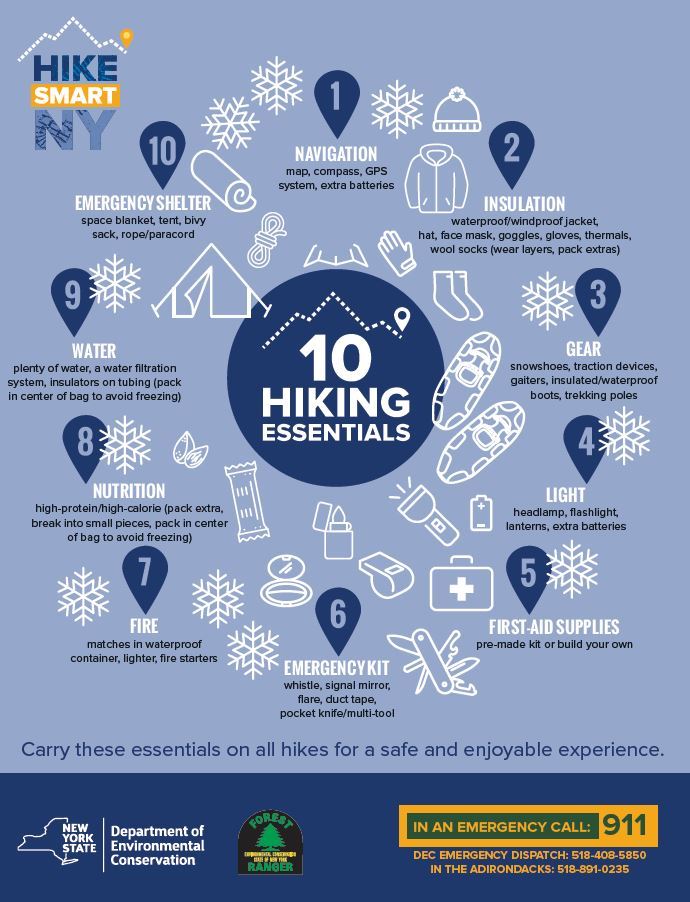
Spring is in full swing. Whether you’re going for a hike, a bike, a paddle, or fishing, Hike Smart NY can help you prepare with a list of 10 essentials, guidance on what to wear, and tips for planning your trip with safety and sustainability in mind.
Snow Today, Sun Tomorrow
This week’s snowstorm was a great reminder of how rapidly conditions can change during the spring season. That’s why it is important that you check the weather for the day before, the day of, and the day after your planned outing. By checking the weather for the day before your trip, you will gain a better understanding of the conditions you may encounter on the trail. Knowing the forecast for the day informs what gear and layers you need to bring. Checking the weather for the night of your outing and the day after will tell you the extra items you may need in case of an unexpected overnight.
Keep in mind that forecasts are predictions, not promises. Weather may change from the original forecast, so it is best to be prepared with extra layers and rain gear no matter the weather report. Conditions, including temperature and wind speeds, will also change as you gain elevation or break above tree line.
Leave No Trace
Follow the Seven Principles of Leave No Trace to maintain minimal impact on the environment and the natural resources of the Adirondacks. Use proper trail etiquette to ensure an enjoyable experience for yourself and others and tread lightly!
This Earth Day, Give Back by Getting Involved
Earth Day, April 22, is a wonderful time to assess how we interact with our natural world. Do you Leave No Trace while recreating outdoors? Do you pick up trash along trails or your street? Our outdoor spaces give us so much – fresh air, a place to recreate, an opportunity to slow down and disconnect – just to name a few. We rely on the earth for everything, so it’s important that we also consider how we can give back to it.
This Earth Day, find out how getting involved with Leave No Trace can help you give back. Whether it’s participating in a volunteer day, attending an event, taking a training, or supporting a program – there are many ways to join Leave No Trace in making a positive difference for our outdoor spaces as well as current and future visitors.
|