A Project of the Hudson River Estuary Program
Compiled and edited by Tom Lake, Consulting Naturalist
Love Our NY Lands
State Lands Belong to All of Us
All New Yorkers and visitors should be able to access, enjoy, and feel welcome on state lands. These lands belong to all of us, our families, and our neighbors. While enjoying these shared spaces, be respectful of other visitors. Share trails, treat people with kindness, and leave things as you found them for others to enjoy. All of us have a responsibility to protect State lands for future generations. For more information, visit: https://www.dec.ny.gov/outdoor/119881.html
Overview
A first appearance of any wildlife is always exciting, especially when it is a raptor from a faraway place. Our great blue heron colonies seemed to be relatively flourishing, and Hudson Valley bald eagle nests celebrated several hatches this week, some with multiple nestlings.
Highlight of the Week
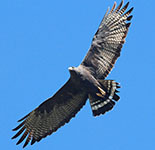 4/2 – Brooklyn, New York City: In mid-morning, from Green-Wood Cemetery in Brooklyn, I spotted a small flock of raptor-like birds flying northwest toward Staten Island. The flock included two turkey vultures, a red-tailed hawk, and a bird that looked like a cross between the two. The mysterious visitor had a hawk outline and turkey vulture coloration of black with pale underwings. I sent a photo of the bird to my friends and passed it through a bird identification app. The app suggested it was a zone-tailed hawk (Buteo albonotatus). The bird departed quickly, chased away by one of the cemetery’s resident red-tailed hawks before heading west across New York Harbor. (Photo of zone-tailed hawk courtesy of Alan Schmierer) 4/2 – Brooklyn, New York City: In mid-morning, from Green-Wood Cemetery in Brooklyn, I spotted a small flock of raptor-like birds flying northwest toward Staten Island. The flock included two turkey vultures, a red-tailed hawk, and a bird that looked like a cross between the two. The mysterious visitor had a hawk outline and turkey vulture coloration of black with pale underwings. I sent a photo of the bird to my friends and passed it through a bird identification app. The app suggested it was a zone-tailed hawk (Buteo albonotatus). The bird departed quickly, chased away by one of the cemetery’s resident red-tailed hawks before heading west across New York Harbor. (Photo of zone-tailed hawk courtesy of Alan Schmierer)
- Angela Panetta
[David Allen Sibley (2000) remarks how the zone-tailed hawk is incredibly similar looking, especially in profile, to the turkey vulture, with which it often soars. As serious birders remind us, check every bird; do not assume that a flock of look-alikes, are all alike. Tom Lake]
[This zone-tailed hawk sighting was a first for New York State. They are rare in the Northeast, typically seen only soaring over the Southwest U.S. or Central and South America. However, to some hawk watchers, this record was anticipated. Zone-tailed hawks, in very small numbers, have been documented from Virginia to Nova Scotia in four of the last eight years, as they expand their range in North America. Cornell Lab of Ornithology]
Natural History Entries
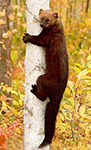 4/2 – Essex County, HRM 280: For only my second time ever, I saw a living fisher (Pekania pennanti) running across the road in early evening two miles east of Olmsteadville. It was beautiful with a dark brown body and tail, lighter brown head, and neck. I've seen three or four other fishers up here, but they sadly have all been roadkill. (Photo of fisher courtesy of Doug Domedion) 4/2 – Essex County, HRM 280: For only my second time ever, I saw a living fisher (Pekania pennanti) running across the road in early evening two miles east of Olmsteadville. It was beautiful with a dark brown body and tail, lighter brown head, and neck. I've seen three or four other fishers up here, but they sadly have all been roadkill. (Photo of fisher courtesy of Doug Domedion)
- Mike Corey
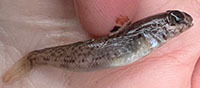 4/2 – Annandale-on-Hudson, HRM 98.5: We checked our fyke net today that we had set in the Saw Kill at Tivoli South Bay. We had a modest haul of 19 glass eels. Among other fish, however, was a central mudminnow, a banded killifish, a four-spined stickleback (Apeltes quadracus), and a round goby. It was the first round goby we have caught in a fyke net. This invasive species was initially found in the Hudson River Estuary last year across a thirteen-mile reach of tidewater south of Troy. (Photo of round goby courtesy of Sarah Mount) 4/2 – Annandale-on-Hudson, HRM 98.5: We checked our fyke net today that we had set in the Saw Kill at Tivoli South Bay. We had a modest haul of 19 glass eels. Among other fish, however, was a central mudminnow, a banded killifish, a four-spined stickleback (Apeltes quadracus), and a round goby. It was the first round goby we have caught in a fyke net. This invasive species was initially found in the Hudson River Estuary last year across a thirteen-mile reach of tidewater south of Troy. (Photo of round goby courtesy of Sarah Mount)
- Sarah Mount, Benjamin Harris, Hunter Lee
[The round goby is native to the Black and Caspian seas and was likely introduced by ballast water to the Great Lakes in the 1990s. It has the potential to cause significant ecological and recreational impacts. Round gobies are voracious feeders and compete with native species for food and spawning habitat. Their diet includes small invertebrates, mussels, and the eggs of native species and popular sportfish such as smallmouth bass and walleye. If you catch a round goby in the Hudson River, take multiple photographs from different angles and record the date and location of capture. Please send (e-mail) photographs and information to: isinfo@dec.ny.gov. Do not release the fish. DEC will continue to monitor this invasive fish in the Hudson River. NYSDEC]
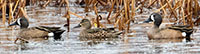 4/3 – Town of Warwick, HRM 41: I went out this morning in search of waterfowl, checking several lakes and ponds in southern Orange County. I finished up at the 335-acre Liberty Marsh, part of the U.S. Fish and Wildlife Service’s Wallkill River National Wildlife Refuge. This was the best birding location, which I walked in the rain. In all, I totaled 17 species of waterfowl. Among them were Canada goose, wood duck, blue-winged teal, northern shoveler, American Wigeon, American black duck, northern pintail, green-winged teal, ring-necked duck, and pied-billed grebe. (Photo of blue-winged teal courtesy of Matt Zeitler) 4/3 – Town of Warwick, HRM 41: I went out this morning in search of waterfowl, checking several lakes and ponds in southern Orange County. I finished up at the 335-acre Liberty Marsh, part of the U.S. Fish and Wildlife Service’s Wallkill River National Wildlife Refuge. This was the best birding location, which I walked in the rain. In all, I totaled 17 species of waterfowl. Among them were Canada goose, wood duck, blue-winged teal, northern shoveler, American Wigeon, American black duck, northern pintail, green-winged teal, ring-necked duck, and pied-billed grebe. (Photo of blue-winged teal courtesy of Matt Zeitler)
- Matt Zeitler
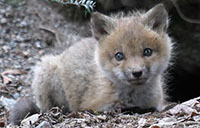 4/3 – Hudson River Watershed: It is that time of year again. Red fox kits are emerging from their dens to explore their new world after being kept inside with their mothers nursing for the first 4-5 weeks of life. The red fox (Vulpes vulpes) is one of the most widely distributed members of the order Carnivora. They are found across the Northern Hemisphere including most of North America, Europe, and Asia, plus parts of North Africa. They share their sub-family, Caninae (from Latin canis meaning “dog”) with domestic dogs, wolves, foxes, and coyotes. The males are called dogs, the females are called vixens, and young cubs are known as kits. The species primarily feeds on small rodents, though it may also target rabbits, squirrels, game birds, reptiles, and invertebrates (Pringle 2017). As with reptiles and amphibians, vehicular traffic can represent danger for wildlife. Red fox and their kits may use roads to cross from denning sites to foraging locations. Cautious driving habits can save wildlife, including red foxes. (Photo of red fox (kit) courtesy of Mary Holland) 4/3 – Hudson River Watershed: It is that time of year again. Red fox kits are emerging from their dens to explore their new world after being kept inside with their mothers nursing for the first 4-5 weeks of life. The red fox (Vulpes vulpes) is one of the most widely distributed members of the order Carnivora. They are found across the Northern Hemisphere including most of North America, Europe, and Asia, plus parts of North Africa. They share their sub-family, Caninae (from Latin canis meaning “dog”) with domestic dogs, wolves, foxes, and coyotes. The males are called dogs, the females are called vixens, and young cubs are known as kits. The species primarily feeds on small rodents, though it may also target rabbits, squirrels, game birds, reptiles, and invertebrates (Pringle 2017). As with reptiles and amphibians, vehicular traffic can represent danger for wildlife. Red fox and their kits may use roads to cross from denning sites to foraging locations. Cautious driving habits can save wildlife, including red foxes. (Photo of red fox (kit) courtesy of Mary Holland)
- Tom Lake
 4/4 – Hudson River Watershed: Fish-of-the-Week for Week 167 is the longnose gar (Lepisosteus osseus), number 16 (of 236) on our watershed list of fishes. If you would like a copy of our list, e-mail - trlake7@aol.com. 4/4 – Hudson River Watershed: Fish-of-the-Week for Week 167 is the longnose gar (Lepisosteus osseus), number 16 (of 236) on our watershed list of fishes. If you would like a copy of our list, e-mail - trlake7@aol.com.
Gar have lived in North American waters for 50 million years. Fossil gar found in rocks from the Green River formation of western Wyoming are so like gar found today in New York waters that they are thought to be members of the modern genus Lepisosteus. Longnose gar is one of two species of their family, Lepisosteidae, found in the Hudson River watershed. The other is the nonnative alligator gar (L. osseus).
Longnose gar is a primitive-looking, extremely well adapted fish, whose evolutionary journey began several hundred million years ago. With a fusiform body, armor-like ganoid scales, long narrow jaws full of very sharp teeth, growing to six-feet-long, they have been described by zoologist Archie Carr as having a “Paleozoic leer.”
Found in eastern North America from Quebec to northern Mexico, longnose gar are primarily freshwater fishes although they can live in coastal marine waters (their type site, where first described, is Virginia). In New York State, they occur in relatively large lakes such as Lake George and Lake Champlain, as well as both Lake Erie and Lake Ontario. They are a voracious lie-in-wait predator, essentially piscivores (fish eaters) but have been known to eat blue crabs in brackish water. The New York State longnose gar angling record was set by Michael Gatus in 2018, in South Bay of Lake Champlain, with a 14 lb., 10 oz, 52.25-inch-long fish (they are known to reach 72-inches and 50 lb).
A unique characteristic of gar is their ability to assimilate atmospheric oxygen allowing them to live in low dissolved oxygen conditions such as warm, shallow freshwater habitats. This is likely an evolutionary adaptation for survival in an aquatic world far different than today.
Their presence in the watershed is supported by a single 30-inch fish found impinged on the intake screens at the Roseton Power Generating Facility (river mile 66.5) in Orange County and recovered by Tom Lake in 1989. That gar was believed to have been a canal immigrant from Lake Champlain via the Hudson-Champlain Canal. In our watershed, longnose gar is designated as a nonnative, freshwater, Mississippi refugium, canal immigrant. However, given their present proximity to our watershed to the north, west, and south, it is not beyond the realm that longnose gar may have once been native to the watershed in the long-ago Pleistocene.
On May 13, 1994, five dead longnose gar were recovered from an outwash area on the Saw Mill River in Yonkers (eight dead gar were reported there the day before). While it was possible that longnose gar were resident, albeit never reported there before, we viewed the likelihood with a great deal of skepticism.
On June 1, 1994, a day-long investigation of the Saw Mill River watershed was conducted by fish doctors C. Lavett Smith and Bob Schmidt, as well as Christopher Letts, and Tom Lake. Using gill nets, dip nets, and seines, the exhaustive sampling resulted in a collection of eight rather unremarkable resident species, but no evidence of longnose gar.
Subsequent analyses of the stomach contents from the five longnose gar, conducted by Norma Feinberg (Ichthyology Department, American Museum of Natural History), revealed partially digested striped bass and white catfish. In trying to contemplate where the gar may have encountered these species, we considered several possibilities: Sawmill River, Hudson River, Lake Champlain, Lake Erie, and the Chesapeake Bay system.
After much consideration of the various physical and chemical components of each system, the conclusion was that at least five of the eight longnose gar were likely dumped in the Saw Mill River by an angler returning from a trip to the Chesapeake Bay area, possibly the Potomac River where longnose gar are common (Hildebrand and Schroeder 1928:78). In the end, they were not from the watershed, but their appearance gave us a wonderful mystery to unravel and a memorable educational journey. (Photo of longnose gar with permission by National Aquarium)
- Tom Lake
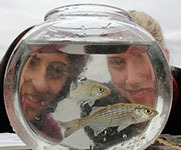 4/4 – Hudson River Estuary: The 2022 Hudson River recreational striped bass season opened on April 1 in waters upriver from the George Washington Bridge. Regulations for creeling recreationally caught striped bass is limited to fish caught within a slot size of 18-to-28-inches total length (no fish smaller than 18” or greater than 28” may be kept). Total length is defined as the distance from the tip of the nose to the tip of the caudal fin. 4/4 – Hudson River Estuary: The 2022 Hudson River recreational striped bass season opened on April 1 in waters upriver from the George Washington Bridge. Regulations for creeling recreationally caught striped bass is limited to fish caught within a slot size of 18-to-28-inches total length (no fish smaller than 18” or greater than 28” may be kept). Total length is defined as the distance from the tip of the nose to the tip of the caudal fin.
In concert with the season opening is the opportunity to participate in the Hudson River: Striped Bass Cooperative Angler Program. You can share your fishing trip information and help biologists understand and manage our Hudson River striped bass fishery. For more information you can contact hudsonangler@dec.ny.gov or go to: https://www.dec.ny.gov/docs/remediation_hudson_pdf/hrcoopanglerelogbook.pdf (Photo of striped bass courtesy of Chris Bowser)
- Jessica Best
4/5 – Bedford, HRM 35: I stopped by the great blue heron rookery today and was surprised to see that the nest count was now up to six. Three of them had a heron settled down in the nest, partly visible, sitting on eggs. The other three each had a heron perched on the side of their nest. The nests were very shallow and appeared to still be under construction. Hopefully they will keep on building.
- Jim Steck
4/5 – Yonkers, HRM 18: Our staff at the Sarah Lawrence Center for the Urban River at Beczak checked our glass eel fyke net that we had set out overnight in the Beczak tidemarsh. The glass eel catch (217) was modestly good, although not reaching our season high point in late March of over 400. We also found two mummichogs in the net. Afterwards, we made our five semi-daily seine hauls that collected seven mummichogs (60 millimeters [mm]).
The river temperature was 47 degrees Fahrenheit (F), the salinity was low at 1.9 parts-per-thousand (ppt), and the dissolved oxygen (sometimes called “DO” for short) was12.2 parts-per-million (ppm).
- Jason Muller, Emma Salada, Zensu Nguyen, Maddie Eggen
4/6 – Minerva, HRM 284: I heard my first Minerva peeper of the year on a warm night a couple hours after last light. And it was just that, one peeper. A timid little sound.
- Mike Corey
4/6 – Yonkers, HRM 18: Our staff at the Sarah Lawrence Center for the Urban River at Beczak checked our glass eel fyke net that we had set in the Beczak tidemarsh. Our numbers were falling; today’s catch was 48. The river temperature was 47 degrees F, the salinity was still low at 1.87 ppt, and the dissolved oxygen was 12.02 ppm.
- Jason Muller, Ivan Cabada, Tyler Freeland, Ishika Joshi, Cecilia Goncalves de Azeredo
[As if the life history of American eels was not mystical enough, the factors that may, or may not, effect the pulse of glass eels upriver in spring remains elusive. At the extremes, one day we may see 1,000, and the next day none.
Sarah Mount offers her thoughts on what factors impact glass eel numbers day-to-day. These include lunar cycle (spring tides), timing of the overnight flood tide, water temperature, and precipitation-stream flow. What makes finding a single answer difficult is parsing all these factors since they are all occurring at the same time. Often, we see peaks that align with spring tides; sometimes we see impacts of water temperature (particularly early in the season); but often specific relationships are hard to discern because there are multiple factors at play at the same time. Further complicating the answer is that different factors are important at different times during the season. In addition, gear performance is always a consideration.
Our ultimate dilemma, however, was whenever we'd get close to what we thought was THE prime mover, the unexpected would occur, and that would befuddle us no end. Some factors may be too subtle to notice let alone measure. I tend to fall back on the age-old maxim for an estuary, where "no one moment will ever recur again in exactly the same way." That about covers it.
- Tom Lake ]
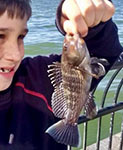 4/6 – Manhattan, HRM 2: Our Hudson River Park’s River Project staff, along with two Harbor School interns, checked our sampling and collection gear that we deploy off Pier 40 in Hudson River Park. It was an exhilarating day for us given the meager catches of winter. Our crab pots held a 170 mm-long “blackfish” (tautog) as well as two juvenile black sea bass (55-60 mm). Our minnow traps caught several grass shrimp and isopods. It was an exciting first day on the job for our new high school interns. (Photo of black sea bass courtesy of Tom Lake) 4/6 – Manhattan, HRM 2: Our Hudson River Park’s River Project staff, along with two Harbor School interns, checked our sampling and collection gear that we deploy off Pier 40 in Hudson River Park. It was an exhilarating day for us given the meager catches of winter. Our crab pots held a 170 mm-long “blackfish” (tautog) as well as two juvenile black sea bass (55-60 mm). Our minnow traps caught several grass shrimp and isopods. It was an exciting first day on the job for our new high school interns. (Photo of black sea bass courtesy of Tom Lake)
- Zoe Kim, Siddhartha Hayes, Toland Kister, Demolyn Ramirez, Juliet Wiley
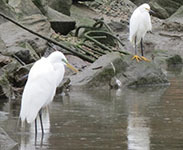 4/6 – Manhattan, New York City: Rainy weather is sometimes a bummer, but it does bring out a lot of the birds on the Island. Our Randall’s Island Park Alliance Staff spotted six egrets today at the Little Hell Gate Salt Marsh Inlet, including two great egrets and four snowy egrets, the most we've seen together in a long while. (Photo of Snowy egret-Great egret courtesy of Jackie Wu) 4/6 – Manhattan, New York City: Rainy weather is sometimes a bummer, but it does bring out a lot of the birds on the Island. Our Randall’s Island Park Alliance Staff spotted six egrets today at the Little Hell Gate Salt Marsh Inlet, including two great egrets and four snowy egrets, the most we've seen together in a long while. (Photo of Snowy egret-Great egret courtesy of Jackie Wu)
- Jackie Wu
4/7 – Minerva, HRM 284: It was not a great maple syrup season for my small-time operation, not by any stretch, but it was not a totally bad one, either. The “sapping season” will be done this week and I will have made three-quarters of a gallon of maple syrup by the time I am done reducing the sap.
- Mike Corey
4/7 – New Paltz, HRM 78: There was a tundra swan today, in the cornfields between the Wallkill View Farm stand and the bridge over the Wallkill River in New Paltz. Tundra swans are often called “America’s native swan.” They are occasional visitors to the Hudson Valley during spring and fall migrations.
- Brian Houser
[Archaeological evidence recovered from these flood plain cornfields date human occupation in that area to at least 13,000 years ago. Tom Lake]
 4/7 – Town of Poughkeepsie: Again, this year, bald eagle nest NY62 has produced two healthy-looking nestlings. The original male and female built the first NY62 nest two miles away on Wheeler Hill Road, Town of Wappinger, in February 2001.They had no eggs that first year; their incredible run of success began in 2002. The tally, to date, for NY62, is 25 nestlings in 21 years. Pretty impressive considering there were five years where the nest failed. The Town of Poughkeepsie site is their third nest; two previous abandoned nests were in the Town of Wappinger. 4/7 – Town of Poughkeepsie: Again, this year, bald eagle nest NY62 has produced two healthy-looking nestlings. The original male and female built the first NY62 nest two miles away on Wheeler Hill Road, Town of Wappinger, in February 2001.They had no eggs that first year; their incredible run of success began in 2002. The tally, to date, for NY62, is 25 nestlings in 21 years. Pretty impressive considering there were five years where the nest failed. The Town of Poughkeepsie site is their third nest; two previous abandoned nests were in the Town of Wappinger.
The original male was hit and killed by Amtrak in 2017. He carried a blue leg band number N42 and was one of three nestlings fledged from a nest on the Delaware River in Sullivan County in 1995. He was six years old in 2001 when he and his mate began. We always believed that the female was of similar age, a "new adult," perhaps of French-Canadian origin, and they had met while wintering in the Hudson Valley in 2000. The N42 replacement male began siring eaglets in 2018 and has had five successful seasons.
Our Soul of NY62 collection of expert birders has been largely responsible for compiling the chronological details of NY62 through world-class photographs. (Photo of bald eagles courtesy of Dawn Renee Newlander)
- Tom Lake
4/7 – Yonkers, HRM 18: Our staff at the Sarah Lawrence Center for the Urban River at Beczak checked our glass eel fyke net that we had set out overnight in the Beczak tidemarsh. Our numbers were shrinking; today’s catch was 39 glass eels. Our only other catch was a single Leidy’s comb jelly. The river temperature was 46 degrees F, the salinity was 2.5 ppt, and the dissolved oxygen was12.2 ppm.
- Jason Muller, Ivan Cabada, Rachel Lynch, Kiki Quiros, Annie Bingham
4/8 – Waterford, HRM 158: After more than three inches of rain upstream in the watershed yesterday, the Mohawk and Hudson rivers were at flood stage in several areas including Waterford, where the docks were underwater, and streets were inundated.
It was quite the setting for an earlier than projected hatch date for the pair of bald eagles in NY485. Based on the start of incubation, we had guessed a hatch on April 9. Today I watched one of the adults return to the nest with a fish. The incubating adult tore a small morsel of fish with its beak, walked to the center of the nest, lowered the morsel down, and came up with an empty beak. A new little eaglet may have just had its first meal.
- Howard Stoner
4/8 – Selkirk, HRM 135: There had been a hatch at bald eagle nest NY81 across the river from Henry Hudson Park, in Rensselaer County, near the mouth of the Moordener Kill. This afternoon I saw a changeover of the adults; one left as the other came into the nest. The outgoing eagle dove in the river, and caught a fish, and then flew up in a tree and began eating it. Soon the leftovers were brought to the nest where it was shared with a nestling.
- Roberta Jeracka
[Roberta’s description of eagle behavior is not uncommon, especially among young males. They, will, on occasion, take a fish to a nearby perch, eat all the “good parts,” and then take the remnants to the nest. They tend to outgrow this behavior rather quickly. Tom Lake]
4/8 – Yonkers, HRM 18: Our staff at the Sarah Lawrence Center for the Urban River at Beczak checked our glass eel fyke net that we had set overnight in the Beczak tidemarsh. Our glass eel numbers perked up a bit to 74. Other fish included three mummichogs (58 mm).
Later, we made our seine hauls catching five, thumbnail-size, young-of-year (YOY) winter flounder. That gave us 17 for the season, an unusually high number, possibly reflecting a good year class for winter flounder downriver in marine waters. Last spring, we caught only six. The river temperature was 46 degrees F, the salinity was 2.84 ppt, and the dissolved oxygen was11.3 ppm.
- Jason Muller, Kiki Quiros, Ishika Joshi, Gabrielle Krieger
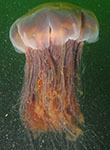 4/8 – Manhattan, New York City: Our Randall’s Island Park Alliance Staff went seining today at the Water's Edge Garden on the Harlem River. We were assisted by high school students from Repertory Company High School for Theatre Arts. We didn't catch any fish, but that did not matter! We caught many invertebrates including eleven comb jellies about the size of a peanut M&M and a colony of star tunicates. 4/8 – Manhattan, New York City: Our Randall’s Island Park Alliance Staff went seining today at the Water's Edge Garden on the Harlem River. We were assisted by high school students from Repertory Company High School for Theatre Arts. We didn't catch any fish, but that did not matter! We caught many invertebrates including eleven comb jellies about the size of a peanut M&M and a colony of star tunicates.
Among true jellyfish, we caught at least 40 lion’s mane (Cyanea capillata) in three hauls of our seine. Their bells (umbrella) ranged from roughly the size of a half dollar to about the diameter of the lid to a pint of ice cream. These are the largest jellyfish in the world with some reaching more than a meter across with tentacles that stretch more than 75 feet, although those of that size are rare. Water temperature was 48 degrees F, salinity was 16.0 ppt, and the dissolved was 9.0 ppm. (Photo of lion's mane courtesy of Dan Hershman)
- Jackie Wu
[Note: Ken Gosner's Guide to Identification of Marine and Estuarine Invertebrates (1971) is the best source for taxonomic identification for the Lion's mane jellyfish (Cyanea capillata). Tom Lake]

Spring 2022 Natural History Programs and Events
The World Fish Migration Foundation
The World Fish Migration Foundation is partnering with Wildlife Forever Fish Art for a Fish Flag Contest. In past years, students were asked to create a painting or drawing of a migratory fish. This year, in a break from tradition, students are encouraged to create a migratory fish flag of any shape, size, and material! This award highlights the diversity of migratory fish from across the world and the importance of the free-flowing rivers they rely on. This global contest is open to all young artists ages 5-18 and is free to enter.
To enter the Fish Flag Contest, young artists should:
1. Go to https://www.fishflags.org for more information on the contest and World Fish Migration Day
2. Create a flag depicting a migratory fish species of your choice such as American eel, American shad, Atlantic sturgeon, Atlantic tomcod, river herring, and striped bass. To qualify, your migratory fish must spend some of its life in freshwater.
3. Complete an entry form and submit your flag before the April 14th deadline (visit www.fishflags.org) to learn more).
4. Fly your flag on World Fish Migration Day: May 21, 2022!
Feel free to reach out to Nicole Friedman, the coordinator of the Fish Flag Contest (nicole@fishmigration.org) with any questions about the contest or World Fish Migration Day.
Let’s use art to make a difference!
Winners will be announced during a live broadcast on May 21.
Pollution with PCBs in this section of the Hudson River accumulates in the fat tissue of fish and has led the NYS Dept of Health to issue the following advisories regarding eating fish you catch between Troy and Catskill. This advice is based on laboratory testing of fish caught in this section of the river, and the detected PCBs in these fish.
Announcing the 2022 Hudson River Striped Bass Cooperative Angler Program
You can share your fishing trip information and help biologists understand and manage our Hudson River striped bass fishery. Here’s how it works: Fill out a logbook provided by us whenever you fish on the Hudson River (by boat or from shore). You can also use our survey123 app and record your trips using a smart phone or computer. Record general location, time, gear used, what you caught (or if you didn’t catch anything) and return the logbook when you are done fishing for the season. You’ll receive an annual newsletter summarizing the information in addition to the latest news regarding regulations and the river. Whether you catch-and-release or take home a keeper, you can be part of the Cooperative Angler Program. Online logbook instructions can be found here: https://www.dec.ny.gov/docs/remediation_hudson_pdf/hrcoopanglerelogbook.pdf
Join today by contacting: hudsonangler@dec.ny.gov or call 845-256-3009
Hudson Estuary Trees for Tribs Program
Now Accepting Applications. The Hudson River Estuary Program’s Trees for Tribs program offers free native trees and shrubs for planting along the tributary streams in the Hudson River Estuary watershed. Our staff can help you with a planting plan and work with your volunteers. Due date for Applications is March 1 for 2022 spring planting projects. Download and submit the two-page application found here: www.dec.ny.gov/docs/remediation_hudson_pdf/hrewtftap14.pdf. For more information about the program please visit the DEC website at: www.dec.ny.gov/lands/43668.html. If you have questions about a potential planting site, please contact Beth Roessler and Emily Haase at: HudsonEstuaryTFT@dec.ny.gov, or call (845)256-2253 to find out if your site is eligible for a 2022 planting project!
Hudson River Education
Teachers and students will enjoy our new Hudson River K-12 Unit of Study. This carefully curated group of lesson plans, arranged by topic and/or grade, brings together great learning tools developed by the DEC and dozens of estuary partners:
https://www.dec.ny.gov/education/25386.html
Hudson River Miles
The Hudson is measured north from Hudson River Mile 0 at the Battery at the southern tip of Manhattan. The George Washington Bridge is at HRM 12, the Tappan Zee 28, Bear Mountain 47, Beacon-Newburgh 62, Mid-Hudson 75, Kingston-Rhinecliff 95, Rip Van Winkle 114, and the Federal Dam at Troy, the head of tidewater, at 153. The tidal section of the Hudson constitutes a bit less than half the total distance – 315 miles – from Lake Tear of the Clouds to the Battery. Entries from points east and west in the watershed reference the corresponding river mile on the mainstem.
To Contribute Your Observations or to Subscribe
The Hudson River Almanac is compiled and edited by Tom Lake and emailed weekly by DEC's Hudson River Estuary Program. Share your observations by e-mailing them to trlake7@aol.com. To subscribe to the Almanac (or to unsubscribe), use the links on DEC's Hudson River Almanac or DEC Delivers web pages.
Useful Links
National Oceanic and Atmospheric Administration online tide and tidal current predictions are invaluable when planning Hudson River field trips. For real-time information on Hudson River tides, weather and water conditions from sixteen monitoring stations, visit the Hudson River Environmental Conditions Observing System website.
DEC's Smartphone app for iPhone and Android is now available at: New York Fishing, Hunting & Wildlife App.
|