A Project of the Hudson River Estuary Program
Compiled and edited by Tom Lake, Consulting Naturalist
Love Our NY Lands
State Lands Belong to All of Us
All New Yorkers and visitors should be able to access, enjoy, and feel welcome on state lands. These lands belong to all of us, our families, and our neighbors. While enjoying these shared spaces, be respectful of other visitors. Share trails, treat people with kindness, and leave things as you found them for others to enjoy. All of us have a responsibility to protect State lands for future generations. For more information, visit: https://www.dec.ny.gov/outdoor/119881.html
Overview
With spring officially arriving, the river was giving off optimistic vibes ranging from fish in the nets to eagle’s eggs hatching. Typical of our Vernal Equinox, the High Peaks of the Adirondacks were still snow-covered, the river largely ice bound. Yet, 300 miles south and several hundred feet lower in elevation, the river was welcoming fishes from the sea and all manner birds were returning from wintering ranges.
Highlight of the Week
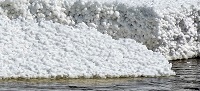 3/16 – Warren County, HRM 240-245: My discovery of a thick sheet of “ice balls” in the Ice Meadows on the Hudson River between Warrensburg and The Glen caused quite a stir. While the thick ice sheet in the middle of the river appeared as typically solid ice, a closer look showed that an acre-size sheet was made up of a huge quantity of individual snow-ice balls, each up to six-inches in diameter. Some were collected to study the inside structure to help identify their origin. (Photo of ice balls courtesy of Jeff Nadler) 3/16 – Warren County, HRM 240-245: My discovery of a thick sheet of “ice balls” in the Ice Meadows on the Hudson River between Warrensburg and The Glen caused quite a stir. While the thick ice sheet in the middle of the river appeared as typically solid ice, a closer look showed that an acre-size sheet was made up of a huge quantity of individual snow-ice balls, each up to six-inches in diameter. Some were collected to study the inside structure to help identify their origin. (Photo of ice balls courtesy of Jeff Nadler)
- Jeff Nadler (Hudson-Mohawk Bird Club)
[Long time investigative Queen of the Ice Meadows, Evelyn Greene, calls the ice balls “wonderful,” perhaps as much for their mystery as their sparkling appearance. They are solid ice all the way through, translucent, but when the sun hits them, they are a brilliant white. Evelyn offers a theory that whirlpools, possibly at the contact of the downriver cover, could have formed some of them. But an acre, three feet deep?
Evelyn Greene describes the Ice Meadows as a natural grassland that is presumably made possible by ice and water scouring of the cobbles and edges that kills or at last flattens shrubs and trees. This results in the ground being open to the sun all summer, unlike in the nearby forest, and a wide variety of plants can grow in different habitats. Tom Lake]
Natural History Entries
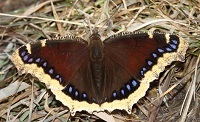 3/16 – Town of Saugerties, HRM 102: Under warm sunshine, I encountered my first adult butterfly of the season today, a mourning cloak. The butterfly spent the better part of an hour imbibing on wet, muddy soil in my yard. It appeared to be tanking up for the first time after a long hibernation. (Photo of mourning cloak courtesy of Steve Chorvas) 3/16 – Town of Saugerties, HRM 102: Under warm sunshine, I encountered my first adult butterfly of the season today, a mourning cloak. The butterfly spent the better part of an hour imbibing on wet, muddy soil in my yard. It appeared to be tanking up for the first time after a long hibernation. (Photo of mourning cloak courtesy of Steve Chorvas)
- Steve Chorvas
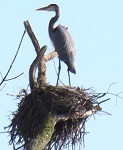 3/16 – Bedford, HRM 35: I went by the Bedford great blue heron rookery to see what remained of it after the winter storms. At this point, it appeared that there were three active nests. Each of the three had a single adult perched on each nest. The male typically shows up first to claim the nest and then awaits the arrival of their mate. Back in 2014, there were at least 20 nests; last year there were only five, with each winter storm having taken down some of the nest trees. (Photo of great blue heron courtesy of Jim Steck) 3/16 – Bedford, HRM 35: I went by the Bedford great blue heron rookery to see what remained of it after the winter storms. At this point, it appeared that there were three active nests. Each of the three had a single adult perched on each nest. The male typically shows up first to claim the nest and then awaits the arrival of their mate. Back in 2014, there were at least 20 nests; last year there were only five, with each winter storm having taken down some of the nest trees. (Photo of great blue heron courtesy of Jim Steck)
- Jim Steck
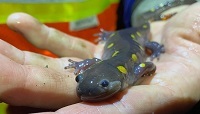 3/19 – Hudson River Watershed. While the forecasted rain didn’t arrive until late and in some locations, was joined by thunder and lightning, the migration of forest amphibians to vernal pools continued tonight. More than sixty stalwart volunteers of the Amphibian Migrations and Road Crossings Project collected and submitted migration data from across eight counties in the estuary watershed. Similar to March 7, they observed a range of weather, from no rain to downpour, with most experiencing light rain. The average reported air temperature was 55 degrees Fahrenheit. 3/19 – Hudson River Watershed. While the forecasted rain didn’t arrive until late and in some locations, was joined by thunder and lightning, the migration of forest amphibians to vernal pools continued tonight. More than sixty stalwart volunteers of the Amphibian Migrations and Road Crossings Project collected and submitted migration data from across eight counties in the estuary watershed. Similar to March 7, they observed a range of weather, from no rain to downpour, with most experiencing light rain. The average reported air temperature was 55 degrees Fahrenheit.
Preliminary data indicated that volunteers counted 16 species and 2,263 amphibians (1,619 live/644 dead), and assisted 1,484 salamanders, frogs, and toads across roads. They reported highest numbers for spring peeper (602 live/243 dead) and spotted salamander (400 live/145 dead), with lower numbers of wood frogs (154 live/24 dead) than observed earlier in the month, as they near the end of their mating season. Depending on local conditions, migration to breeding pools may continue on the next warm, rainy nights and in some locations, amphibians may already be leaving pools and returning to the forest. If you can, it’s best to avoid driving on these rainy nights of late winter and early spring, since many salamanders and frogs need to cross roads on their breeding migrations and even on low-traffic roads, mortality can be high.
You can find more information about the Amphibian Migrations and Road Crossings Project in the NYSDEC press release at https://www.dec.ny.gov/press/124870.html or by visiting the project website at https://www.dec.ny.gov/lands/51925.html. (Photo of spotted salamander courtesy of Lea Mazzei)
- Laura Heady, Emma Clements
3/19 – Albany County, HRM 157: We parked at the Mohawk Hudson Land Conservancy Fox Preserve, a rolling two-mile walk in the woods along Shaker Creek overlooking the Mohawk River. The trails were extremely muddy, so we crossed the road and walked down the bike path to the bridge over Shaker Creek that offers a wide vista onto the Mohawk River. There were waterfowl aplenty, with many ring-necked ducks and buffleheads. We also found greater scaup, lesser scaup, hooded merganser, common merganser, gadwall, and green-winged teal. There were still some remnant ice blocks and slabs grounded along the channel from the ice jam that had formed last month.
- Tom Williams, Colleen Williams (Hudson-Mohawk Bird Club)
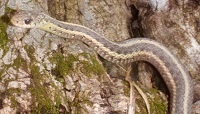 3/19 – New Paltz, HRM 78: While walking in our woods on a warm 60 degrees Fahrenheit (F) mid-afternoon, I came upon my first snake sighting of the year. It was a thin 15-inch eastern garter snake nosing around the base of a sugar maple. It hesitated when I took its picture, and then it was back on its way. (Photo of garter snake courtesy of Bob Ottens) 3/19 – New Paltz, HRM 78: While walking in our woods on a warm 60 degrees Fahrenheit (F) mid-afternoon, I came upon my first snake sighting of the year. It was a thin 15-inch eastern garter snake nosing around the base of a sugar maple. It hesitated when I took its picture, and then it was back on its way. (Photo of garter snake courtesy of Bob Ottens)
- Bob Ottens
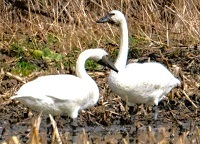 3/19 – Orange County, HRM 57: I found four tundra swans this afternoon in a field in New Hampton. They were far-and-away the highlight of my weekend. When I spotted the birds, I was sure they had to be either tundra or trumpeter swans. When I got them in the scope, I could see a yellow spot at the base of two of them, indicative of tundra swans. The birds appeared to be a family unit, with two adults and two younger birds. While I was looking at the swans, I heard a distant, familiar call. I looked straight up as three sandhill cranes flew high overhead, flying northeast until they were out of sight. (Photo of tundra swans courtesy of Matt Zeitler) 3/19 – Orange County, HRM 57: I found four tundra swans this afternoon in a field in New Hampton. They were far-and-away the highlight of my weekend. When I spotted the birds, I was sure they had to be either tundra or trumpeter swans. When I got them in the scope, I could see a yellow spot at the base of two of them, indicative of tundra swans. The birds appeared to be a family unit, with two adults and two younger birds. While I was looking at the swans, I heard a distant, familiar call. I looked straight up as three sandhill cranes flew high overhead, flying northeast until they were out of sight. (Photo of tundra swans courtesy of Matt Zeitler)
- Matt Zeitler
[Tundra swans are often called “America’s native swan.” Their common name refers to their summer nesting range north of Hudson Bay in the Arctic tundra. They can usually be heard calling long before they are seen, which leads to another frequently used colloquial name, “whistling swan.” David Sibley remarks that distant flocks sound like “baying hounds.” Tundra swans are occasional visitors to the Hudson Valley during spring and fall migrations. - Tom Lake]
3/20 – Hudson River watershed: On today’s Vernal Equinox, which arrived at 11:32 a.m., the first day of spring, we began our twenty-ninth year of the Hudson River Almanac.
With direction from Fran Dunwell, the Hudson River Almanac began on the vernal equinox of 1994; each Almanac volume covers vernal equinox-to-vernal equinox, a natural year. It began as a modest public forum for sharing stories (real stories as well as tall tales), ideas and adventures from the High Peaks of the Adirondacks, 320 miles to the sea. Across 28 years, our intention has been to document events that define the seasons. The Almanac has since grown with a distribution list approaching 20,000 readers featuring photographs and a range of contributions from elementary school poetry to the proclamations of scientists.
- Tom Lake
Pete Seeger commented on the Hudson River Almanac in 2003, when the Almanac was a printed volume: “This unusual and inspiring annual volume tells us of the diverse life in the river, and above it and alongside it. And the thousand-odd paragraphs are contributed by a diverse lot of people of all ages and backgrounds and occupations. Credit fisherman-scholar Tom Lake who has had a lifelong love affair with the river for pulling the whole project together, getting support of the Governor, and participation of the New York State Department of Environmental Conservation.
You can dip into it on any page. But beware. You'll find yourself reading the whole 120 pages, and before you know it, you'll be visiting the shores, talking with fisherman, birdwatchers, boaters, and one of these days, swimmers. The slow but steady restoration of what was once a filthy sewer from Albany to NYC is a great American story.”
3/20 – Quito, Ecuador: In 2009, I co-led a class of SUNY Dutchess Community College anthropology students to Ecuador. On the Vernal Equinox, we arrived at the little town of San Antonio de Pichincha, the exact geographic location where our GPS read 0 degrees latitude, 0 minutes, and 0 seconds. It is called Ecuador Mitad del Mundo, or “middle of the world.” Our students were able to straddle the equator with one foot in springtime and the other in autumn. It was a memorable moment, certain to last a lifetime.
- Tom Lake
[The Vernal Equinox is a point in time when the sun's rays cross directly over the Earth's equator and provides nearly equal periods of day and night in both hemispheres. The word equinox literally means 'equal night'. NOAA]
3/20 – Minerva, HRM 284: I heard my first flock of passing-through red-winged blackbirds today, noisily hanging out in a maple tree. Lakes and ponds were still very locked in. I heard a couple of Carolina wrens being cranky with each other in my mock orange bush.
As for the maple sap-to-syrup season, it began very slowly over past week or so with too many days in the 50's, even 60's, without the needed frosts at night. I've made only about a quart of syrup. Last year was a banner year, comparatively. I'm hoping for better luck next week.
- Mike Corey
3/20 – Saratoga County, HRM 173: This morning at Wright's Loop in Stillwater, I found a blue-winged teal (FOY) along with many green-winged teal, a few northern pintails, American wigeons, and a wood duck. On the southern part of the Loop there was a flock of American pipits (FOY) forging in the mud.
- John Hershey (Hudson-Mohawk Bird Club)
[FOY = First of the Year. Tom Lake]
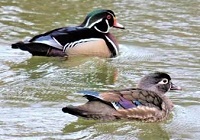 3/20 – Albany, HRM 145: Winter’s ice was nearly gone from Lake Washington on the Vernal Equinox and three pairs of migrating wood ducks (Aix sponsa) were taking advantage. These may be my favorite duck, especially the males, a flamboyant showcase of color with its rainbow green striped head, bright red eyes, orange bill, speckled ruddy-brown breast and buff sides. The females are also real beauties with their white-rimmed eyes, soft brown tones and blue/purple tipped wing feathers. 3/20 – Albany, HRM 145: Winter’s ice was nearly gone from Lake Washington on the Vernal Equinox and three pairs of migrating wood ducks (Aix sponsa) were taking advantage. These may be my favorite duck, especially the males, a flamboyant showcase of color with its rainbow green striped head, bright red eyes, orange bill, speckled ruddy-brown breast and buff sides. The females are also real beauties with their white-rimmed eyes, soft brown tones and blue/purple tipped wing feathers.
Unique among American ducks, the wood duck has claws on its webbed feet allowing it to land on a branch and nest in tree cavities near water. Normally they are quite skittish, timid birds and I treasured the moment to observe these truly magnificent native ducks. (Photo of wood ducks courtesy of Mario Meier)
- Mario Meier
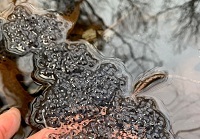 3/20 – Town of Esopus: Spring peepers and wood frogs were calling from vernal pools in late afternoon, and the evidence of successful mating was just under the water’s surface, attached to a fallen branch: wood frog egg masses. The appearance of the wood frog’s lumpy egg mass is often compared to tapioca pudding, and each mass can have as many as 1,000 eggs. (Photo of wood frog eggs courtesy of Laura Heady) 3/20 – Town of Esopus: Spring peepers and wood frogs were calling from vernal pools in late afternoon, and the evidence of successful mating was just under the water’s surface, attached to a fallen branch: wood frog egg masses. The appearance of the wood frog’s lumpy egg mass is often compared to tapioca pudding, and each mass can have as many as 1,000 eggs. (Photo of wood frog eggs courtesy of Laura Heady)
- Laura Heady
*** Fish of the Week ***
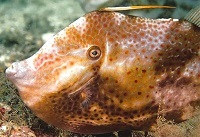 3/21 – Hudson River Watershed: Fish-of-the-Week for Week 165 is the orange filefish (Aluterus schoepfii), number 231 (of 236) on our watershed list of fishes. If you would like a copy of our list, e-mail - trlake7@aol.com. 3/21 – Hudson River Watershed: Fish-of-the-Week for Week 165 is the orange filefish (Aluterus schoepfii), number 231 (of 236) on our watershed list of fishes. If you would like a copy of our list, e-mail - trlake7@aol.com.
The orange filefish is one of two members of the filefish family (Monacanthidae) documented for our watershed. They are a reef-associated marine species found from Nova Scotia to Brazil, including Bermuda and the northern Gulf of Mexico. In our area they are considered a temperate marine stray.
Orange filefish are “paddle-shaped,” deeply keeled, strongly compressed, and overall olive-gray to rich orange, with large yellow blotches and red-orange spots. They share an almost magical trait with a few other fishes, in that they can change their color quickly to match their surroundings.
Their stout first dorsal spine that they raise when they feel threatened, is a good diagnostic feature. They can get to 24 inches long but are generally smaller. Orange filefish prefer living in sea grass beds or other submerged aquatic vegetation; their small terminal mouth has specialized incisor teeth on the upper and lower jaw which they use to graze on a variety of plants, including algae and sea grasses.
Briggs and Waldman (2002) tell us that orange filefish are uncommon in the New York Bight. We have just two records for the watershed from the American Museum of Natural History’s collection of fishes: August 1966 (no location or size documented), and September 1987 (149 millimeters[mm]) caught by Normandeau Associates at river mile 29. (Photo of orange filefish courtesy of Suzan Meldonian)
- Tom Lake
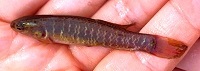 3/21 – Staatsburg, HRM 85: An ecology class from Dutchess Community College helped us check our glass eel fyke net at the Enderkill. We found no glass eels (immature American eels), but we did catch a central mudminnow (Umbra limi). As we were packing up our gear, we spotted a beaver swimming downstream. (Photo of central mudminnow courtesy of Sarah Mount) 3/21 – Staatsburg, HRM 85: An ecology class from Dutchess Community College helped us check our glass eel fyke net at the Enderkill. We found no glass eels (immature American eels), but we did catch a central mudminnow (Umbra limi). As we were packing up our gear, we spotted a beaver swimming downstream. (Photo of central mudminnow courtesy of Sarah Mount)
- Sarah Mount
[The central mudminnow is a nonnative fish species, a canal immigrant from the Midwest via the Great Lakes. Tom Lake]
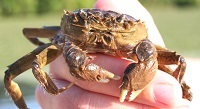 3/21 – Ulster County, HRM 85: Volunteers assisted us in checking our glass eel fyke net, set in Black Creek in the Town of Esopus. We found no glass eels, but we did catch a small Chinese mitten crab. (Eriocheir sinensis). (Photo of Chinese mitten crab courtesy of Chris Bowser) 3/21 – Ulster County, HRM 85: Volunteers assisted us in checking our glass eel fyke net, set in Black Creek in the Town of Esopus. We found no glass eels, but we did catch a small Chinese mitten crab. (Eriocheir sinensis). (Photo of Chinese mitten crab courtesy of Chris Bowser)
- Sarah Mount
[The invasive Chinese mitten crab (Eriocheir sinensis) is native to the estuaries of China where it is highly regarded in the market. It is believed they were introduced to the U.S. in the 1980s in San Francisco Bay.
Mitten crabs are catadromous, meaning that they spend much of their life in freshwater, then return to higher salinities to reproduce. The salinity gradients of east coast estuarine systems like the Chesapeake Bay, Delaware Bay, and the Hudson River are nearly ideal for them. Adult mitten crabs have a carapace width of about three inches, but six of its eight legs are almost twice as long, giving them an almost spider crab look. Unlike the native blue crab, a swimming crab, mitten crabs are burrowing crabs, much like our mud crabs only many times larger. They have a generalist diet, varied in prey, and their potential ecological impact on east coast estuaries is still unknown. Tom Lake]
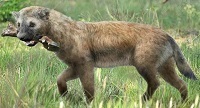 3/21 – Hyde Park, HRM 75: This afternoon, Marge Mangold’s groundskeeper was attending to their early spring gardening when he came across a large channel catfish lying in the grass. We live a couple of hundred yards from the Hudson River, and I knew that had been the source. Earlier, I had witnessed an adult bald eagle flying in from the river carrying a fish while being harassed by a crow. As it few over Marge Mangold’s Garden, the crow's pestering encouraged the eagle to drop its prey, a large channel catfish. (Photo of bone-eating dog with permission by Free Social Encyclopedia) 3/21 – Hyde Park, HRM 75: This afternoon, Marge Mangold’s groundskeeper was attending to their early spring gardening when he came across a large channel catfish lying in the grass. We live a couple of hundred yards from the Hudson River, and I knew that had been the source. Earlier, I had witnessed an adult bald eagle flying in from the river carrying a fish while being harassed by a crow. As it few over Marge Mangold’s Garden, the crow's pestering encouraged the eagle to drop its prey, a large channel catfish. (Photo of bone-eating dog with permission by Free Social Encyclopedia)
- Jane Kantner
[This was a truly timeless Hudson River moment. Earlier this year, we had reports of both a striped bass and a small Atlantic sturgeon being dropped onto surprised shore walkers. Eagles have been dropping fish on our heads ever since the first of our species arrived, at least 13,000 years ago. Perhaps even before, when bone-eating dogs (Borophagus diversidens) would have offered silent appreciation for a free meal from the sky. Tom Lake]
3/21 – Beacon, HRM 61: With the ice out of the river, the water looking more like spring, and warmer weather setting in, I gave the Beacon shoreline at Long Dock Park a try, and the channel catfish were biting. Today, I caught and released two channel catfish, both weighing a bit over three pounds. Channel catfish seem to be the last to stop biting in the fall, and the first to start up again in the spring.
- Bill Greene
[For the last month or so, we have been commenting on “signs of spring.” Among them is having Bill Greene back on the river in pursuit of carp and catfish! Tom Lake]
3/21 – Westchester County, HRM 45: I came upon a strange sight today. Driving north along the river on routes 6/202, nicknamed the “Goat Path,” I spotted two common ravens heading for a rock face where I suspected they had a nest. One carried a small rodent in its beak. Early nesting may have already produced a nestling.
- Scott Craven
3/22 – Minerva, HRM 284: I heard my first brown creeper out in the forest today. Pretty exciting for me, and quite unmistakable. Robins were bouncing around in the snow-less yard with a musical backdrop of red-winged blackbird songs.
- Mike Corey
3/22 – Minerva, HRM 284: The last several days, with air temperatures in the 40's but nothing less than 32 degrees at night, maple sap collecting has been awful—our stovetop syrup-making operation has been on hiatus. However, today, after a good overnight freeze, the trees were cooking with sap again. I will boil again tomorrow, as I think we'll get another good freeze tonight.
- Mike Corey
[Perfect condition for collecting maple sap, to reduce to maple syrup, requires warm days for the sap to flow, and then freezing cold nights to seal the spiles and cease the sap flow. Tom Lake]
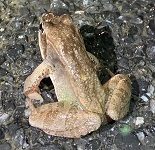 3/22 – Saugerties, HRM 102: There have not been any new harbor seal sightings, but we are noticing clear signs of spring. Wood frogs have been calling from a supra-tidal pool near the trailhead on Lighthouse Drive. An osprey, first one we’ve seen this season, circled overhead while fussing at a pair of bald eagles perched in a treetop near the mouth of Esopus Creek. 3/22 – Saugerties, HRM 102: There have not been any new harbor seal sightings, but we are noticing clear signs of spring. Wood frogs have been calling from a supra-tidal pool near the trailhead on Lighthouse Drive. An osprey, first one we’ve seen this season, circled overhead while fussing at a pair of bald eagles perched in a treetop near the mouth of Esopus Creek.
We last saw the harbor seal, flipper tagged #246, on New Year’s Day as Esopus Creek was becoming frozen-over. That marked day 878 of this marine mammal’s amazing affinity for this freshwater habitat. We have hopes that he may show up as spring arrives and Esopus Creek fills with river herring in from the sea to spawn. (Photo of wood frog courtesy of Laura Heady)
- Patrick Landewe
3/22 – Hook Mountain, HRM 31: We counted ten north-migrating raptors at the Hook Mountain Hawkwatch today. Red-shouldered hawk was high count with three; bald eagle, red-tailed hawk, and Cooper’s hawk were next with two each. Non-raptor migrants included black vulture (13) and turkey vulture (3).
- Eugene Gardner
3/22 – Yonkers, HRM 18: Our staff at the Sarah Lawrence Center for the Urban River at Beczak made six seine hauls today off our beach and in our tidemarsh. While our catch was rather meager, the eight gorgeous mummichogs (killifish) we netted (the largest was 75 mm), made the catch special.
Later, we checked our glass eel fyke net that we had set in the Beczak tidemarsh. Our catch was memorable, highlighted by 756 glass eels. Other fish included winter flounder (7), mummichogs (2), and one larval Atlantic herring. The river temperature was 49 degrees F, the salinity was low at 2.61 parts-per-thousand (ppt), and the dissolved oxygen was a very healthy 13.15 parts-per-million (ppm).
- Jason Muller, Emma Salada, Muhammad Raza, Zensu Nguyen, Maddie Eggen
[Seines are mentioned in Almanac observations relating to research and education. Seine is a French word, from the Latin sagëna, which means a fishing net designed to hang vertically in the water, the ends of which are drawn together to enclose fish. A seine is a net with a float line on top, a lead line on the bottom, and tight meshes in between.
Hudson River seines range in length from fifteen to six-hundred feet long, four-to-eight-feet in depth, and mesh size of ¼ to 2½-inches, or even larger for sturgeon, depending upon application. The longer seines must be set and hauled by a boat and crew. Shorter nets are used by educators, researchers, and bait dealers. New York State residents can use a seine in the Hudson River, not to exceed 36 square feet in area, to catch bait for their own personal use. Using a larger seine requires a License to Collect and Possess (LCP) from the NYSDEC Special Licenses Unit.
Stone netsinkers from ancient contexts found along the river provide evidence that seines and other nets were being used in the Hudson River for as long as our species has been here. Tom Lake]
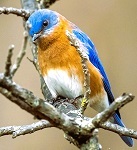 3/23 – Milan, HRM 90: There have been eastern bluebirds nesting on my property ever since a Dutchess County Bluebird Trail, with twelve nest boxes, was established in 2000. None of mine had ever displayed unusual behavior until last summer and then again, this year. A male and a female spend a good part of each day very close to our house relentlessly attacking the windows. Vehicles in the driveway, or in an open garage, are also fair game. This means that windows and side-view mirrors must be cleaned before a vehicle is driven. Guests are warned that an open car window will inevitability mean that vehicle’s interior will have to be cleaned as well. 3/23 – Milan, HRM 90: There have been eastern bluebirds nesting on my property ever since a Dutchess County Bluebird Trail, with twelve nest boxes, was established in 2000. None of mine had ever displayed unusual behavior until last summer and then again, this year. A male and a female spend a good part of each day very close to our house relentlessly attacking the windows. Vehicles in the driveway, or in an open garage, are also fair game. This means that windows and side-view mirrors must be cleaned before a vehicle is driven. Guests are warned that an open car window will inevitability mean that vehicle’s interior will have to be cleaned as well.
Also unusual is that the female is just as aggressive as the male. Neither are intimidated people. However, if they are frightened away, they perch nearby and scold whomever has disturbed them. Afterwards, they immediately return to their mischief. Despite what may be considered annoying behavior that causes a mess, these two beautiful birds are welcomed and much appreciated at our home.
A new recent behavior is that they are eating suet. They prefer shaved suet from a mealworm feeder but will use the suet feeders if they don’t have to engage with woodpeckers. Are they being spoiled? For certain. They now have begun to visit the nest boxes and perhaps will devote their energy to nesting rather than mischief! (Photo of eastern bluebird courtesy of John Badura)
- Frank Margiotta (Ralph T. Waterman Bird Club)
3/23 – Yonkers, HRM 18: Our staff at the Sarah Lawrence Center for the Urban River at Beczak checked our glass eel fyke net that we had set overnight in the Beczak tidemarsh. Our glass eel numbers continued at a quite extraordinary level with 530 today. The only other fish was a mummichog. The river temperature was 44 degrees F, the salinity continued low at 2.09 ppt, and the dissolved oxygen was a very healthy 12.93 ppm.
- Jason Muller, Ishika Joshi, Cecilia Goncalves de Azeredo, Ivan Cabada, Louisa Hausslein
3/23 – Manhattan, HRM 2: Our Hudson River Park’s River Project staff checked our sampling and collection gear that we deploy off Pier 40 in Hudson River Park. As has been the case in recent weeks, there were no fish in our traps and pots. However, we did pull up both sand shrimp (Crangon septemspinosa) and grass shrimp (Palaemonetes sp.).
- Natalie Kim, Zoe Kim
3/24 – Saugerties Lighthouse, HRM 102: An osprey was busy this afternoon carrying sticks to channel marker #93 at the mouth of Esopus Creek. This is likely one member of the osprey pair that have built a nest on the channel marker the past five years. Last year, the pair returned by March 27. In 2020, the first one appeared on March 24 and was joined by its mate on the following day.
- Patrick Landewe
3/24 – Croton-on-Hudson, HRM 34: For weeks now, we have witnessed strange fish behavior in Croton Bay and at the mouth of the Croton River. At first, I thought the school was feeding but I don’t see any evidence of baitfish. We’ve seen fishes laying on their side and the water turning milky suggesting milt being released. I would be interested in hearing your opinion on the behavior being exhibited here.
- Dennis Kooney
[For the last few weeks, we’ve been receiving e-mails from a variety of observers, including fishermen, kayakers, birders, and beach walkers, of what appeared to be large schools of striped bass in the Tappan Zee, in particular Croton Bay. Large numbers of wintering striped bass in the Tappan Zee are not new. It has been river lore along the Tappan Zee and Haverstraw Bay for several generations.
Some angler theories are calling it striped bass spawning behavior. However, there are two factors that argue against it: The water is far too cold, by 20 degrees F, and the river is brackish in the Tappan Zee. Striped bass eggs require freshwater, found at least 45-50 miles upriver, to hatch.
What they were feeding on is a good question, for which we have very few candidates. It was far too early for alewives and way too early for menhaden. However, this late winter we have seen a fair number of Atlantic herring in the Tappan Zee (winter spawners at sea), so just maybe. Tom Lake]
3/24 – Yonkers, HRM 18: Our staff at the Sarah Lawrence Center for the Urban River at Beczak checked our glass eel fyke net that we had set in the Beczak tidemarsh. We were seeing no gaps in the pulse of glass eels from the sea as our modest size fyke net captured 437 today. In the net’s cod end we also found thirteen comb jellies and one larval Atlantic herring. The river temperature was 45 degrees F, the salinity was 3.67 ppt, and the dissolved oxygen was11.95 ppm.
- Jason Muller, Annie Bingham, Rachel Lynch, Ruby Alcorn
3/24 – Manhattan, New York City: Our Randall's Island Park Alliance Staff did a bit of waterfowl monitoring today. We found a red-breasted merganser along the Bronx Kill, as well as a mute swan, mallards, and many gulls of mixed species. At least two of them were great black-backed gulls. Along the way, we came upon five Canada geese, a pair of buffleheads, and a double-crested cormorant. Dissolved oxygen (DO) in the Bronx Kill was 11.0 ppm and the salinity was surprisingly high at 24.0 ppt.
- Jackie Wu
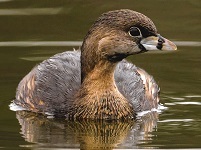 3/25 – Saratoga Lake, HRM 182: The lake was half-covered with “rotten” ice this morning; a stiff west wind had pushed almost all of it to the east side of the lake. There were small groups of greater scaup, ring-necked ducks, buffleheads, common mergansers, and a single pied-billed grebe, discreetly separated, in the few and scattered open leads. On the north end, we spotted a beaver just offshore, half out of the water, munching on a branch. When it had enough, its tail gave a big splash and the beaver dissolved back into the lake. Any birding trip around Saratoga Lake is a tricky adventure with a combination of too many good views and too few good places to pull over. As we neared the south end, although our attention was divided, we recovered in time to see seven snow geese pass over our vehicle, front to back, so low we felt we might have reached up and touched them. (Photo of pied-billed grebe courtesy of Jim Yates) 3/25 – Saratoga Lake, HRM 182: The lake was half-covered with “rotten” ice this morning; a stiff west wind had pushed almost all of it to the east side of the lake. There were small groups of greater scaup, ring-necked ducks, buffleheads, common mergansers, and a single pied-billed grebe, discreetly separated, in the few and scattered open leads. On the north end, we spotted a beaver just offshore, half out of the water, munching on a branch. When it had enough, its tail gave a big splash and the beaver dissolved back into the lake. Any birding trip around Saratoga Lake is a tricky adventure with a combination of too many good views and too few good places to pull over. As we neared the south end, although our attention was divided, we recovered in time to see seven snow geese pass over our vehicle, front to back, so low we felt we might have reached up and touched them. (Photo of pied-billed grebe courtesy of Jim Yates)
- Tom Lake, Phyllis Lake
[“Rotten ice,” in the parlance of ice fishermen, is late winter-early spring ice on its way out, too thick to cast a lure, but too thin to walk on. Tom Lake]
3/25 – Verplanck, HRM 40.5: It was that time again: Osprey had returned to the mid-river channel marker off Veterans Memorial Park for their sixth consecutive year. We could already see the beginnings of the nest and we will be watching for the next several months as they hatch and raise their young. It seems that they are out most of the day searching for the perfect construction material for their nest.
- Dianne Picciano
3/25 – Bedford, HRM 35: I stopped by the great blue heron rookery and was surprised to see that a fourth nest was under construction by a pair of herons. It was very shallow and did not appear to be a viable nest at this point. Two other nests both had a heron incubating. Yet another had a heron incubating, reaching down into the nest and apparently tending to eggs. Soon, its mate showed up, possibly to change places.
- Jim Steck
[Birds turn their eggs several times a day so that the embryos inside develop properly. Herons lay from two to five eggs at about two-day intervals. Both herons take turns incubating the eggs as soon as the first one is laid. It is common for herons to be off the eggs for a short period of time before exchanging nesting duties. Jim Steck]
3/25 – Westchester County, HRM 34: A relatively new great blue heron rookery, one we’ve dubbed The Pound Ridge Rookery, was beginning to look occupied. Three of the 8-10 nests now had birds in them, and a lot of coming and going with new sticks for nest maintenance. It was difficult to get a sense of the true size of this rookery as so many of the nests are hidden among the crowns of mature evergreen trees.
- Rick Stafford
3/25 – Yonkers, HRM 18: Our staff at the Sarah Lawrence Center for the Urban River at Beczak made six seine hauls this morning hoping for fish but having to settle for ctenophores: two Leidy’s comb jellies (Mnemiopsis leidyi), both the size of a nickel.
Later, our staff checked our glass eel fyke net that we had set out overnight in the Beczak tidemarsh. While glass eel numbers had moderated somewhat, we still counted 86. Other fish in the net included a single mummichog and three larval Atlantic herring, as well as two comb jellies.
The river temperature was 44 degrees F, the salinity stayed low at 3.10 ppt, and the dissolved oxygen was 11.96 ppm.
- Jason Muller, Emma Salada, Mia Harada, Zensu Nguyen, Gabrielle Krieger
3/25 – Manhattan, HRM 8: It is nearing the season for the great northward brant migration to the Arctic. Many thousands winter throughout the Gateway National Recreation Area, in particular Sandy Hook (NJ). On my walk home today, I found eighty of them on the grass just north of the 103rd Street footbridge along the Harlem River.
- Jackie Wu
Spring 2022 Natural History Programs and Events
The World Fish Migration Foundation
The World Fish Migration Foundation is partnering with Wildlife Forever Fish Art for a Fish Flag Contest. In past years, students were asked to create a painting or drawing of a migratory fish. This year, in a break from tradition, students are encouraged to create a migratory fish flag of any shape, size, and material! This award highlights the diversity of migratory fish from across the world and the importance of the free-flowing rivers they rely on. This global contest is open to all young artists ages 5-18 and is free to enter.
To enter the Fish Flag Contest, young artists should:
1. Go to https://www.fishflags.org for more information on the contest and World Fish Migration Day
2. Create a flag depicting a migratory fish species of your choice such as American eel, American shad, Atlantic sturgeon, Atlantic tomcod, river herring, and striped bass. To qualify, your migratory fish must spend some of its life in freshwater.
3. Complete an entry form and submit your flag before the April 14th deadline (visit www.fishflags.org) to learn more).
4. Fly your flag on World Fish Migration Day: May 21, 2022!
Feel free to reach out to Nicole Friedman, the coordinator of the Fish Flag Contest (nicole@fishmigration.org) with any questions about the contest or World Fish Migration Day.
Let’s use art to make a difference!
Winners will be announced during a live broadcast on May 21.
Pollution with PCBs in this section of the Hudson River accumulates in the fat tissue of fish and has led the NYS Dept of Health to issue the following advisories regarding eating fish you catch between Troy and Catskill. This advice is based on laboratory testing of fish caught in this section of the river, and the detected PCBs in these fish.
Announcing the 2022 Hudson River Striped Bass Cooperative Angler Program
You can share your fishing trip information and help biologists understand and manage our Hudson River striped bass fishery. Here’s how it works: Fill out a logbook provided by us whenever you fish on the Hudson River (by boat or from shore). You can also use our survey123 app and record your trips using a smart phone or computer. Record general location, time, gear used, what you caught (or if you didn’t catch anything) and return the logbook when you are done fishing for the season. You’ll receive an annual newsletter summarizing the information in addition to the latest news regarding regulations and the river. Whether you catch-and-release or take home a keeper, you can be part of the Cooperative Angler Program. Online logbook instructions can be found here: https://www.dec.ny.gov/docs/remediation_hudson_pdf/hrcoopanglerelogbook.pdf
Join today by contacting: hudsonangler@dec.ny.gov or call 845-256-3009
Hudson Estuary Trees for Tribs Program
Now Accepting Applications. The Hudson River Estuary Program’s Trees for Tribs program offers free native trees and shrubs for planting along the tributary streams in the Hudson River Estuary watershed. Our staff can help you with a planting plan and work with your volunteers. Due date for Applications is March 1 for 2022 spring planting projects. Download and submit the two-page application found here: www.dec.ny.gov/docs/remediation_hudson_pdf/hrewtftap14.pdf. For more information about the program please visit the DEC website at: www.dec.ny.gov/lands/43668.html. If you have questions about a potential planting site, please contact Beth Roessler and Emily Haase at: HudsonEstuaryTFT@dec.ny.gov, or call (845)256-2253 to find out if your site is eligible for a 2022 planting project!
Hudson River Education
Teachers and students will enjoy our new Hudson River K-12 Unit of Study. This carefully curated group of lesson plans, arranged by topic and/or grade, brings together great learning tools developed by the DEC and dozens of estuary partners:
https://www.dec.ny.gov/education/25386.html
Hudson River Miles
The Hudson is measured north from Hudson River Mile 0 at the Battery at the southern tip of Manhattan. The George Washington Bridge is at HRM 12, the Tappan Zee 28, Bear Mountain 47, Beacon-Newburgh 62, Mid-Hudson 75, Kingston-Rhinecliff 95, Rip Van Winkle 114, and the Federal Dam at Troy, the head of tidewater, at 153. The tidal section of the Hudson constitutes a bit less than half the total distance – 315 miles – from Lake Tear of the Clouds to the Battery. Entries from points east and west in the watershed reference the corresponding river mile on the mainstem.
To Contribute Your Observations or to Subscribe
The Hudson River Almanac is compiled and edited by Tom Lake and emailed weekly by DEC's Hudson River Estuary Program. Share your observations by e-mailing them to trlake7@aol.com. To subscribe to the Almanac (or to unsubscribe), use the links on DEC's Hudson River Almanac or DEC Delivers web pages.
Useful Links
National Oceanic and Atmospheric Administration online tide and tidal current predictions are invaluable when planning Hudson River field trips. For real-time information on Hudson River tides, weather and water conditions from sixteen monitoring stations, visit the Hudson River Environmental Conditions Observing System website.
DEC's Smartphone app for iPhone and Android is now available at: New York Fishing, Hunting & Wildlife App.
|