
Amphibian Migrations - March 19 Report, Upcoming Conditions
The New York State Department of Environmental Conservation sent this bulletin on 03/23/2022 04:29 PM EDT |
| DEC Delivers - Information to keep you connected and informed from the NYS Department of Environmental Conservation |
| Share or view as a web page || Update preferences or unsubscribe |
Amphibian Migrations and Road CrossingsA Project of the NYSDEC Hudson River Estuary Program and Cornell University |
In this issue
March 19 Migration Report
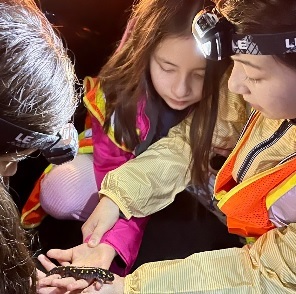
Photo right: Younger AM&RC volunteers in the Town of Rensselaerville (Albany County) admire a spotted salamander. Photographed on March 19, 2022 by H. Martel. We still need to verify some species identifications but so far, the data indicate that volunteers counted 16 species and 2,263 amphibians (1,619 live and 644 dead), and assisted 1,484 salamanders, frogs, and toads across roads. About 10x more mole salamanders were observed in this wave of migration than on March 7, and fewer wood frogs. Spring peepers were still moving in large numbers - and they've been heard singing, along with wood frogs. The preliminary species breakdowns are below.
Photo above: Spring peeper observed on March 19 in the Town of Poestenkill (Rensselaer County) by volunteer A. Onion. So far this year, volunteers counted more than 2,500 peepers (1,637 live/945 dead). Preliminary Data Submitted by Volunteers (Note: We're still verifying some identifications.) Salamander Species (live#/dead #) Frog and Toad Species (live#/dead#) Toad Notes! Volunteers also started seeing more of the later-breeding species like American toad. According to the excellent guide, The Amphibians and Reptiles of New York State (Gibbs et al. 2007), American toads are not very particular about habitat and breed in ponds, ditches, lakes, marshes, and wet meadows. The authors noted that American toads avoid breeding in vernal pools occupied by wood frogs to avoid predation on their tadpoles by the larger wood frog tadpoles. It's a frog-eat-frog world! Upcoming Migration Conditions
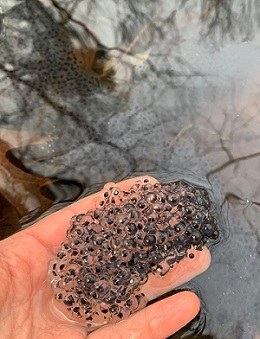
Depending on your location, the rainfall this week may bring another wave of migration, perhaps tonight or tomorrow night. Remember that if vernal pool breeding is farther along in your area, amphibians may start heading back to the forest. In other parts of the Hudson Valley, we may still be seeing arrivals. As always, check local forecasts. Photo: Wood frog egg mass observed in the Town of Esopus (Ulster County) on March 20, 2022 - the first day of Spring! By L. Heady Subscribe for AM&RC BulletinsDid someone forward this email to you? If you'd like to subscribe to receive AM&RC news and migration updates yourself, click here to sign up. If you're new to the AM&RC Project, please check the Resources for Volunteers on our webpage and take all measures to keep yourselves safe when surveying roads. I always say it -- AM&RC volunteers are the best around! Thank you for all you do. Laura Heady Check out our website! Conservation Planning in the Hudson River Estuary Watershed |
 All weather arrows pointed toward a "big night" of migration on Saturday; alas, the forecasted rain didn't come until late and was in short duration, and in some locations, it was joined by strong winds, thunder, and lightning. Nevertheless, 65 stalwart volunteers collected and submitted data from across eight counties in the estuary watershed. Similar to March 7, they observed a range of weather, from "no rain" to "downpour," with most experiencing light rain and an overall average reported air temperature of 55 degrees Fahrenheit.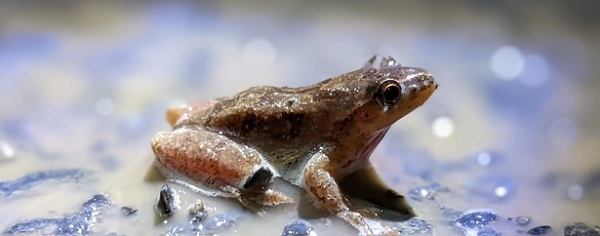
 At this point, the vernal pool species--wood frog, spotted salamander, and Jefferson/blue spotted salamander complex--have been observed from the lower to upper estuary watershed, along with the start of egg masses. In addition to the "medium nights" of migration observed on March 7 and 19, there have been small movements documented by volunteers on other mid-March nights and there has likely been unobserved amphibian migrations when suitable conditions arrived in the wee hours.
|
The New York State Department of Environmental Conservation respects your right to privacy and welcomes your feedback | Update preferences or unsubscribe | Learn more about DEC Delivers |
|
Connect with DEC:    
|
|
| Basil Seggos, Commissioner | |