A Project of the Hudson River Estuary Program
Compiled and edited by Tom Lake, Consulting Naturalist
Love Our NY Lands
State Lands Belong to All of Us
All New Yorkers and visitors should be able to access, enjoy, and feel welcome on state lands. These lands belong to all of us, our families, and our neighbors. While enjoying these shared spaces, be respectful of other visitors. Share trails, treat people with kindness, and leave things as you found them for others to enjoy. All of us have a responsibility to protect State lands for future generations. For more information, visit: https://www.dec.ny.gov/outdoor/119881.html
Overview
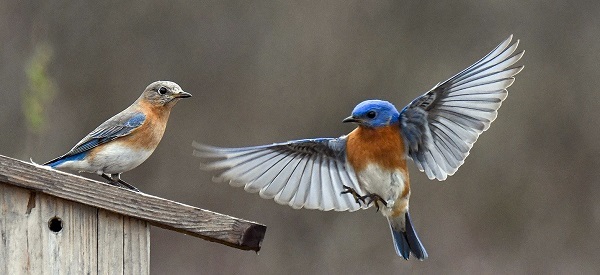
Bluebirds are always a winning subject especially coming out of winter. This week we feature eastern bluebirds both as a seasonal highlight and as a long-term restoration project. Many of our eagle nests are incubating. Fish are returning to some of our educator’s nets, including glass eels, and in the sky, even at night, skeins of Canada geese are heading north.
Highlight of the Week
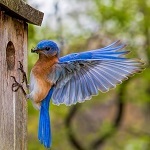 3/15 – Dutchess County: During the Ralph T. Waterman Bird Club’s May 1960 Census of Dutchess County, we counted only six eastern bluebirds. Florence Germond, an original club member, decided to try to help the bluebirds. In March 1962, after learning about building nest boxes and setting up a Bluebird Trail, Florence and her helpers installed 22 nest boxes in the towns of Stanford, Pleasant Valley, and Clinton Corners. That season, six new bluebirds fledged from one of the nest boxes in Stanford. In 1988, the Bluebird Trail was extended by 46 nest boxes to the Dutchess towns of Wappinger, East Fishkill, and Hopewell Junction. 3/15 – Dutchess County: During the Ralph T. Waterman Bird Club’s May 1960 Census of Dutchess County, we counted only six eastern bluebirds. Florence Germond, an original club member, decided to try to help the bluebirds. In March 1962, after learning about building nest boxes and setting up a Bluebird Trail, Florence and her helpers installed 22 nest boxes in the towns of Stanford, Pleasant Valley, and Clinton Corners. That season, six new bluebirds fledged from one of the nest boxes in Stanford. In 1988, the Bluebird Trail was extended by 46 nest boxes to the Dutchess towns of Wappinger, East Fishkill, and Hopewell Junction.
From 22 nest boxes in 1962, the Bluebird Trail has expanded to 493 mounted nest boxes throughout Dutchess County, with 20 trail volunteers monitoring them. Over the last sixty years, 33,929 bluebirds have fledged and a total of 129 volunteers have monitored the nest boxes. Across those 60 years, the Trail’s yearly fledges have exceed 1,000 several times. Last year, the Bluebird Trail fledged 753 eastern bluebirds. Florence died on October 13, 1994, but The Ralph T. Waterman Bird Club’s Bluebird Trail continues. (Photo of eastern bluebird courtesy of Tom McDowell)
- Susan Gilnack
Natural History Entries
3/12 – Ulster County: The weather was nasty today as I went to check on bald eagle nest NY142. I found an adult sitting on the side of the nest ripping pieces of something (fish?) and dropping them inside, perhaps feeding a hatchling. The other adult may have been in the nest as well. Today would have been Day 35 of incubating, right on target for a hatch. If there was a hatch, and everything goes well, we may see a fledge between May 22 and June 9 (72-90 days).
- Bill Bollinger
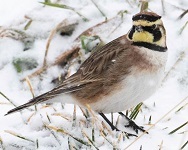 3/12 – Orange County, HRM 46-41: I headed out to the Black Dirt region of Orange County just as it began snowing. Once there, one of my first birds was a beautiful rough-legged hawk. It was snowing quite a bit, but the birds were active. I found many horned larks and spent most of the morning looking through them searching for my main target of the morning: Lapland longspur. I eventually did locate one; its plumage was nice, but this far into March I was hoping for better. A small flock of snow geese flew overhead, and I was eventually able to relocate them. They blended in very well in a distant snowy field. (Photo of horned lark courtesy of Matt Zeitler) 3/12 – Orange County, HRM 46-41: I headed out to the Black Dirt region of Orange County just as it began snowing. Once there, one of my first birds was a beautiful rough-legged hawk. It was snowing quite a bit, but the birds were active. I found many horned larks and spent most of the morning looking through them searching for my main target of the morning: Lapland longspur. I eventually did locate one; its plumage was nice, but this far into March I was hoping for better. A small flock of snow geese flew overhead, and I was eventually able to relocate them. They blended in very well in a distant snowy field. (Photo of horned lark courtesy of Matt Zeitler)
- Matt Zeitler
3/13 – Town of Wappinger, HRM 67.5: An adult bald eagle from nest NY459 moved tentatively across the mud flats of the tidal Wappinger Creek probably searching for fish that had been stranded in tide pools. After three-plus days of extremely strong northwest winds, we were having a blowout tide. Blowout tides are not common. They occur most frequently following several days of steady and strong north-northwest winds. According to Dr. Alan F. Blumberg, director of the Center for Maritime Systems at the Stevens Institute of Technology, blowout tides result from these winds acting on the ocean off New York Harbor, causing extremely low tides there and in turn up the Hudson. It culminates in an ebb tide that seems to go seaward forever, draining tide marshes and inshore shallows, giving us a glimpse of seldom seen parts of the river bottom. As the tide very slowly began to rise, a red fox walked gingery along the edge of the tide pools, likely in search of stranded fish as well.
- Tom Lake
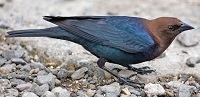 3/13 – Town of Wappinger, HRM 67: Heavy and protracted snow and ice hit the Mid-Hudson Valley today. The north-migrating songbirds were in a panic. Our feeders were unable to service the incredible numbers of common grackles, brown-headed cowbirds, red-winged blackbirds, and the notorious starling brothers. Three pounds of seed per feeder lasted not more than an hour before a refill was necessary. Waiting queues were ignored as the larger blackbirds bullied their way to the feeders. It all looked like a frenetic rest stop on the Interstate. (Photo of brown-headed cowbird courtesy of Alan Wilson) 3/13 – Town of Wappinger, HRM 67: Heavy and protracted snow and ice hit the Mid-Hudson Valley today. The north-migrating songbirds were in a panic. Our feeders were unable to service the incredible numbers of common grackles, brown-headed cowbirds, red-winged blackbirds, and the notorious starling brothers. Three pounds of seed per feeder lasted not more than an hour before a refill was necessary. Waiting queues were ignored as the larger blackbirds bullied their way to the feeders. It all looked like a frenetic rest stop on the Interstate. (Photo of brown-headed cowbird courtesy of Alan Wilson)
- Tom Lake, Phyllis Lake
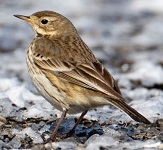 3/13 – Orange County, HRM 46-41: I headed out to the Black Dirt this morning. A Ross’s goose and a greater white-fronted goose were reported there yesterday evening; both of those birds were on my mind, but there was no luck. I did catch up with several Lapland longspurs—a couple had some great-looking plumage—but never came close enough for photos. An American pipit landed nearby several times, giving me some excellent photo opportunities. Before we know it, spring will finally have sprung, so I was happy to enjoy winter’s last hurrah. (Photo of American pipit courtesy of Matt Zeitler) 3/13 – Orange County, HRM 46-41: I headed out to the Black Dirt this morning. A Ross’s goose and a greater white-fronted goose were reported there yesterday evening; both of those birds were on my mind, but there was no luck. I did catch up with several Lapland longspurs—a couple had some great-looking plumage—but never came close enough for photos. An American pipit landed nearby several times, giving me some excellent photo opportunities. Before we know it, spring will finally have sprung, so I was happy to enjoy winter’s last hurrah. (Photo of American pipit courtesy of Matt Zeitler)
- Matt Zeitler
3/13 – Hook Mountain, HRM 31: We counted a single north-migrating raptor at the Hook Mountain Hawkwatch today, a red-shouldered hawk. The only other migrant was a turkey vulture. Non-raptor migrants included common nighthawk, two together, of which one repeatedly dove on the other as both dropped steeply. I initially thought they were merlin, but they had long wings and a flash of white. They were joined by a third nighthawk and all three flew northwest. Additionally, there were two common ravens and two male eastern bluebirds singing beautifully.
- Ajit I. Antony
3/14 – Rensselaer County, HRM 139: We were thrilled (once we figured out what it was) to learn that we have a woodcock in our small field in North Greenbush. They have quite the distinctive beak. Hopefully we will get to see some aerial displays soon!
- Audrey Van Genechten, Kevin Van Genechten
3/14 – Poughkeepsie, HRM 75.5: We found a single glass eel, our first of the season in the Fall Kill fyke net this afternoon. The water temperature was 42 degrees Fahrenheit (F). Scattered across the net, out of the water, were many winged midge flies. It was an early spring hatch of those tiny red aquatic squiggles into tiny black winged aerial adults.
- Chris Bowser, Sarah Mount
3/14 – Hook Mountain, HRM 31: With four inches of new snow, we counted a single north-migrating raptor at the Hook Mountain Hawkwatch today, a red-shouldered hawk. Lingering raptors, not counted as migrants, included two red-tailed hawks and one peregrine falcon.
- Carl Howard
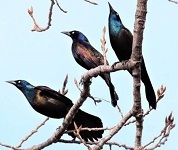 3/15 – Town of Niskayuna, HRM 158: Today my wife Robin and I took our three grandchildren for a balmy walk along the Mohawk River on the Mohawk-Hudson Bike Trail in Lions Park, Niskayuna. We are always delighted to see a red squirrel, such a lithe difference from its larger and overly abundant grey relative. Today we met a pair of them frisking around a budding tree. One was peeking down at us, his crimson tail arched. A little farther on we came upon a trio of male common grackles talking it up that spring was finally here. The spring sun brought out their remarkably turquoise and purple sheen. if grackles weren’t so common they would be more appreciated. As a final sign of spring, we heard a lone male spring peeper sending out his piercing and metered chirping “peep” from the marshland. (Photo of common grackles courtesy of Mario Meier) 3/15 – Town of Niskayuna, HRM 158: Today my wife Robin and I took our three grandchildren for a balmy walk along the Mohawk River on the Mohawk-Hudson Bike Trail in Lions Park, Niskayuna. We are always delighted to see a red squirrel, such a lithe difference from its larger and overly abundant grey relative. Today we met a pair of them frisking around a budding tree. One was peeking down at us, his crimson tail arched. A little farther on we came upon a trio of male common grackles talking it up that spring was finally here. The spring sun brought out their remarkably turquoise and purple sheen. if grackles weren’t so common they would be more appreciated. As a final sign of spring, we heard a lone male spring peeper sending out his piercing and metered chirping “peep” from the marshland. (Photo of common grackles courtesy of Mario Meier)
- Mario Meier, Robin Meier
3/15 – Albany, HRM 145: I witnessed a bit of magic on the Hudson River this morning. On my walk along the river just south of Jennings Landing in Albany, I saw eleven flocks of Canada geese, “high-flyers,” heading north. The flock sizes ranged from seven to thirty birds.
- Susan Carver
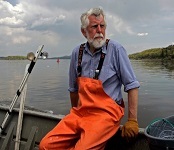 3/15 – Hudson River Estuary: Prior to 2010, today was traditionally the first day of commercial shad season, the first day when you were allowed to set or drift a gill net in the Hudson River for American shad. However, that did not imply that the fish would be there. American shad arrived from the sea at their own time, a time that primarily coincided with the right water temperature. Meltwater from late winter snowstorms, especially in the High Peaks of the Adirondacks, would suppress the warming of the river and push the date out. Once the river reached the mid-40s Fahrenheit, the males, or buck shad, would begin nosing up the river, a sinuous journey that allowed them to slowly acclimate to the lessening salinity. In the weeks that followed, more and more female, or roe shad would ascend the river, all heading above the salt to the freshwater reach to spawn from Hyde Park to the head of tide at Troy. Eventually, the run would even out, bucks and roe, before concluding in late May, dominated by roe shad. (Photo of shad, herring & crab fisherman John Mylod courtesy of Tom Lake) 3/15 – Hudson River Estuary: Prior to 2010, today was traditionally the first day of commercial shad season, the first day when you were allowed to set or drift a gill net in the Hudson River for American shad. However, that did not imply that the fish would be there. American shad arrived from the sea at their own time, a time that primarily coincided with the right water temperature. Meltwater from late winter snowstorms, especially in the High Peaks of the Adirondacks, would suppress the warming of the river and push the date out. Once the river reached the mid-40s Fahrenheit, the males, or buck shad, would begin nosing up the river, a sinuous journey that allowed them to slowly acclimate to the lessening salinity. In the weeks that followed, more and more female, or roe shad would ascend the river, all heading above the salt to the freshwater reach to spawn from Hyde Park to the head of tide at Troy. Eventually, the run would even out, bucks and roe, before concluding in late May, dominated by roe shad. (Photo of shad, herring & crab fisherman John Mylod courtesy of Tom Lake)
- Tom Lake
3/15 – Yonkers, HRM 18: Our staff at the Sarah Lawrence Center for the Urban River at Beczak made our five traditional seine hauls today with minimal results. The warming of the water and the increase in salinity seemed to have little positive effect. We netted two comb jellies and one grass shrimp of 38 millimeters (mm). Later, we checked our glass eel fyke net that we had set in the Beczak tidemarsh. Our catch in the marsh was markedly better as we caught two glass eels, two larval Atlantic herring, and one mummichog. The river temperature had risen to 44 degrees F, the salinity had increased to 4.95 parts-per-thousand (ppt), and the dissolved oxygen was 12.19 parts-per-million (ppm).
- Jason Muller, Emma Salada, Kathy Nolan, Muhammad Raza
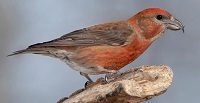 3/16 – Albany County, HRM 140: I took a walk this morning along the Civilian Conservation Corp (CCC) Road in Rensselaerville State Forest. Pine siskin numbers seemed to be increasing, barred owls were engaged in duets in broad daylight, and a red crossbill pair was mating atop a Norway spruce. Now is a great time to get out and try to confirm red crossbill breeding for the Breeding Bird Atlas in Region 8. Besides Rensselaerville, Burnt-Rossman Hills State Forest and environs in Schoharie County is a good spot in Warren County and Cherry Plain State Park and Berlin Mountain in Rensselaer County. (Photo of red crossbill courtesy of Tom Lawler) 3/16 – Albany County, HRM 140: I took a walk this morning along the Civilian Conservation Corp (CCC) Road in Rensselaerville State Forest. Pine siskin numbers seemed to be increasing, barred owls were engaged in duets in broad daylight, and a red crossbill pair was mating atop a Norway spruce. Now is a great time to get out and try to confirm red crossbill breeding for the Breeding Bird Atlas in Region 8. Besides Rensselaerville, Burnt-Rossman Hills State Forest and environs in Schoharie County is a good spot in Warren County and Cherry Plain State Park and Berlin Mountain in Rensselaer County. (Photo of red crossbill courtesy of Tom Lawler)
- Zach Schwartz-Weinstein (Hudson-Mohawk Bird Club)
3/16 – Rensselaer, HRM 139: We came upon a nice variety of waterfowl in wet fields on both sides of Staats Island Road beyond the Papscanee Creek crossing. Besides numerous Canada geese, there was a snow goose, many green-winged teal, northern pintails, American wigeons, hooded mergansers, black ducks, wood ducks, a horned grebe, and a single great blue heron standing in the creek.
- Cindy Edwardson, Chris Edwardson (Hudson-Mohawk Bird Club)
3/16 – Yonkers, HRM 18: Our staff at the Sarah Lawrence Center for the Urban River at Beczak checked our glass eel fyke net that we had set overnight in the Beczak tidemarsh. Glass eels continued to show up in small numbers, as well as two mummichogs, and five amphipods. The river temperature was 44 degrees F, the salinity increased to 5.17 ppt, and the dissolved oxygen was 12.32 ppm.
- Jason Muller
3/16 – Manhattan, HRM 2: Our Hudson River Park’s River Project staff checked our sampling and collection gear that we deploy off Pier 40 in Hudson River. Our pots and traps did not contain any fish today, but we did pull up grass shrimp, blue mussels (Mytilus edulis) and, for the first time in a while, a Beroe’s comb jelly!
- Natalie Kim, Zoe Kim
*** Fish of the Week ***
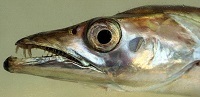 3/17 – Hudson River Watershed: Fish-of-the-Week for Week 164 is the Atlantic cutlassfish (Trichiurus lepturus), number 216 (of 236) on our watershed list of fishes. If you would like a copy of our list, e-mail - trlake7@aol.com. 3/17 – Hudson River Watershed: Fish-of-the-Week for Week 164 is the Atlantic cutlassfish (Trichiurus lepturus), number 216 (of 236) on our watershed list of fishes. If you would like a copy of our list, e-mail - trlake7@aol.com.
The Atlantic cutlassfish is the only member of the snake mackerel family (Trichiuridae) documented for the watershed. They are found in circum-tropical and temperate waters of the world. In the Atlantic, they range from Cape Cod to Argentina, being much more common south of Chesapeake Bay. In our area, they are designated as a temperate marine stray. They favor muddy bottoms of shallow coastal waters, often entering estuaries and feeding on fishes, squid, and crustaceans.
The Atlantic cutlassfish, with its large, fang-like teeth, looks like a creature from a nightmare. They are elongate, strongly compressed, with a strap-like body, silver to metallic blue, and a dorsal fin that runs from its head to the tip of its tail. From Greek, its genus translates to hair, and its trivial name to head, thus their other common name, largehead hairtail. Briggs and Waldman (2002) consider them rare in the New York Bight with two old records from Gravesend Bay, Brooklyn (1897 and 1901). There is one Hudson River estuary record, from Indian Point (river mile 42) 1985, a 165 mm (6.5-inches) juvenile. (Photo of Atlantic cutlassfish courtesy of Bob Grieser)
- Tom Lake
3/17 – Little Stony Point, HRM 55: As we approached the beach at Little Stony Point early this morning, we saw movement in the water. It was a harbor seal, its head and snout poking out of the water. The seal swam in the grip of a strong flood tide about a hundred yards north of us, dove for twenty seconds, resurfaced, and then continued north until it was out of sight.
- Seth Dinitz, Ellie Dinitz
3/17 – Yonkers, HRM 18: Our staff at the Sarah Lawrence Center for the Urban River at Beczak checked our glass eel fyke net that we had set in the Beczak tidemarsh. We must have intercepted a surge of glass eels as we counted 38 in the net, as well as one mummichog. The river temperature was 42 degrees F, the salinity increased to 6.91 ppt, and the dissolved oxygen was 12.0 ppm.
- Jason Muller, Diane McKay
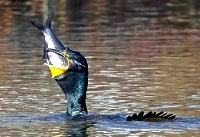 3/17 – Staten Island, New York City: I watched, today, as double-crested cormorant repeatedly dived for fish in Wolfes Pond, a freshwater lake on Staten Island. One surfaced with a large gizzard shad clenched in its serrated bill. Tipping its head back, the bird began the long and tortuous task of swallowing the fish. (Photo of double-crested cormorant courtesy of Rob Brauman) 3/17 – Staten Island, New York City: I watched, today, as double-crested cormorant repeatedly dived for fish in Wolfes Pond, a freshwater lake on Staten Island. One surfaced with a large gizzard shad clenched in its serrated bill. Tipping its head back, the bird began the long and tortuous task of swallowing the fish. (Photo of double-crested cormorant courtesy of Rob Brauman)
- Rob Brauman
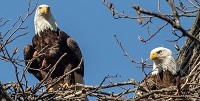 3/18 – Town of Poughkeepsie: Amid a string of spring-like days, the adults in bald eagle nest NY62 were faithfully incubating and just simply waiting. They were likely within a week of a hatch. (Photo of bald eagles courtesy of Bob Rightmyer) 3/18 – Town of Poughkeepsie: Amid a string of spring-like days, the adults in bald eagle nest NY62 were faithfully incubating and just simply waiting. They were likely within a week of a hatch. (Photo of bald eagles courtesy of Bob Rightmyer)
Bob Rightmyer
3/18 – Hudson River Watershed: Full moon. Among indigenous peoples, full moons have long been labeled with names that are rooted in oral traditions, tribal memories, and ethnographic accounts. Among Mohican people, whose ancestral homeland lies within the Hudson River watershed, the March full moon is known as the Crow Moon (Kã'Kã'koowe keesok). Tribal translations of full moons pre-date colonization and generally reflect the seasonality of the lunar phase. Moon phases, in fact, are used by indigenous people as measurements of time.
- Larry Madden
3/18 – Hudson Highlands, HRM 53: Below is a March 1891 article that ran in both Peekskill's Highland Democrat, and the Sullivan County’s Jeffersonville County Record. The story describes a seasonal refuge for wintering bald eagles.
“Travelers on the Hudson River and West Shore Railroads say they never before saw so many American eagles hovering along the Hudson river as this winter. Cro’ Nest [Crow’s Nest Mountain] seems to be the favorite place for the eagles and their screams can be heard a long distance. A man shot one of these birds near Cornwall. It measured seven feet from tip to tip of its wings. It is now in the hands of a taxidermist.”
- Edythe Ann Quinn
3/18 – Yonkers, HRM 18: Our staff at the Sarah Lawrence Center for the Urban River at Beczak checked our glass eel fyke net that we had set overnight in the Beczak tidemarsh. We found a bonanza in the net as we counted 102 glass eels. Other fish in the fyke included six mummichogs and 13 larval Atlantic herring. The river temperature was 43 degrees F, the salinity was 6.2 ppt, and the dissolved oxygen was 11.93 ppm.
- Jason Muller, Emma Salada, Gabrielle Krieger
3/18 – Staten Island, New York City: Recently, I watched as a harbor seal captured and devoured an American eel in Great Kills Harbor.
- Rob Brauman
Spring 2022 Natural History Programs and Events
The World Fish Migration Foundation
The World Fish Migration Foundation is partnering with Wildlife Forever Fish Art for a Fish Flag Contest. In past years, students were asked to create a painting or drawing of a migratory fish. This year, in a break from tradition, students are encouraged to create a migratory fish flag of any shape, size, and material! This award highlights the diversity of migratory fish from across the world and the importance of the free-flowing rivers they rely on. This global contest is open to all young artists ages 5-18 and is free to enter.
To enter the Fish Flag Contest, young artists should:
1. Go to https://www.fishflags.org for more information on the contest and World Fish Migration Day
2. Create a flag depicting a migratory fish species of your choice such as American eel, American shad, Atlantic sturgeon, Atlantic tomcod, river herring, and striped bass. To qualify, your migratory fish must spend some of its life in freshwater.
3. Complete an entry form and submit your flag before the April 14th deadline (visit www.fishflags.org) to learn more).
4. Fly your flag on World Fish Migration Day: May 21, 2022!
Feel free to reach out to Nicole Friedman, the coordinator of the Fish Flag Contest (nicole@fishmigration.org) with any questions about the contest or World Fish Migration Day.
Let’s use art to make a difference!
Winners will be announced during a live broadcast on May 21.
Pollution with PCBs in this section of the Hudson River accumulates in the fat tissue of fish and has led the NYS Dept of Health to issue the following advisories regarding eating fish you catch between Troy and Catskill. This advice is based on laboratory testing of fish caught in this section of the river, and the detected PCBs in these fish.
Can You Eat the Striped Bass from the Hudson River?
This is part of a series of submissions for the NYS Department of Health’s Hudson River Fish Advisory Outreach Project (HRFAOP) by project grantee, Cornell Cooperative Extension of Saratoga County, Diane Whitten, Resource Educator. Contact: dwhitten@cornell.edu
Striped bass are one of the most well-known fish in the entire Hudson River, prized by generations of fishermen. It’s prized not only for its size (they can be upwards of 30+ pounds) and the exhilaration of catching one, but it’s also prized for its culinary value. It’s eaten by more fishermen than any other fish from the Hudson River. But, are they safe to eat?
Most anglers consider striped bass “ocean fish,” believing they spend only a short portion of their lives in the Hudson River during their annual spring spawning run and believing striped bass are not as contaminated with PCBs as other Hudson River fish.
However, tagging studies done by researchers showing the migration of striped bass indicate that some striped bass stay in the Hudson River for much longer than previously thought. Researchers have discovered a legal-sized “resident population” that stays in the Hudson River, especially between Troy and Catskill, for much longer than their spawning run. Sampling of striped bass for PCBs by New York State Department of Environmental Conservation (NYS DEC) over many decades shows that these fish have PCB levels often three to four times higher than other striped bass found south of the Rip Van Winkle Bridge in Catskill, as high as catfish. The NYS DOH advice is that no one should eat striped bass caught between Troy and Catskill. This advice has been in place for more than 20 years.
To learn more, including what the chances of catching a striped bass contaminated with PCBs are, visit this NYS Dept. of Health website: https://www.health.ny.gov/fish/stripedbass.html
Announcing the 2022 Hudson River Striped Bass Cooperative Angler Program
You can share your fishing trip information and help biologists understand and manage our Hudson River striped bass fishery. Here’s how it works: Fill out a logbook provided by us whenever you fish on the Hudson River (by boat or from shore). You can also use our survey123 app and record your trips using a smart phone or computer. Record general location, time, gear used, what you caught (or if you didn’t catch anything) and return the logbook when you are done fishing for the season. You’ll receive an annual newsletter summarizing the information in addition to the latest news regarding regulations and the river. Whether you catch-and-release or take home a keeper, you can be part of the Cooperative Angler Program. Online logbook instructions can be found here: https://www.dec.ny.gov/docs/remediation_hudson_pdf/hrcoopanglerelogbook.pdf
Join today by contacting: hudsonangler@dec.ny.gov or call 845-256-3009
Hudson Estuary Trees for Tribs Program
Now Accepting Applications. The Hudson River Estuary Program’s Trees for Tribs program offers free native trees and shrubs for planting along the tributary streams in the Hudson River Estuary watershed. Our staff can help you with a planting plan and work with your volunteers. Due date for Applications is March 1 for 2022 spring planting projects. Download and submit the two-page application found here: www.dec.ny.gov/docs/remediation_hudson_pdf/hrewtftap14.pdf. For more information about the program please visit the DEC website at: www.dec.ny.gov/lands/43668.html. If you have questions about a potential planting site, please contact Beth Roessler and Emily Haase at: HudsonEstuaryTFT@dec.ny.gov, or call (845)256-2253 to find out if your site is eligible for a 2022 planting project!
Hudson River Education
Teachers and students will enjoy our new Hudson River K-12 Unit of Study. This carefully curated group of lesson plans, arranged by topic and/or grade, brings together great learning tools developed by the DEC and dozens of estuary partners:
https://www.dec.ny.gov/education/25386.html
Hudson River Miles
The Hudson is measured north from Hudson River Mile 0 at the Battery at the southern tip of Manhattan. The George Washington Bridge is at HRM 12, the Tappan Zee 28, Bear Mountain 47, Beacon-Newburgh 62, Mid-Hudson 75, Kingston-Rhinecliff 95, Rip Van Winkle 114, and the Federal Dam at Troy, the head of tidewater, at 153. The tidal section of the Hudson constitutes a bit less than half the total distance – 315 miles – from Lake Tear of the Clouds to the Battery. Entries from points east and west in the watershed reference the corresponding river mile on the mainstem.
To Contribute Your Observations or to Subscribe
The Hudson River Almanac is compiled and edited by Tom Lake and emailed weekly by DEC's Hudson River Estuary Program. Share your observations by e-mailing them to trlake7@aol.com. To subscribe to the Almanac (or to unsubscribe), use the links on DEC's Hudson River Almanac or DEC Delivers web pages.
Useful Links
National Oceanic and Atmospheric Administration online tide and tidal current predictions are invaluable when planning Hudson River field trips. For real-time information on Hudson River tides, weather and water conditions from sixteen monitoring stations, visit the Hudson River Environmental Conditions Observing System website.
DEC's Smartphone app for iPhone and Android is now available at: New York Fishing, Hunting & Wildlife App.
|