A Project of the Hudson River Estuary Program
Compiled and edited by Tom Lake, Consulting Naturalist
Love Our NY Lands
State Lands Belong to All of Us
All New Yorkers and visitors should be able to access, enjoy, and feel welcome on state lands. These lands belong to all of us, our families, and our neighbors. While enjoying these shared spaces, be respectful of other visitors. Share trails, treat people with kindness, and leave things as you found them for others to enjoy. All of us have a responsibility to protect State lands for future generations. For more information, visit: https://www.dec.ny.gov/outdoor/119881.html
Overview
The Hudson River, based on environmental factors such as lengthening days and water temperature, was at the point where shad and herring in from the sea were receiving the get-ready signal. Seals in the estuary seemed to be setting up shop in anticipation.
There was a time in mid-March, decades ago, when all our shad fishermen would be busy in their garage, basement, or shack, hanging twine, seaming lines, painting floats, and checking bioindicators like water temperature and the blooming of tell-tale flowers such as shadbush. Those were rough times in early spring, with ice in the boats and fingers numb. I wonder if when our history is written, readers will exclaim, “How quaint.”
Highlight of the Week
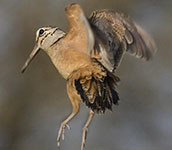 3/6 – Croton Point, HRM 34-35: Dusk was a quiet affair in the park a couple of nights ago, but tonight was a different story. Just before sunset, we spotted an American woodcock walking with its clockwork stride and probing the thawing ground with its long beak. As the sky darkened, from all around the grassland hill, came the loud sound of male woodcocks engaging in their fascinating courtship display. They begin by making an unmistakable "peent" call from the ground, then fly up as high as 300 feet into the air before descending slowly, the air passing through their wings making a high-pitched twittering sound. It's a magical experience to be surrounded by these unseen birds engaging in their eons-old rituals. (Photo of American woodcock courtesy of Marty Jones) 3/6 – Croton Point, HRM 34-35: Dusk was a quiet affair in the park a couple of nights ago, but tonight was a different story. Just before sunset, we spotted an American woodcock walking with its clockwork stride and probing the thawing ground with its long beak. As the sky darkened, from all around the grassland hill, came the loud sound of male woodcocks engaging in their fascinating courtship display. They begin by making an unmistakable "peent" call from the ground, then fly up as high as 300 feet into the air before descending slowly, the air passing through their wings making a high-pitched twittering sound. It's a magical experience to be surrounded by these unseen birds engaging in their eons-old rituals. (Photo of American woodcock courtesy of Marty Jones)
- Sharon AvRutick, Joe Wallace
Natural History Entries
Note: Ed McGowan’s Hudson River Almanac entry last week, featuring a first-of-season spotted salamander, occurred on February 22.
- Tom Lake
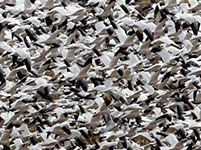 3/5 – Town of Wawayanda, HRM 47: I headed over to the Black Dirt this morning where I sorted through Canada Geese and flocks of mixed blackbirds looking for rarities; I came up empty. Then, on to the cornfields along Onion Avenue where I was pleasantly surprised to find a large flock of snow geese. I estimated approximately four to five-thousand geese were present. It wasn’t long after I grabbed my scope, that a model airplane flushed all the geese. It was quite a spectacle, but I was disappointed to not have had the opportunity to try and locate a Ross’s goose among the flock. (Photo of snow geese courtesy of Matt Zeitler) 3/5 – Town of Wawayanda, HRM 47: I headed over to the Black Dirt this morning where I sorted through Canada Geese and flocks of mixed blackbirds looking for rarities; I came up empty. Then, on to the cornfields along Onion Avenue where I was pleasantly surprised to find a large flock of snow geese. I estimated approximately four to five-thousand geese were present. It wasn’t long after I grabbed my scope, that a model airplane flushed all the geese. It was quite a spectacle, but I was disappointed to not have had the opportunity to try and locate a Ross’s goose among the flock. (Photo of snow geese courtesy of Matt Zeitler)
- Matt Zeitler
[“Black Dirt” is an area of southwest Orange County between Florida and Pine Island. The region is an important agricultural area growing farm produce such as onions, potatoes, lettuce, radishes, cabbage, carrots, corn, pumpkin, and squash in the rich black soil. The Black Dirt topsoil is immensely organic, essentially a compost heap, originating from the decaying flora and fauna of a late-Pleistocene post-glacial lake and swampland. The fields and wetlands contain bones of long extinct species such as mammoths, mastodons, elk-moose, peccary, ground sloth, horse, giant beaver, and other magnificent animals that lived and died there. Tom Lake]
 3/5 – Westchester, Rockland, Sullivan, Dutchess, Putnam, Orange, and Ulster counties, HRM105-16: The New York State Department of Environmental Conservation’s Region 3 Bald Eagle Breeding Summary for 2021 was released today. The report was compiled by Region 3 DEC staff, volunteer nest monitors including Audubon Society staff, New York State Office of Parks, New York City Department Environmental Protection, and New York Army National Guard. 3/5 – Westchester, Rockland, Sullivan, Dutchess, Putnam, Orange, and Ulster counties, HRM105-16: The New York State Department of Environmental Conservation’s Region 3 Bald Eagle Breeding Summary for 2021 was released today. The report was compiled by Region 3 DEC staff, volunteer nest monitors including Audubon Society staff, New York State Office of Parks, New York City Department Environmental Protection, and New York Army National Guard.
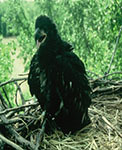
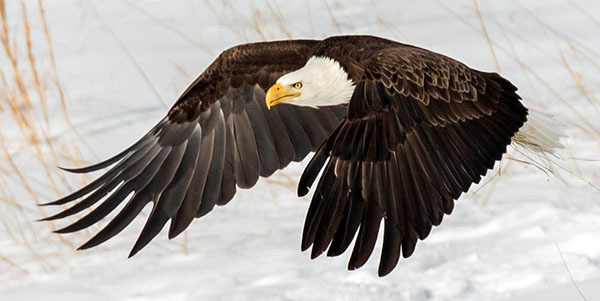
Since 1987, DEC has documented 143 bald eagle territories throughout Region 3. In 2021, 99 occupied bald eagle nesting territories were documented including seven new territories. Of the 99, all but three were determined to be active and 85 were thought to have been successful. Of the 85 assumed successful nests, there were no fewer than 84 nestlings produced (22 with one; 31 with two). (Photo of bald eagle courtesy of Pete Nye)
- Meghan Oberkircher
[A breeding territory is comprised of defended nesting and foraging areas, focused on an active nest, and may include alternate nests that are maintained but not used for nesting in a given year. Tom Lake]
Note: In spring 2021, a bald eagle nesting had fallen from its nest (NY403) in Plattekill (Orange County). It was found on the ground unable to fly. The bird was rehabilitated by Friends of the Feathered and Furry Wildlife Center, and then successfully returned to the nest by Dave Lindemann.
- Tom Lake
[This coming June will be the 25th anniversary (1997) of the first successful bald eagle fledge on the Hudson River in 100 years (bald eagles were last known to nest along the river near West Point in 1890). The nest, in Greene County, was designated NY28. The male fledgling was banded as F20 (Hudson River Almanac, IV:25-26). Why had it taken 100 years? In September 1897, The New York Times editorialized that the number of bald eagles on the Hudson River was becoming a real problem. “Hundreds of eagles have been seen lately in this vicinity [Bear Mountain].” It is very likely that, in autumn, observers were seeing kettles of south-migrating turkey vultures. Bald eagles do not migrate by the hundreds, as do turkey vultures. The editorial concluded with “Eagles will soon become a regular problem if something is not done to exterminate them.” This attitude, coupled with habitat loss and pesticide poisoning (DDT, etc.) was enough to limit the establishment and successful breeding for bald eagle along the Hudson River. Tom Lake]
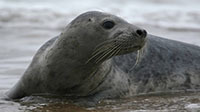 3/5 – Croton Point, HRM 34: I spotted a short, blunt log out in the river off Croton Landing this morning. It dipped under the surface of the water, came up, and through my binoculars I could clearly see a hound dog face, diagnostic of a gray seal. With shoals of wintering striped bass in Croton Bay right now, a seal's appearance was not surprising. (Photo of gray seal courtesy of Tom Lake) 3/5 – Croton Point, HRM 34: I spotted a short, blunt log out in the river off Croton Landing this morning. It dipped under the surface of the water, came up, and through my binoculars I could clearly see a hound dog face, diagnostic of a gray seal. With shoals of wintering striped bass in Croton Bay right now, a seal's appearance was not surprising. (Photo of gray seal courtesy of Tom Lake)
- Charlie Roberto
[Our list of Hudson River Estuary marine mammals documented in the Hudson River Almanac across the last 28 years includes:
- harbor seal (Phoca vitulina)
- hooded seal (Cystophora cristata)
- gray seal (Halichoerus grypus)
- harp seal (Pagophilus groenlandicus)
- common (harbor) porpoise (Phocoena phocoena)
- Risso’s dolphin (Grampus griseus)
- bottlenose (common) dolphin (Tursiops truncatus)
- Florida manatee-2006 (Trichechus manatus latirostris)
- minke whale-2007 (Balaenoptera acutorostrata)
- humpback whale-2016 (Megaptera novaeangliae).
3/5 – Hudson River Watershed, HRM 302-0): Newcomb (61 degrees Fahrenheit [F]), Glens Falls (61), Albany (64), Poughkeepsie (68), and Manhattan (68) set new record high air temperatures for the date.
- National Weather Service
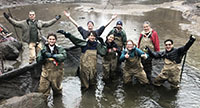 3/6 – Furnace Brook, HRM 38.5: We had a wonderful early morning fyke net install yesterday at Furnace Brook. Our team from the DEC, Ossining High School, and Teatown Reservation were treated to bald eagles cavorting over the Oscawana marsh while we pounded rebar and tied up the net. Today, Marie Perry found two glass eels in the net! (Photo of glass eel fyke net courtesy of Marie Perry) 3/6 – Furnace Brook, HRM 38.5: We had a wonderful early morning fyke net install yesterday at Furnace Brook. Our team from the DEC, Ossining High School, and Teatown Reservation were treated to bald eagles cavorting over the Oscawana marsh while we pounded rebar and tied up the net. Today, Marie Perry found two glass eels in the net! (Photo of glass eel fyke net courtesy of Marie Perry)
- Chris Bowser, Ben Harris, Marie Perry
[Glass eel is a colloquial name owing to their lack of pigment and near transparency. These are juvenile American eels “returning” to the estuaries of their ancestors along the east coast of North America after a lengthy ocean journey. This is a particularly vulnerable time for them, and little is known about this period of their life. In anywhere from 10-30 years, depending upon their sex, they will leave the Hudson River watershed for the sea where they will spawn once and then die, or so we think. Tom Lake]
3/7 – Hook Mountain, HRM 31: We counted an amazing 673 migrants today at the Hook Mountain Hawkwatch. Turkey vulture (568) was high count along with black vulture (2). Red-shouldered hawk was high count among 103 north migrating raptors with 95; Cooper’s hawk was next with four. Non-raptor/vulture migrants included common raven (4), common grackle (273), and Canada goose (2,660).
- Ajit I. Antony
[The Hook Mountain Hawkwatch began in 1971 as an all-volunteer endeavor, an independent group of raptor enthusiasts. The 2021 season is our 52nd. The Hawkwatch is located on the Long Path north of Nyack. During our current COVID-19 pandemic, we are not encouraging groups to visit, but welcome individuals. If you have any questions, please contact me at merlin@pipeline.com. Trudy Battaly]
3/7 – Upper Bay, New York Harbor: Manhattan (74 degrees F) and Newark, NJ (76) set new record high temperatures for the date.
- National Weather Service
3/8 – Saugerties, HRM 102: The ice was out in Esopus Creek. We theorized that the frozen-over creek and nearly-frozen-over river had encouraged the male harbor seal (flipper-tagged #246) to move downriver where he could find the necessary open water to haul out. We last saw the seal on New Year’s Day. That marked day 878 of this marine mammal’s amazing affinity for this freshwater habitat. We have hopes that he may show up as spring arrives and Esopus Creek fills with river herring in from the sea to spawn.
- Patrick Landewe
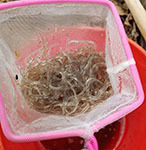 3/8 – Yonkers, HRM 18: Our staff at the Sarah Lawrence Center for the Urban River at Beczak checked our glass eel fyke net that we had set in the Beczak tidemarsh. Our catch was impressive today, as we found our highest number of glass eels (57) of the season thus far. 3/8 – Yonkers, HRM 18: Our staff at the Sarah Lawrence Center for the Urban River at Beczak checked our glass eel fyke net that we had set in the Beczak tidemarsh. Our catch was impressive today, as we found our highest number of glass eels (57) of the season thus far.
Other fish and invertebrates included three larval fishes of uncertain species (pending photograph analysis), two mummichogs, five amphipods, and a white-fingered mud crab. The river was 43 degrees F, the salinity continued low at 1.45 parts-per-thousand (ppt), and the dissolved oxygen (DO) was 13.0 parts-per-million (ppm). (Photo of glass eels courtesy of Tom Lake)
- Jason Muller, Emma Salada, Muhammad Raza, Zensu Nguyen, Phoebe Hurd, Alex Tonsberg
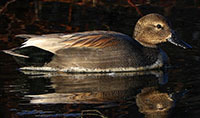 3/9 – Saratoga County, HR 157: I stopped at the main entrance to Vischer Ferry Preserve this morning, but the ponds were still frozen. Farther along, however, I found a good variety of ducks on the mostly ice-free Mohawk River. Using a scope, I was able to make out 38 wood ducks, five gadwall, five green-winged teal (first-of-year), four northern pintail, five American wigeon, and six ring-necked ducks. (Photo of gadwall courtesy of Deborah Tracy Kral) 3/9 – Saratoga County, HR 157: I stopped at the main entrance to Vischer Ferry Preserve this morning, but the ponds were still frozen. Farther along, however, I found a good variety of ducks on the mostly ice-free Mohawk River. Using a scope, I was able to make out 38 wood ducks, five gadwall, five green-winged teal (first-of-year), four northern pintail, five American wigeon, and six ring-necked ducks. (Photo of gadwall courtesy of Deborah Tracy Kral)
- John Hershey
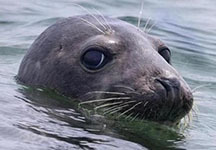 3/9 –Verplanck, HRM 40.5: I was at Old Steamboat Dock this morning watching for eagles and waterfowl. Several skeins of Canada Geese, some mallards, a handful of common mergansers, great cormorants, black vultures, fish crows, and the usual gull assortment were there along with several bald eagles. At 7:30, I spotted a seal, its head popping out of the water. Its “dog face” look instantly recognizable as a gray seal. Last winter (February 16), I came upon a gray seal at the same spot, and I wondered if this one was the same one, having returned. (Photo of gray seal courtesy of Steve Rappaport) 3/9 –Verplanck, HRM 40.5: I was at Old Steamboat Dock this morning watching for eagles and waterfowl. Several skeins of Canada Geese, some mallards, a handful of common mergansers, great cormorants, black vultures, fish crows, and the usual gull assortment were there along with several bald eagles. At 7:30, I spotted a seal, its head popping out of the water. Its “dog face” look instantly recognizable as a gray seal. Last winter (February 16), I came upon a gray seal at the same spot, and I wondered if this one was the same one, having returned. (Photo of gray seal courtesy of Steve Rappaport)
- Steve Rappaport
3/9 – Yonkers, HRM 18: Our staff at the Sarah Lawrence Center for the Urban River at Beczak checked our glass eel fyke net that we had set in the Beczak tidemarsh. Our catch had diminished from yesterday’s season high count with just five glass eels. The river temperature had dropped significantly to 40 degrees F, the salinity continued low at 1.44 ppt, and the dissolved oxygen was 12.94 ppm.
- Jason Muller, Ceilia Goncalves de Azeredo
3/10 – Waterford, HRM 158: The adults in bald eagle nest NY485, after some hesitation, finally began incubating yesterday. They had evened out their long periods of sitting on the nest coupled with efficient changeovers. Today I saw two smooth and gentle changeovers, two hours apart.
- Howard Stoner
*** Fish of the Week ***
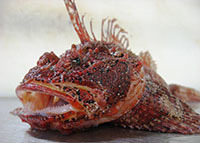 3/10 – Hudson River Watershed: Fish-of-the-Week for Week 163 is the sea raven (Hemitripterus americanus), number 140 (of 236) on our watershed list of fishes. If you would like a copy of our list, e-mail - trlake7@aol.com. 3/10 – Hudson River Watershed: Fish-of-the-Week for Week 163 is the sea raven (Hemitripterus americanus), number 140 (of 236) on our watershed list of fishes. If you would like a copy of our list, e-mail - trlake7@aol.com.
As a result of new DNA analyses, the sea raven is now the only member of the sea raven family (Hemitripidae) documented for the watershed. Until recently, they were included in the sculpin family (Cottidae). Taxonomically, they now fall between the sculpins and the lumpsuckers.
The sea raven is found over rocky or hard bottoms from the Gulf of Saint Lawrence south to Chesapeake Bay. In the far northeastern reach of their range, they are sometimes called King o’ Norway. In our area, they are designated as a temperate marine stray.
They are an elegant, if not handsome, fish. Jordan and Evermann describes them as “a most remarkable fish with a curiously ragged outline of their first dorsal fin and a prickly texture all over.” They are a colorful fish, as well, ranging from blood-red and reddish-purple to chocolate and yellowish-brown. The sea raven can grow to 23-25 inches and weigh 5-7 pounds. Voracious predators, they will snap-bite at anything manageable that they find on the bottom of the sea, from mollusks to crustaceans to fishes such as tautog and bergall.
Evidence of their presence in the watershed is sketchy at best. Briggs and Waldman (2002) describe the sea raven as “common in the ocean.” In the watershed, however, our sole recent reference is a listing by Beebe and Savage (1988), perhaps citing two American Museum of Natural History specimens, AMNH 2156- New York Harbor, 1902 and AMNH 4657- Staten Island, 1907. The former qualifies as the watershed, but the latter’s provenance is questionable. (Photo of sea raven courtesy of Brent Wilson)
- Tom Lake
3/10 – Town of Wappinger: The adults in bald eagle nest NY459 have begun making regular changeovers taking turns incubating eggs. If all goes well for them, we might expect a hatch around April 1 to 4.
- Judy Winter
3/10 – Buchanan, HRM 42: The plaintive cooing of mourning doves is usually one of the signals that spring is coming. As well as this harbinger, the ice on Lake Meahagh was gone, and we’ve been thrilled to have red-winged blackbirds and robins foraging under our feeders. A lone immature bald eagle was soaring over the water today.
- Dorothy Ferguson, Bob Ferguson
3/10 – Yonkers, HRM 18: Our staff at the Sarah Lawrence Center for the Urban River at Beczak checked our glass eel fyke net that we had set in the Beczak tidemarsh. Our catch was impressive for so early in the season and included 20 glass eels, two 40-millimeter (mm) winter flounder, and eight amphipods. The river remained chilly at 41 degrees F, the salinity had dropped precipitously to 1.8 ppt , and the dissolved oxygen remained a healthy 12.93 ppm.
- Jason Muller, McKay, Lynch, Quiros
3/11 – Yorktown Heights, HRM 42: I decided to do a hike at Hilltop Hanover Farm this afternoon before the next snowstorm hit. As I made my way around the trails, off in the distance I heard a loud chorus of spring peepers (Pseudacris crucifer). I slowly made my way to the vernal pond hoping to see at least one of the likely dozens of small frogs. I was out of luck, since they are so small and can easily hide among the leaves. As dusk approaches, their combined song can easily be twice as loud as they were today. I always look forward to their call to get me out of my winter mode and into looking forward to the beginning of the spring season.
- Jim Steck
3/11 – Hook Mountain, HRM 31: We counted ten north-migrating raptors at the Hook Mountain Hawkwatch today. Bald eagle was high count with four; Cooper’s hawk was next with three. Non-raptor migrants included turkey vulture (4) and common raven (2).
- Ajit I. Antony, Liza Antony
3/11 – Yonkers, HRM 18: Our staff at the Sarah Lawrence Center for the Urban River at Beczak checked our glass eel fyke net that we had set in the Beczak tidemarsh. Perhaps not surprising, the net was empty. The river temperature had dropped again to 40 degrees F, the salinity continued low at 1.54 ppt, and the dissolved oxygen was 12.89 ppm.
- Jason Muller, Emma Salads, Gabrielle Krieger, Kiki Quirós
[The flow of many migratory fishes in from the sea does not occur in a continuous stream. Rather, like shad and river herring, they arrive in pulses, with expanding and tapering numbers, and even some gaps such as today’s fyke net catch. There is also a physiological change they must undergo to make the transition from saltwater to freshwater. Tom Lake]
3/11 – Yonkers, HRM 18: This afternoon, our staff at the Sarah Lawrence Center for the Urban River made our standard five hauls of our seine. The total of our catch was a single Leidy’s comb jelly. The river was at 40 degrees F, the salinity had risen to 1.54 ppt, and the dissolved oxygen was 12.89 ppm.
- Jason Muller, Ishika Joshi, Tyler Freeland, Sam Wendel, Ava McGahran, Cecilia Goncalves de Azeredo
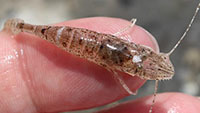 3/11 – Manhattan, HRM 2: Our Hudson River Park’s River Project staff checked our sampling and collection gear that we deploy off Pier 40 in Hudson River Park. There were no fish in our traps and pots today, but we did pull up an interesting array of invertebrates including sand shrimp, grass shrimp, blue mussels, and mud dog whelks. (Photo of sand shrimp courtesy of Molly Jacobson) 3/11 – Manhattan, HRM 2: Our Hudson River Park’s River Project staff checked our sampling and collection gear that we deploy off Pier 40 in Hudson River Park. There were no fish in our traps and pots today, but we did pull up an interesting array of invertebrates including sand shrimp, grass shrimp, blue mussels, and mud dog whelks. (Photo of sand shrimp courtesy of Molly Jacobson)
- Natalie Kim, Zoe Kim
Spring 2022 Natural History Programs and Events
The World Fish Migration Foundation
The World Fish Migration Foundation is partnering with Wildlife Forever Fish Art for a Fish Flag Contest. In past years, students were asked to create a painting or drawing of a migratory fish. This year, in a break from tradition, students are encouraged to create a migratory fish flag of any shape, size, and material! This award highlights the diversity of migratory fish from across the world and the importance of the free-flowing rivers they rely on. This global contest is open to all young artists ages 5-18 and is free to enter.
To enter the Fish Flag Contest, young artists should:
1. Go to https://www.fishflags.org for more information on the contest and World Fish Migration Day
2. Create a flag depicting a migratory fish species of your choice such as American eel, American shad, Atlantic sturgeon, Atlantic tomcod, river herring, and striped bass. To qualify, your migratory fish must spend some of its life in freshwater.
3. Complete an entry form and submit your flag before the April 14th deadline (visit www.fishflags.org) to learn more).
4. Fly your flag on World Fish Migration Day: May 21, 2022!
Feel free to reach out to Nicole Friedman, the coordinator of the Fish Flag Contest (nicole@fishmigration.org) with any questions about the contest or World Fish Migration Day.
Let’s use art to make a difference!
Winners will be announced during a live broadcast on May 21.
Pollution with PCBs in this section of the Hudson River accumulates in the fat tissue of fish and has led the NYS Dept of Health to issue the following advisories regarding eating fish you catch between Troy and Catskill. This advice is based on laboratory testing of fish caught in this section of the river, and the detected PCBs in these fish.
Cut the Fat to Cut the PCBs:
This is part of a series of submissions for the NYS Department of Health’s Hudson River Fish Advisory Outreach Project (HRFAOP) by project grantee, Cornell Cooperative Extension of Saratoga County, Diane Whitten, Resource Educator. Contact: dwhitten@cornell.edu
PCBs (polychlorinated biphenyls) found in Hudson River fish accumulates largely in their fat tissue and is ingested by people who eat the fish. The volume of PCBs ingested can be reduced by nearly 50% by cutting the amount of the fat consumed. Start by skinning the fish, then trimming visible fat along the side, back and belly of the fish. Next, cook the fish in a way that allows excess fat to drip away, such as broiling, grilling, or baking on a rack. Do not pan-fry the fish or use the drippings to make stock or sauce. When eating blue crab, don’t eat the tomalley (“green stuff”) or use the cooking liquid.
Click here for Hudson River Fish Advise for Eating Fish You Catch: https://www.health.ny.gov/publications/2794.pdf
Announcing the 2022 Hudson River Striped Bass Cooperative Angler Program
You can share your fishing trip information and help biologists understand and manage our Hudson River striped bass fishery. Here’s how it works: Fill out a logbook provided by us whenever you fish on the Hudson River (by boat or from shore). You can also use our survey123 app and record your trips using a smart phone or computer. Record general location, time, gear used, what you caught (or if you didn’t catch anything) and return the logbook when you are done fishing for the season. You’ll receive an annual newsletter summarizing the information in addition to the latest news regarding regulations and the river. Whether you catch-and-release or take home a keeper, you can be part of the Cooperative Angler Program. Online logbook instructions can be found here: https://www.dec.ny.gov/docs/remediation_hudson_pdf/hrcoopanglerelogbook.pdf
Join today by contacting: hudsonangler@dec.ny.gov or call 845-256-3009
Hudson Estuary Trees for Tribs Program
Now Accepting Applications. The Hudson River Estuary Program’s Trees for Tribs program offers free native trees and shrubs for planting along the tributary streams in the Hudson River Estuary watershed. Our staff can help you with a planting plan and work with your volunteers. Due date for Applications is March 1 for 2022 spring planting projects. Download and submit the two-page application found here: www.dec.ny.gov/docs/remediation_hudson_pdf/hrewtftap14.pdf. For more information about the program please visit the DEC website at: www.dec.ny.gov/lands/43668.html. If you have questions about a potential planting site, please contact Beth Roessler and Emily Haase at: HudsonEstuaryTFT@dec.ny.gov, or call (845)256-2253 to find out if your site is eligible for a 2022 planting project!
Hudson River Education
Teachers and students will enjoy our new Hudson River K-12 Unit of Study. This carefully curated group of lesson plans, arranged by topic and/or grade, brings together great learning tools developed by the DEC and dozens of estuary partners:
https://www.dec.ny.gov/education/25386.html
Hudson River Miles
The Hudson is measured north from Hudson River Mile 0 at the Battery at the southern tip of Manhattan. The George Washington Bridge is at HRM 12, the Tappan Zee 28, Bear Mountain 47, Beacon-Newburgh 62, Mid-Hudson 75, Kingston-Rhinecliff 95, Rip Van Winkle 114, and the Federal Dam at Troy, the head of tidewater, at 153. The tidal section of the Hudson constitutes a bit less than half the total distance – 315 miles – from Lake Tear of the Clouds to the Battery. Entries from points east and west in the watershed reference the corresponding river mile on the mainstem.
To Contribute Your Observations or to Subscribe
The Hudson River Almanac is compiled and edited by Tom Lake and emailed weekly by DEC's Hudson River Estuary Program. Share your observations by e-mailing them to trlake7@aol.com. To subscribe to the Almanac (or to unsubscribe), use the links on DEC's Hudson River Almanac or DEC Delivers web pages.
Useful Links
National Oceanic and Atmospheric Administration online tide and tidal current predictions are invaluable when planning Hudson River field trips. For real-time information on Hudson River tides, weather and water conditions from sixteen monitoring stations, visit the Hudson River Environmental Conditions Observing System website.
DEC's Smartphone app for iPhone and Android is now available at: New York Fishing, Hunting & Wildlife App.
|