A Project of the Hudson River Estuary Program
Compiled and edited by Tom Lake, Consulting Naturalist
Love Our NY Lands
State Lands Belong to All of Us
All New Yorkers and visitors should be able to access, enjoy, and feel welcome on state lands. These lands belong to all of us, our families, and our neighbors. While enjoying these shared spaces, be respectful of other visitors. Share trails, treat people with kindness, and leave things as you found them for others to enjoy. All of us have a responsibility to protect State lands for future generations. For more information, visit: https://www.dec.ny.gov/outdoor/119881.html
Overview
While ice, snow, sleet, and sub-freezing air temperatures continued to hold the watershed in a wintery grip, a tiny peek into spring occurred this week. The first “glass eels” of the season (immature American eels) arrived from the sea following their long journey from the greater Sargasso Sea. In the uplands, bald eagles continued to ready their nests; some had already begun incubating eggs.
Highlight of the Week
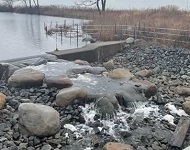 2/25 – Staten Island, New York City: They have arrived! We caught nine glass eels today in eel mops that we had set in a new fish ladder at Wolfe’s Pond Park. Our research gear is run by the New York City Department of Environmental Protection and checked by the NYCDEP and various student groups. (Top right photo of fish ladder courtesy of Rob Brauman; Bottom left photo of glass eels courtesy of Chris Bowser) 2/25 – Staten Island, New York City: They have arrived! We caught nine glass eels today in eel mops that we had set in a new fish ladder at Wolfe’s Pond Park. Our research gear is run by the New York City Department of Environmental Protection and checked by the NYCDEP and various student groups. (Top right photo of fish ladder courtesy of Rob Brauman; Bottom left photo of glass eels courtesy of Chris Bowser)
- Rob Brauman
[Last winter (2021), our first watershed glass eels showed up on February 23 at the Science Barge in Yonkers, also via eel mop checked by Joel Rodriguez. Chris Bowser, Sarah Mount]
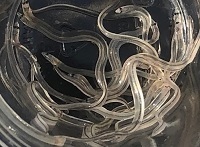 [Eel mops are a basketball-sized tangle of polypropylene tentacles placed in the river and found by glass eels to be a very cozy way station on their trip upstream. The mop can be lifted out, shaken, and glass eels will fall into a waiting bucket. The Atlantic State Marine Fisheries Commission literature has the perfect name for the mops: Medusa device. Medusa was a priestess in Greek mythology. In a fit of anger, the Greek goddess Athena, daughter of Zeus, transformed Medusa's hair into a head of snakes. As the eel mop gyrates in the current, it conjures up that image. Chris Bowser] [Eel mops are a basketball-sized tangle of polypropylene tentacles placed in the river and found by glass eels to be a very cozy way station on their trip upstream. The mop can be lifted out, shaken, and glass eels will fall into a waiting bucket. The Atlantic State Marine Fisheries Commission literature has the perfect name for the mops: Medusa device. Medusa was a priestess in Greek mythology. In a fit of anger, the Greek goddess Athena, daughter of Zeus, transformed Medusa's hair into a head of snakes. As the eel mop gyrates in the current, it conjures up that image. Chris Bowser]
Natural History Entries
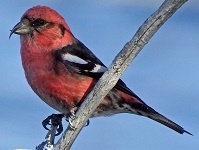 2/19 – Essex County, HRM 300: Recently, we birded the Tahawus area of the Adirondack High Peaks. Red crossbills were gritting in several places, including Route 28N north of Olmsteadville and the Upper Works at Tahawus. Two white-winged crossbills were gritting on the Upper Works Road and a black-backed woodpecker was spotted along Tahawus Road. (Photo of white-winged crossbill courtesy of Bob Duchesne) 2/19 – Essex County, HRM 300: Recently, we birded the Tahawus area of the Adirondack High Peaks. Red crossbills were gritting in several places, including Route 28N north of Olmsteadville and the Upper Works at Tahawus. Two white-winged crossbills were gritting on the Upper Works Road and a black-backed woodpecker was spotted along Tahawus Road. (Photo of white-winged crossbill courtesy of Bob Duchesne)
- Scott Stoner, Denise Stoner (Hudson-Mohawk Bird Club)
[Grit can be defined as particulate gravel, sharp granules, or sand made primarily of ground up minerals. Birds ingest and pass grit to their gizzard, their primary grinding organ, to assist them in grinding up large particles more effectively. The sanding of roads in winter provides songbirds with much grit. Tom Lake]
2/19 – Town of Poughkeepsie: The adults at bald eagle nest NY62 went on eggs today to begin their 32-35-day journey to a hatch. If our calculations are on-target, we ought to see a hatch March 22-25. This is their 22nd year.
- Bob Rightmyer
2/19 – Hudson River Watershed: Some readers have requested some explanation for the concept of river miles used in the Almanac. Each week’s edition of the Almanac contains the following paragraph near the end of the text. With the geographical immensity of the watershed, we have tried to create an uncomplicated protocol for noting locations.
- Hudson River miles (HRM) are measured north from the Battery at the southern tip of Manhattan, Hudson River Mile 0. The George Washington Bridge is at HRM 12, the Tappan Zee 28, Bear Mountain 47, Beacon-Newburgh 62, Mid-Hudson 75, Kingston-Rhinecliff 95, Rip Van Winkle 114, and the Federal Dam at Troy, the head of tidewater, at 153. The tidal section of the Hudson constitutes a bit less than half the total distance—315 miles—from the origin of the river at Lake Tear of the Clouds in the High Peaks of the Adirondacks to the Battery. Entries from points east and west in the watershed, such as the Mohawk River, reference the corresponding latitudinal river mile on the main stem.
The greater, geographic, "Hudson River" travels southeast through the Upper Bay of New York Harbor to the Verrazano Narrows and the sea, ultimately out into the Hudson Canyon, a deep abyss carved out by ancestral glacial meltwater eons ago.
- Tom Lake
2/19 – Green Island, HRM 153: The river was a rolling raucous in midday at the head of tide. There is a fine line between snow squall and snowstorm. We were teetering at that point in a midday whiteout. The freezing west wind could blow you over. At dead low tide, the river appeared even more disturbed. Two adult bald eagles were hunkered in hardwoods in the lee of a tree line. One had an eel. Waterfowl were elsewhere.
- Tom Lake
[In winter, eagles rule the river. It is rare that a day goes by that someone doesn't see an eagle carrying an eel. At times it seems, with all the ice, that capturing one would be impossible. But eagles specialize in the impossible. Tom Lake]
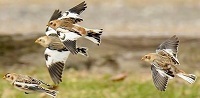 2/20 – Saratoga County, HRM 200: I went to Northumberland this morning and found a huge flock (more than 800) snow buntings. They made repeated flights from a field to a few trees and then back to the field. It was a real spectacle to watch such an immense number of birds act like flock of starlings. (Photo of snow buntings courtesy of Deborah Tracy Kral) 2/20 – Saratoga County, HRM 200: I went to Northumberland this morning and found a huge flock (more than 800) snow buntings. They made repeated flights from a field to a few trees and then back to the field. It was a real spectacle to watch such an immense number of birds act like flock of starlings. (Photo of snow buntings courtesy of Deborah Tracy Kral)
- John Hershey (Hudson-Mohawk Bird Club)
2/20 – Town of Wappinger: I spent some time today watching bald eagle nest NY459 (“Bridge Nest”). In early morning, both adults spent an hour in the nest. The male left, dropped to the forest floor, and came back with a bunch of yellow grass for nest-lining. The adults then set to fixing the grass in place. After those chores, they both flew to a nearby hardwood and mated. There were no eggs yet, but soon.
- Judy Winter
2/20 – Piermont, HRM 25: I headed to Piermont Pier today to see if I could find the little gull reported there earlier. I had no luck on the little gull, but it was good to see some different wintering ducks such as canvasbacks, ruddy ducks, buffleheads, and a single common goldeneye. Gulls were scarce and I only recorded the three expected species, ring-billed, herring, and great black-backed.
- Matt Zeitler
2/21 – Selkirk, HRM 135: Bald eagle nest NY81 across the river from Henry Hudson Park, has a heroic history. The original nest was in use for about eleven years before the tree it was in fell in August 2019. The pair rebuilt a nest nearby in October 2019.
Their nesting attempt failed in 2020. Then a storm on October 4, 2020, destroyed their one-year-old nest. The pair rebuilt the nest that autumn and they bred successfully in 2021. Today they were seen mating, so their 2022 season looks promising.
- John Kent (Hudson-Mohawk Bird Club)
2/21 – Hudson River Watershed: In “an effort out of curiosity,” we conducted an eleven- county regional bird count winter wrap-up that overlapped with Cornell's Great Backyard Bird Count weekend. On some days the brutal winds kept both bird and birder numbers down. Notable sightings included greater white-fronted goose and cackling goose, redhead duck, lesser scaup, and long-tailed duck.
With eight species added today, we presently have a tally of 99 species with a few waiting some details to be certain the entry was correctly identified. If someone went out tonight and heard an American woodcock calling, that would have brought our preliminary total to 100 species. A final summary will follow.
- Rich Guthrie
[Rich’s expression, “an effort out of curiosity,” is a perfect description for almost any adventure in natural history. Tom Lake]
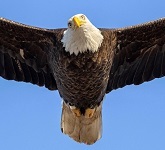 2/21 – Verplanck, HRM 40.5: While watching and photographing bald eagles from Old Steamboat, I spotted one that had a silver leg band and a black leg band with an alphameric N7. This information was sent to Peter Nye, retired DEC bald eagle expert, hoping to discover the eagle’s origin. (Photo of bald eagle courtesy of John Badura) 2/21 – Verplanck, HRM 40.5: While watching and photographing bald eagles from Old Steamboat, I spotted one that had a silver leg band and a black leg band with an alphameric N7. This information was sent to Peter Nye, retired DEC bald eagle expert, hoping to discover the eagle’s origin. (Photo of bald eagle courtesy of John Badura)
- John Badura
[Pete Nye replied that the black N7 bald eagle was one of two nestlings banded at a Hemlock Reservoir nest in Easton, Connecticut on May 4, 2018. From banding in the nest, to being seen at Verplanck, this eagle was free for 1,389 days (3.8 years), newly eclipsed adult. Easton, Connecticut is 60 miles east-northeast of Verplanck. The silver band was a U.S. Fish and Wildlife Service band. Tom Lake]
[Wintering bald eagles from all points north and east arrive by the hundreds on the open tidewater of the Hudson River from December through mid-March. While this annual gathering, a “fusion point,” assures them open-water fishing opportunities, it also provides them with an important venue for socially complex gathering. Unattached adults as well as soon-to-be adults spend the winter amid other eagles with the same goal of finding a mate. Immatures spend the winter in the company of their peers further learning how to be an eagle. Adults mate for life and often winter separately, possibly as a safety or survival strategy to protect their union. Tom Lake]
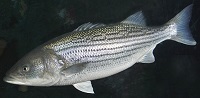 2/21 – Westchester County, HRM 34-33: We went kayaking in mid-afternoon today from Ossining to Croton Point. We began at Ossining and paddled into the ebb tide aiming to find headroom clearance to fit under the railroad bridge from Croton Bay into the Croton River. On our way, we passed over more striped bass in Croton Bay than I had ever seen in my life. It was amazing to look in the water and see schools of striped bass swimming around. The warm air and warming water must have made the shallows more comfortable. From the bow of our kayaks, we could see the river rippling from the bass swimming away from us. We also spotted 10-15 bald eagles. (Photo of striped bass with permission by Chesapeake Bay Program) 2/21 – Westchester County, HRM 34-33: We went kayaking in mid-afternoon today from Ossining to Croton Point. We began at Ossining and paddled into the ebb tide aiming to find headroom clearance to fit under the railroad bridge from Croton Bay into the Croton River. On our way, we passed over more striped bass in Croton Bay than I had ever seen in my life. It was amazing to look in the water and see schools of striped bass swimming around. The warm air and warming water must have made the shallows more comfortable. From the bow of our kayaks, we could see the river rippling from the bass swimming away from us. We also spotted 10-15 bald eagles. (Photo of striped bass with permission by Chesapeake Bay Program)
- Richard Weinberg, Alison North
2/22 – East Fishkill, HRM 66: We had no fewer than 50 red-winged blackbirds in our yard this morning. Some were eating at the seed feeders, but the majority were foraging birdseed that was on the ground. I don’t remember having them in my yard this time of year.
- Diane Anderson
2/22 – Peekskill, HRM 43.5: I drive past the entrance to Camp Smith off Annsville Creek every day, and have for twenty-five years, as part of my daily commute. Today there were eleven bald eagles, both adults and immatures, on the ice and in the trees. That is the highest number I had ever seen there.
- Scott Craven
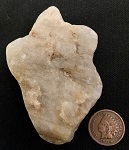 2/23 – Croton-on-Hudson, HRM 34: I was beach combing today at low tide on Croton Bay when I came upon an interesting rock. Holding it in my hand. it appeared to be an artifact (altered by human hands). From one perspective, it looked like a netsinker; from another, it seemed to have been crafted to resemble a turtle. We began to investigate all possibilities. (Top left photo of totem courtesy of Asher Fried; bottom right photo of Mohican Nation Seal courtesy of Tom Lake) 2/23 – Croton-on-Hudson, HRM 34: I was beach combing today at low tide on Croton Bay when I came upon an interesting rock. Holding it in my hand. it appeared to be an artifact (altered by human hands). From one perspective, it looked like a netsinker; from another, it seemed to have been crafted to resemble a turtle. We began to investigate all possibilities. (Top left photo of totem courtesy of Asher Fried; bottom right photo of Mohican Nation Seal courtesy of Tom Lake)
- Asher Fried
[Asher’s rock is an artifact, a palm-sized stone tool fashioned from a chunk of quartzite, a metamorphic rock that evolved over eons from quartz sandstone. The stone tool measures 47.4 x 72.1 millimeters (mm) and is somewhat water-worn. It was pecked or edge-notched on either side suggesting a netsinker. However, quartzite is a very uncommon stone (“lithic”) for creating net sinkers—quartzite is difficult to modify. The overwhelming source for netsinkers in the stone age was soft sandstone—easy to make and easy to discard leave on the beach. Why carry easily crafted rocks around until you go fishing again?
 An alternative role, possibly a dual role, for Asher’s artifact is as an indigenous totem, a sacred object, a spirit helper, often a symbol of a clan or an individual. Croton Point is the ancestral homeland of the Algonquian-speaking Lennni Lenape. Their turtle clan is called Pokekooun’go. Archaeologists are often tasked with looking at indigenous stone art, like studying clouds in the sky, and trying to discern their form and function. In this instance, a turtle. Turtles are common clan totems. “Turtle Island” is a symbol used by some northeast indigenous tribes, in particular Mohican-Munsee and the Haudenosaunee (Iroquois), where the turtle’s carapace represents the North American continent. An alternative role, possibly a dual role, for Asher’s artifact is as an indigenous totem, a sacred object, a spirit helper, often a symbol of a clan or an individual. Croton Point is the ancestral homeland of the Algonquian-speaking Lennni Lenape. Their turtle clan is called Pokekooun’go. Archaeologists are often tasked with looking at indigenous stone art, like studying clouds in the sky, and trying to discern their form and function. In this instance, a turtle. Turtles are common clan totems. “Turtle Island” is a symbol used by some northeast indigenous tribes, in particular Mohican-Munsee and the Haudenosaunee (Iroquois), where the turtle’s carapace represents the North American continent.
As is, this tool cannot be dated; stone can only be accurately dated when found in direct association with an organic context such as bone, shell, or charcoal from hearths that can be radiocarbon dated.
When I squint, and look at this artifact, I see a snapping turtle. But one person’s snapping turtle is another’s river otter. Look at the photo and do your own cloud analysis. Tom Lake]
[Note: One inch equals 25.4 mm. Tom Lake]
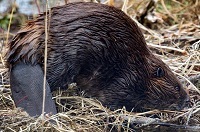 2/23 – Liberty State Park, Jersey City, NJ, HRM 0: I have visited Liberty State Park in Jersey City, NJ, many times but today’s visit brought a surprise. Walking a trail in the Caven Point area of the park, I came upon what appeared to be typical, and recent, beaver browsing in a small swamp. Some trees had been cut down and gnawed with their diagnostic toothy cut marks. By talking with a park ranger, I learned that beaver have been present in the park in small numbers for more than 20 years. With ample wetlands and waterways near Liberty Island State Park, this was not a surprise. 2/23 – Liberty State Park, Jersey City, NJ, HRM 0: I have visited Liberty State Park in Jersey City, NJ, many times but today’s visit brought a surprise. Walking a trail in the Caven Point area of the park, I came upon what appeared to be typical, and recent, beaver browsing in a small swamp. Some trees had been cut down and gnawed with their diagnostic toothy cut marks. By talking with a park ranger, I learned that beaver have been present in the park in small numbers for more than 20 years. With ample wetlands and waterways near Liberty Island State Park, this was not a surprise.
What I found fascinating, as I looked over the wetland, peeking up over the Phragmites was the World Trade Center in Lower Manhattan, less than two miles away. This closeness may be a surprise to many people. The Caven Point area of the park is designated as an ecologically sensitive area for wintering birds and is only open to the public during winter months from October 1 to February 28. (Photo of beaver courtesy of Deborah Tracy Kral)
- Graeme Birchal
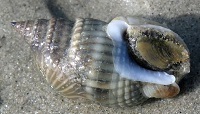 2/23 – Manhattan, HRM 2: Our Hudson River Park’s River Project staff checked our sampling and collection gear that we deploy off Pier 40 in Hudson River Park. While there were no fish in our pots and traps today, there were grass shrimp and, for the first time this season, mud dogs! (Photo of mud dog whelk courtesy of Ron Ceo) 2/23 – Manhattan, HRM 2: Our Hudson River Park’s River Project staff checked our sampling and collection gear that we deploy off Pier 40 in Hudson River Park. While there were no fish in our pots and traps today, there were grass shrimp and, for the first time this season, mud dogs! (Photo of mud dog whelk courtesy of Ron Ceo)
- Natalie Kim, Zoe Kim, Olivia Radick
[The mud dog whelk, or Atlantic dogwinkle (Nucella lapillus) is a species of predatory sea snail, a carnivorous marine gastropod. The dog whelk preys on shellfish like mussels and barnacles. In turn, they are preyed upon by various crabs and birds such as gulls and oystercatchers. Tom Lake]
*** Fish of the Week ***
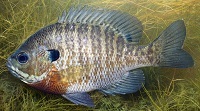 2/23 – Hudson River Watershed: Fish-of-the-Week for Week 161 is the bluegill (Lepomis macrochirus), number 156 (of 236) on our watershed list of fishes. If you would like a copy of our list, e-mail - trlake7@aol.com. 2/23 – Hudson River Watershed: Fish-of-the-Week for Week 161 is the bluegill (Lepomis macrochirus), number 156 (of 236) on our watershed list of fishes. If you would like a copy of our list, e-mail - trlake7@aol.com.
Bluegill is one of thirteen members of the sunfish family (Centrarchidae) in our watershed. Notable others include largemouth and smallmouth bass, pumpkinseed, and crappie. Bluegill is a freshwater fish of Middle-America—their type site (where the species was first described to science) is the Ohio River. Since the mid-19th century, bluegill sunfish have been introduced into our watershed primarily by stocking ponds and lakes for recreational fishing.
They are a rather slab-sided, palm-size panfish that can reach sixteen-inches-long, but their common size is closer to eight-inches. They have a dark blue or black "ear" on an extension of their gill cover (opercular flap) as well as a prominent dark blotch at the base of their soft dorsal fin. The New York State angling record bluegill is 2-pounds 8-ounces from Broome County in 1992.
Bluegill breeding areas can become so overcrowded at times that some males are unable to defend their own territories. In such instances, they can assume the coloration of a female and blend in with other bluegills, or even with related sunfish species, in an established nest and clandestinely reproduce. Hybrid sunfishes are not uncommon (C.L. Smith, 1985). (Photo of bluegill courtesy of NYS Department of Environmental Conservation)
- Tom Lake
2/24 – Fort Edward, HRM 202: Three of us made two trips to the Fort Edward Grasslands, most recently today, and had a wonderful time on each occasion. There were no short-eared owls to be found on our first visit, perhaps due to the frigid wind. However, we saw several rough-legged hawks, red-tailed hawks, and northern harriers. Then, just as we were giving up on the owls, we happened upon a snowy owl that had been found earlier by others. It is a never-failing delight to see them.
Today’s trip was much more productive. We found an obliging little American kestrel, several dark-phase red-tailed hawks, rough-legged hawks, and northern harriers. To cap off the day, we spotted three short-eared owls flitting through one of the loveliest sunsets I have ever experienced. They were calling frequently, which was especially delightful to me—much of my enjoyment of birding is hearing them vocalize.
- Marianne Friers
2/24 – Rensselaer County, HRM 137: I visited the fields of Swartz Farm near Castleton-on-Hudson today. I estimated there were no fewer than 3,000 Canada geese at a pond near their cornfields. Among the Canadas, I counted nine snow geese and two greater white-fronted geese. The latter two geese seemed aggressive, and the other geese avoided them.
- Nancy Kern (Hudson-Mohawk Bird Club)
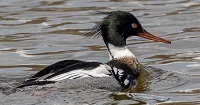 2/24 – Manhattan, New York: We did some winter bird monitoring for Randall's Island Park Alliance today. It was a cold, but we finished before a hailstorm came through. 2/24 – Manhattan, New York: We did some winter bird monitoring for Randall's Island Park Alliance today. It was a cold, but we finished before a hailstorm came through.
We saw a bunch of our usual birds including Canada geese as well as many species of gulls. Shockingly, there were no brants. However, we did spot two red-tailed hawks wheeling over the Little Hell Gate Salt Marsh. In the middle of the Bronx Kill channel, three mute swans paddled along among a gathering of Canada geese. Lastly, we saw two red-breasted mergansers dabbling around at the western end of the Bronx Kill. (Photo of red-breasted merganser courtesy of Jim Yates)
- Jackie Wu
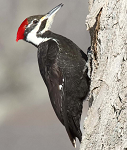 2/25 – Staatsburg, HRM 86: My four-year-old granddaughter, Eva, was looking out our window and asking about the “big woodpecker with the red head” who had come to our feeder. I thought she was referring to a red-bellied woodpecker, an occasional visitor. We were both surprised and excited to see that it was a female pileated woodpecker. (Photo of pilated woodpecker courtesy of Terry Hardy) 2/25 – Staatsburg, HRM 86: My four-year-old granddaughter, Eva, was looking out our window and asking about the “big woodpecker with the red head” who had come to our feeder. I thought she was referring to a red-bellied woodpecker, an occasional visitor. We were both surprised and excited to see that it was a female pileated woodpecker. (Photo of pilated woodpecker courtesy of Terry Hardy)
- Joanne Engle
2/25 – Waterford, HRM 158: The past few days were productive for watching bald eagle nest NY485 on Peebles Island. Today, one of the adults perched in a sycamore swooped down caught a foot-long fish and took it to another tree near the nest. It began eating but then chortled to its mate and took the rest of it to the nest for its mate. I have seen them mating, so although incubation began on March 9 last year, it may be earlier this year.
- Howard Stoner
[When we hear of a fish being brought to an eagle nest, we like to speculate as to it species. With American shad and river herring soon to be coming in from the sea to spawn, bald eagles often give us advance notice of their arrival. In this instance, however, we will guess it was the ever-popular, awful-tasting, gizzard shad. Tom Lake]
2/25 – Croton Point, HR 34: I saw the “eagles at play” phenomenon today that was reported in last week’s Almanac at Croton Point this afternoon. There were three immature bald eagles around the park’s landfill that stretches from Haverstraw Bay east across to Croton Bay. I was alerted to their presence when one of them flew over my head carrying a tree branch. Seconds later, two more immatures flew up to engage the branch-carrier. The three of them made a few dips and passes in hot pursuit before heading toward the river.
- Asher Fried
[Such observations are much more interesting when you know what the birds are up to. These games resemble “tag”; one eagle one will pick up an object and fly off with the others in chasing until it is dropped, whereupon another will pick it up and the game continues. They substitute sticks with ice chunks, dead fish, and shellfish as well. Tom Lake]
2/25 – Upper Bay, New York Harbor: February 25, 1908, we had the first tunnel (railroad) under Hudson River opened, linking New Jersey to New York City (Farmers’ Almanac,1908).
- Cathy Poluski
Winter-Spring 2022 Natural History Programs and Events
Hudson River Watershed:
Can You Eat That Fish from the Hudson River Between Troy and Catskill?
This is part of a series of submissions for the NYS Department of Health’s Hudson River Fish Advisory Outreach Project (HRFAOP) by project grantee, Cornell Cooperative Extension of Saratoga County, Diane Whitten, Resource Educator. Contact: dwhitten@cornell.edu
Pollution with PCBs in this section of the Hudson River accumulates in the fat tissue of fish and has led the NYS Dept of Health to issue the following advisories regarding eating fish you catch between Troy and Catskill. This advice is based on laboratory testing of fish caught in this section of the river, and the detected PCBs in these fish.
Women under 50 and Children under 15: Don’t eat.
Men 15 and over and Women 50 and over: Eat up to 1 meal a month of alewife, blueback herring, rock bass, yellow perch. All other species, including striped bass and walleye: Don’t Eat
Click here for Hudson River Fish Advise for Eating Fish You Catch: https://www.health.ny.gov/publications/2794.pdf
Announcing the 2022 Hudson River Striped Bass Cooperative Angler Program
You can share your fishing trip information and help biologists understand and manage our Hudson River striped bass fishery. Here’s how it works: Fill out a logbook provided by us whenever you fish on the Hudson River (by boat or from shore). You can also use our survey123 app and record your trips using a smart phone or computer. Record general location, time, gear used, what you caught (or if you didn’t catch anything) and return the logbook when you are done fishing for the season. You’ll receive an annual newsletter summarizing the information in addition to the latest news regarding regulations and the river. Whether you catch-and-release or take home a keeper, you can be part of the Cooperative Angler Program. Online logbook instructions can be found here: https://www.dec.ny.gov/docs/remediation_hudson_pdf/hrcoopanglerelogbook.pdf
Join today by contacting: hudsonangler@dec.ny.gov or call 845-256-3009
Hudson Estuary Trees for Tribs Program
Now Accepting Applications. The Hudson River Estuary Program’s Trees for Tribs program offers free native trees and shrubs for planting along the tributary streams in the Hudson River Estuary watershed. Our staff can help you with a planting plan and work with your volunteers. Due date for Applications is March 1 for 2022 spring planting projects. Download and submit the two-page application found here: www.dec.ny.gov/docs/remediation_hudson_pdf/hrewtftap14.pdf. For more information about the program please visit the DEC website at: www.dec.ny.gov/lands/43668.html. If you have questions about a potential planting site, please contact Beth Roessler and Emily Haase at: HudsonEstuaryTFT@dec.ny.gov, or call (845)256-2253 to find out if your site is eligible for a 2022 planting project!
Hudson River Education
Teachers and students will enjoy our new Hudson River K-12 Unit of Study. This carefully curated group of lesson plans, arranged by topic and/or grade, brings together great learning tools developed by the DEC and dozens of estuary partners:
https://www.dec.ny.gov/education/25386.html
Hudson River Miles
The Hudson is measured north from Hudson River Mile 0 at the Battery at the southern tip of Manhattan. The George Washington Bridge is at HRM 12, the Tappan Zee 28, Bear Mountain 47, Beacon-Newburgh 62, Mid-Hudson 75, Kingston-Rhinecliff 95, Rip Van Winkle 114, and the Federal Dam at Troy, the head of tidewater, at 153. The tidal section of the Hudson constitutes a bit less than half the total distance – 315 miles – from Lake Tear of the Clouds to the Battery. Entries from points east and west in the watershed reference the corresponding river mile on the mainstem.
To Contribute Your Observations or to Subscribe
The Hudson River Almanac is compiled and edited by Tom Lake and emailed weekly by DEC's Hudson River Estuary Program. Share your observations by e-mailing them to trlake7@aol.com. To subscribe to the Almanac (or to unsubscribe), use the links on DEC's Hudson River Almanac or DEC Delivers web pages.
Useful Links
National Oceanic and Atmospheric Administration online tide and tidal current predictions are invaluable when planning Hudson River field trips. For real-time information on Hudson River tides, weather and water conditions from sixteen monitoring stations, visit the Hudson River Environmental Conditions Observing System website.
DEC's Smartphone app for iPhone and Android is now available at: New York Fishing, Hunting & Wildlife App.
|