A Project of the Hudson River Estuary Program
Compiled and edited by Tom Lake, Consulting Naturalist
Love Our NY Lands
State Lands Belong to All of Us
All New Yorkers and visitors should be able to access, enjoy, and feel welcome on state lands. These lands belong to all of us, our families, and our neighbors. While enjoying these shared spaces, be respectful of other visitors. Share trails, treat people with kindness, and leave things as you found them for others to enjoy. All of us have a responsibility to protect State lands for future generations. For more information, visit: https://www.dec.ny.gov/outdoor/119881.html
Overview
Except for cold nights and ice on the river, there was no common theme this week. Most activity occurred with birds, including a visit from a rare western songbird and bald eagles preparing for the upcoming nesting season. We also remembered a quite long-ago, iconic, environmental battle on the Hudson River.
Highlight of the Week
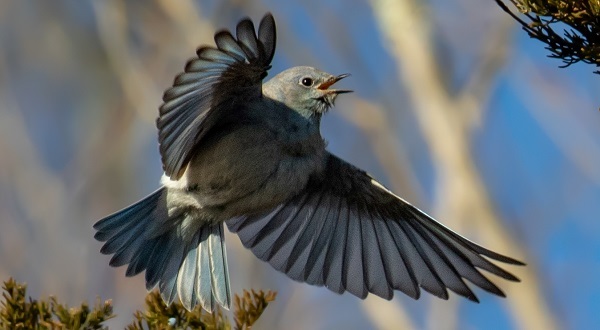
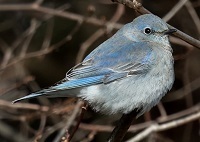 1/17 – Esopus Meadows, HRM 87: Six days ago, I came upon a rare mountain bluebird at Esopus Meadows. At first, I thought it was just an odd-looking female eastern bluebird, so I did not make the identification until I was reviewing my photographs. The bird hung around through today, along with a few eastern bluebirds, feeding on juniper cones. However, the berries were thinning out, so it may not be long before the mountain bluebird moves on to greener pastures. This was only the second confirmed record for Ulster County. The first sighting occurred in December 1990, during the Mohonk Lake/Ashokan Reservoir Christmas Bird Count. (Photo of mountain bluebird courtesy of Deborah Tracy Kral) 1/17 – Esopus Meadows, HRM 87: Six days ago, I came upon a rare mountain bluebird at Esopus Meadows. At first, I thought it was just an odd-looking female eastern bluebird, so I did not make the identification until I was reviewing my photographs. The bird hung around through today, along with a few eastern bluebirds, feeding on juniper cones. However, the berries were thinning out, so it may not be long before the mountain bluebird moves on to greener pastures. This was only the second confirmed record for Ulster County. The first sighting occurred in December 1990, during the Mohonk Lake/Ashokan Reservoir Christmas Bird Count. (Photo of mountain bluebird courtesy of Deborah Tracy Kral)
- Jim Yates
[Jim Yates’ mountain bluebird looked to be a young male with its bright sky-blue tail, lower back and primary wing feathers. The underparts were a soft gray with a little bit of blue blush beginning to show in its chest. Lance Verderame]
[The mountain bluebird (Sialia currucoides) is a thrush (Turdidae) found in the western U.S. from Alaska to Central America. They are an uncommon-to-rare wanderer east of the Rocky Mountains. Tom Lake]
Natural History Entries
1/15 – Rensselaer County, HRM 152–137: The 54th annual Southern Rensselaer Christmas Bird Count was held on December 26. Our 22 participants in seven field parties spent the day logging 66 species and 16,302 individual birds. That's well above our 10-year average of 57 and is the second-highest count on record.
As expected, our highest individual numbers were American crow and European starling. We had none of our winter passerines (snow bunting, horned lark, pine siskin, crossbills, etc.) and sparrow numbers in general were low. Black vultures continued their strong winter roost while a few turkey vultures lingered. Raptors gave a strong showing with Cooper's hawks outnumbering sharp-shinned hawks. All three common falcons—American kestrel, merlin, peregrine—were seen. The most notable sighting was a broad-winged hawk headed south in a hurry! The saddest miss was a Cape May warbler that frequented a feeder in Poestenkill for several weeks, last seen before count week.
- Naomi Lloyd
1/15 – Ulster County, HRM 92: The Ulster County segment of the annual New York State January Waterfowl Count was conducted with eighteen participants in ten field parties encountering 4,384 individuals of 13 species. Our ten-year average for this countywide effort is 13 species and 6,932 individuals.
More than a week of sub-freezing temperatures had frozen-over most sources of water, concentrating waterfowl in small patches of rapids or warm inflows. Fields were free of ice and snow providing good foraging opportunities for geese. Weather conditions on count day were cold (2-14-degrees Fahrenheit (F)) with a bitter wind chill along the Hudson River
Two green-winged teal was a good find in a spring-fed wetland in Eddyville. Esopus Creek, at Glenerie Falls in Saugerties, hosted a large congregation of waterfowl, seven species, including a drake northern pintail and a drake American wigeon. Also in Saugerties, we found the recently famous and rare mountain bluebird. Another northern pintail was encountered in Sawkill Creek, and a record high 55 ring-necked ducks, surpassing last year’s 33, in a large raft on Binnewater Lake. A record high number of 76 hooded merganser was counted, eclipsing 61 from last year and well above our ten-year average of 17.
Canada geese were relatively few in number this year (3,227), falling well short of our 5,422 ten-year average. Observers reported a surprisingly small number of bald eagles (eight adults and two immatures), as well as an American kestrel and a golden eagle encountered along Sawkill Creek.
- Steve Chorvas
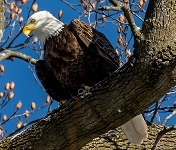 1/15 – Town of Poughkeepsie: Bald eagle nest NY62 is busily preparing for the 2022 breeding season. For the female of the pair, this will be her 22nd year. During her first ten years, she laid her eggs in early-to-mid March. However, in the last decade, she has begun incubating eggs in late February. There are a variety of factors that could account for the earlier egg laying such as maturity of the adults, environmental conditions, and the increased density of eagles in the Hudson Valley. 1/15 – Town of Poughkeepsie: Bald eagle nest NY62 is busily preparing for the 2022 breeding season. For the female of the pair, this will be her 22nd year. During her first ten years, she laid her eggs in early-to-mid March. However, in the last decade, she has begun incubating eggs in late February. There are a variety of factors that could account for the earlier egg laying such as maturity of the adults, environmental conditions, and the increased density of eagles in the Hudson Valley.
Pete Nye sees eagle density as a key factor with potential, or actual, competition for nest sites. Adults simply feel the need to remain on territory and protect nest sites earlier each season, even staying close by year-round, if weather conditions permit. The threat is that "floaters" (unattached adults) might usurp their territories. (Photo of bald eagle courtesy of Bob Rightmyer)
- Tom Lake
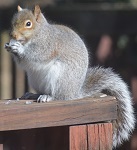 1/16 – Hyde Park, HRM 82: With all this cold weather, we cannot keep our birdbath unfrozen. As a result, the gray squirrels are eating the ice. (Photo of gray squirrel courtesy of Peter Fanelli) 1/16 – Hyde Park, HRM 82: With all this cold weather, we cannot keep our birdbath unfrozen. As a result, the gray squirrels are eating the ice. (Photo of gray squirrel courtesy of Peter Fanelli)
- Peter Fanelli
1/16 – Hudson River Watershed: Fish-of-the-Week for Week 156 is the bonefish (Albula vulpes), number 20 (of 236) on our watershed list of fishes. If you would like a copy of our list of fishes, e-mail - trlake7@aol.com.
The bonefish (Albula vulpes) is the only member of its family (Albulidae) recorded for the watershed and is considered a tropical marine stray. Bob Schmidt, however, notes that there is at least one other bonefish species (A. goreensis) known from the Caribbean, and lacking genetic analysis, we really don't know which species occasionally shows up in the New York Bight. Both species are nearly identical morphologically, but quite distinct genetically. Our next bonefish specimen needs to be genetically sequenced.
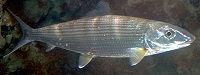 Bonefish are found nearly world-wide in tropically warm oceans. They go through a leptocephalus or planktonic stage, not unlike the American eel. It is likely that the few juveniles we find in New York waters, including the rare adult, were originally Gulf Stream “drifters” that arrived off the New York Bight before metamorphosing into juveniles. The center-of-abundance for bonefish includes the Bahamas, Caribbean, and the Florida Keys. Bonefish are found nearly world-wide in tropically warm oceans. They go through a leptocephalus or planktonic stage, not unlike the American eel. It is likely that the few juveniles we find in New York waters, including the rare adult, were originally Gulf Stream “drifters” that arrived off the New York Bight before metamorphosing into juveniles. The center-of-abundance for bonefish includes the Bahamas, Caribbean, and the Florida Keys.
C. Lavett Smith (1997) describes the bonefish as a slender, terete, fusiform fish almost round in cross section. Böhlke and Chaplin (1968) agree, calling them “spindle-shaped” with an under-set mouth not unlike a pig snout. They favor shallow sandy tide flats where they snuffle along the bottom rooting for mollusks and crustaceans. Bonefish can reach 14 pounds and are among the most prized of gamefish.
The first record of a bonefish in the estuary occurred in October 1990 when a young-of-year (100 millimeters (mm)) was captured in a seine by Tom Lake and Chris Letts on a beach in Ossining (river mile 33). In October 2015, during their Tappan Zee-Haverstraw Bay beach seining, DEC Region 3 Hudson River Fisheries Unit staff, including Bobby Adams, Wes Eakin, Joe Lydon, Akash Thapa, and Russ Berdan, caught a second, also young-of-year (103 mm), bonefish. (Photo of bonefish with permission by NMFS)
- Tom Lake
[1 inch = 25.4 millimeters (mm)]
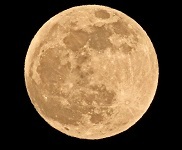 1/17 – Hudson River Watershed: Among indigenous peoples, full moons have long been given names that are rooted in oral traditions, indigenous memories, and ethnographic accounts. Among indigenous peoples of our watershed, tonight’s full moon is known by various names, including the Cracking Tree Moon (Mohican-Munsee) and, my personal favorite, Someone’s Ears are Freezing Moon (Oneida-Haudenosaunee). (Photo of full moon courtesy of Dana Layton) 1/17 – Hudson River Watershed: Among indigenous peoples, full moons have long been given names that are rooted in oral traditions, indigenous memories, and ethnographic accounts. Among indigenous peoples of our watershed, tonight’s full moon is known by various names, including the Cracking Tree Moon (Mohican-Munsee) and, my personal favorite, Someone’s Ears are Freezing Moon (Oneida-Haudenosaunee). (Photo of full moon courtesy of Dana Layton)
- Tom Lake
[Cracking Tree Full Moon: On a cold, dark, winter night, when we are indoors away from the freezing air, we may hear a loud CRACK! This sound is caused by frost cracks in trees. When air temperatures drop well below zero, trees will make all kinds of popping and cracking noises, especially if the temperature drops very quickly. A frost crack occurs when sap inside the tree freezes, causing it to expand in volume. Frost cracks most often occur after very cold, sunny days.
Among Mohican people, the Cracking Tree full moon is called Pathe'naawe mtok keesoox/neepã'ak, and refers particularly to apple, maple, and willows. (Keesoox = sun; Mtok = tree; Neepa'ak = moon)
Among the Munsee, the Cracking Tree full moon is called Pasihleewi-mih tukw-niipaahum, and refers particularly to oak, walnut, beech, and elm.
Tribal translations pre-date colonization and generally reflect the seasonality of lunar phases. Moon phases were used by indigenous peoples as measurements of time. Larry Madden]
1/18 – Saratoga County, HRM 159: I drove the length of Flight Locks Road in Waterford with hopes of seeing a variety of gulls and waterfowl at the boat launch, only to discover that it was frozen over. A single red-tailed hawk hovered like a harrier, using the strong north wind to stay in place. On the way back, I found a lively patch of birds near the entrance of Lock E2 of the Waterford Flight.
I found a small flock of cedar waxwings eating-drinking snow. In the immediate area were American tree and white-throated sparrows, blue jays, white-breasted nuthatches, eastern bluebirds, American robins, and another red-tailed hawk, hanging out in the lower branches of a tree giving its “western movie” k-r-r-r-r call.
- Ron Harrower (Hudson-Mohawk Bird Club)
[The Waterford Flight, built in 1915, is a set of locks on the Erie Canal (E-2 through E-6) that lifts vessels 169 feet from the Hudson River to the Mohawk River, bypassing the Cohoes Falls. Tom Lake]
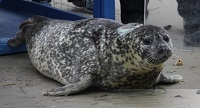 1/18 – Saugerties, HRM 102: We had not seen the male harbor seal in several days. The ice had become thick and unbroken, both out in the river and in Esopus Creek—ice fishers were on the creek today. Where will he go if the creek and river freeze over? 1/18 – Saugerties, HRM 102: We had not seen the male harbor seal in several days. The ice had become thick and unbroken, both out in the river and in Esopus Creek—ice fishers were on the creek today. Where will he go if the creek and river freeze over?
[Ice-over is always a threat with marine mammals in sheltered inshore tidewater. Seals need open water, at least small openings, in order to occasionally haul out, especially at night. However, if winter is severe, tidewater gives seals the option to heading downriver beyond the reach of heavy ice. The Saugerties harbor seal has had three winters of relatively modest ice cover (2019-2021). It is beginning to look as though 2022 may be a challenge.
The danger of freeze-over trapping a seal it is not without precedent in the Hudson River. In summer 2015, a male gray seal made its way upriver past the federal dam at Troy and through the locks of the Hudson-Champlain Canal. It became marooned in the upper Hudson River (Saratoga County), eleven miles above tidewater and 175 miles from the sea.
Through the summer and fall, we expected that the seal would find its way back down to tidewater. However, whether by choice or stubbornness, the seal stayed upriver as winter was about to arrive. Boat traffic was winding down, and the canal locks would soon be closed for the season. River levels would lower and every day the gray seal would find his world shrinking. While he was a boreal seal, comfortable in the cold waters of the North Atlantic, winter in a frozen river between canal locks 1 and 2 could be fatal. Time was running out before the onset of serious winter ice.
In early December 2015, The National Oceanic and Atmospheric Administration (NOAA) gave permission for the Riverhead Foundation, the New York State Canal Corporation, and NYSDEC to attempt a rescue. On December 4, after being trapped for 133 days, the gray seal was successfully rescued from Lock 1. The seal was rehabilitated and later released to the sea at Hampton Bays, Long Island. Tom Lake] (Photo of gray seal courtesy of Tom Lake)
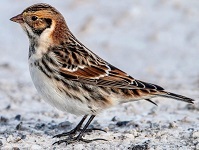 1/19 – Saratoga County, HRM 200: We stopped by a spot recommended for field birds in Northumberland today and waited for the birds to join the American crows in a big field. We were about to give up when thirty birds showed up, followed by even more, until there were 120 birds only fifty feet out in the field. The field birds were moving about quite a bit, so it was difficult at first to spot individuals. Later, reviewing photos, we found as many as five Lapland longspurs. It was great fun to watch individual horned larks and snow buntings eating whole kernels of corn. (Photo of Lapland longspur courtesy of Andrew Simon) 1/19 – Saratoga County, HRM 200: We stopped by a spot recommended for field birds in Northumberland today and waited for the birds to join the American crows in a big field. We were about to give up when thirty birds showed up, followed by even more, until there were 120 birds only fifty feet out in the field. The field birds were moving about quite a bit, so it was difficult at first to spot individuals. Later, reviewing photos, we found as many as five Lapland longspurs. It was great fun to watch individual horned larks and snow buntings eating whole kernels of corn. (Photo of Lapland longspur courtesy of Andrew Simon)
- Ron Harrower, John Hershey (Hudson-Mohawk Bird Club)
[Field birds include horned larks, more regularly seen snow buntings, and Lapland longspurs, a considerably rarer visitor from the Great Plains. Ron Harrower]
1/19 – Greene County, HRM 118: It was so exciting! This was the first time I had ever seen eagles on ice floes. In midday, two adult bald eagles were hanging out on the ice just below the Hudson-Athens Lighthouse. The tide was low, and the ice was still. After ten minutes, one of the eagles took off, headed upriver, and made two pirouettes in the sky. It was beautiful. The eagle then flew over onto Middle Ground (island) and its nest (NY301). The second adult stayed on the ice.
- Cathy Poluski
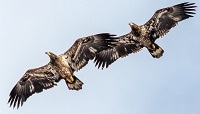 1/19 – Town of Poughkeepsie: The adults in bald eagle NY62 fledged two nestlings last year, one on June 7, the second on June 10. Today, two immature eagles, looking like first-year birds, glided past wing-to-wing, very near nest NY62. There is always the thought that last year’s fledglings may come back to visit. In some instances, it may be true. But with the large number of immature bald eagles wintering along the tidewater Hudson right now, it was impossible to know for sure. (Photo of bald eagles courtesy of Bob Rightmyer) 1/19 – Town of Poughkeepsie: The adults in bald eagle NY62 fledged two nestlings last year, one on June 7, the second on June 10. Today, two immature eagles, looking like first-year birds, glided past wing-to-wing, very near nest NY62. There is always the thought that last year’s fledglings may come back to visit. In some instances, it may be true. But with the large number of immature bald eagles wintering along the tidewater Hudson right now, it was impossible to know for sure. (Photo of bald eagles courtesy of Bob Rightmyer)
- Tom Lake
1/19 – Westchester County, HRM 36: We were walking along the river today at Senasqua when an adult bald eagle swooped down and snatched a gizzard shad out of the water. As it ascended off the river, a second adult eagle came dive-bombing out of the sky causing the fish to be dropped. The dive-bomber eagle caught the fish in mid-air and flew off.
- Jack Hoyle, Lori Hoyle
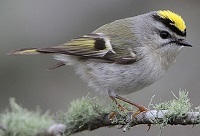 1/20 – Saratoga County, HRM 172: After getting spring water in the Geyser Picnic area of Saratoga Spa State Park, I stopped by Geyser Brook. I was checking to see what was around and hoping for a golden-crowned kinglet. Initially, there wasn't much to see, but then a small flock of blue jays began making a racket in a tall spruce tree. There did not seem to be any raptors around to cause the stir, but other birds seemed to perk up. As a result, a golden-crowned kinglet and white-breasted nuthatch came in and a belted kingfisher began patrolling the brook. (Photo of golden-crowned kinglet courtesy of Ken Barlley) 1/20 – Saratoga County, HRM 172: After getting spring water in the Geyser Picnic area of Saratoga Spa State Park, I stopped by Geyser Brook. I was checking to see what was around and hoping for a golden-crowned kinglet. Initially, there wasn't much to see, but then a small flock of blue jays began making a racket in a tall spruce tree. There did not seem to be any raptors around to cause the stir, but other birds seemed to perk up. As a result, a golden-crowned kinglet and white-breasted nuthatch came in and a belted kingfisher began patrolling the brook. (Photo of golden-crowned kinglet courtesy of Ken Barlley)
- Ron Harrower (Hudson-Mohawk Bird Club)
1/20 – Saratoga County, HRM 157: Sitting among a large gathering of gulls at the edge of the ice just upstream of the Crescent Power Station, I spotted a first-year Iceland gull and a pure white second-year glaucous gull.
- Gregg Recer
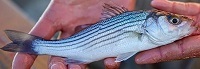 1/20 – Manhattan, HRM 2: Hudson River Park’s River Project staff checked the sampling and collection gear that we deploy off Pier 40 in Hudson River Park. Our traps collected one young-of-year striped bass (93 mm) today, as well as a few grass shrimp (Palaemon sp.) and some amphipods. Catching a striped bass of this size reminded us of the 1969-1984 development effort to fill in the Hudson River off the west side of Manhattan. (Photo of striped bass with permission by USGS) 1/20 – Manhattan, HRM 2: Hudson River Park’s River Project staff checked the sampling and collection gear that we deploy off Pier 40 in Hudson River Park. Our traps collected one young-of-year striped bass (93 mm) today, as well as a few grass shrimp (Palaemon sp.) and some amphipods. Catching a striped bass of this size reminded us of the 1969-1984 development effort to fill in the Hudson River off the west side of Manhattan. (Photo of striped bass with permission by USGS)
- Natalie Kim, Siddhartha Hayes
[The Westway Project sought to create a massive landfill on 181 acres along the river, requiring a mountain of dirt large enough, by one estimate, to bury Central Park six feet deep. Opponents of the project, citing environmental research findings, pointed out that the inter-pier area of Manhattan’s west side was a wintering area for large numbers of young-of-year and yearling striped bass. Thanks to efforts by the Sierra Club, the Clean Air Campaign, Friends of the Earth, and the Hudson River Fisherman’s Association, a Federal Judge denied the project in 1984. Robert H. Boyle (New York Times, June 1984]
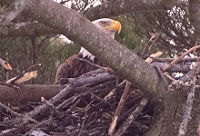
1/21 – Town of Poughkeepsie: The adults in bald eagle nest NY372 were bringing “new timber” to the nest today, refurbishing, shoring up weak points that had been compromised by storms and many months of use. This activity was occurring at scores of eagle nests from the Adirondacks to the sea. (Photo of bald eagle courtesy of John Devitt)
- John Devitt
Hudson River Miles
The Hudson is measured north from Hudson River Mile 0 at the Battery at the southern tip of Manhattan. The George Washington Bridge is at HRM 12, the Tappan Zee 28, Bear Mountain 47, Beacon-Newburgh 62, Mid-Hudson 75, Kingston-Rhinecliff 95, Rip Van Winkle 114, and the Federal Dam at Troy, the head of tidewater, at 153. The tidal section of the Hudson constitutes a bit less than half the total distance – 315 miles – from Lake Tear of the Clouds to the Battery. Entries from points east and west in the watershed reference the corresponding river mile on the mainstem.
To Contribute Your Observations or to Subscribe
The Hudson River Almanac is compiled and edited by Tom Lake and emailed weekly by DEC's Hudson River Estuary Program. Share your observations by e-mailing them to trlake7@aol.com. To subscribe to the Almanac (or to unsubscribe), use the links on DEC's Hudson River Almanac or DEC Delivers web pages.
Useful Links
National Oceanic and Atmospheric Administration online tide and tidal current predictions are invaluable when planning Hudson River field trips. For real-time information on Hudson River tides, weather and water conditions from sixteen monitoring stations, visit the Hudson River Environmental Conditions Observing System website.
DEC's Smartphone app for iPhone and Android is now available at: New York Fishing, Hunting & Wildlife App.
|