A Project of the Hudson River Estuary Program
Compiled and edited by Tom Lake, Consulting Naturalist
Love Our NY Lands
State Lands Belong to All of Us
All New Yorkers and visitors should be able to access, enjoy, and feel welcome on state lands. These lands belong to all of us, our families, and our neighbors. While enjoying these shared spaces, be respectful of other visitors. Share trails, treat people with kindness, and leave things as you found them for others to enjoy. All of us have a responsibility to protect State lands for future generations. For more information, visit: https://www.dec.ny.gov/outdoor/119881.html
Overview
Paired adult bald eagles were beginning to return to their nests as a prelude to the 2022 breeding season. It was another week when winter refused to offer coming attractions–air temperature records were tied or broken.
After this week’s Hudson River Almanac, we will take a three-week hiatus in deference to the Holiday Season. However, we will still be compiling data, stories, and adventures for the Almanac when we come back. So, please enjoy the Holidays and remember us when you find the time. THANK YOU. Happy Holidays!
Highlight of the Week
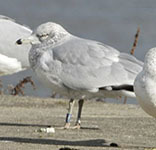 12/12 – Albany County, HRM 133.5: As I checked out the gulls at Coeymans Landing today, I noticed a ring-billed gull (Larus delawarensis) with color-coded leg bands (color-coded leg bands are easy to read and report to track the movements of these birds). I reported the gull and its identifying bands to the U.S. Geological Survey. USGS maintains all bird banding data for North America (USA, Canada, Mexico, Caribbean Islands) and many South American countries. 12/12 – Albany County, HRM 133.5: As I checked out the gulls at Coeymans Landing today, I noticed a ring-billed gull (Larus delawarensis) with color-coded leg bands (color-coded leg bands are easy to read and report to track the movements of these birds). I reported the gull and its identifying bands to the U.S. Geological Survey. USGS maintains all bird banding data for North America (USA, Canada, Mexico, Caribbean Islands) and many South American countries.
Recovery data from the Canadian Wildlife Service: This gull, hatched in 2020, was banded 151 days earlier (July 15, 2021) in Quebec, Canada, by the Department of Sciences Biologiques, Universite Du Quebec A, Montreal. Across 151 days, this gull had traveled 236 miles due south. (Photo of ring-billed gull courtesy of Rich Guthrie)
- Rich Guthrie
[This is a nice reminder of how the Hudson River Flyway connects us to faraway places. Tom Lake]
Natural History Entries
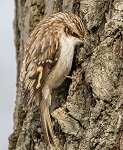 12/10 – Albany, HRM 145: I have seen a brown creeper (Certhia americana) several times since November 1 on a large red oak near our house. The oak, one of three such large red oaks, has a 30-inch diameter and we estimate it to be more than 140-years-old. 12/10 – Albany, HRM 145: I have seen a brown creeper (Certhia americana) several times since November 1 on a large red oak near our house. The oak, one of three such large red oaks, has a 30-inch diameter and we estimate it to be more than 140-years-old.
The brown creeper initially appeared like a hopping piece of bark, as it actively scooted up, down, and around the trunk presumably finding morsels in the cracks of the bark with its long decurved-bill. Seeing it in profile, the head and neck blend into the small oval body.
There is an adjacent cluster of 40-foot hemlocks that provide good cover for the creeper as well as red-breasted and white-breasted nuthatches and black-capped chickadees. The brown creeper seems to only show up in the company of these other “tree hopping” species. (Photo of brown creeper courtesy of Joan Bonin)
- Mario Meier
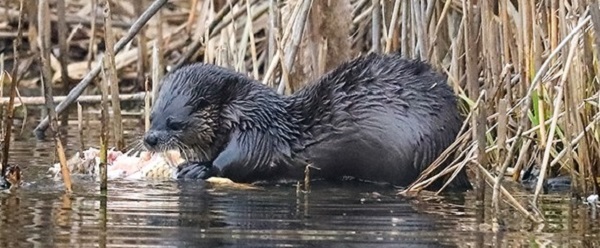
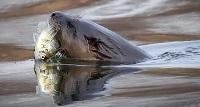 12/10 – Rockland County, HRM 33: I watched from the shore of a pond in the early afternoon as a male river otter, no less than four-foot-long from snout to tail tip, caught and devoured at least three dozen assorted fishes including black crappie and other sunfish. Out in deeper water, he snagged common carp larger than half his own size. Using his mouth and front paws he maneuvered the dying fish to the shallow shoreline where he feasted on its flesh and bones. 12/10 – Rockland County, HRM 33: I watched from the shore of a pond in the early afternoon as a male river otter, no less than four-foot-long from snout to tail tip, caught and devoured at least three dozen assorted fishes including black crappie and other sunfish. Out in deeper water, he snagged common carp larger than half his own size. Using his mouth and front paws he maneuvered the dying fish to the shallow shoreline where he feasted on its flesh and bones.
This was a big otter! Females run less than two–thirds the size of males, thus my guess this was a male. Males weigh up to 30 pounds, females 10-20 pounds. This otter was all of the former. (Photo of river otter courtesy of Roger Pare)
- Roger Pare
[The exact location of this lake is intentionally left vague to protect the river otters. Tom Lake]
12/10 – Manhattan, HRM 2: Our Hudson River Park’s River Project staff checked our sampling and collection gear that we deploy off Pier 40 in Hudson River Park. We were heartened that some fish were still around late in the season as we found a juvenile white perch (180 mm) and two young-of-year black sea bass (65-70 mm) in our traps.
- Natalie Kim, Zoe Kim
[One inch = 25.4 millimeters (mm)]
12/11 –Saugerties, HRM 102: Last night we heard a yelp and a bark from the Saugerties Lighthouse that we sensed was the harbor seal in Esopus Creek. [typical vocalization of a seal]. But it was dark and we could not make out a shape in the water. Given the recent nearby sightings, however, convinced me that it was the seal.
- Patrick Landewe
12/12 – Glasco, HRM 100: A downstream neighbor, Doc Shuter, reported coming upon a harbor seal two miles south of the Saugerties Lighthouse. While kayaking on the east side of Magdalen Island, he encountered the seal. The tide was low and the seal was swimming and splashing in about two feet of water.
- Patrick Landewe
12/13 – Saugerties, HRM 102: The male harbor seal paid a visit to the Saugerties Lighthouse this afternoon. Patrick Wadden, of Arm-of-the-Sea Theater, reported seeing the harbor seal in the shallows north of the lighthouse in the hour before sunset. The was Day 860.
- Patrick Landewe
12/13 – Town of Wappinger: Both adults were present today, for the first time this season, at bald eagle nest NY459, known to nest-watchers as the “Bridge Nest”.
NY459 was a new nest in 2018 when, on May 16, a violent storm called a “microburst” swept across the Hudson River from the west. The storm carried tornadoes and straight-line winds in excess of 95 mph. As it roared through the forest, it snapped off telephone poles, 90-foot white pines, and 45-foot maples like matchsticks. It destroyed NY459 and dumped their two nestlings onto the forest floor. With help from Gary and Mauricette Char Potthast, Meghan Oberkircher, and Annie Mardiney, the two nestlings were sent to a wildlife rehabilitator and survived. By June 26, 2018, the pair had already begun to rebuild the nest.
On May 16, 2019, we discovered that this resilient pair had, once again, two nestlings. The 2020 season continued their remarkable success, with two more nestlings—six nestlings in three years. We have high hopes for 2021.
- Tom Lake
[A microburst is a localized column of sinking air (downdraft) within a thunderstorm that can cause extensive damage. Tom Lake.]
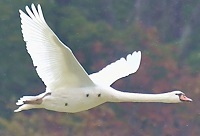 12/14 – Esopus Meadows, HRM 87: In my work, I have found myself at archeological sites in or near cornfields well inland from the Hudson River. There was a time when I would come upon the sharp, four-pronged seeds of the Eurasian water chestnut (Trapa natans) and wonder how they got there, many miles from tidewater or ponds and lakes where it is found. Today, I watched several mute swans flying low over the river, their chests speckled with black water chestnut seeds. As waterfowl feed and forage on the river, the hooked prongs of the seeds adhere to their feathers. When they fly away, wherever they land, the seeds pop off, and the mystery begins anew. (Photo of mute swans courtesy of Julie Elson) 12/14 – Esopus Meadows, HRM 87: In my work, I have found myself at archeological sites in or near cornfields well inland from the Hudson River. There was a time when I would come upon the sharp, four-pronged seeds of the Eurasian water chestnut (Trapa natans) and wonder how they got there, many miles from tidewater or ponds and lakes where it is found. Today, I watched several mute swans flying low over the river, their chests speckled with black water chestnut seeds. As waterfowl feed and forage on the river, the hooked prongs of the seeds adhere to their feathers. When they fly away, wherever they land, the seeds pop off, and the mystery begins anew. (Photo of mute swans courtesy of Julie Elson)
- Tom Lake
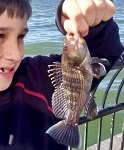 12/14 – Manhattan, HRM 2: Our Hudson River Park’s River Project staff checked our sampling and collection gear that we deploy off Pier 40 in Hudson River Park. We had a bonus in our traps today: three gorgeous young-of-year black sea bass (65-80 mm). (Photo of black sea bass courtesy of Tom Lake) 12/14 – Manhattan, HRM 2: Our Hudson River Park’s River Project staff checked our sampling and collection gear that we deploy off Pier 40 in Hudson River Park. We had a bonus in our traps today: three gorgeous young-of-year black sea bass (65-80 mm). (Photo of black sea bass courtesy of Tom Lake)
- Abby Melissen, Natalie Kim
*** Fish of the Week ***
12/15 – Hudson River Watershed: Fish-of-the-Week for Weeks 151 is the bluespotted sunfish (Enneacanthus gloriosus), number 150 (of 236) on our watershed list of fishes. If you would like a copy of our list, e-mail - trlake7@aol.com.
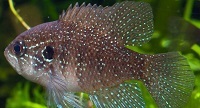 The bluespotted sunfish is one of the most beautiful fishes in New York State. The sides of their head, body, and bases of vertical fins of adult males are colored with irregularly spaced bight turquoise spots surrounded by a black ring. They are one of thirteen members of the sunfish family (Centrarchidae) in our watershed and a relative of well-known and much larger sunfish such as the largemouth and smallmouth bass. The bluespotted rarely exceeds four inches (100 mm) in length. The bluespotted sunfish is one of the most beautiful fishes in New York State. The sides of their head, body, and bases of vertical fins of adult males are colored with irregularly spaced bight turquoise spots surrounded by a black ring. They are one of thirteen members of the sunfish family (Centrarchidae) in our watershed and a relative of well-known and much larger sunfish such as the largemouth and smallmouth bass. The bluespotted rarely exceeds four inches (100 mm) in length.
The bluespotted sunfish has been designated as a freshwater fish native to the Atlantic Coast refugium that includes coastal lowlands from New York to Florida. Along that range, they inhabit shallow ponds, small lakes, and slow-moving acidic streams. They are commonly found in thick communities of aquatic plants such as Eurasian watermilfoil and various pondweeds. Their diet consists of insect larvae and small crustaceans found among these plants. Their spawning season is quite protracted, starting in late spring and lasting throughout the summer.
Locally, bluespotted sunfish are thought to be widespread in Sullivan and Rockland Counties. J.R. Greeley (1937) reported specimens from small ponds in Putnam and Westchester counties as well. Bob Schmidt found Putnam County specimens in the New York State Museum collection from the 1930s, as well as specimens from Putnam and Westchester counties, post-1970.
This Fish-of-the-Week entry was written with advice and assistance from Tom Occhiogrosso and Stephen Goodbread. We referenced their article in The Conservationist, July-August 1981. (Photo of bluespotted sunfish with permission by Tennessee Aquarium)
- Tom Lake
12/16 – Newcomb, HRM 302: The air temperature reached 58 degrees Fahrenheit today, tying the record high for the date.
- National Weather Service
12/16 – Albany, HRM 145: The air temperature reached 64 degrees Fahrenheit. today, exceeding the record high for the date by one degree.
- National Weather Service
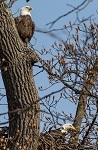 12/16 – Town of Poughkeepsie: The adults from bald eagle nest NY62 were on station today. Their white heads were glowing in the sunlight. The female was settled in the nest and the male was perched on a limb above. This perching arrangement has been the dominant one they use throughout their nesting season. 12/16 – Town of Poughkeepsie: The adults from bald eagle nest NY62 were on station today. Their white heads were glowing in the sunlight. The female was settled in the nest and the male was perched on a limb above. This perching arrangement has been the dominant one they use throughout their nesting season.
This is the start of their 2022 breeding season and the time when they will check the nest for necessary upgrades. It is common to see adults carrying new structure to their nests, from twigs to branches, shoring up the nest against the cold, hard winter winds to come. (Photo of bald eagles courtesy of Bob Rightmyer)
- Tom Lake, T.R. Jackson
12/16 – New York City: The air temperature reached 63 degrees Fahrenheit today, tying the record high for the date. National Weather Service
12/17 – Albany, HRM 145: A year ago today, a nor’easter struck the Capitol Region leaving 28.5 inches of snow, a record for the date and the fourth-most single storm amount for December.
- National Weather Service
12/17 – Saugerties Lighthouse, HRM 102: The male harbor seal was very vocal early this morning. With binoculars, we could see the seal swimming and splashing around a small rock island northwest of the Saugerties Lighthouse. He hauled out on the rock for a minute or two before returning to the water and gradually making his way toward the river channel, yelping and barking whenever he surfaced. This was Day 864.
- Patrick Landewe
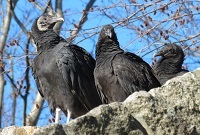 12/17 – Yorktown, HRM 46: Recently, while hiking with some friends at Sylvan Glen Park Preserve at Mohegan Lake, we spotted three black vultures standing on top of a high pile of granite blocks. Every time I have been there, I have seen at least one black vulture in the exact same spot looking down on us. They do not build a nest, but the females will lay their eggs in the rocky crevices. They were 75-feet away, but our presence did not seem to bother them. From 1890 to 1941, Sylvan Glen was an important quarry supplying granite stone for many important buildings in New York City. (Photo of black vultures courtesy of Jim Steck) 12/17 – Yorktown, HRM 46: Recently, while hiking with some friends at Sylvan Glen Park Preserve at Mohegan Lake, we spotted three black vultures standing on top of a high pile of granite blocks. Every time I have been there, I have seen at least one black vulture in the exact same spot looking down on us. They do not build a nest, but the females will lay their eggs in the rocky crevices. They were 75-feet away, but our presence did not seem to bother them. From 1890 to 1941, Sylvan Glen was an important quarry supplying granite stone for many important buildings in New York City. (Photo of black vultures courtesy of Jim Steck)
- Jim Steck
12/17 – Manhattan, New York City: While the total snowfall for Manhattan from a late-autumn blizzard, a year ago today, seemed minuscule compared to locations to the north, the 6.5 inches eclipsed the entire amount recorded for all of winter 2019 in New York City.
- National Weather Service
Fall/Winter 2021 Natural History Programs and Events
Plants and Animals of Conservation Concern: An Introduction to New York State Species Designations Thursday, January 20, 2022, 12:30-2:00 PM
(Register here)
What does it mean when a species is formally listed as endangered, threatened, special concern, or rare? And how do these legal ranks relate to the species of greatest conservation need list or the conservation status determined by the New York Natural Heritage Program? This webinar will provide an introduction to the different designations for plant and animal species in New York State, how they relate to regulatory protections, and how they are addressed in reviewing proposed projects.
Presenters:
Dr. Dan Rosenblatt, Wildlife Diversity Section Head, DEC Division of Fish and Wildlife
Nick Conrad, Information Resources Coordinator, New York Natural Heritage Program
Hudson River Miles
The Hudson is measured north from Hudson River Mile 0 at the Battery at the southern tip of Manhattan. The George Washington Bridge is at HRM 12, the Tappan Zee 28, Bear Mountain 47, Beacon-Newburgh 62, Mid-Hudson 75, Kingston-Rhinecliff 95, Rip Van Winkle 114, and the Federal Dam at Troy, the head of tidewater, at 153. The tidal section of the Hudson constitutes a bit less than half the total distance – 315 miles – from Lake Tear of the Clouds to the Battery. Entries from points east and west in the watershed reference the corresponding river mile on the mainstem.
To Contribute Your Observations or to Subscribe
The Hudson River Almanac is compiled and edited by Tom Lake and emailed weekly by DEC's Hudson River Estuary Program. Share your observations by e-mailing them to trlake7@aol.com. To subscribe to the Almanac (or to unsubscribe), use the links on DEC's Hudson River Almanac or DEC Delivers web pages.
Conservationist Magazine Holiday Promotion
 Conservationist makes a great holiday gift for the whole family, subscribe now to get six issues for only $2 - Plus, the next issue (December/January) will feature a full size 2022 calendar with beautiful nature photography from across New York State. As an added bonus, Conservationist for Kids is included three times per year. Conservationist makes a great holiday gift for the whole family, subscribe now to get six issues for only $2 - Plus, the next issue (December/January) will feature a full size 2022 calendar with beautiful nature photography from across New York State. As an added bonus, Conservationist for Kids is included three times per year.
Gift a subscription of Conservationist to your friends and family.
Useful Links
National Oceanic and Atmospheric Administration online tide and tidal current predictions are invaluable when planning Hudson River field trips. For real-time information on Hudson River tides, weather and water conditions from sixteen monitoring stations, visit the Hudson River Environmental Conditions Observing System website.
DEC's Smartphone app for iPhone and Android is now available at: New York Fishing, Hunting & Wildlife App.
|