A Project of the Hudson River Estuary Program
Compiled and edited by Tom Lake, Consulting Naturalist
Love Our NY Lands
State Lands Belong to All of Us
All New Yorkers and visitors should be able to access, enjoy, and feel welcome on state lands. These lands belong to all of us, our families, and our neighbors. While enjoying these shared spaces, be respectful of other visitors. Share trails, treat people with kindness, and leave things as you found them for others to enjoy. All of us have a responsibility to protect State lands for future generations. For more information, visit: https://www.dec.ny.gov/outdoor/119881.html
Overview
Snowy owls were featured this week continuing what has been a regular seasonal occurrence. Winter waterfowl were trickling southward although there was still plenty of open water to our north. When the first blast of Arctic winter hits southern Canada, there will be a mass exodus. On the water, we relate Part 2 of the saga of our amazing male harbor seal at Saugerties.
Highlight of the Week
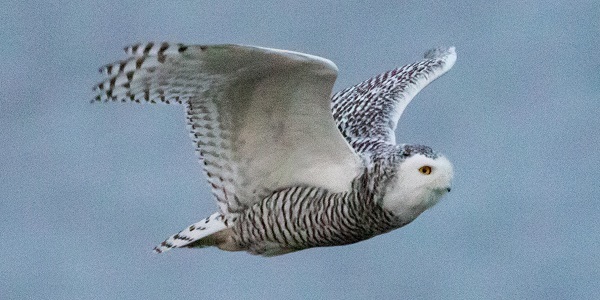
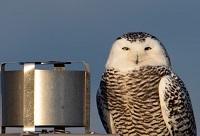 12/4 – Newburgh, HRM 61: I was scanning for uncommon gulls among the 600 that were on the Hudson River at the Newburgh waterfront when I spotted a juvenile female snowy owl with a bright white face sitting on the roof of the Newburgh-Beacon Ferry (New York Waterway). (Photo of snowy owl courtesy of Matt Zeitler) 12/4 – Newburgh, HRM 61: I was scanning for uncommon gulls among the 600 that were on the Hudson River at the Newburgh waterfront when I spotted a juvenile female snowy owl with a bright white face sitting on the roof of the Newburgh-Beacon Ferry (New York Waterway). (Photo of snowy owl courtesy of Matt Zeitler)
- Matt Zeitler
[For snowy owls, it is all about food. One way or another, that’s the motivation. Thick or thin, the strong maintain domination. The weak are forced to seek their own fate. The strongest of the weak explore new options. The weakest of the weak are left behind to employ their own devices. If there is enough food, all’s well. If not, Darwin dials up their number. Rich Guthrie]
Natural History Entries
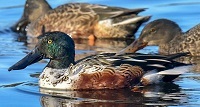 12/3 – Mohawk River, HRM 164: I found five northern shovelers late this afternoon at Wager's Pond, an inlet of the Mohawk River. I have yet to see a northern shoveler at Vischer Ferry Preserve this year, but Wager's Pond is almost there. (Photo of northern shoveler courtesy of Deborah Tracy Kral) 12/3 – Mohawk River, HRM 164: I found five northern shovelers late this afternoon at Wager's Pond, an inlet of the Mohawk River. I have yet to see a northern shoveler at Vischer Ferry Preserve this year, but Wager's Pond is almost there. (Photo of northern shoveler courtesy of Deborah Tracy Kral)
- John Hershey (Hudson-Mohawk Bird Club)
[The northern shoveler (Spatula clypeata) is quite unmistakable. Roger Tory Peterson’s A Field Guide to the Birds of Britain (1993) describes the shoveler as a “Dumpy, neckless, surface-feeding duck with a disproportionally long and spatulate bill pulling its head down.” Peterson adds that “Males have a ‘staring’ yellow eye.” Its genus, Spatula, is the Latin for a "spoon" or "spatula."
Shovelers breed in northern areas of Europe and across most of North America, wintering in the Caribbean and northern South America. In North America, they breed along the southern edge of Hudson Bay and as far south as the Great Lakes. eBird]
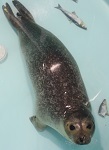 12/3 – Saugerties, HRM 102: Last week we told the story of the male harbor seal, flipper-tagged as number 246, that had chosen to reside in the vicinity of Esopus Creek at Saugerties, 113 miles from the sea, for 620 days. Then, on April 24, 2021, he mysteriously disappeared for 123 days. During those four months, our thoughts ranged from tragedy to abandonment. 12/3 – Saugerties, HRM 102: Last week we told the story of the male harbor seal, flipper-tagged as number 246, that had chosen to reside in the vicinity of Esopus Creek at Saugerties, 113 miles from the sea, for 620 days. Then, on April 24, 2021, he mysteriously disappeared for 123 days. During those four months, our thoughts ranged from tragedy to abandonment.
Then, on June 17, 44 days later, Maxine Montello, Rescue Program Director with the New York Marine Rescue Center, told us she had picked up a male harbor seal with a tag number 246 on Atlantic Beach, Nassau County, Long Island, 140 miles seaward of Saugerties. The seal was getting a lot of attention from the public, had some superficial scaring on his body, so it was decided it would be in the best interest of the seal to give him some rehabilitation.
He was transported to the Marine Rescue center in Riverhead, Suffolk County, Long Island. He stayed at the rescue center for two months and was treated for an infection as well as seal pox (a cutaneous skin condition caused by a Parapoxvirus).
On August 14, after being given a second blue tag, number 105, he was released in Hampton Bays, Suffolk County. From there he began a 210-mile journey from Hampton Bays to New York Harbor and on upriver to Saugerties, where Lighthouse Keeper Patrick Landewe welcomed him ‘home.’ As of now, his quasi-residence in freshwater at Saugerties was at 850 days. (Photo of harbor seal courtesy of Maxine Montello)
- Tom Lake
12/3 – Manhattan, HRM 2: Our Hudson River Park’s River Project staff checked our Pier 40 Hudson River sampling gear in Hudson River Park. While farther upriver, trapping fish was becoming more difficult as the river cools, in this reach of the Upper Bay of New York Harbor, our resident species were still lingering inshore. Today we caught three juvenile black sea bass (55-90 millimeters (mm)) and one young-of-year oyster toadfish (80 mm) in our collection gear.
- Natalie Kim, Zoe Kim
[One inch = 25.4 millimeters (mm)]
12/4 – Mohawk River, HRM 164: Two sandhill cranes, first spotted two days ago by John Hershey, flew out from their roost this morning, and headed eastward down the Mohawk River.
- Tom Williams (Hudson-Mohawk Bird Club)
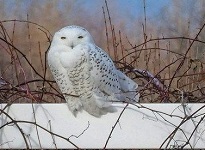 12/4 – Fort Edward, HRM 202: Two snowy owls were seen near midday today at the Fort Edwards Grasslands. The second bird was the easiest to find: it was perched at the top of a utility pole right next to Blockhouse Road. The owl seemed unperturbed by viewers with scopes; vehicular traffic just drove by. It was unknown if the owners of the house near the pole were perturbed or not. 12/4 – Fort Edward, HRM 202: Two snowy owls were seen near midday today at the Fort Edwards Grasslands. The second bird was the easiest to find: it was perched at the top of a utility pole right next to Blockhouse Road. The owl seemed unperturbed by viewers with scopes; vehicular traffic just drove by. It was unknown if the owners of the house near the pole were perturbed or not.
This snowy owl was my bird number 320 across the lower 48 states during this my first full calendar year of retirement. In my quest for bird 320, a few recently got away: a greater white-fronted goose on Collins Lake; a pink-footed goose in Wappingers Falls; a horned grebe on Basic Creek Reservoir; and a winter wren at Five Rivers Environmental Education Center in Delmar. (Photo of snowy owl courtesy of Liz Eqvandt)
- Jeffrey Schoonmaker (Hudson-Mohawk Bird Club)
[Fall and winter incursions of snowy owls are more or less regular occurrences and are thought to be caused by the low numbers of their prey, hares and lemmings, in their northern breeding areas. Succinctly put, snowy owls are circumpolar Arctic birds. In fact, their ghostlike white plumage echoes their snowy Arctic origins. Most owls in our area sleep during the day and hunt at night, but the snowy owl is often active during the day, as we discover when they make their annual winter appearances. Tom Lake]
12/4 – Town of Warwick, HRM 42-41: The 335-acre Liberty Marsh, part of the U.S. Fish and Wildlife Service’s Wallkill River National Wildlife Refuge Complex, adjacent to and near the headwaters of the Wallkill River, was noisily overflowing with dabbling ducks today: mallard, black, gadwall, common pintail, and three northern shovelers. Two rough-legged hawks were perched, a football field apart, on utility poles.
- Tom Lake
12/5 – Beacon, HRM 61: I caught, admired, and released three channel catfish and one carp during today’s fishing session on Long Dock. Two of the catfish were more sizeable (20-21 inches), ones that usually show up in the cooler water of late fall. The other catfish measured eleven inches and the carp was 14 inches.
- Bill Greene
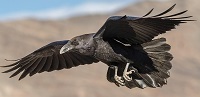 12/6 – Millbrook, HRM 82: A gusty wind blew through a grove of white pines rousting at least twenty roosting black vultures. Once black vultures are in a wind, they are elegant flyers. However, these winds were so strong that the vultures were being blown across the sky, comically bumping into each other. After a while, they were all spread, singly, across the sky, manageably kiting into the wind. (Photo of common raven courtesy of Andrew Lundt) 12/6 – Millbrook, HRM 82: A gusty wind blew through a grove of white pines rousting at least twenty roosting black vultures. Once black vultures are in a wind, they are elegant flyers. However, these winds were so strong that the vultures were being blown across the sky, comically bumping into each other. After a while, they were all spread, singly, across the sky, manageably kiting into the wind. (Photo of common raven courtesy of Andrew Lundt)
- Tom Lake, T.R. Jackson
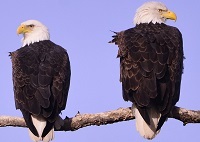 12/7 – Town of Poughkeepsie: Both adults showed up for the first time this season today at bald eagle nest NY372. One was in the nest and the other was in the air. Later, they were perched side-by-side in a nearby hardwood. It appeared to be a promising start to their sixth nesting season. (Photo of bald eagles courtesy of John Devitt) 12/7 – Town of Poughkeepsie: Both adults showed up for the first time this season today at bald eagle nest NY372. One was in the nest and the other was in the air. Later, they were perched side-by-side in a nearby hardwood. It appeared to be a promising start to their sixth nesting season. (Photo of bald eagles courtesy of John Devitt)
- John Devitt
[Among more than fifty Hudson River tidewater nests, bald eagle nest NY372 (nicknamed Tombstone) is a story of both persistence and heartache. The nest was first discovered by Dana Layton in 2015. However, it was not until the next year (2016) that the pair made their first attempt at nesting. That year was their first of three consecutive failed seasons (2016-2018). At the end of 2018, the original pair abandoned the nest.
With a vacant nest, another pair of adult eagles took over for 2019. The female of that pair had not quite reached maturity while the male was fully adult. The new pair did everything right their first year, laying and incubating eggs, conducting changeovers every few hours, but to no avail–there were no hatches for 2019. Then, in 2020, with the female now fully adult, they successfully fledged two young.
Continuing a roller-coaster series of seasons, all looked fine early last year (2021). Nesting started, incubation began, but then it stopped. By April, there were no adults in the nest–they were gone. Our guess is that something happened to the egg(s): broken, unfertilized, predation? There are always unanswered questions with abandoned bald eagle nests.
Tom Lake]
12/8 – Minerva, HRM 284: We had three inches of snow! I was out with my dog in the Back Forty around twilight and we spooked some already night-roosting wild turkeys. They took off from perches in white pines, forty feet above the ground. I followed the path of one of the wild turkeys that flew 500 yards across our old pond (now a frozen mudflat) to trees on the far side. Wild turkeys, despite their imposing size, are excellent flyers.
- Mike Corey
[“Back-forty” is a colloquial expression meant to convey wild or rough terrain adjacent to a developed area. In the instance of a farm, for example, it might be a small percentage of the land left uncultivated or natural, frequently in the “back forty acres” of the property. Tom Lake]
*** Fish of the Week ***
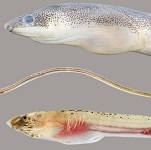 12/9 – Hudson River Watershed: Fish-of-the-Week for Week 150 is the speckled worm eel (Myrophis punctatus), number 22 (of 236) on our watershed list of fishes. If you would like a copy of our list, e-mail - trlake7@aol.com. 12/9 – Hudson River Watershed: Fish-of-the-Week for Week 150 is the speckled worm eel (Myrophis punctatus), number 22 (of 236) on our watershed list of fishes. If you would like a copy of our list, e-mail - trlake7@aol.com.
The speckled worm eel is the sole member of the snake eel family (Ophichthidae) in our watershed. They are pale brown with a fine peppering of black spots on its back and sides.
The speckled worm eel is a benthic, secretive, shallow-water, often brackish estuarine species, frequenting tidal creeks, often over mud and sandy bottoms. They can reach fifteen inches in length and are found along the Atlantic Coast through the Gulf of Mexico and south to Brazil. They are an oceanic spawner south of the Carolinas and are the only member of its genus (Myrophis) distributed outside the tropics in the Western Atlantic. Their larvae are common in the lower Chesapeake Bay in late summer and fall. However, adults are rare. (Murdy, Birdsong, Musick 1997)
Their presence on our list of fishes for the Hudson River watershed, where they are designated as a tropical marine stray, is based on two New York State Museum preserved specimens: A 226 mm juvenile caught by bottom trawl in New York Harbor in February 1984, and a 176 mm juvenile captured in the Arthur Kill in December 1991. Bob Schmidt advises that, “The paucity of specimens available for study from New York waters does not necessarily indicate that this species is rare. Speckled worm eel is difficult to catch in conventional sampling gear because it spends much of its time burrowed in bottom sediments and its small size makes it difficult to retain in netting.”
For information on the speckled worm eel, see Schmidt and Wright (2018), Documentation of Myrophis punctatus (Speckled Worm Eel) from Marine Water of New York Northeastern Naturalist, Issue 25/1. (Photo of speckled worm eel courtesy of Zachery Randall)
- Tom Lake
12/10 – Beacon, HRM 61: I caught, admired, and released two channel catfish in a four-hour fishing session today on Long Dock. The fish measured 16.5 and 17.5-inches. I had hoped for more activity as I was there for nearly all of the incoming tide, usually the most productive. However, I have to appreciate the impact of approaching winter.
- Bill Greene.
Fall/Winter 2021 Natural History Programs and Events
Hudson River Miles
The Hudson is measured north from Hudson River Mile 0 at the Battery at the southern tip of Manhattan. The George Washington Bridge is at HRM 12, the Tappan Zee 28, Bear Mountain 47, Beacon-Newburgh 62, Mid-Hudson 75, Kingston-Rhinecliff 95, Rip Van Winkle 114, and the Federal Dam at Troy, the head of tidewater, at 153. The tidal section of the Hudson constitutes a bit less than half the total distance – 315 miles – from Lake Tear of the Clouds to the Battery. Entries from points east and west in the watershed reference the corresponding river mile on the mainstem.
To Contribute Your Observations or to Subscribe
The Hudson River Almanac is compiled and edited by Tom Lake and emailed weekly by DEC's Hudson River Estuary Program. Share your observations by e-mailing them to trlake7@aol.com. To subscribe to the Almanac (or to unsubscribe), use the links on DEC's Hudson River Almanac or DEC Delivers web pages.
Conservationist Magazine Holiday Promotion
 Conservationist makes a great holiday gift for the whole family, subscribe now to get six issues for only $2 - Plus, the next issue (December/January) will feature a full size 2022 calendar with beautiful nature photography from across New York State. As an added bonus, Conservationist for Kids is included three times per year. Conservationist makes a great holiday gift for the whole family, subscribe now to get six issues for only $2 - Plus, the next issue (December/January) will feature a full size 2022 calendar with beautiful nature photography from across New York State. As an added bonus, Conservationist for Kids is included three times per year.
Gift a subscription of Conservationist to your friends and family.
Useful Links
National Oceanic and Atmospheric Administration online tide and tidal current predictions are invaluable when planning Hudson River field trips. For real-time information on Hudson River tides, weather and water conditions from sixteen monitoring stations, visit the Hudson River Environmental Conditions Observing System website.
DEC's Smartphone app for iPhone and Android is now available at: New York Fishing, Hunting & Wildlife App.
|