A Project of the Hudson River Estuary Program
Compiled and edited by Tom Lake, Consulting Naturalist
Love Our NY Lands
State Lands Belong to All of Us
All New Yorkers and visitors should be able to access, enjoy, and feel welcome on state lands. These lands belong to all of us, our families, and our neighbors. While enjoying these shared spaces, be respectful of other visitors. Share trails, treat people with kindness, and leave things as you found them for others to enjoy. All of us have a responsibility to protect State lands for future generations. For more information, visit: https://www.dec.ny.gov/outdoor/119881.html
Overview
As we paid homage to Thanksgiving, the Hudson River Almanac became a two-week edition.
The days were replete with several Highlight-of-the-Week candidates including a rare goose, a very uncommon seabird, a shadow from the long past, a rare lunar eclipse, an endangered whale species in the East River, and a plea to keep watch for sea turtles.
Highlight of the Week
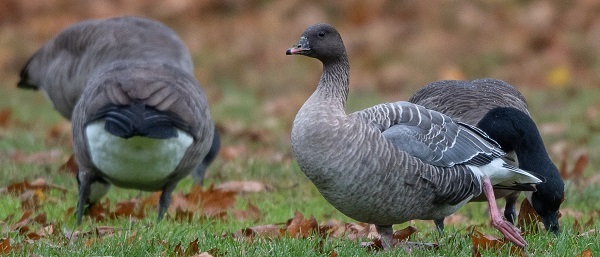
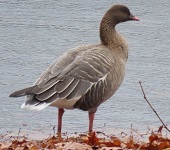 11/26 – Wappingers Falls, HRM 62: In an extraordinary find, we came upon a pink-footed goose on Wappingers Lake within a flock of no fewer than 50 Canada geese. Our quick reporting allowed many others to see this special visitor. For many, it was a “life bird.” (Photo of pink-footed goose courtesy of Debbie Van Zyl) 11/26 – Wappingers Falls, HRM 62: In an extraordinary find, we came upon a pink-footed goose on Wappingers Lake within a flock of no fewer than 50 Canada geese. Our quick reporting allowed many others to see this special visitor. For many, it was a “life bird.” (Photo of pink-footed goose courtesy of Debbie Van Zyl)
- Anne Swaim (Saw Mill River Audubon), Debbie Van Zyl (R.T. Waterman Bird Club)
[The pink-footed goose (Anser brachyrhynchus) breeds in Eastern Greenland, from where North American sightings are presumed to originate, as well as Iceland and Svalbard [Norway]. They winter in northwest Europe and are a rare visitor to the northeast. However, in recent years, pink-footed goose sightings have been increasing in northeastern North America with reports from Quebec, Newfoundland, Maine, Massachusetts, and New York. Since 2007, one has been seen almost every year in New York State usually on Long Island. Their presence mirrors a similar increase of other Eurasian goose species in our area such as barnacle goose and greater white-fronted goose. Stan DeOrsey, Deborah Tracy Kral (R.T. Waterman Bird Club)]
[A “life bird” or a “life list” is a common activity for many naturalists. Typically, these are compilations of related species, like postcards from one’s travels through life. Some people keep bird lists; for others, it is fish, flowers, butterflies, mushrooms, seashells … Anyone can keep a list of almost anything that ultimately gives them a context and appreciation for the natural world. Tom Lake]
Natural History Entries
11/12 – Manhattan, HRM 2: Last week, when our Hudson River Park’s River Project staff checked the sampling and collection gear that we deploy off Pier 40 in Hudson River Park, our catch was as exciting as it was consistent: black sea bass (80-90 millimeters (mm)) and adult tautog (260-300 mm).
- Olivia Radick, Natalie Kim, Yaritza Morales, Helena Kilburn, Zoe Kim
[One inch = 25.4 millimeters(mm)].
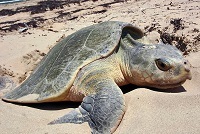 11/12 – Hudson River Estuary/New York Bight: With freezing weather and the cold-water season upon us (water temperatures falling below 50 degrees Fahrenheit (F)), please keep an eye out for stranded sea turtles. Those that have not yet migrated south can become victims of paralyzing “cold stunning,” which is similar to hypothermia. It gives them the appearance of death, but they are actually in dire need of recovery and resuscitation. Do not put them back in the water. 11/12 – Hudson River Estuary/New York Bight: With freezing weather and the cold-water season upon us (water temperatures falling below 50 degrees Fahrenheit (F)), please keep an eye out for stranded sea turtles. Those that have not yet migrated south can become victims of paralyzing “cold stunning,” which is similar to hypothermia. It gives them the appearance of death, but they are actually in dire need of recovery and resuscitation. Do not put them back in the water.
From November through March, we respond to dozens of sea turtles that are found cold-stunned onshore and in our waters at the mercy of the tides and currents. If you come upon a sea turtle, whether you think it's alive or dead, immediately call the New York State Stranding Hotline at (631) 369-9829. If you have photos or videos, please send them to sightings@amseas.org. Learn more information at: https://go.usa.gov/xeWTs (Photo of Kemp's Ridley Sea Turtle courtesy of NOAA)
- Kim Durham, Co-New York State Sea Turtle Coordinator for the Atlantic Marine Conservation Society
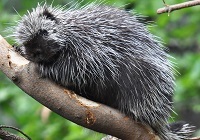 11/13 – West Hurley, HRM 97: During our John Burroughs Natural History Society’s annual Waterfowl Field Trip, we were pleasantly surprised by the appearance of several unexpected mammalian species. We had a porcupine (Erethizon dorsatum) snoozing in an oak tree near the Ashokan Reservoir, which we pointed out to several passing youngsters who had never before seen one in its natural habitat. We shared their excitement! We also enjoyed a swimming and diving river otter in a pond in the vicinity—probably a denizen of Esopus Creek. 11/13 – West Hurley, HRM 97: During our John Burroughs Natural History Society’s annual Waterfowl Field Trip, we were pleasantly surprised by the appearance of several unexpected mammalian species. We had a porcupine (Erethizon dorsatum) snoozing in an oak tree near the Ashokan Reservoir, which we pointed out to several passing youngsters who had never before seen one in its natural habitat. We shared their excitement! We also enjoyed a swimming and diving river otter in a pond in the vicinity—probably a denizen of Esopus Creek.
Unusually mild autumn appears to have postponed some of the water birds’ migration times and we had lower numbers and species variety than in years past. Among the birds we enjoyed observing were ring-necked duck, American black duck, both common and hooded mergansers, common loon, horned grebe, and bufflehead. Others included bald eagles and belted kingfishers. Another highlight was a pair of small Bonaparte’s gulls mingling with a large group of herring gulls and some of our ubiquitous ring-billed gulls. (Photo of North American porcupine courtesy of Smithsonian)
- Deb Weltsch
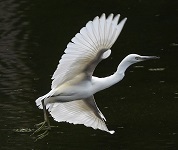 11/13 – Croton-on-Hudson, HRM 35: Out of time-and-tide necessity, this was an early morning arrival on the beach. The river was calm and cold (54 F). However, the National Weather Service was issuing afternoon storm warnings for thunder, lightning, large hail, and strong winds. With yesterday’s Hudson Valley tornados in mind, we hustled along with our hauls with limited late-season expectations. After a few empty landings, we were thrilled to see a near-net-full of Atlantic silverside (61-64 mm), as well as a handful of young-of-year striped bass (65-74 mm) and shore shrimp (Palaemon sp.). The salinity was very low for late autumn at 1.5 parts-per-thousand (ppt). (Photo of little blue heron courtesy of Deborah Tracy Kral) 11/13 – Croton-on-Hudson, HRM 35: Out of time-and-tide necessity, this was an early morning arrival on the beach. The river was calm and cold (54 F). However, the National Weather Service was issuing afternoon storm warnings for thunder, lightning, large hail, and strong winds. With yesterday’s Hudson Valley tornados in mind, we hustled along with our hauls with limited late-season expectations. After a few empty landings, we were thrilled to see a near-net-full of Atlantic silverside (61-64 mm), as well as a handful of young-of-year striped bass (65-74 mm) and shore shrimp (Palaemon sp.). The salinity was very low for late autumn at 1.5 parts-per-thousand (ppt). (Photo of little blue heron courtesy of Deborah Tracy Kral)
- Tom Lake, A. Danforth
11/13 – Croton River, HRM 34: I enjoyed watching an immature little blue heron perched in a riverside mulberry tree where the Croton River meets Croton Bay. After a while, a mob of fish crows landed in the tree, and that was that—the little blue heron flew away.
The return of the Troglodytes was upon us! The air seemed filled with migrating winter wrens (Troglodytes hiemalis), foraging as they traveled. It was not a good time to be a spider.
- Christopher Letts
11/14 – Bedford, HRM 35: Among the 18 south-migrating raptors today at the Bedford Audubon Chestnut Ridge Hawkwatch, red-shouldered hawk was high count with eleven; sharp-shinned hawk was next with five. Turkey vulture (55) dominated the overall count.
- Richard Aracil, Karen Troche, Pedro Troche
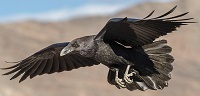 11/14 – Hook Mountain, HRM 31: We counted 15 south-migrating raptors at the Hook Mountain Hawkwatch today. Bald eagle was high count with seven; sharp-shinned was next with four. Turkey vultures (2) took a day off. (Photo of common raven courtesy of Andrew Lunt) 11/14 – Hook Mountain, HRM 31: We counted 15 south-migrating raptors at the Hook Mountain Hawkwatch today. Bald eagle was high count with seven; sharp-shinned was next with four. Turkey vultures (2) took a day off. (Photo of common raven courtesy of Andrew Lunt)
- Felicia Napier, Carl Howard, Vince Plogar
11/15 – Bedford, HRM 35: Among the 14 south-migrating raptors today at the Bedford Audubon Chestnut Ridge Hawkwatch, sharp-shinned hawk was high count with five; red-shouldered hawk was next with three. Once again, turkey vulture (50) dominated the overall count. Other non-raptor migrants included eastern bluebird (252).
- Richard Aracil, Kevin McGrath
11/15 – Hook Mountain, HRM 31: We counted five south-migrating raptors at the Hook Mountain Hawkwatch today. Northern harrier and red-tailed hawk led with two each. We saw one of the harriers go after a red-tailed hawk. The highlight was a migrating flock of common ravens (including a group of seven) playing with each other, some of them flying upside down.
- Ari Weiss, Raimund Miller
11/15 – Manhattan, HRM 2: Hudson River Park’s River Project staff checked the sampling and collection gear that we deploy off Pier 40 in Hudson River Park. Two black sea bass (50-90 mm) and one adult tautog (320 mm) were waiting for us in our traps today.
- Toland Kister, Siddhartha Hayes, Natalie Kim
1/15 – Yonkers, HRM 18: The staff at the Sarah Lawrence Center for the Urban River at Beczak split our seine hauls today between the river (3) and Beczak’s tidemarsh (2). Mummichogs (8) and grass shrimp (10) were the marsh highlights. River fish included Atlantic silverside and young-of-year striped bass (65 mm). The river was 53 F, salinity was 2.0 ppt, and dissolved oxygen (DO) was 9.5 ppm.
- Jason Muller, Michael Castro
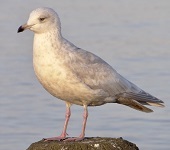 11/16 – Beacon, HRM 61: An early-morning visit to the Beacon waterfront immediately delivered two excellent gull species: Iceland gull and lesser black-backed gull. We then moved a short distance to Long Dock to look for migrant birds heading down the valley. It was not long (7:39 AM) before Debbie Van Zyl spotted a large sea bird flying down the river. We recognized the bird as a booby-gannet (Sulide family). It was moving quickly, and at a distance, so certain identification was not possible. We took photos and later reviewed them to discover that it was an immature northern gannet (Morus bassanus). Debbie posted the sighting in one of the local rare-bird group chats, which encouraged two Manhattan birders to head to the river, fifty miles south, at the George Washington Bridge. (Photo of Iceland gull courtesy of Kurt McDermott) 11/16 – Beacon, HRM 61: An early-morning visit to the Beacon waterfront immediately delivered two excellent gull species: Iceland gull and lesser black-backed gull. We then moved a short distance to Long Dock to look for migrant birds heading down the valley. It was not long (7:39 AM) before Debbie Van Zyl spotted a large sea bird flying down the river. We recognized the bird as a booby-gannet (Sulide family). It was moving quickly, and at a distance, so certain identification was not possible. We took photos and later reviewed them to discover that it was an immature northern gannet (Morus bassanus). Debbie posted the sighting in one of the local rare-bird group chats, which encouraged two Manhattan birders to head to the river, fifty miles south, at the George Washington Bridge. (Photo of Iceland gull courtesy of Kurt McDermott)
- Kyle Bardwell. Debbie van Zyl
[Northern gannets are rare in Dutchess County. We had one in 1968 and another in 1986, both in October. The latter sighting was from Long Dock in Beacon. Barbara Butler]
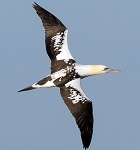 11/16 – Manhattan, HRM 11: We were able to find the Kyle Bardwell-Debbie van Zyl northern gannet at 9:38 AM as it flew past the George Washington Bridge, two hours after it was first seen at Beacon. 11/16 – Manhattan, HRM 11: We were able to find the Kyle Bardwell-Debbie van Zyl northern gannet at 9:38 AM as it flew past the George Washington Bridge, two hours after it was first seen at Beacon.
It all began as we spotted a bald eagle and another bird in flight across the river above the Palisades. The accompanying bird was very large and lanky, somewhat recalling a loon, especially in wing shape, but with a longer tail, no feet projecting, and a different bill shape. It was clearly a Sulid and instantly recognized as an immature northern gannet. The bird’s flight was steady with fairly deep but deliberate and powerful wing beats. (Photo of Northern gannet courtesy of eBird)
- Adrian Burke and Dmitriy Aronov
[Northern gannet is a goose-sized albatross-like seabird nearly always seen over the ocean, rarely venturing inland except to breed. They are birds of the cold North Atlantic, with breeding colonies in the far northeastern Canadian Maritimes. They dive like pelicans or osprey when feeding; author David Sibley describes their entry as “piercing the water,” with a minimum splash, like an Olympic swimmer executing the perfect dive. - Tom Lake]
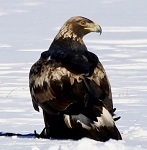 11/16 – Bedford, HRM 35: Among the 35 south-migrating raptors today at the Bedford Audubon Chestnut Ridge Hawkwatch, red-shouldered hawk was high count with twelve; bald eagle was next with five. Today’s golden eagle gave us 15 for the season, one shy of our seasonal record. During the time the golden eagle was in view, there were two other eagles seen chasing and dive-bombing each other; they may also have been golden eagles but were too far away to make a confident identification. Turkey vulture (59) and black vulture (five) dominated the overall count. Non-raptor migrants included common grackle (1,200). (Photo of golden eagle courtesy of Justin Schmidt) 11/16 – Bedford, HRM 35: Among the 35 south-migrating raptors today at the Bedford Audubon Chestnut Ridge Hawkwatch, red-shouldered hawk was high count with twelve; bald eagle was next with five. Today’s golden eagle gave us 15 for the season, one shy of our seasonal record. During the time the golden eagle was in view, there were two other eagles seen chasing and dive-bombing each other; they may also have been golden eagles but were too far away to make a confident identification. Turkey vulture (59) and black vulture (five) dominated the overall count. Non-raptor migrants included common grackle (1,200). (Photo of golden eagle courtesy of Justin Schmidt)
- Richard Aracil, Kate Branch, Pedro Troche
11/16 – Yonkers, HRM 18: Much of our catch today at the Sarah Lawrence Center for the Urban River at Beczak was invertebrates, among them tiny blue crabs (10 mm), sand shrimp (14), and grass shrimp (20). High count among fishes was young-of-year striped bass (95 mm), and mummichog (80 mm). The river was 53 F, salinity was 2.02 ppt, and DO was 9.52 ppm.
- Jason Muller, Anna Mitchell, Ishika Joshi, Rebecca Wilson
[Blue crab measurements (size) are taken in millimeters (mm) point-to-point across their carapace. Tom Lake]
11/17 – Bedford, HRM 35: Among the 35 south-migrating raptors today at the Bedford Audubon Chestnut Ridge Hawkwatch, red-shouldered hawk was high count with 27; Cooper’s hawk was next with three. Turkey vulture (47) and black vulture (three) again dominated our count. Eight southbound common loons were a nice surprise.
- Richard Aracil
11/17 – Yonkers, HRM 18: Today’s catch at the Sarah Lawrence Center for the Urban River at Beczak displayed excellent species diversity among fishes and invertebrates. Our staff made five seine hauls in the river resulting in five fish species: bay anchovy, Atlantic silverside, mummichog, white perch, and young-of-year striped bass (100 mm). Among invertebrates were tiny blue crabs (10 mm), sand shrimp, and grass shrimp. The river temperature was 54 F, the salinity was 2.44 ppt, and the DO was 9.2 ppm.
- Jason Muller, Raven Vance
11/17 – Manhattan, HRM 2: Hudson River Park’s River Project staff checked our Pier 40 sampling gear in Hudson River Park. Today, we collected three gorgeous black sea bass (60-80 mm) and one oyster toadfish (80 mm).
- Natalie Kim, Zoe Kim
11/18 – Schuylerville, HRM 186: I found a cackling goose (Branta hutchinsii) at Hudson Crossing Park in Schuylerville today (easily identifiable by being much smaller). It was with 100 Canada geese in the canal well upstream of Lock 4. I couldn't find anything else different (species) among the many more Canadas near the lock.
- Gregg Recer
11/18 – Little Stony Point, HRM 55: Seven of us gathered on the beach this afternoon to watch the sunset behind Crow’s Nest a full 30 minutes ahead of schedule. Behind us, over Mount Taurus, the full moon was rising. As usual, the ambiance at this beach in the Hudson Highlands, in the late-day shadow of Storm King, was captivating. Fishing seemed almost an afterthought as we set our seine hoping for a good catch but expecting little. A half-dozen empty hauls up the beach, netting nothing, encouraged us to switch tactics. Seining down the beach, into the current, collected a net full of spottail shiners and young-of-year striped bass (72-78 mm). The river was a chilly 51 F.
Finishing up, we heard ravens on Mount Taurus calling loudly, and we could feel that this was sundown on seining for the season; there may be more days, but we had seen the best of it.
- Tom Lake, Peter Dinitz, Ellie Dinitz, Seth Dinitz, T.R. Jackson, B.J. Jackson, Phyllis Lake
11/18 – Hook Mountain, HRM 31: After a slow start, we managed eight south-migrating raptors at the Hook Mountain Hawkwatch today. Golden eagle and red-shouldered hawk shared high count with two each. The 2-3 PM hour was the best with two golden eagles within 20 minutes: an adult at 2:20 PM and a sub-adult at 2:35 PM. The adult flew toward the sun, so our view was aborted, but the sub-adult was in view for five minutes and was well seen with its golden nape lighting up the sky. Turkey vulture (14) and black vulture (three) bolstered our overall numbers.
- Trudy Battaly, Drew Panko, Raimund Miller
11/18 – Yonkers, HRM 18: Young-of-year striped bass (80 mm) made a big push heading seaward today at the Sarah Lawrence Center for the Urban River at Beczak. Others in the net included Atlantic silverside, mummichog, as well as tiny (20 mm) blue crabs, and dime-sized moon jellyfish. The water in the Beczak Tidemarsh was 53 F, the salinity was 2.38 ppt, and the DO was 9.92 ppm.
- Jason Muller, Bella Biane, Diane McKay
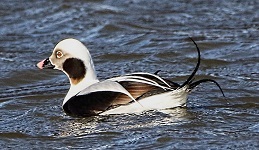 11/19 – Saratoga County, HRM 194-191: We checked out the Hudson River mainly from the Route 4 bridge to the north of Fort Miller hoping to find migrating ducks. We didn't have much luck but did find one long-tailed duck above the falls. Right before dark, we found a northern shrike on the west side of the River in Northumberland not far from Fort Miller. (Photo of long-tailed duck courtesy of Terry Hardy) 11/19 – Saratoga County, HRM 194-191: We checked out the Hudson River mainly from the Route 4 bridge to the north of Fort Miller hoping to find migrating ducks. We didn't have much luck but did find one long-tailed duck above the falls. Right before dark, we found a northern shrike on the west side of the River in Northumberland not far from Fort Miller. (Photo of long-tailed duck courtesy of Terry Hardy)
- John Hershey, Ron Harrower (Hudson-Mohawk Bird Club)
[The long-tailed duck (Clangula hyemalis) is uncommon in the watershed and seen primarily in migration. They breed in Arctic tundra pools, marshes, in large mountain lakes, and winter on the Great Lakes and along the east coast of North America. The former common name for the long-tailed duck was oldsquaw. Although that name is still found in old field guides, it was dropped from common usage more than a decade ago in favor of long-tailed duck. This was done for several reasons, among which was the negative connotation of the English word and its offensive reference to Native Americans. Tom Lake]
 11/19 – Albany, HRM 145: Much of the Hudson Valley was cloudy for tonight’s very unusual partial eclipse of the Full Beaver Moon. We got great glimpses through open patches of sky at near totality (97 % covered at 4:03 AM). As the moon entered the full shadow of the earth (Umbra) all the sunsets around the world turned the moon’s face a ruddy red. Beautiful! (Photo of lunar eclipse courtesy of Robert Hall) 11/19 – Albany, HRM 145: Much of the Hudson Valley was cloudy for tonight’s very unusual partial eclipse of the Full Beaver Moon. We got great glimpses through open patches of sky at near totality (97 % covered at 4:03 AM). As the moon entered the full shadow of the earth (Umbra) all the sunsets around the world turned the moon’s face a ruddy red. Beautiful! (Photo of lunar eclipse courtesy of Robert Hall)
- Mario Meier
[More details from astronomer Bob Berman: This was the longest partial lunar eclipse within a stretch of 1,000 years, more than six hours in total. The last time a partial lunar eclipse lasted that long was in the year A.D. 1440 when the Incas were building Machu Picchu. The next occurrence will be on February 8, 2669. Mario Meier]
11/19 – Hook Mountain, HRM 31: We counted nine south-migrating raptors at the Hook Mountain Hawkwatch today. Red-tailed hawk was high count with five; red-shouldered hawk was next with two. We spotted a non-migrating peregrine falcon kiting into the wind. We did see an “osprey” today, although it was not a bird. It was a Boeing Bell V-22 Osprey far to the north looking very peculiar with huge propellers at the ends of its wings.
- Ajit I. Antony, Liza Antony
11/19 – Manhattan, HRM 2: Hudson River Park’s River Project staff checked the sampling and collection gear that we deploy off Pier 40 in Hudson River Park. One blackfish-tautog (310 mm) and one tiny blue crab (10 mm) were waiting inside our traps. We also had a winter flounder in one of our traps that unfortunately fell back into the river before we were able to bring the crab pot up to the pier.
- Toland Kister, Olivia Radick
11/21 – Saugerties, HRM 102: The male harbor seal, flipper-tagged 246, made an appearance in the early afternoon at the mouth of Esopus Creek. For this marine mammal, this was Day 838 in the freshwater vicinity of Saugerties, 113 miles from the sea.
- Patrick Landewe
11/21 – Beacon, HRM 61: I caught and released four channel catfish and a small carp in a four-hour fishing session today. The channel catfish ranged from 14 to 24 inches long. The carp measured 14 inches. Although I've come to expect that the channel catfish would be actively feeding well into the Fall, it is always nice to see it hold true each year.
- Bill Greene
11/21 – Bedford, HRM 35: Among the 16 south-migrating raptors today at the Bedford Audubon Chestnut Ridge Hawkwatch, red-shouldered hawk was high count with 13; sharp-shinned hawk was next with two. While turkey vultures (41) migrated as a slow trickle, they still dominated the overall count.
- Richard Aracil
11/22 – Yonkers, HRM 18: Young-of-year striped bass, all about 90 mm, dominated our catch again today at the Sarah Lawrence Center for the Urban River at Beczak. There was very little else with one each blue crab, white perch, and Atlantic silverside. The river was 51 F, the salinity was 2.5 ppt, and the DO was a healthy 10.1 ppm.
- Jason Muller, Eli Caref
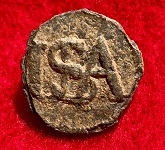 11/23 – Town of Poughkeepsie: Recently, Scott Davis was hiking along the tidewater Wappinger Creek when he noticed a small, round metal button in the talus of an eroding bank. We cleaned it up and did some preliminary research on the button before seeking a professional opinion. Dr. Michael Lucas, a historical archaeologist at the New York State Museum, in confirming our thoughts said, “This was a Revolutionary War [rife in our area] Army shank button (1775-1783). There were several varieties that were produced, some in pewter, and I would imagine this would have been an ordinary soldier rather than an officer.” (Photo of Colonial uniform button courtesy of Tom Lake) 11/23 – Town of Poughkeepsie: Recently, Scott Davis was hiking along the tidewater Wappinger Creek when he noticed a small, round metal button in the talus of an eroding bank. We cleaned it up and did some preliminary research on the button before seeking a professional opinion. Dr. Michael Lucas, a historical archaeologist at the New York State Museum, in confirming our thoughts said, “This was a Revolutionary War [rife in our area] Army shank button (1775-1783). There were several varieties that were produced, some in pewter, and I would imagine this would have been an ordinary soldier rather than an officer.” (Photo of Colonial uniform button courtesy of Tom Lake)
- Tom Lake
[Historical context can create an image of that Colonial-era when soldiers wore buttons on their uniforms and residents tried to save a bit of normalcy in the face of war: Flowers were blooming, birds were migrating, the forest was filled with wildlife, and fish were swimming in the Hudson River. Howard Breslin’s historical fiction, Shad Run (1955) is of that era.
Breslin takes you into the social setting of the time when the river was at our front door providing sustenance for our communities. Poughkeepsie rivermen were marking the rise and fall of the tides, measuring the moment to set their nets for shad, in from the sea to spawn, and then drift the down tide under the stars, hardly different from what we did not 25 years ago. Each spring, fish camps opened along the river full of promise with garlands of mended gill nets hung on clotheslines. All the while they anxiously kept watch for the possibility of English warships. Across the river at Blue Point, Colonial militia, with buttons on their waistcoats, kept an early warning lookout (the British burned Kingston in 1777). Tom Lake]
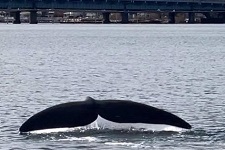 11/23 – Bronx-Queens, New York City: An angler reported spotting and photographing a North Atlantic Right Whale in the East River today near the Throgs Neck Bridge, where the East River meets Long Island Sound. 11/23 – Bronx-Queens, New York City: An angler reported spotting and photographing a North Atlantic Right Whale in the East River today near the Throgs Neck Bridge, where the East River meets Long Island Sound.
- Tom Lake
[The North Atlantic right whale (Eubalaena glacialis) is a baleen whale. Because of their docile nature, their slow surface-skimming feeding behaviors, their tendencies to stay close to the coast, and their high blubber content (which makes them float when they are killed, and which produces high yields of whale oil), right whales were once a preferred target for whalers. At present, they are among the most endangered whales in the world and are protected under the U.S. Endangered Species Act (1973), Marine Mammal Protection Act, and Canada's Species at Risk Act. There are fewer than 366 individuals in existence, the lowest number in twenty years (there were an estimated 481 whales in 2011).
In the western North Atlantic Ocean, they migrate between feeding grounds in the Labrador Sea and their winter calving areas off Georgia and Florida, an ocean area with heavy shipping traffic. Vessel strikes and entanglement in fixed fishing gear, which together account for nearly half of all North Atlantic right whale mortality since 1970, are their two greatest threats to recovery. National Marine Fisheries Service, NOAA, Canadian Science Advisory, World Wildlife Fund]
11/24 – Green Island, HRM 153: We were at the head of tide, that magical interface where the sea meets the uplands. Then we almost missed them—two drake red-breasted mergansers were tucked inshore in calm water almost out of sight below the Green Island Power Authority’s hydro-power plant. While these birds are generally uncommon along the estuary the farther from the sea you go, it has not been rare to find one here in migration in early winter, 164 miles from the open ocean. (Photo of North Atlantic right whale courtesy of John Waldman)
- Tom Lake, A. Danforth
*** Fish of the Week ***
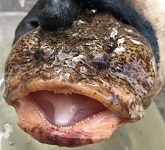 11/25 – Hudson River Watershed: Fish-of-the-Week for Weeks 147-148 is the oyster toadfish (Opsanus tau), number 113 (of 236) on our watershed list of fishes. If you would like a copy of our list, e-mail - trlake7@aol.com. 11/25 – Hudson River Watershed: Fish-of-the-Week for Weeks 147-148 is the oyster toadfish (Opsanus tau), number 113 (of 236) on our watershed list of fishes. If you would like a copy of our list, e-mail - trlake7@aol.com.
Oyster toadfish, known colloquially as “oyster cracker,” can get to 17 inches long, range from Cape Cod to Florida, and are common along the Atlantic Coast and in New York Harbor. They are quite a handsome fish and are so admired by anglers that they have been lovingly dubbed the “mother-in-law” fish.
They set up shop on the bottom of the river and, with strong jaws and sharp teeth, they crush and feed on shellfish such as crabs, oysters, and other bivalves. While they are most often found in salt or brackish water, they can tolerate low salinity and even freshwater for a short time. Archaeological evidence (toadfish bones) found in hearths and middens on Dogan Point (river mile 40) suggests that indigenous peoples enjoyed eating oyster toadfish as well. (Photo of oyster toadfish courtesy of Toland Kister)
- Tom Lake
Fall/Winter 2021 Natural History Programs and Events
Webinar: Protecting Wildlife Habitat through Land Use Planning
Wednesday, December 7, 1:00-2:30 PM
(Register here)
Our presenters will draw on two decades of socioecological research experience to discuss best practices for protecting wildlife and habitat through conservation development. They will share regional studies that demonstrate why such practices are needed, the type and quality of existing protection mechanisms in Northeast land-use codes and ordinances, factors associated with success or failure to implement conservation design principles, and critical areas for future research.
Presenters:
Dr. Michale Glennon, Science Director at Paul Smith's College Adirondack Watershed Institute Dr. Heidi Kretser, Senior Conservation Social Scientist at the Wildlife Conservation Society
Funding Available for Hudson River Fish Advisory Outreach Initiative
Fish are an important part of a healthy diet, containing high quality protein, essential nutrients, healthy fish oils, and low saturated fat. However, fish in some New York water bodies contain chemicals at levels that may be harmful to health. To help people make healthier choices about which fish to eat, the New York State Department of Health (NYSDOH) issues advice about eating fish you catch. One of the water bodies for which NYSDOH has fish advisories is the Hudson River.
The Hudson River Fish Advisory Outreach Project’s goal is for all Hudson fish and blue crab consumers know about, understand, and follow the NYSDOH advisories. To this end, Health Research, Inc. and NYSDOH announce the availability of a total of $90,000 per year to develop partnerships with local groups. Applications for funding must serve populations that fish or are likely to eat fish from the Hudson River in Albany, Bronx, Columbia, Dutchess, Greene, New York, Orange, Putnam, Rensselaer, Rockland, Saratoga, Ulster, Washington, and/or Westchester counties. Priority audiences are women under 50 (childbearing years), families with children under 15, minority, low-income, low-literacy, and limited-English proficiency individuals.
Maximum awards are for $15,000 a year. Government entities and community based not-for-profit organizations are eligible to apply. Applications are due December 1, 2021. For details, visit the project’s Request for Applications website.
- Audrey Vangenechten, NYS Department of Health
Hudson River Miles
The Hudson is measured north from Hudson River Mile 0 at the Battery at the southern tip of Manhattan. The George Washington Bridge is at HRM 12, the Tappan Zee 28, Bear Mountain 47, Beacon-Newburgh 62, Mid-Hudson 75, Kingston-Rhinecliff 95, Rip Van Winkle 114, and the Federal Dam at Troy, the head of tidewater, at 153. The tidal section of the Hudson constitutes a bit less than half the total distance – 315 miles – from Lake Tear of the Clouds to the Battery. Entries from points east and west in the watershed reference the corresponding river mile on the mainstem.
To Contribute Your Observations or to Subscribe
The Hudson River Almanac is compiled and edited by Tom Lake and emailed weekly by DEC's Hudson River Estuary Program. Share your observations by e-mailing them to trlake7@aol.com. To subscribe to the Almanac (or to unsubscribe), use the links on DEC's Hudson River Almanac or DEC Delivers web pages.
Discover New York State
The Conservationist, the award-winning, advertisement-free magazine focusing on New York State's great outdoors and natural resources. The Conservationist features stunning photography, informative articles and around-the-state coverage. Visit The Conservationist webpage for more information.
Useful Links
National Oceanic and Atmospheric Administration online tide and tidal current predictions are invaluable when planning Hudson River field trips. For real-time information on Hudson River tides, weather and water conditions from sixteen monitoring stations, visit the Hudson River Environmental Conditions Observing System website.
DEC's Smartphone app for iPhone and Android is now available at: New York Fishing, Hunting & Wildlife App.
|