
Amphibian Migrations - Update and Tomorrow's Forecast
The New York State Department of Environmental Conservation sent this bulletin on 03/30/2021 05:21 PM EDT |
| DEC Delivers - Information to keep you connected and informed from the NYS Department of Environmental Conservation |
| Share or view as a web page || Update preferences or unsubscribe |
Amphibian Migrations and Road CrossingsA Project of the NYSDEC Hudson River Estuary Program and Cornell University |
|
What an incredible month of migration! And it's not over yet. March Migration Update In the Hudson River estuary watershed, migrating amphibians have been observed from the lower reaches of the valley up to the Capital District. Peak activity was recorded by AM&RC volunteers on the nights of March 18 and March 24, with continuing movement observed on March 28. There are lots of numbers to crunch from the 200+ data forms submitted this month, so stay tuned for a more detailed account!
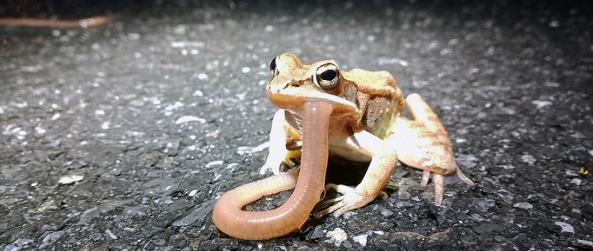
This wood frog paused during migration to snack on one of the many worms that were also lured by the rain. Photographed on March 24, 2021 in Town of Esopus (Ulster County) by C. Gentry Moving (Crawling, Hopping) Forward What can you expect in the coming week? Wood frogs are calling from breeding pools, and if you have a chance to peer into the water, you might see salamander spermatophores and egg masses from wood frogs, spotted salamanders, and Jefferson/blue-spotted salamander complex. For tips on egg mass identification, check out the "Signs of Pool Breeding" on the backside of our Woodland Pool Wildlife photo identification guide. With today's sunshine and tomorrow's forecast for a warm, rainy afternoon and evening, the conditions look promising for more migration tomorrow night (March 31). Depending on where you live in the watershed, you may see fewer wood frogs on the move, as their breeding is well underway, but still may witness later-arriving or departing salamanders. You will likely continue to see common species that aren't "obligate" woodland pool breeders (i.e., they breed in a variety of wetlands and waterbodies) such as spring peeper, American toad, gray tree frog, and red-spotted newt. Time will tell, and we look forward to hearing what AM&RC volunteers observe! Thank you all for keeping safe, helping amphibians on their journeys, and sharing your data for the AM&RC Project! After several years with erratic weather, hard-to-predict migrations, or activity that occurred in the wee hours, 2021 is already shaping up to be a stellar year for seeing lots of amphibian diversity and helping during this critical phase of their life cycles. Best regards, Laura Heady Check out our new website! Conservation Planning in the Hudson River Estuary Watershed The Amphibian Migrations & Road Crossings Project is part of a larger effort to partner with local communities to conserve forests, wetlands, and natural areas that sustain the health and resiliency of the entire estuary watershed. |
|
The New York State Department of Environmental Conservation respects your right to privacy and welcomes your feedback | Update preferences or unsubscribe | Learn more about DEC Delivers |
|
Connect with DEC:    
|
|
| Basil Seggos, Commissioner | |