A Project of the Hudson River Estuary Program
Compiled and edited by Tom Lake, Consulting Naturalist
COVID-19 Guidance for Enjoying the Outdoors
While enjoying outdoor spaces, please continue to follow the CDC/NYSDOH guidelines for preventing the spread of colds, flu, and COVID-19. To find out more about enjoying DEC lands and New York's State Parks, visit DEC's website Play Smart*Play Safe*Play Local; https://www.dec.ny.gov/outdoor/119881.html
Keep at least six (6) feet of distance between you and others.
Wear a cloth face covering in public settings where social distancing measures are difficult to maintain.
Avoid close contact, such as shaking hands, hugging, and kissing.
Wash hands often or use a hand sanitizer when soap and water are not available.
Avoid surfaces that are touched often, such as doorknobs, handrails, and playground equipment.
DEC recommends avoiding busy trailheads. Find the trails less traveled and visit when trails may not be as busy during daylight hours.
Overview
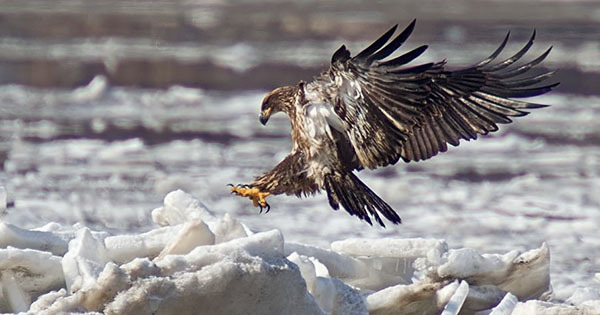
The common theme this week was that winter was slowly “creeping down the river,” accompanied by dozens, even scores of wintering bald eagles, just a short flight ahead of heavy ice. Seal sightings continued to add to the winter drama, and paired bald eagles continued staying busy with their nests.
Highlight of the Week
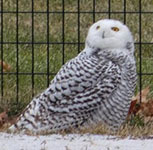 1/27 – Manhattan, HRM 7.5: Like an apparition, a snowy owl suddenly appeared on a sports field in the North Meadow of Central Park this morning. In searching the historic occurrences of snowy owls in Manhattan, the only record American Museum of Natural History ornithologist Paul Sweet was able to find was mid-December 1890 by L. S. Foster (Proceedings of Linnaean Society of New York, 1891). (Photo of snowy owl courtesy of NYC Audubon) 1/27 – Manhattan, HRM 7.5: Like an apparition, a snowy owl suddenly appeared on a sports field in the North Meadow of Central Park this morning. In searching the historic occurrences of snowy owls in Manhattan, the only record American Museum of Natural History ornithologist Paul Sweet was able to find was mid-December 1890 by L. S. Foster (Proceedings of Linnaean Society of New York, 1891). (Photo of snowy owl courtesy of NYC Audubon)
- Tom Lake
Natural History Entries
1/23 – Minerva, HRM 284: I was out in the “back-forty” snowshoeing with my neighbor in about ten-inches of snow. The hike over the back-forty pond was interesting. There was plenty of ice, but the several inches of snow on top provided an insulated top to the sandwich, with four inches of nasty slush between ice and snow. We got slush on the snowshoe bottoms, which froze nicely in the ten-below-zero wind-chill air temperature. Still a fun hike. Lots of white-tail deer tracks but little else. Just a while ago I had the pleasure of finding otter slides around the pond shoreline.
- Mike Corey
[“Back-forty” is a colloquial expression meant to convey wild or rough terrain adjacent to a developed area. In the instance of a farm, for example, it might be a small percentage of the land left uncultivated or natural, frequently in the “back forty acres” of the property. Tom Lake]
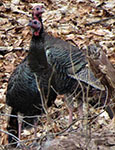 1/24 –Town of Esopus: Our small swamp area on the Hudson River edge has great birding. Today, it featured both hen and drake common mergansers and a sharp-shinned hawk that hunted the swamp all afternoon. Five healthy-looking wild turkeys, in no hurry, wandered through. Near dusk, two pairs of immature bald eagles, thirty-seconds apart, flew down along the shoreline. (Photo of wild turkeys courtesy of Mario Meier) 1/24 –Town of Esopus: Our small swamp area on the Hudson River edge has great birding. Today, it featured both hen and drake common mergansers and a sharp-shinned hawk that hunted the swamp all afternoon. Five healthy-looking wild turkeys, in no hurry, wandered through. Near dusk, two pairs of immature bald eagles, thirty-seconds apart, flew down along the shoreline. (Photo of wild turkeys courtesy of Mario Meier)
- Mario Meier
1/25 – The Glen, HRM 245: With the very cold recent weather, the frazil ice had taken over the Hudson River’s Ice Meadows south of The Glen. It is a formation that is somewhat unique to this reach of the river, and it was good to see. I passed by today, and it looked like several feet of ice covered the channel.
- Mike Corey
[Frazil ice first forms as tiny round crystals—after nucleating in some way that has long been a puzzle to scientists—throughout the river in cold weather. Turbulent super-cooled (slightly below 32-degree Fahrenheit (F)) water tumbles the crystals around making them grow until they float at the surface in loose agglomerations. It looks like floating snow. If frazil touches something underwater, a deadfall or a rock, it sticks. It builds from the sides and from the middle of the river and can eventually form dams. Such is the case at the Ice Meadows where the ice can grow to near glacial proportions. Cobbles and gravels at the bottom can be popped to the surface when the ice becomes buoyant enough. This process adds to the other river dynamics that are constantly moving sand, silt, gravel, and cobbles along the riverbed. Evelyn Greene]
1/25 – Columbia County, HRM 109: Brilliant sunlight lit up an adult bald eagle wheeling overhead at the North Germantown boat launch. After nights of well below freezing, skirt ice was expanding out from the shore. A stiff north wind and a strong ebb current brought down ice floes decorated by eight immature bald eagles. In an odd juxtaposition, eight adult eagles were perched in trees across on Greene Point, evenly spaced, appearing like light bulbs.
- Tom Lake
1/25 – Poughkeepsie, HRM 76: I had never seen a day like this. Bald eagles were everywhere along the river across a half-mile reach above Poughkeepsie. I counted 22, both adults and immatures, in six hours. - Vivian Yess Wadlin
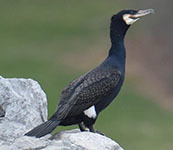 1/25 – Bear Mountain to George’s Island, HRM 46-39: We proceeded for seven miles south along the river from the Bear Mountain Bridge, past Iona Island, Dunderberg, and Peekskill Bay, to George’s Island. Our count by then included 15 bald eagles—nine adults, six immatures—and 25 great cormorants. 1/25 – Bear Mountain to George’s Island, HRM 46-39: We proceeded for seven miles south along the river from the Bear Mountain Bridge, past Iona Island, Dunderberg, and Peekskill Bay, to George’s Island. Our count by then included 15 bald eagles—nine adults, six immatures—and 25 great cormorants.
Five of the great cormorants were sighted from Old Steamboat Dock in Verplanck where, closeup, identification was easy. The other 20 were in the water near the light tower in Peekskill Bay, having been chased off the tower by two adult eagles. This light tower has a history of “attracting” great cormorants in winter. Our most pleasant surprise was spotting a seal, near shore, from Old Steamboat Dock. (Photo of great cormorant courtesy of Mike Kalin)
- Gerhard Patsch, Tracy Patsch
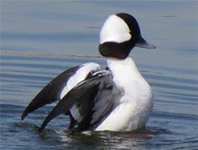 1/25 – Croton-on-Hudson, HRM 34: Buffleheads [ducks] have been a colorful constant in the river off Croton Landing all winter. Today, however, they provided some entertainment and a hint of spring: There were two separate clusters, each containing a single female and multiple males. The males engaged in complex and engaging courtship displays, bobbing their heads, pretending to preen, chasing after each other, and flapping their brightly patterned wings. The females, on the other hand, looked completely uninterested. (Photo of bufflehead courtesy of Jen Adams) 1/25 – Croton-on-Hudson, HRM 34: Buffleheads [ducks] have been a colorful constant in the river off Croton Landing all winter. Today, however, they provided some entertainment and a hint of spring: There were two separate clusters, each containing a single female and multiple males. The males engaged in complex and engaging courtship displays, bobbing their heads, pretending to preen, chasing after each other, and flapping their brightly patterned wings. The females, on the other hand, looked completely uninterested. (Photo of bufflehead courtesy of Jen Adams)
- Joe Wallace and Sharon AvRutick
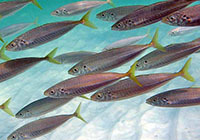 1/26 – Hudson River Watershed: Fish-of-the-Week for Week 105 is the round scad (Decapterus punctatus), number 22 (of 234) on our watershed list of fishes. If you would like a copy of our list, e-mail - trlake7@aol.com. 1/26 – Hudson River Watershed: Fish-of-the-Week for Week 105 is the round scad (Decapterus punctatus), number 22 (of 234) on our watershed list of fishes. If you would like a copy of our list, e-mail - trlake7@aol.com.
Round scad are small marine fishes that belong to the jack family (Carangidae). According to C. Lavett Smith’s Field Guide to Tropical Marine Fishes, roundscad are most often found in southern temperate and tropical seas straying northward in the Gulf Stream to New England. They mostly feed on copepods but have also been known to eat gastropod larvae. The average adult can reach 12-inches. The round scad was added to the Hudson River Watershed List of Fishes in 2007, even though it was first collected in 1979.
The Chronology:
1979 - We were running down all possible “new” and undocumented Hudson River fish species, focusing primarily on power plant consultants' collections. This was advance legwork that contributed to C. Lavett Smith’s book The Inland Fishes of New York State (1985). We heard a rumor that a power company consultant had recovered and identified a juvenile mackerel scad, a new species for the river, from the Indian Point impingement screens. We investigated but no one could locate the specimen. We opted, rightfully so, to leave it out of the Hudson River Fish Fauna list—no body, no record.
2007 - I came across a specimen in a jar in the New York State Museum fish collection that was labeled “mackerel scad, 82 mm-long, young-of-the-year, collected July 19, 1979, Unit 3 intake screens, River mile 42 [Indian Point].” This was the missing fish from 28 years ago. However, when Kathy Schmidt went to sketch the scad, I took a closer look and discovered that it was, in fact, a round scad (Decapterus punctatus). At that point, it was added to our list. (Photo of round scad courtesy of NMFS)
- Bob Schmidt
Dave Taft made the astute observation that this was not unlike uncovering a long-forgotten mummy in a Cairo museum.
- Tom Lake
Hudson River Jacks – Carangidae include:
- crevalle jack, (Caranx hippos)
- round scad, (Decapterus punctatus)
- Atlantic moonfish, (Selene setapinnis)
- lookdown, (Selene vomer)
- permit, (Trachinotus falcatus)
1/27 – New Hamburg, HRM 67.5: Winter continued its relentless creep down the river, featuring ice floes of various proportions including some a half-acre in size. Soon, the ebb tides will draw ice out of marshes and coves to add to the ice cover.
From the waterfront in midday, I counted nine bald eagles, all immatures, six on the ice and three perched on the limestone escarpment (Cedarcliff) across the river. I would guess all were wintering birds moving south one flight ahead of heavy ice and finding open water. One huge ice floe, drifting in the last of the down tide, held four eagles. The coming drama was predictable: As the ice floe reached Diamond Reef, it was bifurcated by the winter buoy. One half of the floe moved past still holding two eagles; the other half stalled a bit, hung-up on the buoy, and its two eagles flew off.
- Tom Lake
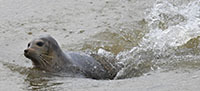 1/27 – Croton Point, HRM 34: Charlie Roberto spotted a harbor seal frolicking at high tide this morning at Sarah Teller's Point. The seal appeared to have a yellow tag on its rear flipper. (Photo of harbor seal courtesy of Karalyn Lamb) 1/27 – Croton Point, HRM 34: Charlie Roberto spotted a harbor seal frolicking at high tide this morning at Sarah Teller's Point. The seal appeared to have a yellow tag on its rear flipper. (Photo of harbor seal courtesy of Karalyn Lamb)
- Karalyn Lamb, Charlie Roberto
[This may be the same harbor seal spotted on January 14 by Rick Broat, Jack Hoyle, and Lori Hoyle. That seal was also frolicking at the nearby mouth of the Croton River. We are investigating the yellow tag. Even without a number for the tag, we may be able to determine where it was tagged. It is possible that this is the same seal that was spotted two days ago five miles upriver at Verplanck. Tom Lake]
[As we investigated the tag on this harbor seal, Sarah Callan, Assistant Manager of the Mystic Marine Aquarium’s Animal Rescue Program, confirmed that the seal had been rehabilitated and released from her facility in Mystic, Connecticut].
1/28 – Stillwater, HRM 171.5: I searched for the previously reported greater white-fronted goose this morning to no avail. We then explored some of the Northumberland fields and found at least 200 snow buntings and some horned larks near Purinton. We also checked a number of regular spots where we found smaller numbers of all three field birds including horned larks and Lapland longspurs. My favorite spot for field birds, at Williams Lane, was the biggest surprise with no field birds at all but a flock of an estimated 200 common redpolls.
- John Hershey, Ron Harrower
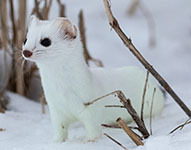 1/28 – Galeville, HRM 74: I came upon a little ermine (short-tailed weasel) this morning at the Shawangunks Grasslands National Wildlife Refuge. It was very energetic, darting back and forth and very curious. I was surprised how small it was, maybe nine inches including the tail. I find it so interesting that their fur changes color for the winter. Seeing this made my day! (Photo of short-tailed weasel courtesy of Karen Maloy Brady) 1/28 – Galeville, HRM 74: I came upon a little ermine (short-tailed weasel) this morning at the Shawangunks Grasslands National Wildlife Refuge. It was very energetic, darting back and forth and very curious. I was surprised how small it was, maybe nine inches including the tail. I find it so interesting that their fur changes color for the winter. Seeing this made my day! (Photo of short-tailed weasel courtesy of Karen Maloy Brady)
- Karen Maloy Brady
[Ermine, or stoat, are common names of the short-tailed weasel (Mustela erminea), native to North America. In winter, weasels gradually molt replacing their brown fur with white except for the black tip of their tail. In the northeast, weasels molt to white between October and December and back to brown fur between March and May. Tom Lake]
1/29 –New Hamburg, HRM 67.5: We have recently discussed in the Almanac Diamond Reef, located in mid-river off New Hamburg, as a sport and commercial fishing beacon. Two days ago, we witnessed the reef’s winter buoy creating new geometric patterns in the river’s ice. Interest in Diamond Reef can be found 136 years ago in William C. Harris’ The Angler’s Guide and Tourist’s Gazetteer (1885):
- “New Hamburgh [Diamond] Reef on the Hudson r. [River] ? m; white perch and striped bass, the first being most abundant; shrimp, worms and live bait used; July, August and September best; hotels $1.50 p.d. [per day]; guides at moderate cost; boats $1.00 p.d.; the above reef is celebrated for its white perch fishing, and in late August sport is had in catching snappers (young bluefish) ¼ lb. on the surface with minnow bait.”
- Tom Lake
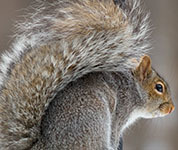 1/29 – Beacon, HRM 61: I had a discussion with three students today on the beach at Long Dock. We debated on the relative likelihood that a bald eagle, a harbor seal, or even a gray squirrel, could come to like you if you behaved in a certain way. 1/29 – Beacon, HRM 61: I had a discussion with three students today on the beach at Long Dock. We debated on the relative likelihood that a bald eagle, a harbor seal, or even a gray squirrel, could come to like you if you behaved in a certain way.
My thought was that true wildlife is ambivalent. They do not like you; they do not dislike you. In my opinion, they either feel comfortable with your presence, or they feel uncomfortable with your presence. It borders on trust, but even that is a bit too anthropomorphic. I have met many walkers, hikers, bird watchers, and just curious individuals, who in varying degrees, feel they can broach that human—wildlife chasm.
Elementary school students will sometimes pound a finger on the side of a fish tank and when asked what that was all about, will innocently reply, “If I can only get that fish’s attention, we might be friends.”
I have come upon people “hugging” eagle nest trees, huge cottonwoods and tulip trees. When asked what was up, I’ve been told that they were trying to “connect” to the spirit of the eagle. I think showing respect, especially in keeping our distance, is what we hope for. Otherwise, our behavior betrays the word “wild.” (Photo of gray squirrel courtesy of John Badura)
- Tom Lake
Winter 2021 Natural History Programs
Wednesday, February 10, 4:30-6:00 PM (Webex or Zoom -TBD)
Volunteer Training 2021 Amphibian Migrations and Road Crossings Project
This year we are offering a modified online training for new participants and a refresher for returning volunteers that will include: an overview of how to volunteer, data collection methods, safety tips, and ideas for local coordination from program partners.
Registration Link: https://www.surveymonkey.com/r/VirtualAMRCTraining2021
For more information: https://www.dec.ny.gov/lands/51925.html.
Please contact: emma.clements@dec.ny.gov if you have questions
Hudson Estuary Trees for Tribs Program - Now Accepting Applications
The Hudson River Estuary Program’s Trees for Tribs program offers free native trees and shrubs for planting along the tributary streams in the Hudson River Estuary watershed. Our staff can help you with a planting plan and work with your volunteers. We are now accepting applications through March 1 for 2021 spring planting projects. Download and submit the two-page application found here: www.dec.ny.gov/docs/remediation_hudson_pdf/hrewtftap14.pdf.
For more information about the program or to download an application, please visit the DEC website at: www.dec.ny.gov/lands/43668.html . If you have questions about a potential planting site, please contact Beth Roessler and Anna Palmer at: HudsonEstuaryTFT@dec.ny.gov, or call (845)256-3875 to find out if your site is eligible for a 2021 planting project!
Day-in-the-Life Videos (Hudson River Estuary Program)
The Day-in-the-Life Team and DEC produced three interactive videos from live footage at three geographic areas of the Hudson River estuary. Watch each one with your class to explore the Hudson River at your own pace. Watch the video pertaining to your region along the River or watch all three!
Students can collect data virtually alongside our partner organizations with their data sheets and an online Clearwater fish key.
Upper Estuary (Poughkeepsie to Troy and beyond):
• Video
• Data Sheet
Lower Estuary (Yonkers to Beacon/Newburgh):
• Video
• Data Sheet
NY Harbor (and connected waterways):
• Video
• Data Sheet
The Estuary Live! (Hudson River Estuary Program)
Our environmental education programs are broad, varied, flexible, and dependent on the needs and interests of your students. These distance-learning programs can last anywhere from 30 minutes to an hour and are available on ZOOM, Google classrooms, or Webex platforms. Pre-program materials from our Virtual River content include videos and lesson plans for students to explore before their Estuary Live! program. Students are encouraged to ask questions which creates an interactive learning environment, rather than a lecture. Estuary Live! is often hosted from an outdoor location but is dependent on the weather and cell service. The Norrie Point Environmental Center has three indoor sets (The Library, The Lab, and The Classroom) that allow us to stay connected during lessons and give students a feeling of being here with us.
Program types and a brief description of the topics:
Wildlife (e.g., amphibians, turtles, and fish)
Hudson River basics, e.g. geography, tides, salinity, turbidity, temperature, basic ecology.
Climate change
American Eels
Stream Study: macroinvertebrates, e.g., adaptations, habitat, and human impact.
Educators can schedule a program for their students:
https://docs.google.com/forms/d/e/1FAIpQLScr6Sidcq70JL3xLvubH1J-WfAkRMsR6AWvUtHsdcOiUvXrcw/viewform
Contact Maija Lisa Niemistö email:maija.niemisto@dec.ny.gov
Follow Us On-Line:
Check out our wonderful Tide Finder video (3 minutes) with Chris Bowser marking the extreme highs and lows of a full moon tidal cycle: Tide Finder video
Virtual River website: Virtual River Website
Hudson River Miles
The Hudson is measured north from Hudson River Mile 0 at the Battery at the southern tip of Manhattan. The George Washington Bridge is at HRM 12, the Tappan Zee 28, Bear Mountain 47, Beacon-Newburgh 62, Mid-Hudson 75, Kingston-Rhinecliff 95, Rip Van Winkle 114, and the Federal Dam at Troy, the head of tidewater, at 153. The tidal section of the Hudson constitutes a bit less than half the total distance – 315 miles – from Lake Tear of the Clouds to the Battery. Entries from points east and west in the watershed reference the corresponding river mile on the mainstem.
To Contribute Your Observations or to Subscribe
The Hudson River Almanac is compiled and edited by Tom Lake and emailed weekly by DEC's Hudson River Estuary Program. Share your observations by e-mailing them to trlake7@aol.com. To subscribe to the Almanac (or to unsubscribe), use the links on DEC's Hudson River Almanac or DEC Delivers web pages.
Discover New York State
The Conservationist, the award-winning, advertisement-free magazine focusing on New York State's great outdoors and natural resources. The Conservationist features stunning photography, informative articles and around-the-state coverage. Visit The Conservationist webpage for more information.
Useful Links
National Oceanic and Atmospheric Administration online tide and tidal current predictions are invaluable when planning Hudson River field trips. For real-time information on Hudson River tides, weather and water conditions from sixteen monitoring stations, visit the Hudson River Environmental Conditions Observing System website.
DEC's Smartphone app for iPhone and Android is now available at: New York Fishing, Hunting & Wildlife App.
PLAY SMART * PLAY SAFE * PLAY LOCAL: Get Outside Safely, Responsibly, and Locally
New York State is encouraging residents to engage in responsible recreation during the ongoing COVID-19 public health crisis. NYSDEC and State Parks recommendations for getting outside safely incorporate guidance from the Centers for Disease Control and Prevention and the NYS Department of Health for reducing the spread of infectious diseases.
DEC and State Parks are encouraging visitors to New York's great outdoors to use the hashtags #PlaySmartPlaySafePlayLocal, #RecreateResponsibly, and #RecreateLocal on Facebook, Twitter, and Instagram to share their visit and encourage others to get outside safely, responsibly, and locally, too. Use the DECinfo Locator to find a DEC-managed resource near you and visit the State Parks website for information about parks and park closures.
Take the Pledge to PLAY SMART * PLAY SAFE * PLAY LOCAL: Enjoy the Outdoors Safely and Responsibly
1. I pledge to respect the rules and do my part to keep parks, beaches, trails, boat launches, and other public spaces safe for everyone.
2. I will stay local and close to home.
3. I will maintain a safe distance from others outside of my household.
4. I will wear a mask when I cannot maintain social distancing.
5. I accept that this summer, I may have to adjust how I enjoy the outdoors to help keep myself and others healthy and safe, even if it means changing my plans to visit a public space.
6. I will be respectful of others by letting them pass by me if needed on a trail and keeping my blanket ten feet apart from others on the beach.
7. I will move quickly through shared areas like parking lots, trailheads, and scenic areas to avoid crowding.
8. If I'm not feeling well, I will stay home.
Information about the Hudson River Estuary Program is available on DEC's website at http://www.dec.ny.gov/lands/4920.html.
|