A Project of the Hudson River Estuary Program
Compiled by Tom Lake, Consulting Naturalist
COVID-19 Guidance for Enjoying the Outdoors
While enjoying outdoor spaces, please continue to follow the CDC/NYSDOH guidelines for preventing the spread of colds, flu, and COVID-19. To find out more about enjoying DEC lands and New York's State Parks, visit DEC's website Play Smart*Play Safe*Play Local; https://www.dec.ny.gov/outdoor/119881.html
Keep at least six (6) feet of distance between you and others.
Wear a cloth face covering in public settings where social distancing measures are difficult to maintain.
Avoid close contact, such as shaking hands, hugging, and kissing.
Wash hands often or use a hand sanitizer when soap and water are not available.
Avoid surfaces that are touched often, such as doorknobs, handrails, and playground equipment.
DEC recommends avoiding busy trailheads. Find the trails less traveled and visit when trails may not be as busy during daylight hours.
Overview
Our highlight this week is a very seasonal story with a happy ending. As odd as it seems, the story began inside the Rockefeller Center Christmas Tree in Midtown Manhattan. We also look back 172 years to get a feel for fishing off the city docks of New York. And, there was an early morning seine haul when a single white perch became the catch of the day.
Highlight of the Week
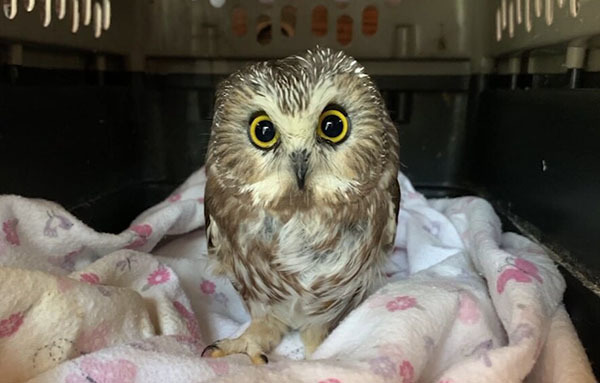
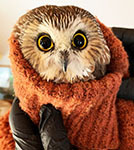 11/16 – Manhattan, HRM 4: The 2020 Rockefeller Center Christmas tree, a 72-foot-tall Norway spruce (Picea abies), arrived in Manhattan today with a stowaway: an adult male saw-whet owl (Aegolius acadicus). The owl had survived a three-day, 170-mile trip, from Oneonta, Otsego County, New York. 11/16 – Manhattan, HRM 4: The 2020 Rockefeller Center Christmas tree, a 72-foot-tall Norway spruce (Picea abies), arrived in Manhattan today with a stowaway: an adult male saw-whet owl (Aegolius acadicus). The owl had survived a three-day, 170-mile trip, from Oneonta, Otsego County, New York.
Workers at Rockefeller Center discovered and rescued the owl and transported him to the Ravensbeard Wildlife Center in Saugerties. Wildlife Center Director Ellen Kalish noted that three days with no food or water had left him a little on the thin side, but his eyes were bright, and he was otherwise in good condition—x-rays indicated no broken bones. The owl was given fluids along with "all the mice he will eat." Ellen Kalish continued, “Once our vet checks the owl, and gets a clean bill of health, he would be released into an appropriate forest” [see 11/21 below and go to https://ravensbeard.org]. (Photo of saw-whet owl courtesy of Ellen Kalish)
- Tom Lake
[The saw-whet is native to North America where it favors coniferous forests at higher latitudes across the continent. They are considered to be the smallest owl species found in North America reaching no more than five inches in length and weighing no more than three ounces. Tom Lake]
[The first Christmas tree at Rockefeller Center was erected in 1931, during the Depression-era construction of Rockefeller Center, when workers decorated a 20-foot-tall balsam fir with "strings of cranberries, garlands of paper, and even a few tin cans" on Christmas Eve (Lambert 2008).]
Natural History Entries
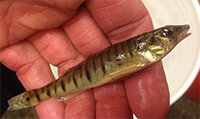 11/14 – Waterford, HRM 159: We were seining just west of the Hudson, at the top of the Waterford Flight, a series of five locks that lifts vessels 170 feet above the Hudson River to the beginning of the Erie Canal and the Mohawk River. The river was a nearly numbing 49 degrees Fahrenheit (F), and our catch was unremarkable both in diversity and numbers: spottail shiners and banded killifish. Then, our final haul produced a welcome surprise, a northern logperch (65 millimeters (mm)). (Photo of northern logperch courtesy of Chris Bowser) 11/14 – Waterford, HRM 159: We were seining just west of the Hudson, at the top of the Waterford Flight, a series of five locks that lifts vessels 170 feet above the Hudson River to the beginning of the Erie Canal and the Mohawk River. The river was a nearly numbing 49 degrees Fahrenheit (F), and our catch was unremarkable both in diversity and numbers: spottail shiners and banded killifish. Then, our final haul produced a welcome surprise, a northern logperch (65 millimeters (mm)). (Photo of northern logperch courtesy of Chris Bowser)
- Tom Lake, A. Danforth
[Note: One inch = 25.4 millimeters (mm)]
[Northern logperch (Percina caprodes semifasciata) is one of seven perches (Percidae) found in the Hudson River watershed. Better known members include yellow perch and walleye. Northern logperch is native to the Mississippi River system and likely migrated to the Hudson River watershed in the past century through the New York State canal system. They have become one of the signature fishes of the Mohawk River through which they sometimes reach the Hudson River via the Erie Canal. Bob Schmidt notes that the population of northern logperch of the Hudson watershed have distinct, saddle-like markings. Tom Lake.
11/14 – Greene County: Some sage advice from Rich Guthrie: Heads up! Give those flyover geese skeins a close second look this winter. A birder in western Massachusetts photographed a barnacle goose slipping by in the middle of one of those flocks. A few years ago, one of our young birders got a photo of a Ross’ goose in a flyover flock of snow geese. Bird every bird.
- Rich Guthrie
11/14 – Little Stony Point, HRM 55: We had a stark seasonal moment today: With recent nighttime temperatures dipping into the twenties, the monarch migration had apparently ended. Along the strand line and windrows on the beach were the remnants of those that had not made it—a broken scattering of orange and black.
- Tom Lake, A. Danforth
11/14 – Bedford, HRM 35: We spotted 33 migrating raptors at the Bedford Audubon Chestnut Ridge Hawkwatch today including a golden eagle; red-shouldered hawk was high count with15. Vultures (turkey 65, black 2) led among non-raptor migrants that also included nine red-crossbills.
- Richard Aracil, John Gluth, Karen Troche, Mike, Pedro Troche
11/14 – Hook Mountain, HRM 31: We spotted 45 migrating raptors at the Hook Mountain Hawkwatch today; red-tailed hawk was high count with13. Vultures (turkey 30, black 12) led among non-raptor migrants that also included ten bald eagles and two golden eagles.
- Vince Plogar, Tom Fiore
11/15 – Millbrook, HRM 82: We heard a plaintive k-i-r-r-r coming from above the treetops. Almost in unison we said, “red-tailed hawk.” Against a dull gray sky over an autumn-cum-winter forest of leafless trees, we watched two adult red-tailed hawks in an early aerial courtship. Their acrobatics included wing-touches, belly-rolls, and a series of spiraling ascents followed by determined stoops ending nearly in the canopy of the trees. After a while, a gusty west wind pushed them away, across a swamp and into farmland of empty fields.
- Tom Lake, T.R. Jackson, B.J. Jackson
11/15 – Bedford, HRM 35: We spotted 43 migrating raptors at the Bedford Audubon Chestnut Ridge Hawkwatch today including a golden eagle; red-shouldered hawk was high count with 27. Turkey vultures (50) led among non-raptor migrants that also included two bald eagles.
- Richard Aracil, Karen Troche, Pedro Troche
11/15 – Hook Mountain, HRM 31: We spotted 22 migrating raptors at the Hook Mountain Hawkwatch today; red-tailed hawk led the count with eight. Collectively, turkey vulture (5) and black vulture (3) led among non-raptor migrants that also included six red-headed ducks.
- Felicia Napier
11/16 – Bedford, HRM 35: We spotted 20 migrating raptors at the Bedford Audubon Chestnut Ridge Hawkwatch today including three bald eagles; red-shouldered hawk was high count with seven. Collectively, turkey vulture (113) and black vulture (one) led among non-raptor migrants.
- Richard Aracil, Pedro Troche
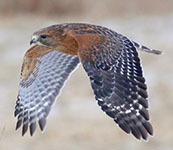 11/16 – Hook Mountain, HRM 31: We counted only one migrating raptor—a red-shouldered hawk—at the Hook Mountain Hawkwatch today. Black vulture (50) led among non-raptor migrants. Non-migrating raptors included two peregrine falcons. (Photo of red-shouldered hawk courtesy of Brian Rusnica) 11/16 – Hook Mountain, HRM 31: We counted only one migrating raptor—a red-shouldered hawk—at the Hook Mountain Hawkwatch today. Black vulture (50) led among non-raptor migrants. Non-migrating raptors included two peregrine falcons. (Photo of red-shouldered hawk courtesy of Brian Rusnica)
- Ajit I. Antony, Liza Antony
11/16 – Manhattan, New York City: The Randall’s Island Park Alliance spotted our first brant of the season today. Park birders had seen them three weeks ago, but we are beginning to see more of the wintering brant now. I hope they will stay around and help us beat our 2019 Christmas Bird Count number of 722.
- Chris Girgenti, Jackie Wu
11/17 – Bedford, HRM 35: We spotted four migrating raptors at the Bedford Audubon Chestnut Ridge Hawkwatch today including three bald eagles; red-shouldered hawk was high count with three. Turkey vulture (50) led among non-raptor migrants that also included 1,200 common grackles.
- Richard Aracil
11/17 – Hook Mountain, HRM 31: There were gray monochrome vistas with faint drizzle and a few snowflakes from the summit today at the Hook Mountain Hawkwatch. Just when you think you've seen every permutation of light and shadow that the Hook can throw at you, it amazes you once again. During mid-morning, the surface of the Tappan Zee looked like hammered metal; from high on Hook, the choppy surface of the river looked magically frozen. It was impossible to photograph (or describe) but quite mesmerizing. In early afternoon, the Hudson Highlands disappeared in a sheet of gray, the wind came up, and it began to rain.
In the end, we counted just three migrating raptors; red-tailed hawk was high count with two. Collectively, turkey vulture (11) and black vulture (7) led among non-raptor migrants that also included six red-headed ducks.
While intently focusing on a kettle of five local turkey vultures, a duck (canvasback?) blasted into the scope’s objective with rapid-fire wingbeats. It was startling after the vultures’ languorous, who-will-stall-first gliding demeanor.
- John Phillips
11/17 – Manhattan, HRM 13.5: At midday, it appeared that there were no waterfowl at all on the still water of Inwood Hill Park’s Spuyten Duyvil Creek. Then I spotted a pair of mallards paddling along until they stopped, turned to face each other, and dipped their bills into the water several times in unison. Then they continued on their way, the female leading. Suddenly the male rose flapping, neck extended, feet on the water. They went on for a bit and then repeated what may have been a bonding ritual.
On the path up through the Clove and on the ridge, there was very little fall color, a few red oaks, and some yellow maples, but most trees were either still green or already bare. I did see one winterberry (Ilex verticillata), apparently a cultivar, with yellow berries.
- Thomas Shoesmith
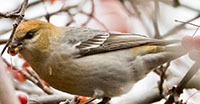 11/18 – Hamilton County, HRM 265: In late afternoon, I counted ten female pine grosbeaks (Pinicola enucleator) feeding in our apple trees. (Photo of pine grosbeak courtesy of Sue Barth) 11/18 – Hamilton County, HRM 265: In late afternoon, I counted ten female pine grosbeaks (Pinicola enucleator) feeding in our apple trees. (Photo of pine grosbeak courtesy of Sue Barth)
- Mike Moccio, Wanda Moccio (Hudson-Mohawk Bird Club
11/18 – Bedford, HRM 35: We spotted 63 migrating raptors at the Bedford Audubon Chestnut Ridge Hawkwatch today including four bald eagles; red-shouldered hawk was high count with 35. Turkey vulture (56) led among non-raptor migrants that also included a very fast flyby of a small flock of what I think were red crossbill.
- Richard Aracil
11/18 – Hook Mountain, HRM 31: We counted 50 migrating raptors at the Hook Mountain Hawkwatch today; red-tailed hawk was high count with 24 including four bald eagles. Turkey vulture (22) led among non-raptor migrants that also included nearly 300 Canada geese in various-size skeins. In one fairly large southbound flock of Canadas was a single snow goose.
- Tom Fiore
11/19 – Bedford, HRM 35: We spotted 102 migrating raptors at the Bedford Audubon Chestnut Ridge Hawkwatch today including four bald eagles; red-shouldered hawk was high count with 88. Turkey vulture (75) led among non-raptor migrants. Our best sighting of the day was two sandhill cranes seen to our distant south, heading southwest, following the north shore of Long Island Sound.
- Richard Aracil
11/19 – Manhattan, HRM 2: Our Hudson River Park’s River Project Staff checked the sampling and collection gear that we deploy off Pier 40 in Hudson River Park. Our catch on this day included five spider crabs (Libinia sp.), a single blue crab that escaped before being measured, a Pacific (Asian) shore crab (Hemigrapsus sanguineus), and a 75 mm lined sea horse!
- Anna Koskol, Olivia Radick
11/19 – Manhattan, New York City: The Randall’s Island Park Alliance conducted a water quality check on the Bronx Kill today and found it to be uncharacteristically salty at low tide (mid-20 parts-per-thousand (ppt)). Waterbirds on the Bronx Kill included a belted kingfisher, an adult yellow-crowned night heron, and a great blue heron.
- Jackie Wu, Chris Girgenti
11/20 – Washington County, HR 192: I came upon a small flock of pine grosbeaks feeding in ornamental crabapple trees along the entrance drive at Christ the King Center on Barton Road in Greenwich.
- Richard Guthrie
11/20 – Bedford, HRM 35: We spotted 55 migrating raptors at the Bedford Audubon Chestnut Ridge Hawkwatch today; red-shouldered hawk was high count with 41. Turkey vulture (35) led among non-raptor migrants.
- Tait Johansson
11/20 – Hook Mountain, HRM 31: We counted 36 migrating raptors at the Hook Mountain Hawkwatch today; red-shouldered hawk was high count with 26 including a bald eagle. Vultures (turkey (20), black (2) led among non-raptor migrants.
- Ajit I. Antony, Liza Antony
11/20 – Manhattan, New York City: Given the steady presence of striped bass in the estuary, especially young-of-year, it is interesting to look back to the public perception of Hudson River striped bass in1848. Robert DeCandido provides a peek into the past from the New York Herald Tribune (1888) titled Fishing off New York Docks.
“Forty years ago [1848] there was good fishing from the docks of New York and fine striped bass were freely taken, especially at the Battery. As the city grew and the water became fouler the fishing ceased. Of late, fishermen have found out that at the upper end of the city, on the North [Hudson] River side, there are a few bass to be taken. This week a man took four striped bass of one pound each, at the foot of 138th Street, and three more were taken from the cinder banks north of the Manhattan Iron Works. It is estimated that at least sixty bass were taken between the cinder banks and Spuyten Duyvil on Sunday last.”
- Tom Lake
11/20 – Wappinger Falls, HRM 67: I counted 21 common mergansers—all hens, not a single drake—on Wappinger Lake yesterday. That entire assemblage, or so it seemed, moved downstream a half-mile today to the tidewater Wappinger Creek, a half-mile upstream from New Hamburg.
- Tom Lake
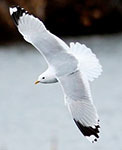 11/20 – Kingston, HRM 92: I found a single, first-winter, mew gull mixed in with a good-size flock of ring-billed gulls at Kingston Point Beach on the Hudson River today. The mew gull, also called the common gull (Larus canus), is native to northern Europe. They migrate west to Great Britain and occasionally to North America. European field guides refer to them as the common gull; American field guides tend to use the name mew gull. 11/20 – Kingston, HRM 92: I found a single, first-winter, mew gull mixed in with a good-size flock of ring-billed gulls at Kingston Point Beach on the Hudson River today. The mew gull, also called the common gull (Larus canus), is native to northern Europe. They migrate west to Great Britain and occasionally to North America. European field guides refer to them as the common gull; American field guides tend to use the name mew gull.
- Mark DeDea
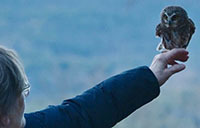 11/21 – Ulster County, HRM 102: This was release day for the adult male saw-whet owl that had been rescued from the Rockefeller Center Christmas tree—a 72-foot-high Norway spruce—five days ago. The owl had been rehabilitated at Ravensbeard Wildlife Center in Saugerties. 11/21 – Ulster County, HRM 102: This was release day for the adult male saw-whet owl that had been rescued from the Rockefeller Center Christmas tree—a 72-foot-high Norway spruce—five days ago. The owl had been rehabilitated at Ravensbeard Wildlife Center in Saugerties.
“Rockefeller” (workers in Rockefeller Plaza had dubbed him “Rockefeller”) was released on O'Hayo Mountain in Woodstock in a mixed deciduous and conifer (pine-hemlock) forest. He took a few moments standing on my hand before selecting a nearby tree branch. He then flew beautifully away and landed gracefully.(Photo of saw-whet owl courtesy of Ellen Kalish)
- Ellen Kalish
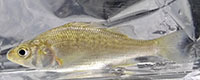 11/21 – Little Stony Point, HRM 55: We set our seine in the early morning ebb tide wondering how many days we had left with our net. The river was 52 degrees F, still within the barely warm-water realm of finding inshore fishes with our net. Salinity was holding steady at 2.0 ppt. In a bit of a surprise, we caught some young-of-autumn silver-dollar size blue crabs, all males. Among a treasure trove of young-of-year striped bass (70-74 mm) was a single white perch (85 mm), a common fish in the river, but the first we had seen on this beach all year. (Photo of white perch courtesy of Tom Lake) 11/21 – Little Stony Point, HRM 55: We set our seine in the early morning ebb tide wondering how many days we had left with our net. The river was 52 degrees F, still within the barely warm-water realm of finding inshore fishes with our net. Salinity was holding steady at 2.0 ppt. In a bit of a surprise, we caught some young-of-autumn silver-dollar size blue crabs, all males. Among a treasure trove of young-of-year striped bass (70-74 mm) was a single white perch (85 mm), a common fish in the river, but the first we had seen on this beach all year. (Photo of white perch courtesy of Tom Lake)
- Tom Lake
11/21– Bedford, HRM 35: We spotted 64 migrating raptors, including seven bald eagles, at the Bedford Audubon Chestnut Ridge Hawkwatch today; red-shouldered hawk, continuing in excellent numbers (736) for what has been the biggest season by far for this hawkwatch, was high count with 41. We also had the Hawkwatch’s fourteenth golden eagle of the season, but this one was not (yet) a migrant. Turkey vulture (24) led among non-raptor migrants.
- Richard Aracil, Karen Troche, Pedro Troche
11/21 – Hook Mountain, HRM 31: We counted 67 migrating raptors at the Hook Mountain Hawkwatch today; red-shouldered hawk was high count with 35 including eight bald eagles. Turkey vultures (81) led among non-raptor migrants that also included a single monarch butterfly.
- Tom Fiore, John Beccarelli, Kristine Wallstrom
11/22 – Ulster County, HRM 92: While walking on the Ontario and Western (O&W) Rail Trail just south of Hurley this morning, we came upon a fisher (Martes pennanti) in the forest as it approached the trail from the west. The fisher stopped, became aware of us, and turned to go back down a steep hillside. It took its time, and we were able to get a good look at its long, dark, black body, bushy tail, and its undulating gait as it traversed the woods, ran down the trunks of several fallen trees, and paused for a good while before disappearing farther down an embankment. It was quite an unexpected and exciting sighting for both of us!
- Betsy Blair, Nancy Beard
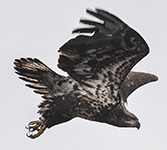 11/22 – Wappinger Lake, HRM 67: Debbie van Zyl found some nice waterfowl on Wappinger Lake today, including Canada geese (122), gadwall (2), American wigeon (2), hooded merganser (2), and some hen common mergansers. Into that setting, a bald eagle arrived. The immature eagle sported an orange leg band (banded as a nestling in Massachusetts), went into a dive putting up ducks and gulls. (Photo of banded bald eagle courtesy of Deborah Tracy Kral) 11/22 – Wappinger Lake, HRM 67: Debbie van Zyl found some nice waterfowl on Wappinger Lake today, including Canada geese (122), gadwall (2), American wigeon (2), hooded merganser (2), and some hen common mergansers. Into that setting, a bald eagle arrived. The immature eagle sported an orange leg band (banded as a nestling in Massachusetts), went into a dive putting up ducks and gulls. (Photo of banded bald eagle courtesy of Deborah Tracy Kral)
- Deborah Tracy Kral
11/22– Bedford, HRM 35: We spotted 14 migrating raptors, including two bald eagles, at the Bedford Audubon Chestnut Ridge Hawkwatch today; red-shouldered hawk was high count with eleven. Turkey vulture (26) led among non-raptor migrants that also included a red crossbill flyover.
- Richard Aracil
11/22 – Hook Mountain, HRM 31: We counted 42 migrating raptors at the Hook Mountain Hawkwatch today, including fourteen bald eagles and a short-eared owl; red-shouldered hawk was high count with 18. Nine bald eagles passed over in mid-morning, including a “flock” of seven flying together. Vultures (turkey 15, black 5) led among non-raptor migrants.
- Felicia Napier, Vince Plogar
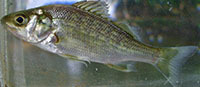 11/23 – Hudson River Watershed: Fish-of-the-Week for Weeks 97-98 is the white perch (Morone americana), number 143 (of 234) on our watershed list of fishes. If you would like a copy of our list, e-mail - trlake7@aol.com. 11/23 – Hudson River Watershed: Fish-of-the-Week for Weeks 97-98 is the white perch (Morone americana), number 143 (of 234) on our watershed list of fishes. If you would like a copy of our list, e-mail - trlake7@aol.com.
White perch are native to the Atlantic slope from the Canadian Maritimes to the Carolinas, especially estuaries and bays, with a center of abundance between the Hudson River and Chesapeake Bay. White perch have also been extensively stocked in freshwater lakes. They are one of three River Basses (Moronidae) found in the watershed and are closely related to both striped bass and white bass. They do well in an estuary if given time to acclimate, physiologically, to water ranging from salt to brackish to fresh.
J.R. Greeley notes in his Biological Survey of the Lower Hudson Watershed (1937) that commercial gill net fishing for white perch through the winter ice was very common in Hudson tidewater through the mid-20th century. In the early-mid 20th century, it was a tradition for Hudson Valley commercial netters to tinker with white perch distribution by taking five-gallon buckets of them to local ponds to stock for ice-fishing season. While they can reach 18-inches, those we see in the Hudson River are a foot-long or less.
One day in October 1988, on successive casts, Chris Lake caught a striped bass, a white perch, and a white bass on a silver artificial lure in the warm-water outflow of the Danskammer Power Generating Facility (Orange County). I wonder if that moment, when all three Moronids were present, has ever recurred. (Photo of white perch with permission by NJ DEP)
- Tom Lake
11/23 – Bedford, HRM 35: We spotted 14 migrating raptors, including two bald eagles, at the Bedford Audubon Chestnut Ridge Hawkwatch today; red-shouldered hawk was high count with eleven. Snow geese (31) in a flyover led among non-raptor migrants as well as a very high-flying loon that I was unable to identify to species.
- Richard Aracil
11/23 – Hook Mountain, HRM 31: We counted eleven migrating raptors at the Hook Mountain Hawkwatch today including two bald eagles; red-tailed hawk was high count with nine. We spotted a few non-migrant peregrine falcons, two of which were adults. All of the others we have seen this season have been immatures. We enjoyed watching their power and streamlined shape as they flew right into the wind without any effort. Black vultures led among non-raptor migrants with nine.
- Ajit I. Antony, Liza Antony
11/24 – Bedford, HRM 35: We spotted 37 migrating raptors, including two bald eagles, at the Bedford Audubon Chestnut Ridge Hawkwatch today; red-shouldered hawk was high count with 24. Non-raptor migrants included 727 southbound Canada Geese and two loons, one of which was a red-throated loon.
- Richard Aracil, Karen Troche, Pedro Troche
11/24 – Hook Mountain, HRM 31: We counted 26 migrating raptors at the Hook Mountain Hawkwatch today; bald eagle and red-tailed hawk were co-high count with eight each.
While discussing diagnostic behaviors of merlins, such as their strident vocalizations and fleeting visitations, a loud squabble was heard beyond the east edge and suddenly three small, dark merlins burst up past the trees, disappearing quickly, two along the north slope, one along the south cliff–gone!
- John Phillips, Jack Lorenze, Vince Plogar
11/24 – Manhattan, HRM 2: Our Hudson River Park’s River Project Staff checked the sampling and collection gear that we deploy off Pier 40 in Hudson River Park. The overnight catch in our pots and traps was meager, but a gorgeous black sea bass (60 mm) made it memorable.
- Olivia Radick, Anna Koskol
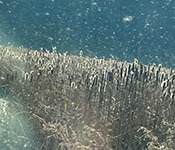 11/25 – Rockland County, HRM 45.5: On a breezy afternoon on Iona Island, it looked like a snow squall had moved in. Actually, it was millions upon millions of cattail seeds, making a pretty amazing spectacle. (Photo of cattails courtesy of William Sherwood) 11/25 – Rockland County, HRM 45.5: On a breezy afternoon on Iona Island, it looked like a snow squall had moved in. Actually, it was millions upon millions of cattail seeds, making a pretty amazing spectacle. (Photo of cattails courtesy of William Sherwood)
- William Sherwood
11/25 – Bedford, HRM 35: We spotted 38 migrating raptors, including a bald eagle, at the Bedford Audubon Chestnut Ridge Hawkwatch today; red-shouldered hawk was high count with 29. Despite the late date, another excellent flight was seen for red-shouldered hawk.
- Richard Aracil, Karen Troche, Pedro Troche
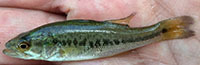 11/26 – Beacon, HRM 61: It was seasonally warm on Thanksgiving Day and we thought some beach-work might complement a turkey dinner. We began our investigation of the shallows off Long Dock in a driving rain and finished up thirty minutes later in sunshine. All the while, an adult bald eagle was perched in the crown of a tall oak out on the point. Our catch was rewarding but unremarkable, a common combination of late-in-the-season fishes. Young-of-year striped bass (78-83 mm) dominated, but the prize came on the last haul, a young-of-year largemouth bass (87 mm). The river was still bearably cool at 50 degrees F, and the salinity had fallen to 1.0 ppt. (Photo of largemouth bass courtesy of A. Danforth) 11/26 – Beacon, HRM 61: It was seasonally warm on Thanksgiving Day and we thought some beach-work might complement a turkey dinner. We began our investigation of the shallows off Long Dock in a driving rain and finished up thirty minutes later in sunshine. All the while, an adult bald eagle was perched in the crown of a tall oak out on the point. Our catch was rewarding but unremarkable, a common combination of late-in-the-season fishes. Young-of-year striped bass (78-83 mm) dominated, but the prize came on the last haul, a young-of-year largemouth bass (87 mm). The river was still bearably cool at 50 degrees F, and the salinity had fallen to 1.0 ppt. (Photo of largemouth bass courtesy of A. Danforth)
- Tom Lake, A. Danforth
11/27 – Hook Mountain, HRM 31: We counted five migrating raptors at the Hook Mountain Hawkwatch today; red-shouldered hawk was high count with four. The first migrant of the day was a black vulture in mid-morning headed south far out over Westchester County.
- Ajit I. Antony, Liza Antony
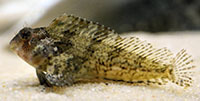 11/27 – Manhattan, HRM 2: Our Hudson River Park’s River Project Staff checked the sampling and collection gear that we deploy off Pier 40 in Hudson River Park. Our catch was small but diverse and included two young-of-autumn blue crabs (35 mm carapace-width) and this season’s first (100 mm) feather blenny (Hypsoblennius hentz). (Photo of feather blenny with permission by NMFS) 11/27 – Manhattan, HRM 2: Our Hudson River Park’s River Project Staff checked the sampling and collection gear that we deploy off Pier 40 in Hudson River Park. Our catch was small but diverse and included two young-of-autumn blue crabs (35 mm carapace-width) and this season’s first (100 mm) feather blenny (Hypsoblennius hentz). (Photo of feather blenny with permission by NMFS)
- Olivia Radick, Helen Polanco
Fall 2020 Natural History Programs
Natural History Programs sponsored by the Livingston Free Library: Join us for thirty-minute presentations on Turtles, Climate Change, Invasive Species, and more followed by Q&A, presented by Naturalist Chelsea Moore of the NYSDEC Hudson River Estuary Program, offered every other Wednesday to the Livingston Library at 11:00 AM and to the Starr Library at 4:00 PM.
Snow and Ice (water chemistry and animal tracking)
Wednesday, December 4, 2020 11:00 AM and 4:00 PM
Winter trees (photosynthesis)
Wednesday, December 16, 2020 11:00 AM and 4:00 PM
Registration for Starr, e-mail: Daniel@starrlibrary.org
Registration for http://livingston.lib.ny.us/ or Livingstonlibrary105@gmail.com
The Estuary Live! (Hudson River Estuary Program)
Our environmental education programs are broad, varied, flexible, and dependent on the needs and interests of your students. These distance-learning programs can last anywhere from 30 minutes to an hour and are available on ZOOM, Google classrooms, or Webex platforms. Pre-program materials from our Virtual River content include videos and lesson plans for students to explore before their Estuary Live! program. Students are encouraged to ask questions which creates an interactive learning environment, rather than a lecture. Estuary Live! is often hosted from an outdoor location but is dependent on the weather and cell service. The Norrie Point Environmental Center has three indoor sets (The Library, The Lab, and The Classroom) that allow us to stay connected during lessons and give students a feeling of being here with us.
Program types and a brief description of the topics:
Wildlife (e.g., amphibians, turtles, and fish)
Hudson River basics, e.g. geography, tides, salinity, turbidity, temperature, basic ecology.
Climate change
American Eels
Stream Study: macroinvertebrates, e.g., adaptations, habitat, and human impact.
Educators can schedule a program for their students:
https://docs.google.com/forms/d/e/1FAIpQLScr6Sidcq70JL3xLvubH1J-WfAkRMsR6AWvUtHsdcOiUvXrcw/viewform
Contact Maija Lisa Niemistö email:maija.niemisto@dec.ny.gov
Follow Us On-Line:
Check out our wonderful Tide Finder video (3 minutes) with Chris Bowser marking the extreme highs and lows of a full moon tidal cycle: Tide Finder video
Virtual River website: Virtual River Website
Hudson River Miles
The Hudson is measured north from Hudson River Mile 0 at the Battery at the southern tip of Manhattan. The George Washington Bridge is at HRM 12, the Tappan Zee 28, Bear Mountain 47, Beacon-Newburgh 62, Mid-Hudson 75, Kingston-Rhinecliff 95, Rip Van Winkle 114, and the Federal Dam at Troy, the head of tidewater, at 153. The tidal section of the Hudson constitutes a bit less than half the total distance – 315 miles – from Lake Tear of the Clouds to the Battery. Entries from points east and west in the watershed reference the corresponding river mile on the mainstem.
To Contribute Your Observations or to Subscribe
The Hudson River Almanac is compiled and edited by Tom Lake and emailed weekly by DEC's Hudson River Estuary Program. Share your observations by e-mailing them to trlake7@aol.com. To subscribe to the Almanac (or to unsubscribe), use the links on DEC's Hudson River Almanac or DEC Delivers web pages.
Discover New York State
The Conservationist, the award-winning, advertisement-free magazine focusing on New York State's great outdoors and natural resources. The Conservationist features stunning photography, informative articles and around-the-state coverage. Visit The Conservationist webpage for more information.
Useful Links
National Oceanic and Atmospheric Administration online tide and tidal current predictions are invaluable when planning Hudson River field trips. For real-time information on Hudson River tides, weather and water conditions from sixteen monitoring stations, visit the Hudson River Environmental Conditions Observing System website.
DEC's Smartphone app for iPhone and Android is now available at: New York Fishing, Hunting & Wildlife App.
PLAY SMART * PLAY SAFE * PLAY LOCAL: Get Outside Safely, Responsibly, and Locally
New York State is encouraging residents to engage in responsible recreation during the ongoing COVID-19 public health crisis. NYSDEC and State Parks recommendations for getting outside safely incorporate guidance from the Centers for Disease Control and Prevention and the NYS Department of Health for reducing the spread of infectious diseases.
DEC and State Parks are encouraging visitors to New York's great outdoors to use the hashtags #PlaySmartPlaySafePlayLocal, #RecreateResponsibly, and #RecreateLocal on Facebook, Twitter, and Instagram to share their visit and encourage others to get outside safely, responsibly, and locally, too. Use the DECinfo Locator to find a DEC-managed resource near you and visit the State Parks website for information about parks and park closures.
Take the Pledge to PLAY SMART * PLAY SAFE * PLAY LOCAL: Enjoy the Outdoors Safely and Responsibly
1. I pledge to respect the rules and do my part to keep parks, beaches, trails, boat launches, and other public spaces safe for everyone.
2. I will stay local and close to home.
3. I will maintain a safe distance from others outside of my household.
4. I will wear a mask when I cannot maintain social distancing.
5. I accept that this summer, I may have to adjust how I enjoy the outdoors to help keep myself and others healthy and safe, even if it means changing my plans to visit a public space.
6. I will be respectful of others by letting them pass by me if needed on a trail and keeping my blanket ten feet apart from others on the beach.
7. I will move quickly through shared areas like parking lots, trailheads, and scenic areas to avoid crowding.
8. If I'm not feeling well, I will stay home.
Information about the Hudson River Estuary Program is available on DEC's website at http://www.dec.ny.gov/lands/4920.html.
|