A Project of the Hudson River Estuary Program
Compiled by Tom Lake, Consulting Naturalist
COVID-19 Guidance for Enjoying the Outdoors
While enjoying outdoor spaces, please continue to follow the CDC/NYSDOH guidelines for preventing the spread of colds, flu, and COVID-19. To find out more about enjoying DEC lands and New York's State Parks, visit DEC's website Play Smart*Play Safe*Play Local; https://www.dec.ny.gov/outdoor/119881.html
Keep at least six (6) feet of distance between you and others.
Wear a cloth face covering in public settings where social distancing measures are difficult to maintain.
Avoid close contact, such as shaking hands, hugging, and kissing.
Wash hands often or use a hand sanitizer when soap and water are not available.
Avoid surfaces that are touched often, such as doorknobs, handrails, and playground equipment.
DEC recommends avoiding busy trailheads. Find the trails less traveled and visit when trails may not be as busy during daylight hours.
Overview
Each year, on the week of September 11, we commemorate the memories of a few of the little-known heroes of that tragic day. For this week at least, remembering the day through the eyes of those who lived it, is a full and fitting overview.
Highlights of the Week
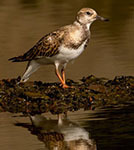 9/7 – Cohoes, HRM 157: At first light today, I spotted a ruddy turnstone (Arenaria interpres) foraging at the Cohoes Flats. The uncommon shorebird shared the Flats with a semipalmated plover a few dozen feet away and a flock of pectoral sandpipers. Other birds on-site were Bonaparte’s gull and a pied-billed grebe. (Photo of ruddy turnstone courtesy of Jim Yates) 9/7 – Cohoes, HRM 157: At first light today, I spotted a ruddy turnstone (Arenaria interpres) foraging at the Cohoes Flats. The uncommon shorebird shared the Flats with a semipalmated plover a few dozen feet away and a flock of pectoral sandpipers. Other birds on-site were Bonaparte’s gull and a pied-billed grebe. (Photo of ruddy turnstone courtesy of Jim Yates)
- Zach Schwartz-Weinstein (Hudson-Mohawk Bird Club)
[Ruddy turnstone, a small shorebird, is an uncommon sighting in the Hudson Valley, usually only one or two each season during migration. We’d likely see more of them if we had more access to large lake shores. There have been stretches of nearly a decade where there are no reports at all.
- Zach Schwartz-Weinstein
9/7 – Esopus Meadows, HRM 87: It was early morning at the Esopus Lighthouse Park when I spotted a shorebird fly in over the water chestnut beds, a flock of blue-winged teals, and a couple of pied-billed grebes. It was a ruddy turnstone. There were no other shorebirds around. I took a walk to get a better view and found it, not surprisingly, flipping stones and foraging on the shoreline.
- Jim Yates
Natural History Entries
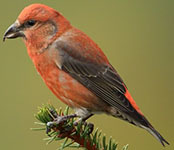 9/5 – Rensselaer County, HRM 155: At Grafton Lakes State Park, over the last week, we have spotted some lesser-seen songbird species including red crossbills, mostly feeding high up in white pines on the plentiful cones. Similarly, red-breasted nuthatches have been prolific and the most commonly seen and heard migrants. We've also seen warblers mixed in feeding flocks, including Canada, black-and-white, and Cape May. Our commonly seen warblers, yellow-rumped, common yellowthroat, Blackburnian, and our beloved black-throated green have also been around. Other common feeding flock species we've seen are the black-capped chickadee, white-breasted nuthatch, tufted titmouse, brown creeper, golden-crowned kinglet, and red-eyed vireo. (Photo of red crossbill courtesy of Judd Patterson) 9/5 – Rensselaer County, HRM 155: At Grafton Lakes State Park, over the last week, we have spotted some lesser-seen songbird species including red crossbills, mostly feeding high up in white pines on the plentiful cones. Similarly, red-breasted nuthatches have been prolific and the most commonly seen and heard migrants. We've also seen warblers mixed in feeding flocks, including Canada, black-and-white, and Cape May. Our commonly seen warblers, yellow-rumped, common yellowthroat, Blackburnian, and our beloved black-throated green have also been around. Other common feeding flock species we've seen are the black-capped chickadee, white-breasted nuthatch, tufted titmouse, brown creeper, golden-crowned kinglet, and red-eyed vireo. (Photo of red crossbill courtesy of Judd Patterson)
- Mary Downey
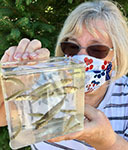 9/6 – Hamilton County, HRM 242: We hauled our seine in a quiet backwater of the Sacandaga River in the Town of Wells. Unlike previous adventures here, due to COVID-19, the shoreline was empty of observers but for us. Each haul produced 30-40 small fish of several different species, a mix of native as well as introduced fishes. 9/6 – Hamilton County, HRM 242: We hauled our seine in a quiet backwater of the Sacandaga River in the Town of Wells. Unlike previous adventures here, due to COVID-19, the shoreline was empty of observers but for us. Each haul produced 30-40 small fish of several different species, a mix of native as well as introduced fishes.
The two nonnative minnows we caught, fathead (Pimephales promelas) and bluntnose (P. notatus), can likely trace their ancestry to an angler’s bait bucket in the Sacandaga watershed. It is common practice for most anglers to set their bait free at the end of the day. Bait and tackle shops routinely purchase quantities of minnows from out-of-state wholesalers, thus fish from faraway places are introduced into the Hudson River watershed. Three native fishes in our seine were the fallfish (Semotilus corporalis; also, a minnow), pumpkinseed sunfish, and banded killifish. The water was 70 degrees Fahrenheit (F), at least ten degrees cooler than the warm water of the lower estuary. (Photo of minnows courtesy of Tom Lake)
- Audrey Pless, Phyllis Lake, Tom Lake
[In a world often overflowing with alien, invasive, and misplaced species, we often speak of “native” species as a counterpoint. When we ask students what we mean by native, we get answers like, “It has always been here.” But always is an inexact adverb. Since the Hudson Valley was covered with more than a mile of ice 20,000 years ago (no one was home), perhaps a better measure is to ask, “Was the plant, bird, fish, flower, or mammal here when the first Europeans arrived?” If so, it is native; if not it was introduced later on, thus nonnative. Tom Lake]
9/6 – Hudson River Watershed: Even a casual reader of the Hudson River Almanac will discover that seining is a common theme, most often pertaining to fisheries monitoring, research, and education.
A seine is a net with a float-line on top, a lead-line on the bottom, and tight meshes in between. The word seine is French, from the Latin sagëna, which means a fishing net designed to hang vertically in the water, the ends of which are drawn together to enclose the fish. Those referenced in the Almanac range in length from 15-to-200-feet-long, four-to-eight-feet in depth, and mesh size from quarter-inch to three-inches depending upon the target fish. They are an excellent tool used to sample an area and collect aquatic animals generally without injuring the catch. Haul seines, long nets that required a boat to set and many strong arms to haul, were used in Hudson River commercial fishing from Colonial times until the last decade of the 20th century. In the decades following World War II, Ossining’s Henry Gourdine and his crew set a haul seine in Haverstraw Bay and the Tappan Zee with a mile of mesh in pursuit of American shad, striped bass, and sturgeon. Haul seines have since been outlawed; in the hands of competent fishers, they were simply too efficient.
- Tom Lake
9/5 – Bedford, HRM 35: Among the 17 migrating raptors today at the Bedford Audubon Chestnut Ridge Hawkwatch, broad-winged hawk was high count with five. Non-raptor migrants included cedar waxwings (50), ruby-throated hummingbirds (10), monarch butterflies (9), and one common nighthawk.
- Richard Aracil, Jack Kozuchowski, Karen Troche, Pedro Troche
9/5 – Hook Mountain, HRM 31: We counted 41 migrating raptors at the Hook Mountain Hawkwatch today. Osprey was high count with ten. Non-raptor migrants included five ruby-throated hummingbirds.
- Kyle Bardwell, Felicia Napier, Steve Sachs, Tim Brew
9/6 – Saugerties, HRM 102: Some friends of the Saugerties Lighthouse reported seeing the long-term resident harbor seal from their boat just north of the lighthouse. This was Day 397 for the male harbor seal in the vicinity of Saugerties-Esopus Creek.
- Patrick Landewe
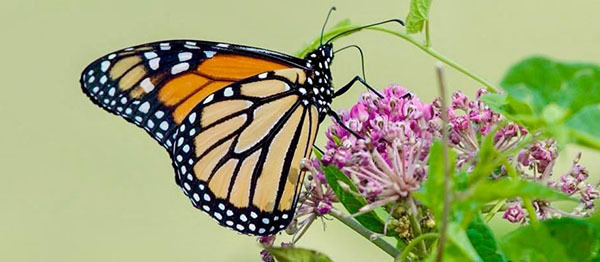
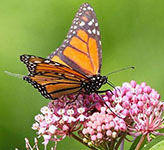 9/6 – Bedford, HRM 35: We counted the most one-day migrating raptors so far this season today at Bedford Audubon Chestnut Ridge Hawkwatch. Among the 42 migrating raptors, osprey was high count with 19. Non-raptor migrations included ruby-throated hummingbirds (16), common nighthawks (24), all in the last hour of the watch, and our highest number of monarchs this season (91). (Photo of monarch butterfly courtesy of Terry Hardy) 9/6 – Bedford, HRM 35: We counted the most one-day migrating raptors so far this season today at Bedford Audubon Chestnut Ridge Hawkwatch. Among the 42 migrating raptors, osprey was high count with 19. Non-raptor migrations included ruby-throated hummingbirds (16), common nighthawks (24), all in the last hour of the watch, and our highest number of monarchs this season (91). (Photo of monarch butterfly courtesy of Terry Hardy)
- Richard Aracil, Karen Troche, Pedro Troche
[This is the season of the southbound flight of the monarch butterfly (Danaus plexippus). It is estimated that as many as 500,000 monarchs strike off for the south and southwest from late August, through September, and into October until the first killing frost arrives.
It is thought that their migration is triggered by lessening daylight, the angle the sun, and generally lowering air temperatures. They ride cold fronts during the day, sometimes covering as much as eighty miles. Traveling south, they congregate in night roosts in large numbers on points of land at the river’s edge, waiting for a breeze to help them across. On some September nights, you can find them roosting in trees on Denning’s Point (Dutchess County) and Sarah’s Point (Westchester County) waiting, sometimes a day or two, for just the right following breeze to lift them up and over the river.
Most monarchs arrive in Mexico by November to the Oyamel fir (Abies religiosa) forests of the Sierra Madre Mountains of Mexico. They winter in the same 11-12 mountain areas, twenty colonies, at elevations of 7,200-10,800-feet above sea level. Monarchs roost together to stay warm with tens of thousands clustering on a single tree. They will stay there until mid-March when lengthening daylight, an increased angle of the sun, and generally rising air temperatures encourages their northward migration.
The northward migration will include four generations of monarchs. Generation one monarchs are the offspring of the monarchs that wintered in Mexico. Each successive generation travels farther north and it will take three more generations to reach the northern United States and Canada. The fourth and final generation will spend the summer in their northern reach until early autumn when they instinctively sense the changes that will, once again, have them heading south to complete the cycle.
- Tom Lake]
9/6 – Hook Mountain, HRM 31: We counted 24 migrating raptors at the Hook Mountain Hawkwatch today. Broad-winged hawk was high count with eight. Non-raptor migrants included two monarch butterflies.
- Felicia Napier
*** Fish of the Week ***
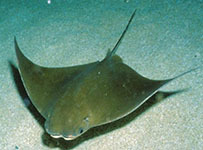 9/7 – Hudson River Watershed: Fish-of-the-Week for Week 87 is the cownose ray (Rhinoptera bonasus), number 11 (of 234), on our Hudson River Watershed List of Fishes. If you would like a copy of our list, e-mail: trlake7@aol.com 9/7 – Hudson River Watershed: Fish-of-the-Week for Week 87 is the cownose ray (Rhinoptera bonasus), number 11 (of 234), on our Hudson River Watershed List of Fishes. If you would like a copy of our list, e-mail: trlake7@aol.com
[The cownose ray is a cartilaginous marine fish species and the only member of its family (Rhinopteridae) in the watershed. They are native to the northwestern Atlantic and are found along the coast, entering into estuaries, from southern New England to northern Florida. Cownose rays have strong, specially adapted teeth that they use to crush clams, oysters, and other shellfish. They are reported to get to 3-feet-across their elliptical, nearly round body.
The cownose ray was added to our fish list on August 29, after Bob Schmidt, Bryan Weatherwax, and Jeremy Wright looked at a photo that accompanied a 1932 article in the Albany Times-Union telling the tale of a large skate or ray that had been caught in the Hudson River by anglers on August 4, 1932. They noticed that the fish in the 88-year-old photo was a cownose ray.
The literature cites conflicting records of abundance for the cownose ray in Chesapeake Bay, an estuarine complex that is frequently referenced as a somewhat analogous system: Hildebrand and Schroeder (1928) called it "very rare"; Murdy, Birdsong, and Musick (1977) called it "abundant," extending as far up the bay to Tilghman Island in brackish water [about 100 miles].” However, neither of them mentions occurrences or even inclinations of the fish being in freshwater.
As a result, the record of the cownose ray in full freshwater at the head of tide, nearly 160 miles from the open sea, remains as either a mystery, or an occasion where a fish traveled well beyond its literature. (Photo of cownose ray courtesy of Dan Grubbs)
- Tom Lake
9/7 – Bedford, HRM 35: There was a very small flight today at the Bedford Audubon Chestnut Ridge Hawkwatch. It pretty much stopped when the southeast wind picked up in the afternoon. Among the twelve migrating raptors, broad-winged hawk and osprey were high count with four each. Non-raptor migrants included a dozen ruby-throated hummingbirds.
- Tait Johansson, Karen Troche, Pedro Troche
9/7 – Hook Mountain, HRM 31: We counted 28 migrating raptors at the Hook Mountain Hawkwatch today. Osprey was high count with 16. Non-raptor migrants included a ruby-throated hummingbird.
- Ajit I. Antony
9/8 – Bedford, HRM 35: Among the 22 migrating raptors today at the Bedford Audubon Chestnut Ridge Hawkwatch, osprey was high count with eight. It was quite slow overall, with a noticeable lack of vultures and red-tailed hawks throughout most of the day. Non-raptor migrants included ruby-throated hummingbirds (19) and monarch butterflies (5).
- Richard Aracil, Julia Berliner, Pedro Troche
9/8 – Hudson River Watershed: Seining primer, continued: Students often ask, "Why do we seine?" Seining is like a mystery. Seining is a doorway into the river that we cannot otherwise see. We seine for knowledge, for the magic of discovery. The anticipation renders seining like a romance. As the net comes in, the experience can be akin to opening a birthday present. Most of all, seining is like reading a book and each page holds some new magic for us.
Seining has become a tool for a cross section of users, for a variety of purposes. It takes the term "real time" to its core. Most of the basic environmental education we do is reflective on what has been done before. However, every time we haul a seine, we are having a unique experience: all of its components never come together in exactly the same way, from the environment, to the river, to our catch.
Seining uncovers the cryptic nature of fishes. It is not birding. It is not butterflying. It is not identifying trees through their leaves. Those are all endeavors that are often easy and obvious. When we stand on a beach with students and extend our arms to points north and south and tell them there are a million fish across that reach of the river, they must take our word for it. All they see is blue-gray water. But then we haul a seine a hundred feet, slide it up on the sand, and out spills a hundred fish. You can almost hear them doing the math to incorporate the immensity of the river.
- Tom Lake
9/8 – Hook Mountain, HRM 31: We counted five migrating raptors at the Hook Mountain Hawkwatch today, three osprey and two bald eagles. Non-raptor migrants included a ruby-throated hummingbird.
- John Phillips
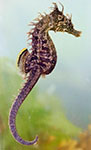 9/8 – Manhattan, HRM 2: Our Hudson River Park’s River Project Staff checked the sampling and collection gear that we deploy off Pier 40 in Hudson River Park. Fittingly, our crab pot had collected eight young-of-season blue crabs (10-65 millimeters (mm)). The pot also had four young-of-year oyster toadfish (35-55 mm) and a lined seahorse (65 mm). (Photo of lined sea horse courtesy of Chris Bowser) 9/8 – Manhattan, HRM 2: Our Hudson River Park’s River Project Staff checked the sampling and collection gear that we deploy off Pier 40 in Hudson River Park. Fittingly, our crab pot had collected eight young-of-season blue crabs (10-65 millimeters (mm)). The pot also had four young-of-year oyster toadfish (35-55 mm) and a lined seahorse (65 mm). (Photo of lined sea horse courtesy of Chris Bowser)
-Toland Kister, Olivia Radick
(1 inch = 25.4 millimeters (mm))
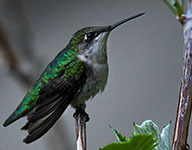 9/9 – Bedford, HRM 35: Among the 22 migrating raptors today at the Bedford Audubon Chestnut Ridge Hawkwatch, osprey and American kestrel were high count with nine each. Non-raptor migrants included ruby-throated hummingbirds (13), monarch butterflies (13), and common nighthawks (7). (Photo of ruby-throated hummingbird courtesy of Deborah Tracy Kral) 9/9 – Bedford, HRM 35: Among the 22 migrating raptors today at the Bedford Audubon Chestnut Ridge Hawkwatch, osprey and American kestrel were high count with nine each. Non-raptor migrants included ruby-throated hummingbirds (13), monarch butterflies (13), and common nighthawks (7). (Photo of ruby-throated hummingbird courtesy of Deborah Tracy Kral)
- Richard Aracil, Jack Kozuchowski, Julia Berliner, Tait Johansson
9/10 – Hudson River Watershed: Seining primer, finale: It is not rare to find ancestral Indian artifacts, primarily stone tools, on Hudson River beaches. They generally range from knives, projectile points, scrapers, and hammerstones, to netsinkers and fire-cracked rock from long-ago hearths.
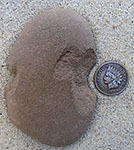 From those assemblages, there is very good evidence that the first of us in the Hudson Valley, as long ago as 12,000 years, manufactured and used nets made of native materials to capture fish. Almost all of their gear has bio-degraded except for net sinkers, small, palm-size pebbles, usually fashioned from soft sedimentary rock. They are recognizable by notches pecked on either side around which natural cordage was used to fasten them to the bottom of a net. Gourds may have been used for floats. From those assemblages, there is very good evidence that the first of us in the Hudson Valley, as long ago as 12,000 years, manufactured and used nets made of native materials to capture fish. Almost all of their gear has bio-degraded except for net sinkers, small, palm-size pebbles, usually fashioned from soft sedimentary rock. They are recognizable by notches pecked on either side around which natural cordage was used to fasten them to the bottom of a net. Gourds may have been used for floats.
It is not rare to find a stone net sinker on a Hudson River beach. At archaeological sites, net sinkers are often found in the same context as smoking huts or smoking platforms. While prehistoric stone artifacts such as net sinkers are timeless in terms of form and function, being inorganic they cannot be precisely dated. A stone net sinker could have been used 1,000 years ago by ancestral Mohicans, or 12,000 years ago by Late Pleistocene foragers. However old, simply holding one of these in your hand takes you to a far different beach, on a long-ago day, in the company of kindred souls. Tom Lake] (Photo of net sinker courtesy of Tom Lake)
- Tom Lake
9/11 – Manhattan, HRM 2: Our Hudson River Park’s River Project Staff checked the sampling and collection gear that we deploy off Pier 40 in Hudson River Park. Our overnight crab pot had collected with six blue crabs, two of which were tiny “bugs” (10-20 mm), along with four larger crabs (110-160 mm). As often happens, they shared the pot with three oyster toadfish, two young-of-year (40-60 mm), and one adult (245 mm). The star of the lift, however, was a gorgeous little young-of-year black sea bass (80 mm).
-Siddhartha Hayes, Anna Koskol
*** A Look-Back 19 years to 9-11-2001, from the Hudson River Almanac VIII ***
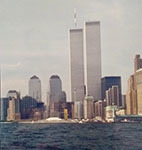 9/11 – Manhattan, HRM 0: It was 392 years ago today, in a relatively idyllic time, that the residents of Manhattan, indigenous Algonkian-speakers, marveled as Henry Hudson and his crew sailed the Half Moon to the edge of their island. On that day, the native people suffered a loss of innocence and, eventually, a grievous change to their culture. Today, on that anniversary, the Island's residents suffered yet another profound loss of innocence amidst the smoke and destruction in lower Manhattan. (Photo of World Trade Center tower courtesy of Tom Lake) 9/11 – Manhattan, HRM 0: It was 392 years ago today, in a relatively idyllic time, that the residents of Manhattan, indigenous Algonkian-speakers, marveled as Henry Hudson and his crew sailed the Half Moon to the edge of their island. On that day, the native people suffered a loss of innocence and, eventually, a grievous change to their culture. Today, on that anniversary, the Island's residents suffered yet another profound loss of innocence amidst the smoke and destruction in lower Manhattan. (Photo of World Trade Center tower courtesy of Tom Lake)
- Tom Lake
9/11 – Putnam County, HRM 55: Driving south on Route 9 in mid-morning, I heard a loud roar and was shocked to see a Boeing 767 passenger jet pass very close overhead heading due south. [I later learned that this was American Airlines Flight 11 out of Boston’s Logan International Airport.]
- Tom Lake
9/11 – Croton Point, HRM 35: Christopher Letts and I were on the beach at Croton Point and we had left our truck radios on as we prepared for our morning school program [American Airlines flight 11 hits the North Tower at 08:46.26].
The school bus arrived with second graders from Coman Hills Elementary in Armonk. They disembarked and were led across a wide grassy field to where we waited on the beach [United Airlines flight 175 hits the South Tower at 09:02.54].
After introductions, we familiarized the student as to where we were on the Hudson River: Thirty-five miles upriver from the Battery (34 miles from the World Trade Centers), and about 120 miles from the head of tide at Troy.
As we began to haul our seine through the grassy shallows thick with wild celery, we positioned the children facing us, away from downriver. A rising trace of smoke, a smudge on an otherwise brilliant blue sky, was on the horizon. Young-of-year striped bass (65-95 mm) dominated our catch, along with a dozen young-of-year tautog (47-54 mm). Each tautog, or blackfish, told a story of its habitat: those caught in the beds of wild celery were a perfect camo-green match; those from the beds of water milfoil were a brighter green; those from the fringes of the light-and-dark sandy bottom flecked with white oyster shells were mottled brown with white specks [the South Tower collapses at 09:59.04].
From the open water adjacent to the grass beds we caught a half-dozen young-of-year bluefish (100-130 mm). We were surprised to find that there were no comb jellies in the shallows. The water temperature was 77 degrees F. The salinity was 7.8 parts-per-thousand (ppt).
By the time the children left us for their ride back to school, their innocence was still intact. They were not aware of anything other than the adults were in a tizzy. They also had a guarded sense of our estuary’s magic and that life was going on [the North Tower collapses at 10:28.31].
- Tom Lake, Christopher Letts
9/11 – Manhattan, HRM 0: Our New Netherlands Museum’s replica of Henry Hudson’s Half Moon was anchored in the Upper Bay of New York Harbor just offshore of the World Trade Center. Coincidently, this was the very spot where, 392 years to the day earlier, the original Half Moon anchored at the same spot.
We were sailing on a Voyage of Discovery, an annual re-creation of the September 1609 voyage of the Half Moon. On board were students from Rensselaer Middle High School, Philip Livingston Magnet Academy, and Bethlehem Central Middle School.
What did the students see? This was a legitimate concern about the impact of the monumental events that unfolded right before our eyes. People are naturally inclined to assume that horrific images of destruction and evil are those that last. But other more profound images emerged at an even deeper and stronger level.
First, the students saw themselves respond immediately, competently and maturely, working as a team to weigh anchor, get the sloop underway, and organize the vessel for protracted operations in conditions that we could not predict. While we could have implemented these actions with only our adult crew, our students took the initiative in the manner in which they had been trained earlier in the voyage. Without any explicit statement to this effect, they shouldered these adult responsibilities and carried them well.
With Bob Sabo in the engine room, we proceeded north. Powerful images unfolded before our eyes. Tens of thousands of people massed along the shoreline where they had become trapped after evacuating buildings. Fireboats like the John Harvey, tugboats, ferries, and commercial vessels from all parts of the harbor moved immediately to their aid. These vessels, overladen with people, moved back and forth from the Battery to New Jersey and Brooklyn. As the towers of the World Trade Center collapsed with a massive explosion, clouds of debris obscured lower Manhattan and reduced visibility on the nearby water to zero. Yet we watched these vessels move deliberately from safety into the fog, putting themselves at grave risk in order to aid those on the shore.
Farther along, we could see a river of people and cars fleeing Manhattan. Every movement of people was north, except for the countercurrent of fire trucks, ambulances, and emergency vehicles of all types moving at maximum speed, carrying rescue workers into the area of maximum danger and need. During the hours it took us to reach the George Washington Bridge, the flow of rescue workers moving south into the danger zone never ceased.
We communicated to the schools in the morning that we were safe, but it was early afternoon before we were finally able to establish direct contact both to confirm our safety and to learn that our own families and communities were safe. By late afternoon we had reached our home port and the safety of King Marine in Verplanck, about forty miles north of the World Trade Center. Never have dock lines felt as secure as those put down that afternoon by Randy King.
We were met by Karen Urbanski, the Rensselaer Middle High School principal, who came with a school bus and counselors from Rensselaer, Philip Livingston Magnet Academy, and Bethlehem Central Middle School.
By late evening our students and their families were rejoined in a joyful reunion for our personal return, yet somber for the tragedy inflicted upon our country.
- William "Chip" Reynolds, Captain of the Half Moon
9/11 – New York Harbor, Upper Bay: What to say, and what to do when the unspeakable happens? On a boat heading back from Ellis Island, jet black plumes of smoke issued up from hell itself where the World Trade Center once stood. They were still smoking after ten hours. The triage center I thought I’d help staff at Ellis Island went completely unused. There was no need for one – the saddest truth of all.
- Dave Taft, National Park Service
9/11 – Arboretum Point, NJ, HRM 16: An osprey, soaring north over the Hudson through a blue September sky, drew my eyes away from the rising gray plume. And I found, for a moment, solace.
- Sandy Bonardi
9/11 – New York Harbor, Upper Bay: Meanwhile, watching from the boat, dozens of tree swallows careened through the hideous smoke. I felt physically ill wondering how the birds maneuvered through the burning papers that still fell through this mess. My mind wandered almost drunkenly, somehow coming to rest upon the subject of places I’d fished all through this besieged harbor. In my mind, stripers took flies, sand worms, and eels off this wall or that abutment, this rip or that hole. Back in reality, thick smoke billowed over one particular “hot spot” where bass hit bait presented “just so” against a seawall last November. It was all oddly engrossing, but there was still no comfort in any of it.
- Dave Taft
9/12 – New York Harbor, Upper Bay: A day later, a bird watcher confided to me that on September 11 he’d watched from the Brooklyn promenade just across the East River as two immature bald eagles rode thermals over what had been the World Trade Center. Feeling guilty, he confessed to watching the birds and not the flames. I assured him it seemed perfectly natural and admitted that I too had been thinking of the fish and the river while watching the disaster play out.
- Dave Taft
9/12 – Croton Point, HRM 34.5: The quarter moon and Venus were sharply etched overhead when we arrived. We climbed to the highest point on the landfill to offer our prayers at sunrise: peace for those who were lost, succor for those still trapped, solace for all of us in this hard, hard time. The sun rose, a flock of bobolinks called from overhead, a monarch butterfly flexed its wings on a clump of goldenrod. We turned toward home. The commuter parking lot at the Croton-on-Hudson railroad station was half-filled with vehicles at a time when it should have been almost empty. Parked there less than twenty-four hours before, their owners had not been able to return to them at the end of the workday. We said another prayer.
- Christopher Letts, Nancy Letts
- Aftermath
Eagles, eagles, soaring so high
Flying in a grand, grand sky.
Looking down at the ground
Not making a single sound.
Elegance in their flight
What a sight!
Proud to be an American bird,
Symbol of strength, power, and courage.
- Shan Ahmad, The River School
9/12 – Manhattan, HRM 0: Rescue workers in the rubble of the former World Trade center encountered water seeping into the lower, and below ground, levels. They wondered where it was coming from. Four-hundred years ago that area had been a tidemarsh.
- Tom Lake
9/14 – Croton Point, HRM 35: Another class of second graders from Coman Hills Elementary in Armonk joined us on the beach. Much as they had three days before, as though nothing had occurred in the interim, our net filled with hundreds of young-of-year fish, predominantly striped bass and white perch. The by-catch was similar: scores of Atlantic silverside, a half-dozen more tautog (69-95 mm), two dozen bluefish (100-130 mm), and three golden shiners. The water temperature was 77̊ degrees F; the salinity was 7.5 ppt.
- Tom Lake, Christopher Letts
*** End of Look-Back ***
9/11 – Bedford, HRM 35: Best numbers of the season at the Bedford Audubon Chestnut Ridge Hawkwatch. Among the 71 migrating raptors, broad-winged hawk was high count with 43. Non-raptor migrants included 54 chimney swifts, 28 double-crested cormorants, and 13 monarch butterflies.
- Richard Aracil, Julia Berliner, Pedro Troche
9/11 – Hook Mountain, HRM 31: We counted 67 migrating raptors at the Hook Mountain Hawkwatch today. Osprey was high count with 26, two of which were carrying fish. Of the 18 migrating American kestrels, seven were male, six were female, and the other five could not be sexed. Non-raptor migrants included two ruby-throated hummingbirds,136 chimney swifts, and 47 double-crested cormorants.
- Ajit I. Antony, Liza Antony
Fall 2020 Natural History Programs
2020 I Bird NY Challenges are open now!
Are you 16 years or younger and live in New York State? If you have an interest in birds, try the I Bird NY challenge! Find 10 common New York bird species and we'll send you a special certificate for taking the challenge. You will also be entered into a random drawing for birding accessories. Download our I Bird NY Beginner's Challenge form (PDF) and get started today. The Beginner's Challenge is also available in Spanish (PDF).
The Experienced Birder Challenge: If you are already a birder, take your birding to the next level by taking the I Bird NY Experienced Birder Challenge! The wide variety of habitats found in New York State support more than 450 different bird species. Find any 10 (or more) different bird species to complete the challenge. Find a lifer? Let us know! Complete and submit the Experienced Birder Challenge entry sheet (PDF) for a chance to be entered in a random drawing for birding accessories. The Experienced Birder's Challenge is also available in Spanish (PDF).
DEC Seeks Birdwatchers to contribute to 2020 Breeding Bird Atlas
NYSDEC Commissioner Basil Seggos has announced a call for citizen-science volunteers to help in the development of a comprehensive, statewide survey that takes place every two decades to detail New York’s breeding bird distribution. Starting in 2020, five years of field surveys will be conducted by volunteers and project partners to provide the data that will be analyzed to create the third New York State Breeding Bird Atlas.
DEC is partnering with the New York Natural Heritage Program, SUNY College of Environmental Science and Forestry (ESF), Audubon New York, Cornell Lab of Ornithology, New York State Ornithological Association, and New York Cooperative Fish and Wildlife Research Unit on this project. When complete, the atlas will provide species-specific details about distribution, maps, and illustrations. The last atlas was published in 2008, with information on its results available on DEC’s website. The 2020 atlas will provide data on changes in species distribution and climate change’s potential impact on wildlife.
To participate, volunteers can make a free eBird account and submit data online through the atlas website (ebird.org/atlasny) or via the eBird mobile app. Simply record the species and any breeding behaviors observed. All sightings can count. As observations are reported, data can be viewed here: https://ebird.org/atlasny/state/US-NY.
Hudson River Miles
The Hudson is measured north from Hudson River Mile 0 at the Battery at the southern tip of Manhattan. The George Washington Bridge is at HRM 12, the Tappan Zee 28, Bear Mountain 47, Beacon-Newburgh 62, Mid-Hudson 75, Kingston-Rhinecliff 95, Rip Van Winkle 114, and the Federal Dam at Troy, the head of tidewater, at 153. The tidal section of the Hudson constitutes a bit less than half the total distance – 315 miles – from Lake Tear of the Clouds to the Battery. Entries from points east and west in the watershed reference the corresponding river mile on the mainstem.
To Contribute Your Observations or to Subscribe
The Hudson River Almanac is compiled and edited by Tom Lake and emailed weekly by DEC's Hudson River Estuary Program. Share your observations by e-mailing them to trlake7@aol.com. To subscribe to the Almanac (or to unsubscribe), use the links on DEC's Hudson River Almanac or DEC Delivers web pages.
Discover New York State
The Conservationist, the award-winning, advertisement-free magazine focusing on New York State's great outdoors and natural resources. The Conservationist features stunning photography, informative articles and around-the-state coverage. Visit The Conservationist webpage for more information.
Useful Links
National Oceanic and Atmospheric Administration online tide and tidal current predictions are invaluable when planning Hudson River field trips. For real-time information on Hudson River tides, weather and water conditions from sixteen monitoring stations, visit the Hudson River Environmental Conditions Observing System website.
DEC's Smartphone app for iPhone and Android is now available at: New York Fishing, Hunting & Wildlife App.
PLAY SMART * PLAY SAFE * PLAY LOCAL: Get Outside Safely, Responsibly, and Locally
New York State is encouraging residents to engage in responsible recreation during the ongoing COVID-19 public health crisis. NYSDEC and State Parks recommendations for getting outside safely incorporate guidance from the Centers for Disease Control and Prevention and the NYS Department of Health for reducing the spread of infectious diseases.
DEC and State Parks are encouraging visitors to New York's great outdoors to use the hashtags #PlaySmartPlaySafePlayLocal, #RecreateResponsibly, and #RecreateLocal on Facebook, Twitter, and Instagram to share their visit and encourage others to get outside safely, responsibly, and locally, too. Use the DECinfo Locator to find a DEC-managed resource near you and visit the State Parks website for information about parks and park closures.
Take the Pledge to PLAY SMART * PLAY SAFE * PLAY LOCAL: Enjoy the Outdoors Safely and Responsibly
1. I pledge to respect the rules and do my part to keep parks, beaches, trails, boat launches, and other public spaces safe for everyone.
2. I will stay local and close to home.
3. I will maintain a safe distance from others outside of my household.
4. I will wear a mask when I cannot maintain social distancing.
5. I accept that this summer, I may have to adjust how I enjoy the outdoors to help keep myself and others healthy and safe, even if it means changing my plans to visit a public space.
6. I will be respectful of others by letting them pass by me if needed on a trail and keeping my blanket ten feet apart from others on the beach.
7. I will move quickly through shared areas like parking lots, trailheads, and scenic areas to avoid crowding.
8. If I'm not feeling well, I will stay home.
Information about the Hudson River Estuary Program is available on DEC's website at http://www.dec.ny.gov/lands/4920.html.
|