A Project of the Hudson River Estuary Program
Compiled and edited by Tom Lake, Consulting Naturalist
COVID-19 Guidance for Enjoying the Outdoors
While enjoying outdoor spaces, please continue to follow the CDC/NYSDOH guidelines for preventing the spread of colds, flu, and COVID-19. To find out more about enjoying DEC lands and New York's State Parks, visit DEC's website Play Smart*Play Safe*Play Local; https://www.dec.ny.gov/outdoor/119881.html
Keep at least six (6) feet of distance between you and others.
Wear a cloth face covering in public settings where social distancing measures are difficult to maintain.
Avoid close contact, such as shaking hands, hugging, and kissing.
Wash hands often or use a hand sanitizer when soap and water are not available.
Avoid surfaces that are touched often, such as doorknobs, handrails, and playground equipment.
DEC recommends avoiding busy trailheads. Find the trails less traveled and visit when trails may not be as busy during daylight hours.
Overview
Due to a pause for Labor Day, we are presenting a double-Almanac this week. Highlights include two very rare bird visits, the addition of a new species for our watershed fish list, and the continuing presence of the harbor seal at Saugerties, now nearly 13 months “in residency.” Hummingbirds and monarchs were streaming south, but the autumn raptor migration was progressing very slowly.
Highlight of the Week
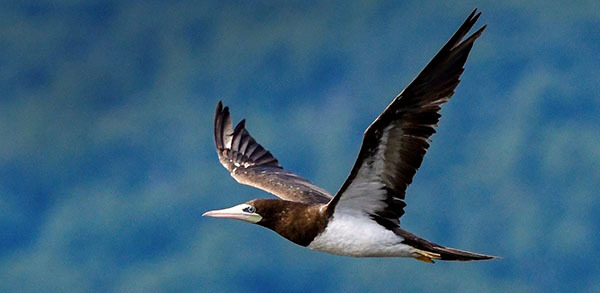
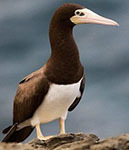 8/31 – Ulster County, HRM 92: A brown booby, first seen and reported by Andrew Block, was still at the Ashokan Reservoir this morning actively feeding with the gulls and cormorants. (Brown Booby photo courtesy of Jan Dunn) 8/31 – Ulster County, HRM 92: A brown booby, first seen and reported by Andrew Block, was still at the Ashokan Reservoir this morning actively feeding with the gulls and cormorants. (Brown Booby photo courtesy of Jan Dunn)
- Wendy Tocci (Hudson-Mohawk Bird Club)
[The brown booby (Sula leucogaster) is a large seabird of the booby family (Sulidae) and is its most common and widespread species. Roger Tory Peterson described its range, quite generally, as “tropical oceans.” In the U.S., they are nowhere common but are occasionally seen along the Gulf Coast and as strays northward along the Atlantic Coast. This appears to be the twelfth record for New York State, most of them on the coast. One inland record, adjacent to our watershed, occurred on Lake Champlain in August 2014. Tom Lake]
Natural History Entries
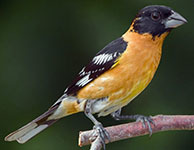 8/22 – Albany County, HRM 143: This evening at the Black Creek Marsh Wildlife Management Area on Hennessy Road, we spotted a male black-headed grosbeak (Pheucticus melanocephalus) perched in a snag with four mourning doves. The bird appeared to be first-winter male with a striking head pattern of black-and-white, a large, grayish, two-toned bill, and a brilliant orange, unmarked chest extending into the chin and onto the nape. (The black-headed is separated from the rose-breasted grosbeak by bill color and streak-free breast.) (Black-headed grosbeak photo courtesy of Eric Ellings) 8/22 – Albany County, HRM 143: This evening at the Black Creek Marsh Wildlife Management Area on Hennessy Road, we spotted a male black-headed grosbeak (Pheucticus melanocephalus) perched in a snag with four mourning doves. The bird appeared to be first-winter male with a striking head pattern of black-and-white, a large, grayish, two-toned bill, and a brilliant orange, unmarked chest extending into the chin and onto the nape. (The black-headed is separated from the rose-breasted grosbeak by bill color and streak-free breast.) (Black-headed grosbeak photo courtesy of Eric Ellings)
- Frank Mitchell, Catherine Mitchell (Hudson-Mohawk Bird Club)
[The black-headed grosbeak is very rare. There is one report from 1965 in eBird from Rich Guthrie in Dutchess County, and a couple more recent reports from New York City. That’s it. It is very rare, but not unheard of. John Kent (Hudson-Mohawk Bird Club)]
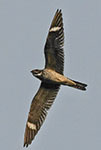 8/22 – Catskill, HRM 113: I saw my first flight of common nighthawks in two years. A group of at least forty birds entertained me for half-an-hour in early evening with their dizzying bug-hunting flight over my house in Catskill. They made me feel that some things were still okay in the world. (Common nighthawk photo courtesy of Deborah Tracy Kral) 8/22 – Catskill, HRM 113: I saw my first flight of common nighthawks in two years. A group of at least forty birds entertained me for half-an-hour in early evening with their dizzying bug-hunting flight over my house in Catskill. They made me feel that some things were still okay in the world. (Common nighthawk photo courtesy of Deborah Tracy Kral)
- Barry Wolven
[The common nighthawk is a New York State species of Special Concern. They are a crepuscular (nocturnal) member of the nightjar family (Caprimulgidae). Their erratic flight and angular wings are distinctive as it flies to catch insects. Deborah Tracy Kral, Ralph T. Waterman Bird Club]
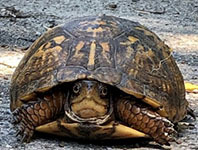 8/22 – New Hamburg, HRM 67.5: We were heading out to run errands this morning and, as we approached the end of our driveway, Jeff yelled STOP! Sitting on the edge of the drive was a beautiful eastern box turtle. As we picked it up to relocate it away from traffic, the turtle promptly closed the front of its shell, shutting the "box." We placed it away from harm into the nearby shrubbery and, by the time we returned, it had moved off to who knows where? While they are not rare in the Hudson Valley, this was only the second one I've encountered in 40 years of living here on our 1.3 square-acre Rabbit Island. (Eastern box turtle photo courtesy of David Cullen) 8/22 – New Hamburg, HRM 67.5: We were heading out to run errands this morning and, as we approached the end of our driveway, Jeff yelled STOP! Sitting on the edge of the drive was a beautiful eastern box turtle. As we picked it up to relocate it away from traffic, the turtle promptly closed the front of its shell, shutting the "box." We placed it away from harm into the nearby shrubbery and, by the time we returned, it had moved off to who knows where? While they are not rare in the Hudson Valley, this was only the second one I've encountered in 40 years of living here on our 1.3 square-acre Rabbit Island. (Eastern box turtle photo courtesy of David Cullen)
- David Cullen, Jeff Cullen
[The primary distribution of the eastern box turtle (Terrapene c. carolina) is southeastern New York State, including the Hudson Valley and Long Island. They can live 50-100 years and reach seven-inches carapace length. It might seem a bit ironic finding this box turtle on an island, since they prefer the uplands to water. However, Rabbit Island has a connection to the mainland. While not specifically protected in New York—since 1905, the turtle has been listed as a “game species” but with no open season—their conservation status is considered vulnerable. Tom Lake]
8/22 – Hook Mountain, HRM 31: On opening day at the Hook Mountain Hawkwatch a single osprey counted as our only migrating raptor. Non-migrating raptors included an adult bald eagle and three red-tailed hawks taking multiple swipes at our decoy-owl.
- Felicia Napier
[The Hook Mountain Hawkwatch began in 1971 as an all-volunteer endeavor with an independent group of raptor enthusiasts. The 2020 season is our 50th anniversary! The Hawkwatch is located on the Long Path north of Nyack. During our current COVID-19 pandemic, we are not encouraging groups to visit, but welcome individuals. All hawk watchers and visitors are required to wear masks and follow social distancing rules. If you have any questions, please contact me at merlin@pipeline.com. Trudy Battaly]
8/23 – Saugerties, HRM 102: Early this morning, I saw the seemingly resident male harbor seal near the base of the channel marker #93 at the end of the jetty at the mouth of Esopus Creek. Visitors to the Saugerties Lighthouse reported seeing the seal yesterday as well, following a kayak—not the first time the seal has been seen tailing kayakers. This was Day 383 for the male harbor seal.
- Patrick Landewe
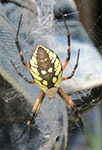 8/23 – Ulster County, HRM 84: I had been watching an orb spider for about a week in Rosendale when a praying mantis came along and made short work of her. Now the mantis is staying with the spider's web and eating hapless flies. The spider did manage to lay her eggs before her demise. (Orb spider photo courtesy of Jay Snow) 8/23 – Ulster County, HRM 84: I had been watching an orb spider for about a week in Rosendale when a praying mantis came along and made short work of her. Now the mantis is staying with the spider's web and eating hapless flies. The spider did manage to lay her eggs before her demise. (Orb spider photo courtesy of Jay Snow)
- Jay Snow
[Orb-weaver spiders are members of the Araneidae spider family. They are the most common builders of spiral wheel-shaped webs and are often found in gardens, fields and forests. "Orb," in English, mean circular, hence the English name of the group. There are at least a dozen orb-weaver spider species in New York State. C.D. Dondale, et al. (2003)]
8/24 – Saugerties, HRM 102: Approaching low tide this morning, we found two adult blue crabs, one male and one female. At first, we thought they were dead crabs but, after peeking under the carapace, we noticed that no one was home. These were moults. We usually find only males this far upriver, and this is the first time we can remember finding a female blue crab at the Saugerties Lighthouse.
- Patrick Landewe
8/25 – Ulster County, HRM 76: I checked 59 milkweed plants in the field in front of my house this morning and found two monarch butterfly caterpillars (Danaus p. plexippus) and two eggs. I found none in my back garden (three weeks ago I would find eggs every day). Maybe the female who was nectaring there left to begin her journey south.
So far, the 2020 season seems a little unusual. In the past, I could stand in a patch of milkweed and spot eggs on the leaves and, if lucky, a few large monarch caterpillars. This year I have been finding only eggs or very small caterpillars. When you are out, notice the passing monarchs flying in a southerly direction as their mystical migration begins.
- Betty Boomer
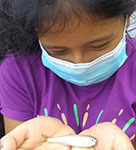 8/25 – Little Stony Point, HRM 55: The beach was empty at dawn, peaceful, not even a gull. We hauled our net in the dropping tide, and little by little we collected scores of seaward-migrating young-of-year fishes, including striped bass (53-79 millimeters (mm)), American shad (74-80 mm), and alewives (50-59 mm). 8/25 – Little Stony Point, HRM 55: The beach was empty at dawn, peaceful, not even a gull. We hauled our net in the dropping tide, and little by little we collected scores of seaward-migrating young-of-year fishes, including striped bass (53-79 millimeters (mm)), American shad (74-80 mm), and alewives (50-59 mm).
Before long, adults and children, big dogs and little dogs, all enraptured by the warm river water (80 degrees Fahrenheit (F)), many sharing curious minds, arrived on the beach. Soon we had 18 masked and socially-distanced beach-goers wanting to hear the story of the river. Silvery young-of-year bluefish (70-72 mm) were like jewels in the small viewing tanks and a tiny nickel-penny-sized blue crab in the palm of every child brought smiles and ticklish delight.
When we went to clear the net, we heard “What’s that?” Hidden in a fold of the mesh, in the back of the bag, was a single silvery-striped adult bay anchovy. Except for Rose Castillo’s sharp eyes, we would have missed it. (Bay anchovy photo courtesy of Tom Lake)
- Tom Lake, A. Danforth
(1 inch = 25.4 millimeters (mm))
8/26 – Little Stony Point, HRM 55: I was snorkeling in the north bay at Little Stony Point just after sunup. The water was 80 degrees F, and I could taste the slight salinity (3.0 parts-per-thousand (ppt)). The quiet ebb tide had settled most of the sediment in the water column, and I was left with about a thirty-inch field of vision, not terrible for estuarine tidewater. It was not unlike watching a snowy black-and-white TV.
There were no identifiable clouds of fish swirling around today. Schools passed in front of me just out sight—shadows, likely young-of-year striped bass. Frenetic silvery bands swept past as well—I guessed young-of-year alewives. As I drifted around the bay, I made an acquaintance with an eight-inch channel catfish and a few well-camouflaged tessellated darters. Swirls of curious spottail shiners came at my mask in 3-D.
I never knew how exquisite the electric blue of a damselfly could be until I watched one from underwater. As it hovered just off the surface, the sunlight refracted and reflected from a thousand facets–from insect to water ripples to my face mask. It was quite psychedelic.
- Tom Lake
8/26 – Bedford, HRM 35: On our first day of the season at the Bedford Audubon Chestnut Ridge Hawkwatch we saw some early movement with a few migrating osprey, northern harrier, broad-winged hawk, and American kestrel. Among the ten migrating raptors, broad-winged hawk was high count with four. Other migrants included ruby-throated hummingbirds (10) and monarch butterflies (4).
- Richard Aracil, Pedro Troche
[The observation point for the Hawkwatch at Chestnut Ridge is at an elevation of 770 feet, with a 180-degree view oriented to the east. Birders have been observing migrating raptors from Chestnut Ridge since at least 1978. Tom Lake]
8/26 – Hook Mountain, HRM 31: We counted thirteen migrating raptors at the Hook Mountain Hawkwatch today. Osprey was high count with five. The highlight was three bald eagles, two of them adults.
Non-raptors included eight common ravens.
- Felicia Napier, Steve Sachs
8/26 – Manhattan, HRM13.5: I visited Inwood Hill Park for the first time this year at a midday low tide. Growth was luxuriant along the inlet of Spuyten Duyvil Creek. Porcelain berry had invaded that area in great abundance. The little patch of horse nettle had spread greatly, but I saw only one flower among all the foliage.
Saltmarsh cordgrass (Spartina alterniflora) was competing with Phragmites and more porcelain berry in the little outlet channel of the boat basin. Elsewhere along the water, saltreed grasses (S. cynosuroides and S. alterniflora) were both flowering, but chairmaker’s bulrush (Scirpus americanus) was finished and false indigo had gone to seed as well.
Tiny flowers of marsh elder were opening and groundsel bush was budding. White sweet clover was blooming at the edge of the path, and a few flowers of bittersweet nightshade are visible among the porcelain berry. Yam-leaved clematis was starting to flower, and the big buds of rose mallow were numerous.
The Nature Center has been closed since Hurricane Sandy in 2012, and its reopening is now delayed by the COVID pandemic. The yard within the center’s fence was a riot of flora, wild and domestic: black-eyed Susan, common mullein, evening primrose (seven-feet-tall), spearmint, common milkweed, lamb’s quarters, clover, chicory, plantain, live-forever, sundrops, butterfly milkweed, field peppergrass, pokeweed, Pennsylvania smartweed, Echinacea, the small umbrella sedge (Cyperus strigosus), cardinal flower and several grasses. The jumbled carpet of foliage was sprinkled throughout with dayflower and quickweed.
- Thomas Shoesmith
8/26 – Manhattan, HRM13.5: On my visit to Inwood Hill Park, I was most pleased by the little “Three Sisters” garden that the Urban Park Rangers planted some years ago. It has been neglected, mostly if not completely, for years, but the maize was six-seven-feet-high, the squash had spread out through the fence and had several big blossoms beginning to open. The beans, not being close enough to the corn stalks to use as a trellis, had enthusiastically climbed the fence, producing flowers and several fine bean pods. Most of all, the maize had a couple of well-formed ears with copious cornsilk.
- Thomas Shoesmith
8/26 – Manhattan, HRM13.5: On a later visit to Inwood Hill Park, I was surprised as I took the path up through the Clove. The lower part is usually pretty damp, and at this season I expect to see abundant jewelweed, underlain with clearweed, but today it was mostly bare. However, both species were abundant higher up the path and on the ridge. Up on the ridge, Virginia knotweed was ubiquitous; garlic mustard, which had been abundant and spreading in recent years, seemed completely absent.
- Thomas Shoesmith
8/27 – Croton Point, HRM 35: We had an entry in the Hudson River Almanac on August 10 discussing an article that appeared in the Sunday edition of the Peekskill Highland Democrat newspaper for November 11, 1894. The article told us that “Mr. F. Walker shot two porpoises in the cove at Croton Point on Tuesday [November 6].” The article added that “They were shipped to New York markets …” In addition to being incredulous that someone would shoot porpoises and then report it in a newspaper, we wondered about the status of marine mammals in the late 19th century New York markets.
Historian Carolyn Hall researched the question and discovered that dolphins were on market lists in Philadelphia as long ago as 1804. In Thomas De Voe’s The Market Assistant (1975), he notes porpoises were in the “large and abundant” category of fish in the New York City markets of the time (1867). De Voe also listed dolphin and bottle-headed dolphin under “large and scarce.” Given that marine mammals were present in the markets of the 1860s and earlier, there is a good chance they were still being brought to market through the end of the 19th century.
- Tom Lake
8/27 – Bedford, HRM 35: There was some light movement, much as we saw yesterday, at the Bedford Audubon Chestnut Ridge Hawkwatch including osprey, northern harrier, broad-winged hawk, and American kestrel. Among the twelve migrating raptors, osprey was high count with six. Other migrants included three ruby-throated hummingbirds.
- Richard Aracil, Pedro Troche
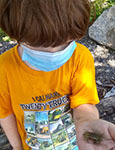 8/28 – Beacon, HRM 61: The strand line of the overnight high tide was bridled with tiderows of wild celery with blue crab moults sprinkled in. Tiny bay barnacles had adhered to some of the wild celery leaves. Our seine was taking a day off it seemed; the net collected just a handful of young-of-year striped bass (70-72 mm). The highlight was the dozen or so “bug” crabs. These are tiny, nickel-size, month-old blue crabs. Held in the palm of your hand, they scurry all over like little bugs. Despite an inch-of-rain overnight, the salinity held steady at 3.0 ppt. The water was 82 degrees F. (Blue crab photo courtesy of Tom Lake) 8/28 – Beacon, HRM 61: The strand line of the overnight high tide was bridled with tiderows of wild celery with blue crab moults sprinkled in. Tiny bay barnacles had adhered to some of the wild celery leaves. Our seine was taking a day off it seemed; the net collected just a handful of young-of-year striped bass (70-72 mm). The highlight was the dozen or so “bug” crabs. These are tiny, nickel-size, month-old blue crabs. Held in the palm of your hand, they scurry all over like little bugs. Despite an inch-of-rain overnight, the salinity held steady at 3.0 ppt. The water was 82 degrees F. (Blue crab photo courtesy of Tom Lake)
- Tom Lake, B.J. Jackson
[The strand line is the point of highest reach for a flood tide. Floatables get left, or stranded there, usually in a linear arrangement as the tide ebbs. Today’s leftovers included aquatic vegetation, crabs moults, fish skeletons and, all too often, human trash. Tom Lake]
8/28 – Bedford, HRM 35: There were some more early migrants today at the Bedford Audubon Chestnut Ridge Hawkwatch that included osprey, bald eagle, northern harrier, Cooper's hawk, broad-winged hawk, American kestrel, and peregrine falcon. Of the thirteen migrating raptors, bald eagle was high count with four. Non-raptor migrants included monarchs (10), ruby-throated hummingbird (10), and cedar waxwing (42)
- Richard Aracil, Pedro Troche
*** Fish of the Week ***
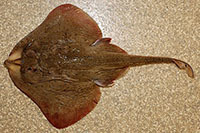 8/28 – Hudson River Watershed: Fish-of-the-Week for Weeks 85-86 is the barndoor skate (Raja laevis), number 9 (of 234), on our Hudson River Watershed List of Fishes. If you would like a copy of our list, e-mail: trlake7@aol.com 8/28 – Hudson River Watershed: Fish-of-the-Week for Weeks 85-86 is the barndoor skate (Raja laevis), number 9 (of 234), on our Hudson River Watershed List of Fishes. If you would like a copy of our list, e-mail: trlake7@aol.com
The barndoor skate (Dipturus laevis) is a cartilaginous marine fish species and one of two species from the family Rajidae (Skates) in the watershed, the other being the little skate (Raja erinacea). They are native to the northwestern Atlantic Ocean and are found from the Grand Banks of Newfoundland south to the Carolinas. They are one of the largest skates found in the North Atlantic reaching lengths up to 5-feet-long feeding on invertebrates and other fishes found near the ocean floor. It is common for beach-walkers to come upon the purse-like black egg cases of skates strewn on the beach at the strand line. They are a leathery pouch that protects a developing skate embryo and are known, colloquially, as “mermaid’s purse.”
When we first decided to feature the barndoor skate as the fish-of-the-week, we prepared an entirely different story to tell. A story that has subsequently been revealed as fiction. The barndoor skate’s inclusion on our Hudson River Watershed List of Fishes had been predicated solely upon a record of a single occurrence. That record began with a story in the Albany Times-Union from August 4,1932. It was a Thursday, in the midst of the Great Depression, when Frank Johnson and two fellow anglers went fishing in the tidewater Hudson a couple of miles upriver from Albany. The newspaper account reported that the anglers caught a large fish thought to be a skate or a ray, on a minnow, with rod and reel. It measured 55-inches total length and weighing 40 pounds. The fish’s head was reportedly donated to the New York State Museum where it was preserved in their fish collection. However, New York State Ichthyologist J.R. Greeley (1936), notes that during subsequent investigations of the specimen at the NYSM, it could not be found and appeared to be lost.
In August 2020, evidence came to hand that Frank Johnson’s fish was not a barndoor skate. It was something else entirely, and the barndoor skate had lost its place on our list. But, the barndoor skate immediately made a comeback. We recognize the East River as a Hudson River Tributary and Samuel Latham Mitchill first described the barndoor skate (1818) from a specimen caught in the East River. We had overlooked that bit of trivia, but we had found a way to keep the barndoor skate on our list. However, this also meant that we had to add Jack Johnson’s fish, the fish in the 1932 photo, to our Hudson River Watershed Fish List. (Barndoor skate photo courtesy of Andy Murch)
- Tom Lake
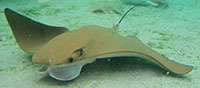 8/29 – North Albany, HRM 147: Today we added species number 234, the cownose ray (Rhinoptera bonasus), to the Hudson River Watershed List of Fishes 8/29 – North Albany, HRM 147: Today we added species number 234, the cownose ray (Rhinoptera bonasus), to the Hudson River Watershed List of Fishes
Ironically, the story of the cownose ray began when C. Lavett Smith, Curator of Fishes at the American Museum of Natural History, included the barndoor skate in his Inland Fishes of New York State (1986). He noted that the skate was caught in North Albany in 1932 and contributed to the New York State Museum fish collection, but he could not locate the specimen. In February 2018, Bob Schmidt and Bryan Weatherwax found a large skate specimen in a tank full of shortnose sturgeon that they carefully identified as a barndoor skate. The data associated with this specimen was consistent with the record in Smith’s book so they thought they had found the missing skate.
However, in August 2020, they looked at a photo that accompanied a 1932 article in the Albany Times-Union telling the tale of a large skate or ray that had been caught in the Hudson River by three anglers on August 4, 1932. Bob, Bryan, and Jeremy Wright noticed that the fish in the 88-year-old photo did not appear to be a barndoor skate, but rather was a cownose ray.
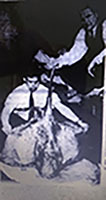 The 1932 article claimed that the head (of the cownose ray) was donated to the NYSM. Yet, there is no trace of it and no mention of a cownose ray in the NYSM fish collection. A mystery. In the past we have accepted bonafide/verifiable photographs of fish as evidence for inclusion in our Hudson River Watershed species list. Given the photographic evidence of a cownose ray from the Hudson River in 1932, we feel comfortable adding the species. But as for the barndoor skate, the collection data is clearly wrong, but where then did it come from? Still a mystery even with fish-in-hand. (Top left photo: Cownose Ray courtesy of Ben Raines; Bottom right photo: 1932 Albany Times Union cownose ray article with permission by Mike Spain, Editor, Albany Times Union) The 1932 article claimed that the head (of the cownose ray) was donated to the NYSM. Yet, there is no trace of it and no mention of a cownose ray in the NYSM fish collection. A mystery. In the past we have accepted bonafide/verifiable photographs of fish as evidence for inclusion in our Hudson River Watershed species list. Given the photographic evidence of a cownose ray from the Hudson River in 1932, we feel comfortable adding the species. But as for the barndoor skate, the collection data is clearly wrong, but where then did it come from? Still a mystery even with fish-in-hand. (Top left photo: Cownose Ray courtesy of Ben Raines; Bottom right photo: 1932 Albany Times Union cownose ray article with permission by Mike Spain, Editor, Albany Times Union)
- Tom Lake
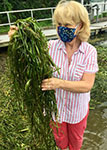 8/29 – North Germantown, HRM 109: One of the most productive spots to haul a net and find young-of-year shad and herring is the ramp of the NYSDEC boat launch. In midday, the tide was perfect, but the entire boat launch was choked with wild celery. We could see fish, albeit inaccessible, as we peeked between the mats of vegetation. Just as deciduous trees in the uplands give up their leaves in autumn, aquatic vegetation does as well. Undaunted, we struggled to find a very small open patch and managed to net a handful of young-of-year striped bass (63-77 mm). The river was 78 degrees F. (Wild celery photo courtesy of Tom Lake) 8/29 – North Germantown, HRM 109: One of the most productive spots to haul a net and find young-of-year shad and herring is the ramp of the NYSDEC boat launch. In midday, the tide was perfect, but the entire boat launch was choked with wild celery. We could see fish, albeit inaccessible, as we peeked between the mats of vegetation. Just as deciduous trees in the uplands give up their leaves in autumn, aquatic vegetation does as well. Undaunted, we struggled to find a very small open patch and managed to net a handful of young-of-year striped bass (63-77 mm). The river was 78 degrees F. (Wild celery photo courtesy of Tom Lake)
- Tom Lake, Phyllis Lake
[Wild celery (Vallisneria Americana) is a native aquatic plant that favors the river’s tidal shallows. Colloquially, it is referred to as “grass.” There is a Hudson River beach in Westchester County (river mile 35) that is called Senasqua. The name translates from an Algonkian dialect (probably Lenape) as “place of the grass.” The grass in the name was wild celery. Although the river is more ecologically dynamic today than it was a thousand years ago, there are still beds of resilient wild celery in the shallows at Senasqua. Tom Lake]
8/29 – Bedford, HRM 35: We did not see any raptor migration today at the Bedford Audubon Chestnut Ridge Hawkwatch. A persistent light mist and drizzle and generally poor conditions led to much-reduced visibility. Non-raptor migrations included 66 cedar waxwings in three flocks of about 20 birds each, a flock of bobolink (5), a ruby-throated hummingbird, and one monarch butterfly.
- Richard Aracil
8/30 – Bedford, HRM 35: This was the busiest day of the season thus far at the Bedford Audubon Chestnut Ridge Hawkwatch. Of the 26 migrating raptors, osprey was high count with 13. Non-raptor migrants included our highest one-day total this season for ruby-throated hummingbirds (33), seen throughout the day zipping to the west-southwest. We also counted four monarchs.
- Richard Aracil, Pedro Troche
8/30 – Hook Mountain, HRM 31: We counted ten migrating raptors at the Hook Mountain Hawkwatch today. Osprey and bald eagle were high count with four-each. Non-raptor migrations included ruby-throated hummingbirds (4), monarch butterflies (30), and common ravens (30 in a single group).
- Felicia Napier, Drew Panko, Steve Sachs, Tim Brew, Trudy Battaly
8/31 – Kowawese, HRM 59: This long and broad beach is a favorite for seining. However, this season it seems to have shifted from a strictly low-tide beach to a mid-tide beach (at low tide, we are now battling rocky hang-downs).
After a half-dozen hauls netting young-of-year striped bass (60-80 mm), American shad (74-81 mm), and alewives (55-63 mm), our last haul of the day was spectacular. The young-of-year fishes were absent and in their place was a bag-full of flashy Atlantic silverside (62-86 mm). The river was 79 degrees F, and the salinity was 2.5 ppt.
- Tom Lake, B.J. Jackson, T.R. Jackson
[Atlantic silverside is one of four silverside species (Atherinidae) in our watershed. They are a marine species that is found along the coast in bays and estuaries from the Gulf of Sant Lawrence to Florida. Atlantic silverside has long been a folkloric fish that can be "fried to a crisp and eaten whole" (Mervin Roberts). Spearing, their colloquial name, were "fried in cooking oil and sold in restaurants as whitebait" (Robert Boyle 1969). Tom Lake]
8/31 – Bedford, HRM 35: This was our best day this season so far at the Bedford Audubon Chestnut Ridge Hawkwatch. At one point, there was a mini-kettle of four raptors passing overhead, hopefully a good early-season sign of things to come. Among the 24 migrating raptors, broad-winged hawk was high count with ten. Non-raptor migrations included one ruby-throated hummingbird.
- Richard Aracil, Pedro Troche
8/31 – Hook Mountain, HRM 31: We counted 41 migrating raptors at the Hook Mountain Hawkwatch today. Broad-winged hawk was high count with 27.
- Vince Plogar
9/1 – Bedford, HRM 35: Despite the unfavorable conditions at the Bedford Audubon Chestnut Ridge Hawkwatch—rain most of the morning—some birds were moving. Among the eleven migrating raptors, broad-winged hawk was high count with four. Non-raptor migrations included ten ruby-throated hummingbirds and four monarch butterflies.
- Richard Aracil
9/1 – Hook Mountain, HRM 31: We counted nine migrating raptors at the Hook Mountain Hawkwatch today. Bald eagle was high count with four. Non-raptor migrations included one monarch butterfly.
- John Phillips
9/2 – Manhattan, HRM 2: Hudson River Park’s River Project Staff checked our sampling and collection gear that we deploy off Pier 40 in Hudson River Park. It may have been the full moon at work because our catch was impressive. Chief among the fishes were seven oyster toadfish, young-of-year to adults (45-245 mm), a gorgeous tautog (“blackfish”; 255 mm), a beautiful summer flounder (350 mm), and a dozen young-of–season blue crabs ranging (30-150 mm).
- Anna Koskol, Tina Walsh
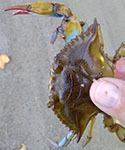 9/3 – Little Stony Point, HRM 55: The beach was deserted at first light. There is a magic that comes with being on this beach at dawn, seeing the promise of a new day as the sunlight captures the face of Storm King Mountain. Falling into the warm summer water felt like being in a cradle (77 F). There was not a ripple on the river, and the calm ambiance made catching fish seem secondary. But, the urge to know what was home today won out, and we made our hauls. 9/3 – Little Stony Point, HRM 55: The beach was deserted at first light. There is a magic that comes with being on this beach at dawn, seeing the promise of a new day as the sunlight captures the face of Storm King Mountain. Falling into the warm summer water felt like being in a cradle (77 F). There was not a ripple on the river, and the calm ambiance made catching fish seem secondary. But, the urge to know what was home today won out, and we made our hauls.
Given the summer catches that we were used to seeing, there were no surprises but, nonetheless, the fishes were welcome. They included young-of-year American shad (80-82 mm), alewives (76-80), and striped bass (52-63 mm). Before long, a few masked and socially-distanced families arrived at the beach. The curiosity for several of them of what we were up to was too much to ignore, especially seeing the gorgeous and decidedly “dangerous” blue crabs that we were catching. Eventually, they moved close, but not too close, enough to ask questions and hear our explanations. (Blue crab photo courtesy of Tom Lake)
- Tom Lake, A. Danforth
[At the end of our day, with a very small audience, we held our (new) traditional Blue Crab Race. This was based on our tried-and-true, student favorite, Eel Race. Like the Eel Race, the Blue Crab Race is best held on a sandy beach, preferably with a gentle slope to the water. Five-gallon buckets, a quarter-filled with water, are lined up a short distance apart, parallel to and several feet from the water’s edge. An Atlantic Blue Crab (“racing crab”) is placed in each. A group of eager students are assigned to each entry. Competing groups can be boys/girls, teachers/students, blue eyes/brown eyes, earth signs/sun signs, or any other meaningful assemblage. The crabs are given honorary names, which makes cheering much more effective. Due to COVID-19 and a shortage of students, we had just two participants this morning, both beach-goers, Ryan and Melissa.
Today’s crabs (89-90 mm carapace width) were named Spiky-Crab (an immature female “Sally”) and Blue-Boy (an immature male “Jimmy”). At the chosen moment the buckets were tipped over and the race was on. The length of the race is a product of factors such as distance to travel, gradient of the beach, wind velocity, barometric pressure, relative humidity, enthusiasm of the cheering students, and the individual crab’s competitive nature. With luck, and about ten seconds, there is a winner. At the start, Spiky-Crab and Blue-Boy hesitated, seeming unsure where they were. But, within seconds, both crabs sensed which way to the water and began to scoot down the beach in their unique side-step manner. Blue-Boy briefly had its antennae in front until the very last when Spiky-Crab, feeling the wet sand, lunged ahead to win. The students were ecstatic and it was difficult to know which one had the winner. Tom Lake]
9/3 – Hook Mountain, HRM 31: We counted seven migrating raptors at the Hook Mountain Hawkwatch today. Osprey was high count with four.
- Trudy Battaly, Drew Panko, Carol Weiss
9/3 – Manhattan, HRM 2: Hudson River Park’s River Project Staff checked our sampling and collection gear that we deploy off Pier 40 in Hudson River Park. Our catch was lean but interesting and included two oyster toadfish (220-225 mm), a black sea bass (75 mmm), and two coupling pairs (mating) of blue crabs.
- Siddhartha Hayes, Marika Krupitsky
9/4 – Hudson River Watershed: In last week’s Fish-of-the-Week we stated that Atlantic salmon were springtime spawners. Following suggestions and corrections from several readers, we would like to amend that statement to say that Atlantic salmon are autumn spawners.
There is some evidence, however, that adult Atlantic salmon, from time to time, have been in the estuary in springtime. Almost all of the records of post-stocking adult salmon, taken illegally in the 19th and 20th century, were caught by springtime commercial fishermen. More recently, an adult female Atlantic salmon (28 inches, 7.0 pounds) was caught in April 2004 by an angler in Rondout Creek.
- Tom Lake
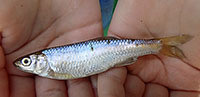 9/4 – Green Island, HRM 153: It was two days past the full moon, and the tides were still feeling its strength and pull. The shallows were low and clear, and there was no sneaking up on the schools of small fish—they quickly swam away from us. With a little trickery and diversion however, we managed to coral 40-50 of them, almost all spotfin shiners (Cyprinella spiloptera), with 2-3 spottail shiners (Notropis hudsonius) mixed in just for confusion. The spotfin is a gorgeous little minnow, native to the Mississippi watershed, that arrived here via canals and bait buckets. They are very common in the Mohawk River but much less so in the Hudson. The river was 75 degrees F. (Spotfin shiner photo courtesy of Tom Lake) 9/4 – Green Island, HRM 153: It was two days past the full moon, and the tides were still feeling its strength and pull. The shallows were low and clear, and there was no sneaking up on the schools of small fish—they quickly swam away from us. With a little trickery and diversion however, we managed to coral 40-50 of them, almost all spotfin shiners (Cyprinella spiloptera), with 2-3 spottail shiners (Notropis hudsonius) mixed in just for confusion. The spotfin is a gorgeous little minnow, native to the Mississippi watershed, that arrived here via canals and bait buckets. They are very common in the Mohawk River but much less so in the Hudson. The river was 75 degrees F. (Spotfin shiner photo courtesy of Tom Lake)
- Tom Lake, Phyllis Lake
9/4 – Bedford, HRM 35: Among the nineteen migrating raptors today at the Bedford Audubon Chestnut Ridge Hawkwatch, osprey was high count with seven. There was a good movement of ruby-throated hummingbirds today with 38 tallied. No fewer than 162 chimney swifts were also noted, but the actual number passing the hawkwatch was likely significantly higher. It was also a good day for monarch butterflies, as we counted 16.
- Richard Aracil, Pedro Troche, Tait Johansson
9/4 – Hook Mountain, HRM 31: We counted forty migrating raptors at the Hook Mountain Hawkwatch today. Osprey was high count with thirty. We had winds from the northwest and limited visibility with considerable haziness—at the start, New York City could not be seen at all.
- Ajit I. Antony, Liza Antony
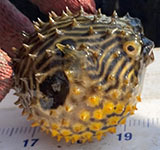 9/4 – Manhattan, HRM 2: Hudson River Park’s River Project Staff checked our sampling and collection gear we deploy off Pier 40 in Hudson River Park. While our pots and traps did not catch many fish, what we found was notable: A young-of-year oyster toadfish, a female lined seahorse (110 mm), and—for the first time ever documented by this survey—a striped burrfish (85 mm). (Striped burrfish photo courtesy of Siddhartha Hayes) 9/4 – Manhattan, HRM 2: Hudson River Park’s River Project Staff checked our sampling and collection gear we deploy off Pier 40 in Hudson River Park. While our pots and traps did not catch many fish, what we found was notable: A young-of-year oyster toadfish, a female lined seahorse (110 mm), and—for the first time ever documented by this survey—a striped burrfish (85 mm). (Striped burrfish photo courtesy of Siddhartha Hayes)
- Siddhartha Hayes, Olivia Radick
The striped burrfish (Chilomycterus schoepfi) is a small, yellowish-green puffer-like fish covered with short, sharp spines. They are designated as a temperate marine stray in our watershed and are found from Florida northward to the New York Bight. Striped burrfish feed on invertebrates such as barnacles and hermit crabs, and they fend off predators by puffing their body into a spiny ball. They are known from verified reports in the lower estuary since 1981, but we have no specimens, nor any data on where they were collected. Tom Lake]
Fall 2020 Natural History Programs
2020 I Bird NY Challenges are open now!
Are you 16 years or younger and live in New York State? If you have an interest in birds, try the I Bird NY challenge! Find 10 common New York bird species and we'll send you a special certificate for taking the challenge. You will also be entered into a random drawing for birding accessories. Download our I Bird NY Beginner's Challenge form (PDF) and get started today. The Beginner's Challenge is also available in Spanish (PDF).
The Experienced Birder Challenge: If you are already a birder, take your birding to the next level by taking the I Bird NY Experienced Birder Challenge! The wide variety of habitats found in New York State support more than 450 different bird species. Find any 10 (or more) different bird species to complete the challenge. Find a lifer? Let us know! Complete and submit the Experienced Birder Challenge entry sheet (PDF) for a chance to be entered in a random drawing for birding accessories. The Experienced Birder's Challenge is also available in Spanish (PDF).
DEC Seeks Birdwatchers to contribute to 2020 Breeding Bird Atlas
NYSDEC Commissioner Basil Seggos has announced a call for citizen-science volunteers to help in the development of a comprehensive, statewide survey that takes place every two decades to detail New York’s breeding bird distribution. Starting in 2020, five years of field surveys will be conducted by volunteers and project partners to provide the data that will be analyzed to create the third New York State Breeding Bird Atlas.
DEC is partnering with the New York Natural Heritage Program, SUNY College of Environmental Science and Forestry (ESF), Audubon New York, Cornell Lab of Ornithology, New York State Ornithological Association, and New York Cooperative Fish and Wildlife Research Unit on this project. When complete, the atlas will provide species-specific details about distribution, maps, and illustrations. The last atlas was published in 2008, with information on its results available on DEC’s website. The 2020 atlas will provide data on changes in species distribution and climate change’s potential impact on wildlife.
To participate, volunteers can make a free eBird account and submit data online through the atlas website (ebird.org/atlasny) or via the eBird mobile app. Simply record the species and any breeding behaviors observed. All sightings can count. As observations are reported, data can be viewed here: https://ebird.org/atlasny/state/US-NY.
Hudson River Miles
The Hudson is measured north from Hudson River Mile 0 at the Battery at the southern tip of Manhattan. The George Washington Bridge is at HRM 12, the Tappan Zee 28, Bear Mountain 47, Beacon-Newburgh 62, Mid-Hudson 75, Kingston-Rhinecliff 95, Rip Van Winkle 114, and the Federal Dam at Troy, the head of tidewater, at 153. The tidal section of the Hudson constitutes a bit less than half the total distance – 315 miles – from Lake Tear of the Clouds to the Battery. Entries from points east and west in the watershed reference the corresponding river mile on the mainstem.
To Contribute Your Observations or to Subscribe
The Hudson River Almanac is compiled and edited by Tom Lake and emailed weekly by DEC's Hudson River Estuary Program. Share your observations by e-mailing them to trlake7@aol.com. To subscribe to the Almanac (or to unsubscribe), use the links on DEC's Hudson River Almanac or DEC Delivers web pages.
Discover New York State
The Conservationist, the award-winning, advertisement-free magazine focusing on New York State's great outdoors and natural resources. The Conservationist features stunning photography, informative articles and around-the-state coverage. Visit The Conservationist webpage for more information.
Useful Links
National Oceanic and Atmospheric Administration online tide and tidal current predictions are invaluable when planning Hudson River field trips. For real-time information on Hudson River tides, weather and water conditions from sixteen monitoring stations, visit the Hudson River Environmental Conditions Observing System website.
DEC's Smartphone app for iPhone and Android is now available at: New York Fishing, Hunting & Wildlife App.
PLAY SMART * PLAY SAFE * PLAY LOCAL: Get Outside Safely, Responsibly, and Locally
New York State is encouraging residents to engage in responsible recreation during the ongoing COVID-19 public health crisis. NYSDEC and State Parks recommendations for getting outside safely incorporate guidance from the Centers for Disease Control and Prevention and the NYS Department of Health for reducing the spread of infectious diseases.
DEC and State Parks are encouraging visitors to New York's great outdoors to use the hashtags #PlaySmartPlaySafePlayLocal, #RecreateResponsibly, and #RecreateLocal on Facebook, Twitter, and Instagram to share their visit and encourage others to get outside safely, responsibly, and locally, too. Use the DECinfo Locator to find a DEC-managed resource near you and visit the State Parks website for information about parks and park closures.
Take the Pledge to PLAY SMART * PLAY SAFE * PLAY LOCAL: Enjoy the Outdoors Safely and Responsibly
1. I pledge to respect the rules and do my part to keep parks, beaches, trails, boat launches, and other public spaces safe for everyone.
2. I will stay local and close to home.
3. I will maintain a safe distance from others outside of my household.
4. I will wear a mask when I cannot maintain social distancing.
5. I accept that this summer, I may have to adjust how I enjoy the outdoors to help keep myself and others healthy and safe, even if it means changing my plans to visit a public space.
6. I will be respectful of others by letting them pass by me if needed on a trail and keeping my blanket ten feet apart from others on the beach.
7. I will move quickly through shared areas like parking lots, trailheads, and scenic areas to avoid crowding.
8. If I'm not feeling well, I will stay home.
Information about the Hudson River Estuary Program is available on DEC's website at http://www.dec.ny.gov/lands/4920.html.
|