A Project of the Hudson River Estuary Program
Compiled by Tom Lake, Consulting Naturalist
COVID-19 Guidance for Enjoying the Outdoors
While enjoying outdoor spaces, please continue to follow the CDC/NYSDOH guidelines for preventing the spread of colds, flu, and COVID-19. To find out more about enjoying DEC lands and New York's State Parks, visit DEC's website Play Smart*Play Safe*Play Local; https://www.dec.ny.gov/outdoor/119881.html
Keep at least six (6) feet of distance between you and others.
Wear a cloth face covering in public settings where social distancing measures are difficult to maintain.
Avoid close contact, such as shaking hands, hugging, and kissing.
Wash hands often or use a hand sanitizer when soap and water are not available.
Avoid surfaces that are touched often, such as doorknobs, handrails, and playground equipment.
DEC recommends avoiding busy trailheads. Find the trails less traveled and visit when trails may not be as busy during daylight hours.
Overview
Following a month where the average daily high temperature in the Mid-Hudson valley was 90 degrees Fahrenheit (F), we moderated this week to 82 degrees. Additional reports from our 9th annual Great Hudson River Fish Count are highlighted along with the ongoing late summer-to-fall migration south, from butterflies to birds to fishes.
Highlight of the Week
 8/18 – Rensselaer County, HRM 172: This is a story of a female ruby-throated hummingbird and her nestling near the Walloomsac River, a tributary of the Hoosic River. 8/18 – Rensselaer County, HRM 172: This is a story of a female ruby-throated hummingbird and her nestling near the Walloomsac River, a tributary of the Hoosic River.
- July 7: We happened to catch a glimpse of her in flight and then perched on a small limb. She was nest-building and the fluffy, partially constructed cup, was daintily decorated with a few pieces of greenery.
- July 29: Mom was sitting on the nest incubating her egg. Her nest was beautifully adorned with a camouflage of lichen.
- August 14: Today, a single not-so-small nestling filled out the nest. After a 25-minute wait, Mom delivered food. She soon departed, and the nestling resumed activity of its own, busily exercising its wings which it would be putting to good use in just a matter of day(s).
- August 18: We looked up to the branch of the black-cherry to visualize what we suspected: an intact but empty ruby-throated hummingbird nest. (Robert Reed photo)
- Rita Reed, Robert Reed (Hudson-Mohawk Bird Club)
Natural History Entries
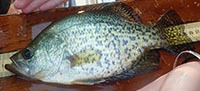 8/14 – Waterford, HRM 157: A total of sixteen staff from New York’s DEC, Parks, and Capitol-Mohawk PRISM offices represented the upper river at the 9th annual Great Hudson River Fish Count. Along with four DEC volunteers, everyone was involved in either collecting or displaying river fishes. 8/14 – Waterford, HRM 157: A total of sixteen staff from New York’s DEC, Parks, and Capitol-Mohawk PRISM offices represented the upper river at the 9th annual Great Hudson River Fish Count. Along with four DEC volunteers, everyone was involved in either collecting or displaying river fishes.
Since 2015, extensive boat electro-fishing has been a part of the Great Fish Count to monitor the fish community in the Hudson River above tidewater. Beginning yesterday, we made five electro-fishing runs in three of the four lower branches (tail-waters) of the Mohawk River near the confluence of the Hudson near Waterford. Two hours of boat electro-fishing resulted in 29 species (albeit no new species) and 293 individual fish. Most adult fishes captured were held overnight in three live cages for public display today.
Overall, smallmouth bass, channel catfish, and spottail shiner were the most common species collected. American eel and white perch were also common. Unlike previous years, we saw no large schools of forage fishes. Young-of-year river herring were present during all runs. (Scott Wells photo)
- Scott Wells
[Electro-fishing (or shocking) gear uses high voltage pulsed DC (direct current) passing from a cathode to an anode which temporarily stuns fish for capture. Fish experience galvanotaxis which causes the fish to involuntarily swim towards the electrical field. The size of fish being targeted determines the amount of voltage and amperage applied to the water. Smaller fish tend to be more difficult to stun than larger fish since smaller fish have less surface area that can be affected by the electrical field. Generally, fish are released unharmed. Wes Eakin (DEC)]
8/14 – Schodack Island State Park, HRM 136: The 9th annual Great Hudson River Fish Count at Schodack Island State Park held a wonderful surprise when a spottail shiner jumped out of the container I held, and made a perfect swan dive into a container held by a youngster. We were all shouting and laughing when it happened, especially since I was socially distanced from where the child was sitting on the dock. The child and her parents were taking a camping adventure by canoe starting from Fish Creek at Schuylerville south to New York City. A trip to remember, no doubt.
We seined about an hour into the flood tide. Our catch, 23 fish, was dominated by young-of-year and included striped bass, American shad, and alewives. Resident fishes in the net were banded killifish and spottail shiner. The water and the air were both 79 degrees F.
- Fran Martino
 8/14 – Ulster County, HRM 92: Three days ago, while conducting a water quality survey at the East Basin of the Ashokan Reservoir, I noticed a medium-sized damselfly clinging to a sampling buoy. Yesterday, I was out again and was happy to find the damselfly in the same spot and took some photos. As I had suspected from the first sighting, it was a dusky dancer (Argia translata). 8/14 – Ulster County, HRM 92: Three days ago, while conducting a water quality survey at the East Basin of the Ashokan Reservoir, I noticed a medium-sized damselfly clinging to a sampling buoy. Yesterday, I was out again and was happy to find the damselfly in the same spot and took some photos. As I had suspected from the first sighting, it was a dusky dancer (Argia translata).
These dark, violet-eyed dancers are partial to large, windswept bodies of water, and the Ashokan fits the description perfectly. Uncontaminated water and suitable habitat are arguably the greatest requirements for this species and other rare aquatic insects, so observations may be viewed as indicators of exceptional quality in the Catskills and New York City reservoir watershed. (Frank Beres photo)
- Frank Beres, Justin Zimmerman
[Dusky Dancer is restricted to the southern half of New York State and has been documented in ten counties prior to the New York Dragonfly and Damselfly Survey (2005-2009). It was documented in ten locations within five counties in this region of the state during the survey. Despite the increased survey effort, county observations have decreased which could be reflective of a population decline. The New York Heritage Program designates the dusky dancer as S1, the highest state conservation ranking: Critically imperiled in the state with five or fewer known populations. Frank Beres]
8/14 – Piermont, HRM 25: Lamont Doherty Earth Observatory's Hudson River Field station, with assistance from the Rockland Conservation and Service Corp, participated in this year's 9th annual Great Hudson River Fish Count. Due to COVID-19 precautions, we were unable to incorporate the community in our fishing efforts, although a few beachgoers asked questions of us while we were in the water. In mid-morning, the salinity was 5.0 parts-per-thousand (ppt), and the water temperature was 82 degrees F.
High count across two seine hauls was Atlantic silverside (34). Other fish included two striped bass, a naked goby, and a small American eel. Crustaceans included five male blue crabs, five female blue crabs, a very small white-fingered mud crab, and an estimated 150 shore shrimp, many of which were carrying eggs.
- Laurel Zaima, Madeline Salino, Moira Delaney
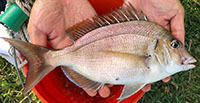 8/14 – Manhattan, New York City: After our seining exploration at the Randall’s Island Water’s Edge Garden on the Harlem River, we made a further contribution to the 9th annual Great Hudson River Fish Count with rod and reel fishing in the East River. Luis Gonzalez, of City Parks Foundation Coastal Classroom, caught a gorgeous scup, as well as a striped bass and a dozen black sea bass. (Peter Park photo) 8/14 – Manhattan, New York City: After our seining exploration at the Randall’s Island Water’s Edge Garden on the Harlem River, we made a further contribution to the 9th annual Great Hudson River Fish Count with rod and reel fishing in the East River. Luis Gonzalez, of City Parks Foundation Coastal Classroom, caught a gorgeous scup, as well as a striped bass and a dozen black sea bass. (Peter Park photo)
- Peter Park
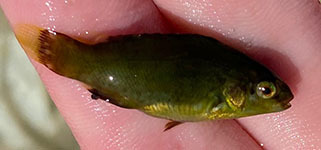 8/14 – Brooklyn, New York City: Delayed due to COVID-19 precautions, The Brooklyn Bridge Park Conservancy finally returned to seining for the season on July 28. Thrilled to be back in the river, we made six seine hauls and captured 77 Atlantic silverside. We also netted young-of-year, including oyster toadfish (25 millimeters (mm)), cunner (28 mm), white mullet (50 mm), and northern pipefish (70 mm). Other species included shore shrimp, white-cross hydroids, comb jellies, and a feisty blue crab. Salinity 25.0 ppm; the water temperature was 79 F. 8/14 – Brooklyn, New York City: Delayed due to COVID-19 precautions, The Brooklyn Bridge Park Conservancy finally returned to seining for the season on July 28. Thrilled to be back in the river, we made six seine hauls and captured 77 Atlantic silverside. We also netted young-of-year, including oyster toadfish (25 millimeters (mm)), cunner (28 mm), white mullet (50 mm), and northern pipefish (70 mm). Other species included shore shrimp, white-cross hydroids, comb jellies, and a feisty blue crab. Salinity 25.0 ppm; the water temperature was 79 F.
With a return to our education and research, we went seining today along the East River for our contribution to the 9th annual Great Hudson River Fish Count. Among the fishes we caught were tautog, alewife, Atlantic silverside, silver perch, skilletfish, and striped killifish. We also had a pleasant surprise: several baby Atlantic horseshoe crabs (5.0 mm) in our ECOncrete tidal pools. The recent rain dropped the salinity down to 20.0 ppm, but the water temperature remained the same at 79 degrees F. (Christina Tobitsch photo)
- Christina Tobitsch, Peter Park, Haley McClanahan, Lhana Ormenyi, Chris Bowser
(1 inch = 25.4 millimeters (mm))
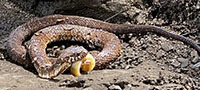 8/15 – Ulster County, HRM 87: While we were enjoying the Esopus Preserve park today, we saw a foot-long northern water snake come out of the Hudson River with an eel in its mouth. They tussled for a bit and the eel briefly got away, but the snake finally won. (Walter Earl photo) 8/15 – Ulster County, HRM 87: While we were enjoying the Esopus Preserve park today, we saw a foot-long northern water snake come out of the Hudson River with an eel in its mouth. They tussled for a bit and the eel briefly got away, but the snake finally won. (Walter Earl photo)
- Walter Earl
*** Fish of the Week ***
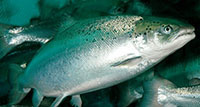 8/16 – Hudson River Watershed: Fish-of-the-Week for Week 84 is the Atlantic salmon (Salmo salar), number 97 (of 233), on our Hudson River Watershed List of Fishes. If you would like a copy of our list, e-mail: trlake7@aol.com 8/16 – Hudson River Watershed: Fish-of-the-Week for Week 84 is the Atlantic salmon (Salmo salar), number 97 (of 233), on our Hudson River Watershed List of Fishes. If you would like a copy of our list, e-mail: trlake7@aol.com
The most fascinating, even mythical, fish on our Hudson River Watershed list is the Atlantic salmon—a story filled with mystery and intrigue. Atlantic salmon are a legendary gamefish in Europe. The world angling record---79 pounds 2 ounces—came from the Tana River in Norway in 1928. The New York State angling record is 24 pounds 15 ounces from Lake Ontario in 1997.
A common Hudson River legend persists that the Atlantic salmon was a native species, and the fact that they are no longer here is largely, and in accurately, blamed on anthropogenic factors. The legend has its origin with Henry Hudson’s voyage up the river in September 1609. The legend was examined by A. Nelson Cheney of the New York Fisheries, Game and Forest Commission, in The Hudson River as a Salmon Stream, presented before the National Fisheries Congress in January 1898.
Robert Juet, the Master’s Mate of the Halfmoon, wrote in the ship’s log for September 3, “So wee weighed and went in and rode in five fathoms [30 feet], oze ground, and saw many Salmons, and Mullet and Rays very great.” For September 15, he noted “Wee ran up into the river, twentie leagues, passing by high mountains [Hudson Highlands?]. Wee had a very good depth at thirteene fathoms [78 feet], and great stores of salmon in the river.” Yet, despite these and other mentions of salmon in the river, not even one was taken at any time while the Halfmoon was in the river.
In analyzing Juet’s observations, several points lead to the likelihood that it was a case of mistaken identity. Atlantic salmon are spring spawners, and therefore, Hudson and his crew would not have seen “large stores of salmon” in the river in September. He may have seen large numbers of schooling fish that were unfamiliar to him, such as striped bass.
While Cheney contends that the Atlantic salmon was never native to the Hudson River watershed, he does allow for them to show up on rare occasions as strays from New England rivers such as the Connecticut. And, there have been strays. James Ellsworth DeKay cited an 1840 record of Atlantic salmon in the estuary as proof that they were native. In his Biological Survey of the Lower Hudson Watershed (1937), J.R. Greeley mentions a 1931 record of a 15-pound Atlantic salmon caught by a Port Ewen shad fisherman. In a recent example, April 2004, a surprised angler caught a domestic brood-stock Atlantic Salmon in the tidewater of Rondout Creek. The fish was a female, 27¾" long and weighing 7 pounds. It had evidently escaped from a hatchery along the Naugatuck River in Connecticut. This is the only Atlantic salmon taken in the Hudson River estuary in DEC records and in the collective memory of Region 3 biologists.
There have been numerous attempts to stock Pacific salmon of several species in the watershed, the Battenkill in particular, beginning in 1873 for several years, and again in 1891. Several hundred thousand fry (young-of-year) were stocked; many if not most migrated to the sea, but there is no record that any ever returned.
The stocking of Atlantic salmon began in 1882 with 225,000 fry released in the river far upstream of tidewater. There was some initial success when four adults, 9-16 pounds, returned from the sea four years later. In the years to follow, a total of 3,486,000 fry and yearlings were stocked resulting in more than 300 adults returning. Unfortunately, all were illegally taken in commercial nets. The number of returns lessened until there were none, and the stocking effort was abandoned.
The lack of suitable spawning habitat and warmer estuarine water temperatures are likely among the limiting factors to Atlantic salmon establishing a viable spawning population. Southern Connecticut appears to be the break-point for Atlantic salmon between New England rivers and the Mid-Atlantic estuaries. (Rudolf Svensen photo)
- Tom Lake
 8/16 – Ulster County, HRM 91: While hiking along a logging road, I came upon an interesting stone laying on the ground in a deep rut. I surmised that it had eroded out of the side. It was a piece of whitish chert, 3 x 2-inches, that appeared to have been chipped and flaked. (Jim Yates photo) 8/16 – Ulster County, HRM 91: While hiking along a logging road, I came upon an interesting stone laying on the ground in a deep rut. I surmised that it had eroded out of the side. It was a piece of whitish chert, 3 x 2-inches, that appeared to have been chipped and flaked. (Jim Yates photo)
- Jim Yates
[Viewing Jim’s photograph allowed us to identify the stone as an artifact, in this instance a stone that had been modified by human hands. Further analysis suggested that it was a prehistoric projectile point, one that had been hafted onto a dart (small spear) and thrown by an atlatl, a spear-thrower.
This was a Jack’s Reef Corner-notched point from the Middle Woodland period of the Hudson Valley and the Northeast. Radio-carbon dating of organics found in direct association with these points suggests a range of dates from AD 500 to 1000. For the Hudson Valley and the Northeast, most dates cluster around AD 750-800, just before the advent of bow-and-arrow technology. The point seems to have been fashioned out of a lithic (stone), possibly Big Springs or Crooked Swamp chert (a crypto-crystalline sedimentary stone).
This was a transition time for us in the Hudson Valley. Bands of hunter-gatherers, fishers and foragers were beginning to occupy villages, ceramics were becoming more sophisticated, crop domestication was becoming more complex and clan politics were becoming more matrilineal (i.e., women were beginning to acquire more influence over the land). This would eventually lead to more dependence upon cultivated crops for subsistence. This was an important cultural moment in our Hudson Valley heritage. Tom Lake]
8/17 – Cohoes, HRM 157: The flock of great egrets at Cohoes kept growing. This morning, Zach Schwartz-Weinstein counted 64, almost all of them flying over as a group. Before 2020, the record high count in eBird for Albany County was 25. From looking at eBird reports for June, when great egrets are all presumably near their breeding area, I see the closest concentrations are along the St Lawrence River from northern New York through the Montreal area, and in western New York at Montezuma and Iroquois National Wildlife Refuges. My guess would be that most of the ones we see in post-breeding dispersal are from the St Lawrence. Maybe their numbers are increasing there.
- John Kent (Hudson-Mohawk Bird Club)
8/18 – Manhattan, HRM 2: Hudson River Park’s River Project Staff checked our sampling and collection gear that we had deployed off Pier 40 in Hudson River Park. Our catch was dominated by eight oyster toadfish (35-215 mm) and a single northern pipefish (165 mm). Mixed in were fifteen blue crabs ranging from young-of-summer to adults (10–160 mm carapace width).
- Daisy Rivera, Olivia Radick
 8/19 – Beacon, HRM 61: Anglers were catching carp off Long Dock, mostly small ones 15-20-inches-long. We opted for the deserted beach and the warm water (84 degrees F) where we could haul our net. On our way there we passed six monarch butterflies heading south. 8/19 – Beacon, HRM 61: Anglers were catching carp off Long Dock, mostly small ones 15-20-inches-long. We opted for the deserted beach and the warm water (84 degrees F) where we could haul our net. On our way there we passed six monarch butterflies heading south.
On the beach we found driftwood on the strand line left by the ebbing tide studded with small bay barnacles. Our catch had taken a bit of a turn: alewives seemed to have left, at least for today, and in their place were American shad (72-76 mm) and blueback herring (51-60 mm). The other young-of-year presence was striped bass (64-72 mm). The salinity had dropped to 2.0 ppt. (Terry Hardy photo)
- Tom Lake, T.R. Jackson, B.J. Jackson
8/19 – Manhattan, New York City: Our Randall’s Island Park Alliance staff seined the Harlem River today at Water's Edge Garden. The first two hauls, against the tidal current, featured the ubiquitous Atlantic silverside, striped bass, and scup. When the tidal current changed on the third haul, bluefish and winter flounder showed up. Overall, Atlantic silverside were high count with 76. We also caught four blue crabs, one a “sally” (immature female). The river was 75 degrees F.
- Jackie Wu
8/20 – Ulster Park, HRM 78: It is the season to go searching for monarch butterfly eggs and caterpillars. During a ten-minute search, I found seven eggs and one 3/8-inch monarch caterpillar on milkweed in the front flower garden on Clay Road. At another stop, a half-mile down the road in front of Graves Elementary School, I found one egg during a five-minute search.
- Betty Boomer
8/20 – Kowawese, HRM 59: Living dangerously! This was the first flood tide after the new moon, what we call a “spring tide,” often higher than normal. We never net the high tide, let alone a moon tide, sensing more difficult terrain and diminishing returns in the high water. It turned out to be a rather odd series of hauls. With the seamline up to our arm pits, we muscled the seine up onto what beach there was, and in every instance, the bag held only young-of-year striped bass. These were all small (52-65 mm) late-hatch fish. All the while we netted, two adult bald eagles pirouetted overhead, likely from one of the two territories within a couple minute’s eagle flight. The water was 83 degrees F, and the salinity was 2.5 ppt.
- Tom Lake, A. Danforth
[Many ocean spawners such as striped bass, American shad, and river herring, have adapted to the vagaries of the river by having extended spawning seasons. The adaptation seems to provide insurance for the young-of-year by drawing out periods of vulnerability due to storms, late winters, early summers, and other weather and water chemistry phenomena. Tom Lake]
 8/21 – Newcomb, HRM 302: I have noticed in the last two weeks that our six common loons (Gavia immer) on Goodnow Flow (lake) in Newcomb have increased their preening and “practice” flights. It seems as if they are preparing to head from northern New York back to the sea for the winter. I have not seen any chicks this season. Is this unusually early or am I trying to place more importance on the activity than I should? (Roy Saplin photo) 8/21 – Newcomb, HRM 302: I have noticed in the last two weeks that our six common loons (Gavia immer) on Goodnow Flow (lake) in Newcomb have increased their preening and “practice” flights. It seems as if they are preparing to head from northern New York back to the sea for the winter. I have not seen any chicks this season. Is this unusually early or am I trying to place more importance on the activity than I should? (Roy Saplin photo)
- Roy Saplin
[If the loons do not have chicks, they may begin to leave as early as September. As much as we like to see them, there is no point in them sticking around. Common loons only come inland to breed, and then it is back out to the ocean. So, I agree, the timing is not off. Charlotte Demers, SUNY-ESF]
8/21 – Cohoes, HRM 157: I found a Baird's sandpiper (Calidris bairdii) at the Cohoes Flats today. It was first spotted yesterday evening by Mark Fitzsimmons, and it was still present this morning. They are not super-rare, but not seen every year in the Albany area.
Other shorebirds and wading birds on the flats included semipalmated plover, least sandpiper, semipalmated sandpiper, spotted sandpiper, greater yellowlegs, and lesser yellowlegs.
- John Kent
8/21 – Ulster Park, HRM 78: I found six more monarch butterfly eggs in a thirty-minute search on Clay Road. In my back garden, I found just one egg. I could find no trace of the nine monarch eggs that were on a single milkweed plant a week ago.
- Better Boomer
8/21 – Manhattan, HRM 2: As the week ended, Hudson River Park’s River Project Staff checked and cleared the sampling and collection gear that we had deployed off Pier 40 in Hudson River Park. We had a very diverse and exciting catch, including seven oyster toadfish (30–240 mm), a naked goby (15 mm), one black sea bass (60 mm), and four lined seahorses (105-120 mm), two of which were males holding eggs in their brood pouches.
-Toland Kister, Olivia Radick
Summer - Fall 2020 Natural History Programs
2020 I Bird NY Challenges are open now!
Are you 16 years or younger and live in New York State? If you have an interest in birds, try the I Bird NY challenge! Find 10 common New York bird species and we'll send you a special certificate for taking the challenge. You will also be entered into a random drawing for birding accessories. Download our I Bird NY Beginner's Challenge form (PDF) and get started today. The Beginner's Challenge is also available in Spanish (PDF).
The Experienced Birder Challenge: If you are already a birder, take your birding to the next level by taking the I Bird NY Experienced Birder Challenge! The wide variety of habitats found in New York State support more than 450 different bird species. Find any 10 (or more) different bird species to complete the challenge. Find a lifer? Let us know! Complete and submit the Experienced Birder Challenge entry sheet (PDF) for a chance to be entered in a random drawing for birding accessories. The Experienced Birder's Challenge is also available in Spanish (PDF).
DEC Seeks Birdwatchers to contribute to 2020 Breeding Bird Atlas
NYSDEC Commissioner Basil Seggos has announced a call for citizen-science volunteers to help in the development of a comprehensive, statewide survey that takes place every two decades to detail New York’s breeding bird distribution. Starting in 2020, five years of field surveys will be conducted by volunteers and project partners to provide the data that will be analyzed to create the third New York State Breeding Bird Atlas.
DEC is partnering with the New York Natural Heritage Program, SUNY College of Environmental Science and Forestry (ESF), Audubon New York, Cornell Lab of Ornithology, New York State Ornithological Association, and New York Cooperative Fish and Wildlife Research Unit on this project. When complete, the atlas will provide species-specific details about distribution, maps, and illustrations. The last atlas was published in 2008, with information on its results available on DEC’s website. The 2020 atlas will provide data on changes in species distribution and climate change’s potential impact on wildlife.
To participate, volunteers can make a free eBird account and submit data online through the atlas website (ebird.org/atlasny) or via the eBird mobile app. Simply record the species and any breeding behaviors observed. All sightings can count. As observations are reported, data can be viewed here: https://ebird.org/atlasny/state/US-NY.
Hudson River Miles
The Hudson is measured north from Hudson River Mile 0 at the Battery at the southern tip of Manhattan. The George Washington Bridge is at HRM 12, the Tappan Zee 28, Bear Mountain 47, Beacon-Newburgh 62, Mid-Hudson 75, Kingston-Rhinecliff 95, Rip Van Winkle 114, and the Federal Dam at Troy, the head of tidewater, at 153. The tidal section of the Hudson constitutes a bit less than half the total distance – 315 miles – from Lake Tear of the Clouds to the Battery. Entries from points east and west in the watershed reference the corresponding river mile on the mainstem.
To Contribute Your Observations or to Subscribe
The Hudson River Almanac is compiled and edited by Tom Lake and emailed weekly by DEC's Hudson River Estuary Program. Share your observations by e-mailing them to trlake7@aol.com. To subscribe to the Almanac (or to unsubscribe), use the links on DEC's Hudson River Almanac or DEC Delivers web pages.
Discover New York State
The Conservationist, the award-winning, advertisement-free magazine focusing on New York State's great outdoors and natural resources. The Conservationist features stunning photography, informative articles and around-the-state coverage. Visit The Conservationist webpage for more information.
Useful Links
National Oceanic and Atmospheric Administration online tide and tidal current predictions are invaluable when planning Hudson River field trips. For real-time information on Hudson River tides, weather and water conditions from sixteen monitoring stations, visit the Hudson River Environmental Conditions Observing System website.
DEC's Smartphone app for iPhone and Android is now available at: New York Fishing, Hunting & Wildlife App.
PLAY SMART * PLAY SAFE * PLAY LOCAL: Get Outside Safely, Responsibly, and Locally
New York State is encouraging residents to engage in responsible recreation during the ongoing COVID-19 public health crisis. NYSDEC and State Parks recommendations for getting outside safely incorporate guidance from the Centers for Disease Control and Prevention and the NYS Department of Health for reducing the spread of infectious diseases.
DEC and State Parks are encouraging visitors to New York's great outdoors to use the hashtags #PlaySmartPlaySafePlayLocal, #RecreateResponsibly, and #RecreateLocal on Facebook, Twitter, and Instagram to share their visit and encourage others to get outside safely, responsibly, and locally, too. Use the DECinfo Locator to find a DEC-managed resource near you and visit the State Parks website for information about parks and park closures.
Take the Pledge to PLAY SMART * PLAY SAFE * PLAY LOCAL: Enjoy the Outdoors Safely and Responsibly
1. I pledge to respect the rules and do my part to keep parks, beaches, trails, boat launches, and other public spaces safe for everyone.
2. I will stay local and close to home.
3. I will maintain a safe distance from others outside of my household.
4. I will wear a mask when I cannot maintain social distancing.
5. I accept that this summer, I may have to adjust how I enjoy the outdoors to help keep myself and others healthy and safe, even if it means changing my plans to visit a public space.
6. I will be respectful of others by letting them pass by me if needed on a trail and keeping my blanket ten feet apart from others on the beach.
7. I will move quickly through shared areas like parking lots, trailheads, and scenic areas to avoid crowding.
8. If I'm not feeling well, I will stay home.
Information about the Hudson River Estuary Program is available on DEC's website at http://www.dec.ny.gov/lands/4920.html.
|