
Environmental News and Events for Nassau and Suffolk Counties (Region 1)
The New York State Department of Environmental Conservation sent this bulletin on 07/29/2020 05:32 PM EDT |
| DEC Delivers - Information to keep you connected and informed from the NYS Department of Environmental Conservation |
| Share or view as a web page || Update preferences or unsubscribe |
Environmental News and Events for Nassau and Suffolk Counties (Region 1) |
Fiddler Crab
Fiddler crabs dig a burrow, retreating to them when birds or people get too close for comfort. If a male successfully attracts a mate, they retreat to the burrow. Two weeks later, the female releases hundreds of eggs into the water, where they hatch and swim as plankton. Mating will take place each moon cycle for the warmer months, males attracting a different female each time. Fiddler crabs feed by filtering bacteria, plankton and other organic material from sand particles, then discarding the cleaned sand in little clumps. The behavior of these crabs is critical to the health of the marshlands. The burrows they dig aerate the sediment, preventing anaerobic conditions that might harm the success of the ecosystem. Colonies of fiddler crabs can turn over tons of sand with their feeding behavior and burrows. Seeing these small animals in large numbers is a sign of summer and a sign of healthy waterways. DEC Improves Hiking Access Opportunities on Rocky Point Pine Barrens State Forest
Now, several months later, the new temporary hiking trail parking lot remains a popular spot for hikers on DEC’s Rocky Point State Forest to start their hiking adventure. DEC created the new lot to increase hiker parking at a time when more individuals are seeking to spend more time outdoors. The temporary hiking trail parking lot is west of Suffolk County Route 21 (Rocky Point – Yaphank Road) and approximately a ½ mile west of an already existing DEC Red Trail Parking Lot along the south side of Route 25A. It is a former New York State Department of Transportation project maintenance yard and has parking for approximately 40 cars currently. Future DEC plans call for lot resurfacing work and other improvements. The .6 mile trail connector intersects the 4.1 mile Rocky Point Blue Trail. You can find more information on Rocky Point Pine Barrens State Forest Recreation opportunities on DEC's website. The Rocky Point Pine Barrens State Forest includes nearly 6,000 acres of Pine Barrens and open lands. The area was once operated by the Radio Corporation of America (RCA) as a global communications center, but that function became obsolete with the arrival of earth orbiting communication satellites. The corporation donated the property to DEC. Region 1 Staff Removed 1.2 tons of Ludwigia from Peconic River
Caption: DEC staff and volunteers pull Ludwigia from Peconic River. Hidden Gem – Clarence Hylan Beavers Memorial Trail
Hiking is allowed throughout the property. The trails lead hikers through oak brush and early successional habitat. The longest hiking trail is the 1.1-mile blue loop trail. The Clarence Hylan Beavers Memorial Trail is a 0.3-mile accessible trail made of crushed stone and sand. The trail drops one foot in elevation for every 20 feet in length. Dedicated as part of DEC’s 2018 Earth Day celebration, the Clarence Hylan Beavers Memorial trail and kiosk celebrates military and environmental legacy of long-time Town of Huntington resident Sgt. Clarence Hylan Beavers. The late Sgt. Beavers was part of an all African-American World War II era 16 person paratrooper unit who became one of the nation’s first groups of smokejumpers and helped lead the way toward military integration in the late 1940s. Mr. Beavers passed away on December 4, 2017, at the age of 96. Sgt. Beavers was the last surviving member of the first all African-American paratroopers from the 555th Parachute Infantry Battalion known as the Triple Nickles. During World War II, Triple Nickle paratroopers worked with the United States Department of Agriculture (USDA) Forest Service on Operation Firefly, a joint military and Forest Service mission designed to prevent Japanese incendiary bomb attacks from ravaging the nation’s western forests. For more information on the Kings Park Unique Area, please visit DEC's website. 100th Day at Stony Brook Coronavirus Testing Site
The coronavirus drive-thru test site began operating on March 18, 2020, and aimed to provide testing to thousands of Long Islanders in order to flatten the curve and reduce coronavirus throughout the region. The site was staffed by volunteers from over a dozen state agencies, including 56 staff from DEC Region 1 and Marine Resources.
The site not only collected swabs through the drive-thru testing lanes, but also accommodated a Stony Brook University Hospital Field Emergency Department (FED) that operated from 11 a.m. to 11 p.m. to triage COVID-only patients. The FED operated from March 24 - May 6 and swabbed 1656 patients with a one day high of 147 on March 30. The drive-thru test site continues to operate weekdays from 8 a.m. - 6 p.m. and reduced hours on weekends. Many thanks to all the volunteers, support staff, and command staff that continue to volunteer to keep the site running smoothly. #GetCountedNY
New York urges you to be part of our complete count effort, which will ensure census data is accurate. It’s quick and simple to participate, and it can even be done online now. Don’t be anonymous. Make sure you are counted in the 2020 U.S. Census, and encourage friends, family and co-workers to participate as well. Census data is an important tool that will help shape our future, and an accurate tally will help ensure everyone counts when it comes to key decisions impacting our future. |
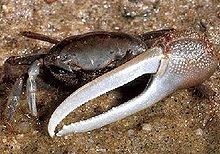 Many New Yorkers seek the sandy ocean beaches during the summer, but on the muddy edges of estuaries are crowds of a different type. Fiddler crabs are native crabs that form colonies in the intertidal zone of marine estuaries from Haverstraw Bay on the Hudson south to sand and mudflats throughout the Long Island region. Males have a large claw and a small claw, while females have two smaller claws. The males use this oversized appendage to signal to others of their strength and prowess, driving away rivals and attracting females.
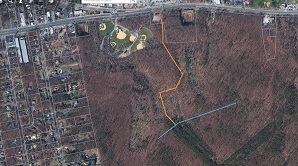 In April 2020, DEC announced the opening of a temporary hiking trail parking lot along Route 25A in Rocky Point.
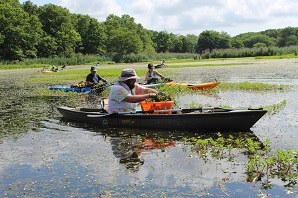 In early July, Region 1 and Region 2 Fisheries and staff and volunteers with the Long Island Invasive Species Area (LIISMA) worked for hours to remove the invasive freshwater invasive plant water primrose (or Ludwigia peploides) in the Peconic River by the Edwards Avenue Dam in Calverton. The staff used kayaks to access the Ludwigia and hand remove it from the waterway. This invasive species originating from South and Central America out-competes native plants, blocks sunlight to plants below, reduces oxygen levels in waters, reduces biodiversity and impedes fish habitat and recreational use of the river. Yearly removal and ongoing management are needed to ensure the plant does not continue to expand throughout the Peconic River. Recreationalists are reminded to wash off boats and equipment prior to entering a new waterway to
 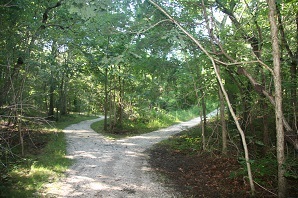 Kings Park Unique Area is a 69-acre green space, located at the southwest corner of Meadow and Lawrence Roads in Kings Park. The area is open for hiking, bowhunting, and wildlife viewing and features an accessible parking lot and trail. The land, originally part of the Kings Park State Hospital, was transferred to DEC in 1966 to serve as a "greenway" for the surrounding residential developments.
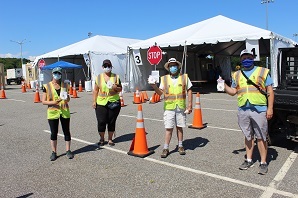 On June 25, 2020, DEC Region 1 Staff along side New York State Department of Health, Stony Brook University Hospital, and 11 other New York State agencies, celebrated the 100th day of operation of the New York State coronavirus drive-thru testing site in South P lot in Stony Brook University.
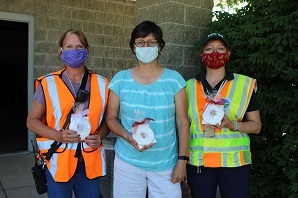 Through June 25th, the site collected 42,873 swabs and accounted for 14 percent of the swabs collected in Suffolk County. Included in these tests were over 1,600 first responders and 1,700 nursing home, healthcare and essential workers. At the peak of the pandemic in New York State, the site collected up to 1085 swabs in a single day, plus another 47 through the Field Emergency Department.
 Did you complete the census yet?
|
The New York State Department of Environmental Conservation respects your right to privacy and welcomes your feedback | Update preferences or unsubscribe | Learn more about DEC Delivers. |
|
Connect with DEC:     2020 Census: New York counts on you |
|
| Basil Seggos, Commissioner | |